
A single missed transit window at the Panama Canal can result in cancellation fees reaching $200,000, making equipment reliability a high-stakes priority for every master and ship owner. In the Gulf of Panama, where humidity levels frequently exceed 90 percent and sea temperatures hover near 30 degrees Celsius, your HVAC system faces an incredibly corrosive environment. You know that a cooling failure is more than a comfort issue; it threatens vital bridge electronics and risks non-compliance with Maritime Labour Convention standards. Finding certified technicians for marine air conditioning repair panama in Balboa or Cristobal should not be the bottleneck that delays your voyage.
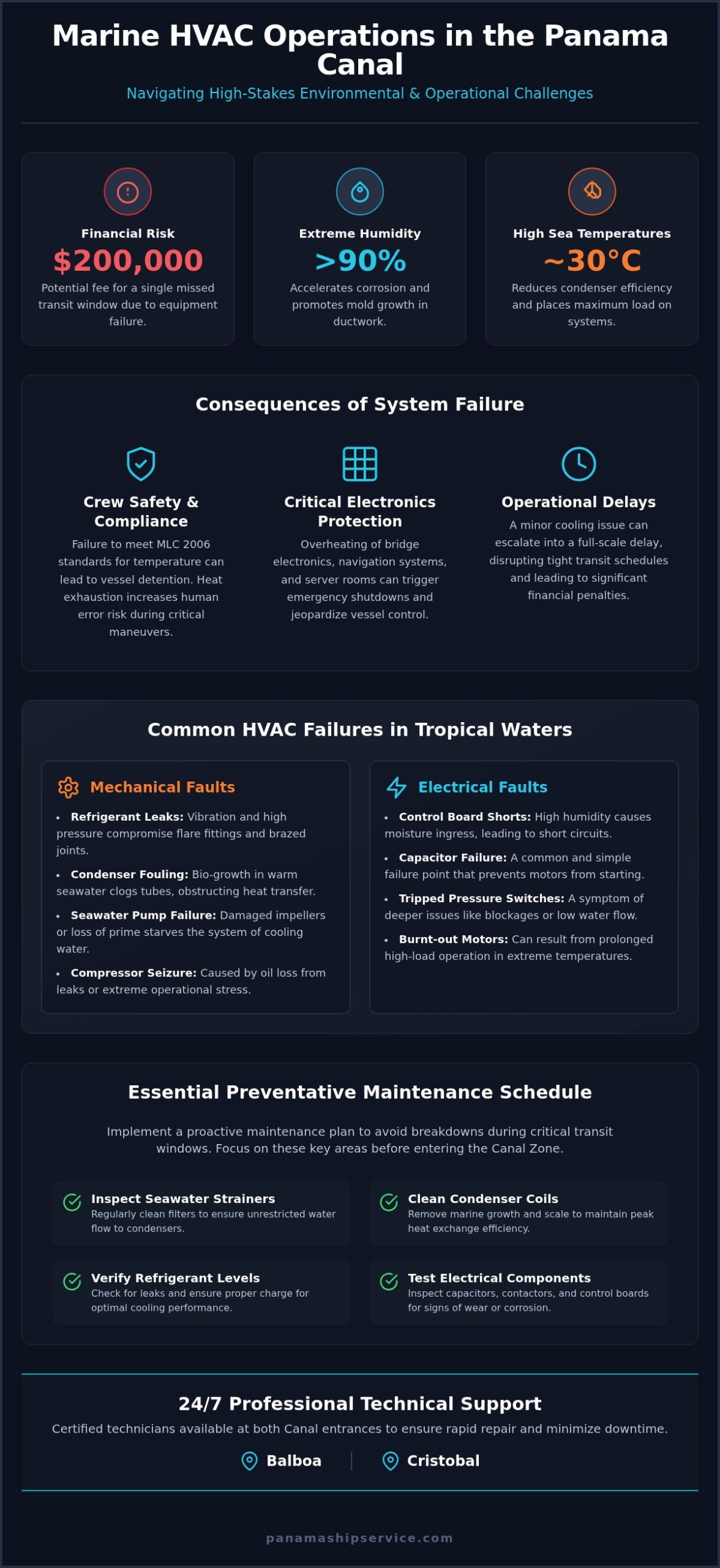
We understand the pressure of strict scheduling and the technical demands of tropical maritime operations. This guide provides expert insights into rapid HVAC restoration and preventative maintenance strategies designed specifically for the Canal’s unique conditions. You will learn how professional mechanical support ensures crew safety, protects high-value cargo, and keeps your vessel on its precise transit timeline. We will outline the specialized solutions available to maintain long-term reliability and operational efficiency while navigating one of the world’s most demanding maritime hubs.
Key Takeaways
- Understand why Panama’s extreme humidity accelerates HVAC corrosion and how climate control directly impacts crew safety and fatigue management.
- Identify common tropical system failures, such as vibration-induced refrigerant leaks and condenser fouling, to prevent operational downtime.
- Evaluate the financial benefits of system replacements versus the rising costs of emergency repairs for aging marine HVAC units.
- Implement a preventative maintenance schedule for seawater strainers and condenser coils to avoid breakdowns during critical transit windows.
- Access professional marine air conditioning repair panama through 24/7 technical support available at both Balboa and Cristobal ports.
The Critical Role of Marine Air Conditioning in Panama Canal Operations
The Panama Canal serves as a critical artery for global trade, but its unique geography presents severe operational challenges for shipboard climate control systems. Maintaining a functional HVAC plant is a baseline requirement for any vessel preparing for transit. In this high-stakes environment, air conditioning is an essential mechanical component that protects the ship’s most valuable assets: its personnel and its technology. When systems fail, the need for expert marine air conditioning repair panama becomes urgent to avoid costly scheduling disruptions and safety risks.
Environmental Challenges of the Panama Isthmus
Panama’s tropical climate is notoriously aggressive toward mechanical equipment. Relative humidity levels frequently exceed 90 percent, which accelerates electrolytic corrosion on evaporator coils and creates ideal conditions for rapid mold growth within ductwork. These conditions don’t just degrade air quality; they physically break down the system’s structural integrity over time. Constant exposure to salt air further compounds these issues, leading to premature component failure if not addressed by specialized technicians.
Additionally, ambient sea temperatures in the region often hover between 28°C and 30°C. This high baseline temperature significantly reduces the heat exchange efficiency of seawater-cooled condensers. Systems that operate adequately in cooler latitudes often reach a breaking point during the 8 to 12 hour transit through the locks. This “Canal Factor” puts maximum load on compressors and motors exactly when the vessel can least afford a mechanical failure. A system running at peak capacity in these temperatures requires perfectly clean heat exchangers to avoid high-pressure trips.
Regulatory and Operational Risks of HVAC Failure
Operating without functional A/C carries significant regulatory weight. The Maritime Labour Convention (MLC) 2006 mandates specific temperature and humidity standards for seafarer living quarters. Failure to maintain these standards isn’t just a comfort issue; it’s a compliance failure that can lead to vessel detention or expensive crew grievances. Beyond legal risks, the human element is critical. Heat exhaustion leads to fatigue, which directly increases the risk of human error during complex maneuvers within the Canal’s narrow reaches.
Technical risks are equally severe. Modern bridge electronics and server rooms generate substantial internal heat. Without constant cooling, navigation systems, communication arrays, and engine room monitoring tools can overheat and trigger emergency shutdowns. By consolidating marine air conditioning repair panama with other essential mechanical ship repairs, operators can address these vulnerabilities efficiently. Handling HVAC maintenance alongside broader mechanical tasks during a single service window minimizes downtime and ensures the vessel remains mission-ready for its scheduled transit. This proactive approach prevents a minor cooling issue from escalating into a full-scale operational delay.
Common Marine HVAC Failures in Tropical Waters
Tropical maritime environments are notoriously hostile to standard climate control systems. High-pressure operation in the warm waters surrounding the Isthmus frequently leads to refrigerant leaks. Vibration from the vessel’s propulsion system often compromises flare fittings and brazed joints over time. When pressures spike due to elevated ambient temperatures, these minor leaks quickly become catastrophic failures. Identifying these issues early is critical for maintaining an efficient cooling plant and protecting sensitive onboard assets.
Mechanical vs. Electrical A/C Issues
Distinguishing between a mechanical seizure and an electrical fault is the first step in effective marine air conditioning repair panama. A compressor that fails to start might suffer from a burnt-out motor, but it’s often a simple capacitor failure or a tripped high-pressure switch. The extreme humidity at the Canal frequently causes moisture ingress into compressor control boards, leading to short circuits and erratic sensor readings. Seawater pumps also play a vital role. If the pump loses prime or the impeller is damaged, the condenser cannot shed heat, causing the system to cycle off to prevent a total meltdown. Troubleshooting these malfunctions in high-heat conditions requires specialized diagnostic tools and deep technical knowledge.
The Impact of Salinity on Marine HVAC
Salinity levels in the Pacific and Caribbean accelerate the pitting corrosion of aluminum fins and copper tubing. Standard residential or commercial units aren’t built for this. They lack the necessary marine-grade coatings and galvanic protection to survive more than a few months. Professional marine air conditioning repair panama focuses on using corrosion-resistant materials and specialized coatings like epoxy-phenolic treatments. These protect evaporator and condenser coils from the aggressive salt air. Beyond the coils, high salinity and warm water encourage rapid biofouling. Barnacles, tube worms, and algae thrive in these conditions, quickly clogging seawater strainers and heat exchangers. This fouling restricts flow, reduces cooling capacity, and can lead to expensive internal damage if left untreated.
Operational readiness is not just about comfort; it’s a requirement under U.S. regulations for Panama Canal transit, which emphasize the maintenance of essential shipboard equipment. Clogged drainage systems are another common failure point. High humidity results in excessive condensation. If drain lines are blocked by slime or mold, water overflows into cabins and server rooms, causing interior damage and health hazards. For vessels experiencing these complex technical challenges, engaging a specialized partner for mechanical ship repairs ensures that both electrical and mechanical vulnerabilities are addressed before they impact your schedule.
Vessel HVAC Strategy: Repair vs. Replacement
Determining whether to invest in marine air conditioning repair panama or proceed with a full system overhaul is a critical financial decision for ship managers. The choice often hinges on the immediate operational necessity of a Panama Canal transit versus the long-term lifecycle costs of the vessel’s HVAC plant. A systematic assessment starts with analyzing the service history and the frequency of previous mechanical breakdowns. If the plant requires constant intervention to maintain set points, the total cost of ownership is likely spiraling out of control.
When to Opt for Immediate Repair
Immediate repairs are the most logical choice when the system is relatively modern or has a documented history of reliable performance. Minor issues such as a refrigerant recharge, capacitor replacement, or a faulty seawater pump impeller can be resolved quickly at anchorage. These interventions restore essential cooling for the crew and bridge electronics without risking the vessel’s transit schedule. Cleaning fouled heat exchangers is another high-value, low-cost fix that immediately improves condenser efficiency in warm tropical waters. These solutions ensure safe passage while deferring larger capital expenditures until the next scheduled dry dock period.
Signs That Full System Replacement is Necessary
Chronic compressor failures are a clear indicator that the system has reached the end of its economic life. When the frequency of emergency calls increases, the cumulative cost of marine air conditioning repair panama often exceeds the investment required for a new installation. Severe structural corrosion of the air handling units, particularly in the drain pans and frames, suggests that the unit’s integrity is compromised beyond simple patching. Additionally, transitioning to modern units allows for the use of environmentally friendly refrigerants. This ensures compliance with evolving MARPOL standards and reduces the risk of future regulatory penalties or port state control issues.
Modern marine A/C units offer significant energy efficiency gains, often reducing electrical load by 20 to 30 percent compared to legacy systems. This reduction lowers fuel consumption and lessens the strain on the vessel’s auxiliary generators. In Panama, the availability of spare parts for older, obsolete systems is increasingly limited. Sourcing specialized components for discontinued models can lead to extended lead times that a busy vessel cannot afford. Upgrading to current technology ensures that technical support and replacement parts are readily accessible in major maritime hubs like Balboa and Cristobal, providing long-term reliability for future voyages through the region.
Preventative Maintenance: Avoiding Mid-Transit Breakdowns
A mid-transit HVAC failure is an avoidable operational risk that can jeopardize both crew safety and technical compliance. When a vessel is positioned within the locks, the engine department cannot simply pause operations to address a cooling trip. Rigorous preventative maintenance is the only reliable safeguard against these high-pressure scenarios. By identifying vulnerabilities before the vessel reaches the anchorage, ship managers can ensure a seamless passage through the Isthmus.
Seawater strainers require constant monitoring, especially in the nutrient-rich waters of the Pacific and Caribbean. Marine growth can clog a strainer in a matter of days, restricting flow and causing high-pressure trips. Cleaning and descaling condenser coils before arrival is equally vital. This process ensures optimal heat transfer, allowing the system to handle the maximum thermal load imposed by Panama’s 30 degree Celsius sea temperatures. Monitoring refrigerant pressures and compressor oil levels allows for the detection of slow leaks that might otherwise go unnoticed until the system fails under load.
The Engineer’s Pre-Arrival Checklist
Before entering the Canal, the technical department should conduct a focused audit of the entire HVAC plant. This includes inspecting belt tension and ensuring blower motor alignment to prevent mechanical stress and premature bearing failure. Verifying the integrity of ductwork and insulation prevents energy loss and stops condensation from damaging interior spaces. Most importantly, engineers must check for early signs of refrigerant oil staining around joints and valves. If oil is present, a leak is active. Addressing these issues with professional marine air conditioning repair panama before transit prevents a total system freeze-up when the cooling demand is at its peak.
Long-Term Protection Strategies
Sustainable reliability in tropical environments requires a proactive approach to component protection. Applying specialized anti-corrosive treatments to external components and evaporator coils provides a necessary barrier against extreme humidity. Implementing consistent chemical water treatment for chilled water loops prevents internal scaling and pipe degradation. Training the crew to recognize early warning signs, such as unusual compressor cycling or rising discharge temperatures, allows for intervention before a component reaches the point of catastrophic failure. Don’t leave your vessel’s climate control to chance. Secure your operational schedule by coordinating professional mechanical ship repairs with our technical team before your next scheduled transit.
Finally, testing emergency backup systems and ventilation fans ensures that even if a primary chiller fails, the vessel can maintain the minimum airflow required for bridge electronics. These systems are often neglected until they are needed most. A functional backup provides the critical margin of safety required for a successful transit through one of the world’s most demanding maritime environments. Maintaining these standards is essential for long-term operational efficiency and fiscal responsibility.
Panama Ship Service: Your Partner for Marine A/C Excellence
Panama Ship Service operates as a specialized technical hub at the heart of the world’s most critical maritime crossing. We provide 24/7 technical availability for vessels requiring marine air conditioning repair panama, ensuring that mechanical failures don’t translate into missed transit windows. Our strategic presence in both Balboa on the Pacific side and Cristobal on the Atlantic side allows us to respond with the urgency required by modern shipping schedules. We recognize that every hour at anchorage impacts your bottom line. Our logistics are optimized for speed and precision to keep your vessel moving.
Why Choose Our Technical Team?
Our engineers bring deep technical experience across a broad spectrum of vessels, including commercial container ships, offshore support units, and naval platforms. This versatility is essential because marine HVAC systems vary significantly in complexity and scale. We maintain a robust inventory of marine-grade spare parts to facilitate immediate repairs, bypassing the delays often associated with international shipping. This proactive readiness is vital when meeting strict Panama Canal transit slots where there’s zero room for equipment failure. Our team doesn’t just patch problems; we provide long-term reliability in the face of Panama’s extreme tropical conditions.
Consolidated Services for Maximum Efficiency
Efficiency in maritime operations is achieved through the consolidation of technical tasks. By integrating A/C servicing with broader mechanical ship repairs, you eliminate the need to coordinate multiple vendors. This “one-stop-shop” approach is a core part of our commitment to minimizing vessel downtime. While our HVAC technicians are restoring your cooling plant, our hull teams can simultaneously perform underwater hull services at the anchorage. This parallel workflow maximizes the utility of your stay in Panamanian waters.
Working with a single point of contact simplifies billing and streamlines communication between the bridge and the service provider. We ensure your vessel is fully ‘Canal-ready’ through comprehensive technical inspections that cover all critical systems. You can delegate the complexity of these mechanical requirements to our seasoned veterans, allowing your crew to focus on the operational demands of the transit. Reliable marine air conditioning repair panama is a fundamental component of our total vessel support strategy. We protect your equipment, your cargo, and your schedule from the unpredictable challenges of the tropics.
Secure Your Vessel’s Performance for the Next Transit
Navigating the Panama Canal demands total equipment reliability. You’ve seen how extreme tropical humidity accelerates corrosion and how a single HVAC failure can compromise crew safety and vital navigation electronics. By implementing a rigorous preventative maintenance schedule and choosing a clear repair vs. replacement strategy, you protect your vessel from the high financial risks of transit delays. Accessing expert marine air conditioning repair panama at the right moment ensures your ship remains compliant with international labor standards and rigorous operational requirements.
Panama Ship Service provides a comprehensive one-stop-shop for all your technical needs at this strategic hub. We offer 24/7 emergency response and specialized expertise in minimizing vessel downtime through efficient, consolidated logistics. Whether you require immediate repairs at anchorage or long-term maintenance planning, our technical team is ready to support your fleet’s success in this demanding region. Contact Panama Ship Service for Immediate Marine A/C Support today. We look forward to ensuring your next transit is efficient, safe, and entirely trouble-free.
Frequently Asked Questions
Can you perform A/C repairs while the vessel is at anchorage?
Yes, technical teams conduct most repairs at the Pacific or Atlantic anchorages. Safety regulations prevent active maintenance during the actual transit through the locks. Performing service while the vessel is waiting for its slot ensures the system is fully operational before entering the Canal. This approach minimizes downtime and allows for complex mechanical tasks to be completed without disrupting the vessel’s primary mission.
How quickly can a technician board my vessel in Balboa or Cristobal?
Technicians can typically board your vessel within a few hours of arrival at the Balboa or Cristobal anchorage. Our strategic positioning at both ends of the Canal allows for rapid mobilization of personnel and equipment. We prioritize time-sensitive requests to align with your scheduled transit window. Efficient logistics and local expertise ensure that your cooling issues are diagnosed and addressed before they impact your operational timeline.
Do you provide 24/7 emergency HVAC services for ships in transit?
We maintain 24/7 technical availability to handle emergency repairs for vessels arriving at the Panama Canal. HVAC failures don’t follow a schedule, and the extreme tropical heat requires an immediate response. Our teams are ready to deploy at any hour to restore crew comfort and protect sensitive bridge electronics. This round-the-clock service is a core part of our commitment to maintaining vessel readiness in a high-pressure environment.
What types of marine A/C systems do you specialize in?
Our team specializes in a wide range of systems, including large-scale centrifugal chillers, direct expansion (DX) units, and modular split systems. We have experience with diverse HVAC plants found on commercial container ships, offshore support vessels, and naval platforms. Whether your vessel uses a centralized chilled water loop or individual air handling units, our technicians possess the technical knowledge to troubleshoot and repair complex marine-grade configurations.
Can you source specialized marine HVAC spare parts in Panama?
We maintain a robust local inventory of essential marine-grade components, including compressors, fan motors, and expansion valves. Sourcing marine air conditioning repair panama parts locally is critical for avoiding the long lead times associated with international shipping. If a specialized part isn’t immediately available, our logistics network can expedite procurement to ensure your vessel remains on schedule. This capability is a key advantage for ships with tight transit windows.
Are your technicians certified to handle marine refrigerants?
All technicians are fully trained and equipped to handle marine refrigerants in compliance with international environmental standards. This includes the recovery, recycling, and proper disposal of gases to meet MARPOL requirements. We use specialized equipment to detect leaks and ensure that the system is recharged to precise manufacturer specifications. Proper refrigerant management is essential for system efficiency and regulatory compliance during your stay in Panamanian waters.
Do you offer A/C maintenance for both commercial vessels and yachts?
How does marine A/C repair impact my Panama Canal transit schedule?
Professional marine air conditioning repair panama is designed to prevent schedule disruptions by resolving issues while the vessel is at anchorage. A functional HVAC system is often a prerequisite for safe transit, as it prevents bridge electronics from overheating. By addressing repairs before you enter the locks, you eliminate the risk of a mid-transit mechanical failure. Our goal is to ensure your vessel is ‘Canal-ready’ without causing any delay to your booked slot.