
Imagine your vessel is flagged for hull damage at the Panama Canal just as transit auction prices reach a staggering $5.3 million. In this high-pressure environment, a marine damage assessment survey is much more than a routine inspection. It’s the critical piece of evidence that determines whether you face a rejected claim or a successful insurance recovery. If the documentation isn’t perfect, you’re looking at mounting surcharges and a vessel that’s stuck in limbo while the clock ticks. Every hour of delay is a direct hit to your bottom line.
You likely already understand that coordinating between surveyors, repair teams, and class societies is a logistical nightmare. We’ve designed this guide to simplify that complexity and restore your operational momentum. You’ll learn exactly how to manage surveys to secure full insurance reimbursement and minimize vessel downtime. We’ll walk through the current ACP notification protocols, the latest 2026 IMO safety standards, and the specific steps required to get a class-approved damage report that clears your ship for Canal transit.
Key Takeaways
- Learn the essential steps of a marine damage assessment survey, including mandatory ACP notification protocols and physical inspections at Balboa or Cristobal.
- Identify the specific documentation required to satisfy the maritime insurance “burden of proof” for both H&M and P&I claims.
- Understand how to convert surveyor findings into precise requests for mechanical ship repairs to ensure structural integrity and class compliance.
- Minimize costly Panama Canal transit delays by integrating damage surveys with immediate repair services to expedite official clearance.
- Navigate the complex coordination between insurers and class societies to secure successful claim outcomes and rapid vessel turnaround.
What is a Marine Damage Assessment Survey?
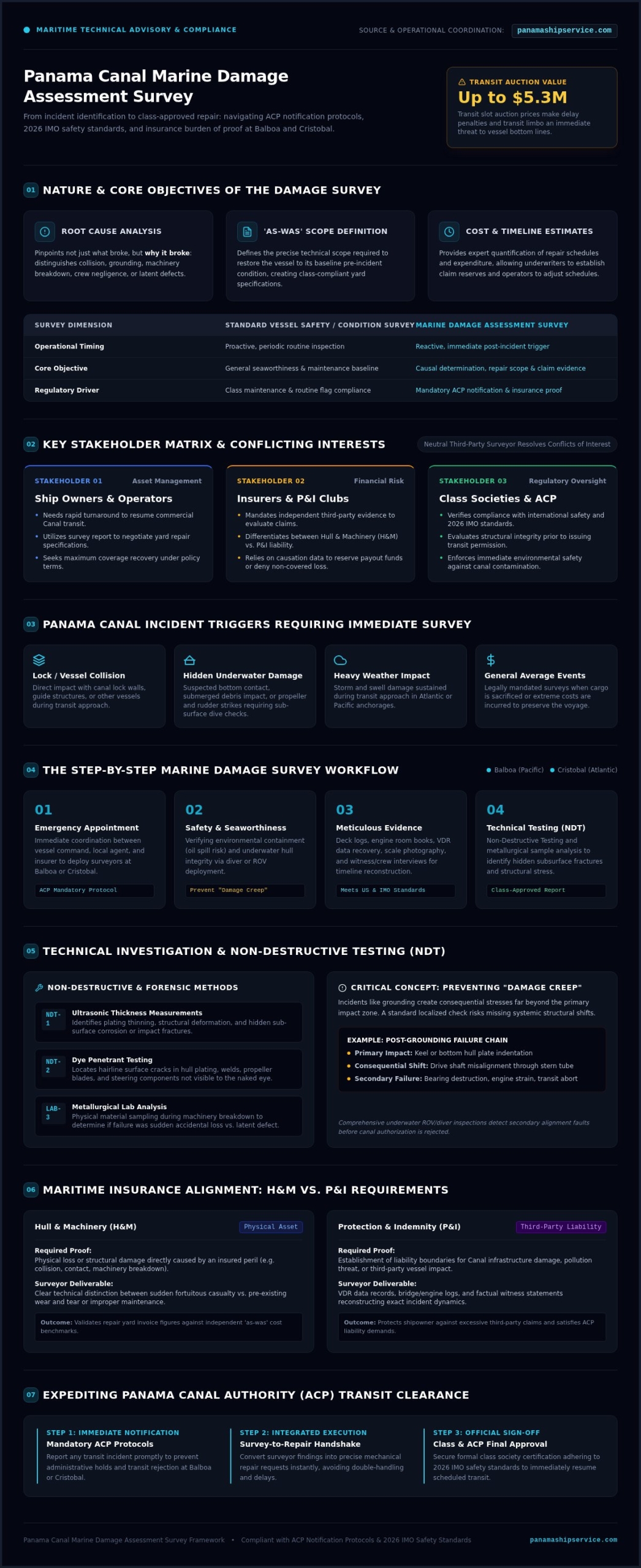
A marine damage assessment survey is a formal, technical investigation conducted to establish the nature, cause, and extent of damage sustained by a vessel. Unlike a routine condition survey, which focuses on general maintenance and seaworthiness, a damage assessment is a reactive procedure triggered by a specific incident. It serves as the primary technical document for insurance claims and repair planning. Insurers mandate independent third-party assessments to ensure an impartial evaluation of the incident, preventing conflicts of interest between the ship owner and the underwriter. This process often builds upon the baseline data established in a standard vessel safety survey, which provides the necessary context for the ship’s pre-incident condition.
Several key stakeholders rely on this report to make critical operational and financial decisions. Ship owners use it to define repair specifications and negotiate with yards. Underwriters and P&I Clubs use the findings to determine coverage eligibility and liability. Finally, Class Societies review the surveyor’s findings to ensure that any proposed repairs meet international safety standards before the vessel returns to service. Because these parties often have competing interests, the surveyor’s role as a neutral expert is vital for reaching a consensus.
Primary Objectives of the Damage Surveyor
The surveyor’s first priority is identifying the root cause of the damage. They determine whether the incident resulted from a collision, grounding, machinery failure, or crew negligence. This isn’t just about what broke; it’s about why it broke. Once the cause is established, the surveyor defines the exact scope of work needed to restore the vessel to its ‘as-was’ condition. This involves providing an expert estimate of repair costs and timelines. These figures are essential for insurers to reserve funds and for operators to manage their commercial schedules.
When to Trigger a Damage Assessment in Panama
In the Panama Canal, timing is everything. Operators must trigger a marine damage assessment survey immediately following any transit incident to comply with Panama Canal Authority (ACP) protocols. Beyond obvious collisions, assessments are necessary for heavy weather damage or suspected ‘hidden’ underwater hull issues that could compromise transit safety. In complex cases involving ‘General Average’ declarations, where cargo is sacrificed or expenses are incurred to save the voyage, a survey is legally required to distribute costs among all parties. Quick action at Balboa or Cristobal ports prevents minor issues from becoming grounds for a transit rejection.
The Step-by-Step Marine Damage Survey Process
The execution of a marine damage assessment survey requires precise coordination between the vessel’s command, the local agent, and the insurer. Once an incident occurs, the operator must immediately appoint a surveyor to attend the vessel at Balboa or Cristobal ports. This physical inspection is the foundation of the claim. It involves reviewing deck logs, engine room records, and Voyage Data Recorder (VDR) data to reconstruct the event. Modern assessments rely heavily on Non-Destructive Testing (NDT), such as ultrasonic thickness measurements or dye penetrant testing, to identify structural failures that aren’t visible to the naked eye.
Initial Inspection and Safety Assessment
The surveyor’s first task is verifying the vessel’s immediate seaworthiness and environmental safety. If there’s a risk of oil discharge or hull compromise, the surveyor coordinates with underwater hull services to perform sub-surface inspections using divers or ROVs. This stage is critical for identifying ‘damage creep,’ where consequential damage, like misaligned shafts following a grounding, manifests away from the primary impact zone. If you need immediate technical support during this high-pressure phase, Panama Ship Service provides integrated survey and repair coordination to keep your schedule on track.
Evidence Gathering and Documentation
Documentation must be meticulous to survive the scrutiny of underwriters. Photographic evidence protocols require capturing the scale, location, and context of every defect. Surveyors also conduct interviews with crew members and witnesses to establish a factual timeline. In cases of machinery failure, collecting material samples for metallurgical analysis is often necessary to distinguish between sudden accidental loss and latent defects. These rigorous standards align with international best practices and U.S. regulations on marine casualty investigations, ensuring the report holds weight in legal and insurance proceedings.
Drafting the Preliminary Report
Speed is essential at the Panama Canal. Surveyors issue ‘Field Notes’ almost immediately, allowing the operator to begin the repair tendering process before the final report is signed. These notes distinguish between ‘Incident Damage’ and ‘Fair Wear and Tear,’ which is a common point of contention in claims. The surveyor then produces the Repair Specification, which is the comprehensive technical blueprint for all subsequent work. This document ensures that every contractor involved understands exactly what’s required to restore the vessel to its pre-incident state while meeting class requirements.
Aligning Damage Assessments with Insurance Claims
A technical report is the only bridge between a damaged hull and a successful insurance payout. In maritime law, the burden of proof rests entirely on the vessel operator to demonstrate that a loss occurred due to a covered peril. A comprehensive marine damage assessment survey serves as this primary evidence. Without a report that clearly links the physical damage to a specific incident, underwriters may categorize the loss as wear and tear, leading to a summary rejection. Managing the joint survey process, where your surveyor and the underwriter’s representative inspect the vessel together, is vital to reaching an early agreement on the scope of work and avoiding protracted disputes.
Insurance requirements differ significantly depending on the policy in play. Hull and Machinery (H&M) surveys focus on the physical restoration of the asset, while Protection and Indemnity (P&I) surveys address liabilities such as cargo damage or environmental impact. The surveyor’s “Cause of Loss” statement is the most scrutinized sentence in the entire document. It dictates whether the policy is triggered. If the surveyor fails to use precise industry terminology or misses critical causal links, the adjuster has sufficient grounds to contest the claim’s validity.
Proving Proximate Cause
To secure a payout, the surveyor must document the “proximate cause” of the incident. If the damage resulted from “Perils of the Sea,” the report must include specific data on sea states, wind speeds, and vessel positioning. This level of detail mirrors the rigor found in NOAA’s hurricane response protocols, where multi-layered data is used to assess large-scale maritime impacts. The report must also address potential complications like crew negligence or latent defects. Under standard H&M clauses, crew negligence is often covered, but a latent defect might be excluded. Clarity here is the difference between a full reimbursement and a total loss of coverage.
Quantifying the Financial Loss
Adjusters don’t just look at what happened; they look at the cost of fixing it. The survey must clearly separate “Temporary Repairs” required for safe Panama Canal transit from the “Permanent Repairs” needed to satisfy Class Society standards. These distinctions are critical for managing your deductible and ensuring that “Loss of Hire” or business interruption claims are accurately supported by technical timelines. Utilizing professional marine surveys in Panama ensures that repair invoices are justified to adjusters through documented evidence of local labor rates and material costs. This proactive documentation prevents adjusters from “haircutting” your claim based on generic global averages that don’t reflect the reality of emergency repairs at the Canal.
Technical Considerations: From Survey to Repair
The transition from an insurance-focused marine damage assessment survey to actual technical execution is where many vessel operators lose critical time. A technical report must be converted into a detailed Request for Quote (RFQ) that repair yards can use to provide accurate pricing and realistic timelines. This stage requires a deep understanding of maritime engineering to ensure the proposed scope of work satisfies both the insurer’s cost constraints and the Class Society’s safety requirements. Without this alignment, you risk performing repairs that Class won’t certify, leading to expensive rework and extended vessel downtime.
Steel Fabrication and Structural Integrity
Structural hull damage requires a precise measurement of plate deformation and frame misalignment. Surveyors must assess weld integrity to determine if local patches are sufficient or if full crop-and-renew procedures are necessary. These measurements are crucial for steel fabrication; they dictate the volume of material needed and the specific welding certifications required for the job. For operators at the Panama Canal, accessing reliable mechanical ship repairs in Panama ensures that these structural interventions are handled by teams familiar with both local logistics and international standards. This technical oversight prevents “repair creep,” where initial estimates balloon once work begins.
Mechanical and Underwater Damage
Not all damage is visible from the deck. When a vessel experiences propulsion issues or grounding, diving teams are deployed to survey rudders and propellers. These underwater inspections are often integrated into an In-Water Survey in Lieu of Dry-docking (UWILD) protocol, which requires close coordination with class surveyors to approve the inspection method. Inside the vessel, mechanical failures following a blackout or engine room fire require a systematic teardown to identify internal machinery damage. The surveyor’s role is to verify that the repair method restores the component’s original design specifications. Permanent repair methods, such as line boring or crankshaft grinding, must be documented and approved by Class before the vessel is cleared for its next voyage.
Consolidating these technical services under one provider reduces the risk of miscommunication between the surveyor and the repair team. When the same entity manages the marine damage assessment survey and the subsequent mechanical work, the transition is seamless. If your vessel requires an immediate technical evaluation at Balboa or Cristobal, contact Panama Ship Service to mobilize our integrated survey and mechanical repair teams today.
Streamlining Surveys and Repairs at the Panama Canal
Vessels transiting the Panama Canal operate under extreme scheduling pressure and high financial stakes. When an incident occurs, Balboa and Cristobal ports serve as strategic hubs for emergency intervention. A marine damage assessment survey conducted at these locations isn’t just a technical requirement; it’s the fastest way to clear your vessel for transit. Consolidating these services reduces operational friction significantly. Using a single provider to manage both the technical survey and the repair execution ensures that the repair specifications align perfectly with the surveyor’s findings, preventing delays caused by conflicting reports or miscommunicated scopes of work.
Navigating Panama Canal Authority (ACP) inspections alongside private insurance surveys requires specialized local knowledge. The ACP Board of Inspectors must investigate incidents before a vessel departs Canal waters. Missing this window can jeopardize your legal standing and future claims. Coordinating these official proceedings with your private survey is essential for maintaining a consistent narrative for underwriters. Real-time reporting allows for faster transit clearance, as technical data and seaworthiness certifications are delivered to ACP decision-makers while the vessel is still at the pier, minimizing the risk of being moved to a costly anchorage.
Panama Ship Service: Your Operational Partner
We provide 24/7 availability for urgent damage assessments throughout the Canal zone, ensuring that a qualified surveyor is on-site within hours of an incident. Our integrated technical teams are capable of executing the exact repairs identified during the inspection, from steel fabrication to complex engine work. By utilizing our expertise in mechanical ship repairs, you restore vessel readiness without the need to coordinate multiple disconnected contractors. We handle the technical complexity so you can focus on your transit schedule and commercial obligations.
Next Steps Following a Maritime Incident
If your vessel sustains damage, immediate action is required to protect your insurance recovery and minimize downtime. Follow these steps to ensure a smooth assessment process:
- Contact your P&I club and local Panama agent immediately to report the incident and initiate the claim.
- Prepare the vessel’s Master’s Statement of Fact, ensuring it provides a clear, chronological account for the surveyor.
- Secure all VDR data and engine room logs to support the cause-of-loss investigation.
- Request a comprehensive survey and repair quote from a single provider to present a unified technical case to your underwriters.
Taking these proactive steps ensures that your marine damage assessment survey is accurate, class-compliant, and optimized for a successful insurance payout. For yacht captains and vessel operators planning their onward itinerary after transit clearance, arranging transient berthing through facilities like buccmarina.com provides reliable dockage as voyages resume toward the Atlantic coast.
Securing Your Transit and Your Insurance Recovery
The success of a maritime insurance recovery depends entirely on the technical accuracy of the initial report. A comprehensive marine damage assessment survey provides the necessary evidence to satisfy underwriters while ensuring all repairs meet stringent Class Society standards. By understanding the short notification windows required by the Panama Canal Authority and the specific documentation needed for H&M claims, operators can avoid the common pitfalls of claim rejection and extended transit delays.
Consolidating your survey and technical response with a single partner reduces operational friction. We maintain strategic facilities at both the Balboa and Cristobal ports, offering class-approved survey standards alongside in-house mechanical and steel repair capabilities. This integrated approach allows for simultaneous assessment and execution, significantly reducing vessel downtime. Don’t let a maritime incident compromise your commercial schedule or your financial recovery. Contact Panama Ship Service for Professional Marine Surveys and Emergency Repairs to ensure your vessel returns to service with full insurance backing. We’re ready to protect your interests at every stage of the recovery process.
Frequently Asked Questions
What is the difference between a damage survey and a P&I survey?
A damage survey typically focuses on the physical restoration of the ship’s structure and machinery for Hull and Machinery (H&M) claims. In contrast, a P&I survey addresses third-party liabilities, such as cargo damage, pollution, or crew injury. While a damage assessment determines how to fix the ship, a P&I survey determines the financial impact on other parties. Both are essential for a complete risk assessment following a maritime incident.
How long does a typical marine damage assessment survey take in Panama?
Most physical inspections for a marine damage assessment survey at Balboa or Cristobal are completed within 4 to 8 hours. However, the total duration depends on the extent of the damage and the accessibility of affected areas. Preliminary field notes are often issued immediately to facilitate repair tendering. Complex cases involving internal machinery teardowns or extensive underwater inspections may require 24 to 48 hours to finalize technical findings.
Can I repair my ship before the insurance surveyor arrives?
You shouldn’t commence permanent repairs until the insurer’s surveyor has inspected the damage. Doing so can jeopardize your claim by destroying the evidence needed to prove the cause of loss. If immediate temporary repairs are necessary for the safety of the crew or the environment, document every step with high-resolution photographs and keep all damaged parts. Always consult your P&I club or local agent before altering the incident site.
What documents should the Master have ready for the damage surveyor?
The Master should prepare a comprehensive documentation package to expedite the process. This includes:
- Deck and engine room logbooks from the time of the incident.
- The Master’s Statement of Fact and witness statements.
- Voyage Data Recorder (VDR) downloads and electronic chart screenshots.
- Recent maintenance records and previous class survey reports.
Having these ready allows the surveyor to establish a factual timeline quickly and accurately.
Is a dive survey required for all hull damage claims?
A dive survey is mandatory if there is any suspicion of sub-surface damage following a grounding, allision, or propeller strike. Even if internal tanks appear intact, external hull deformation or coating failure can only be verified through underwater inspections. We utilize specialized diving teams at both ends of the Canal to perform these checks. These inspections ensure that hidden structural issues don’t lead to a transit rejection by the ACP.
Who pays for the marine damage assessment survey?
The ship owner or operator typically appoints and pays for their own surveyor to protect their technical interests during the claim process. While underwriters also appoint their own surveyors at their expense, the owner’s survey costs are often reimbursable as part of the claim if the loss is covered. Investing in an independent marine damage assessment survey ensures you have technical evidence to contest any potential “haircutting” of repair invoices by the insurer’s adjuster.
What happens if the owner’s surveyor and the insurer’s surveyor disagree?
Disagreements are usually managed through the joint survey process, where both parties inspect the damage simultaneously to reach a technical consensus. If a conflict persists regarding the cause of loss or repair scope, the surveyors will issue separate reports. In such cases, the claim may move to formal adjustment or arbitration. Clear, data-driven evidence and Non-Destructive Testing (NDT) results are the best tools for resolving these technical disputes efficiently.
How does the Panama Canal Authority (ACP) view private damage surveys?
The ACP conducts its own mandatory investigations through the Board of Inspectors to determine transit safety and liability within Canal waters. While the ACP doesn’t rely on private surveys for its official rulings, your private survey report is vital for your insurance claim and for proving seaworthiness to the Authority. Consolidating your private survey with a provider that understands ACP protocols helps ensure that repair specifications meet both Canal and Class requirements.