
At 02:45 hours, just three miles from the Cristobal breakwater, a sudden RPM fluctuation on your main engine can trigger a cascade of events costing upwards of $45,000 in missed slot fees and ACP penalties. You understand that in the high-stakes environment of the Panama Canal, timing isn’t just a preference. Effective marine diesel engine troubleshooting is the difference between a profitable voyage and a logistical nightmare. Mechanical failures are frustrating, but the real danger lies in the hours lost while your crew digs through 500-page manuals that offer no immediate answers.
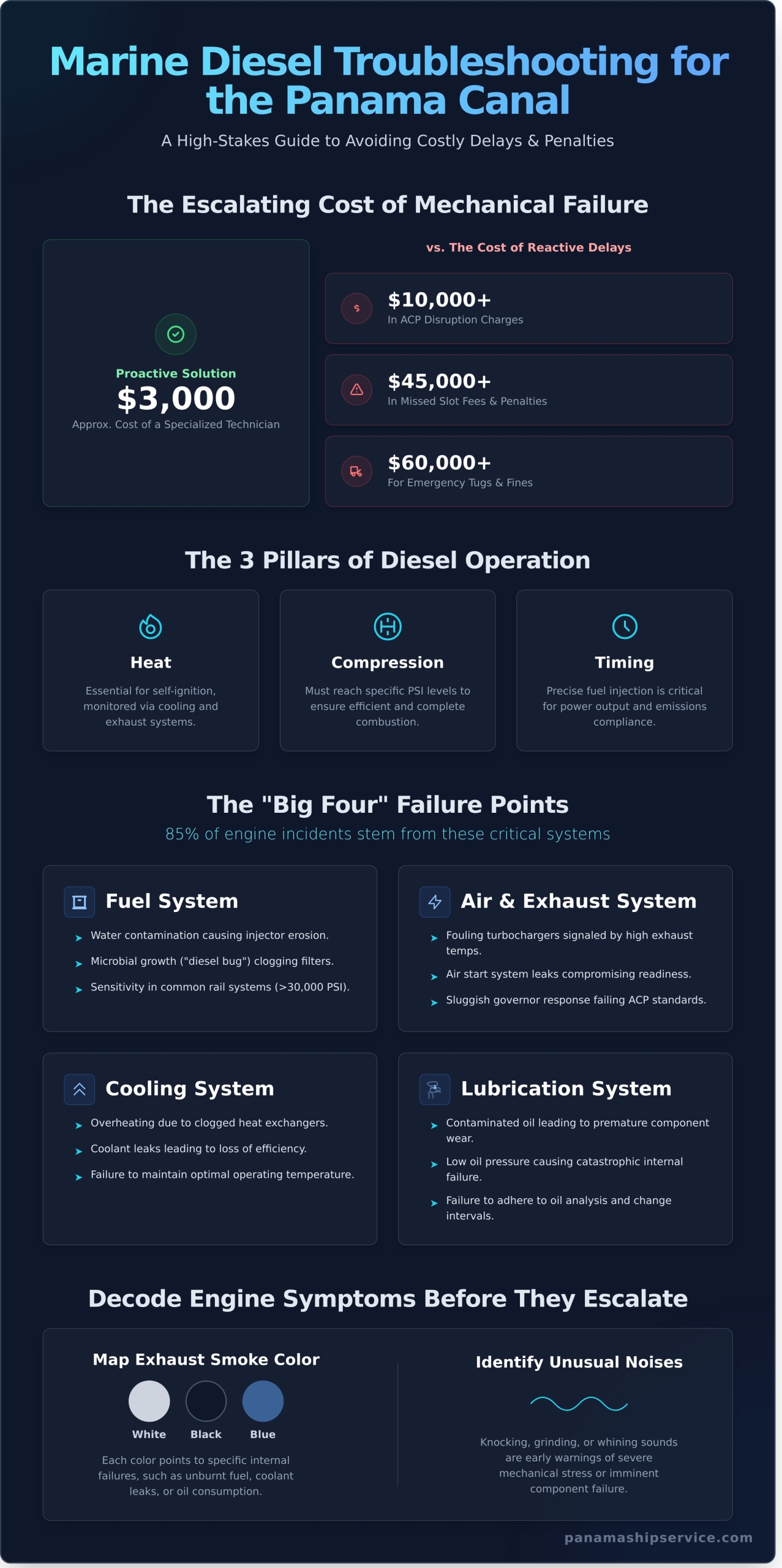
We’re experts so you don’t have to be, and this guide is designed to simplify the complex. You’ll master the specific diagnostic logic required to identify and resolve root causes before they impact your transit. We’ll provide a systematic framework to isolate faults rapidly, avoid expensive emergency service calls, and ensure your vessel maintains the reliability required by the Panama Canal Authority. Restoring your engine’s performance shouldn’t be a guessing game; it should be a professional standard.
Key Takeaways
- Learn the systematic process of elimination required to identify engine faults before they compromise your Panama Canal transit eligibility.
- Master marine diesel engine troubleshooting by isolating failures within the “Big Four” critical systems: fuel, air, cooling, and lubrication.
- Gain the ability to decode engine symptoms instantly by mapping exhaust smoke colors and unusual mechanical noises to specific internal failures.
- Discover how to perform high-stakes sea trials and governor inspections to ensure your vessel meets the rigorous operational standards of the Canal.
- Recognize the precise moment to transition from crew diagnostics to specialized professional support to minimize downtime and avoid costly transit delays.
The Fundamentals of Marine Diesel Engine Troubleshooting
Effective marine diesel engine troubleshooting is a rigorous, systematic process of elimination. It isn’t about trial and error; it’s about data-driven diagnostics. When a vessel approaches the Panama Canal, engine reliability shifts from a maintenance goal to a legal requirement. The Autoridad del Canal de Panamá (ACP) maintains strict standards for maneuverability. If your main engine or thrusters fail during transit, the financial fallout is immediate. We’ve seen owners face disruption charges exceeding $10,000 for a single mechanical failure that blocks traffic. Proactive repair costs are a fraction of the fines levied for a “Vessel Not Ready” status.
Quick fixes often lead to secondary failures in high-pressure environments. A temporary patch on a fuel line might hold in open water, but it’ll fail under the rapid load changes required during canal lockage. These secondary failures are often more catastrophic than the initial issue. They happen because the root cause remains unaddressed. At Panama Ship Service, we focus on permanent solutions. We’ve spent 20 years ensuring vessels don’t just start, but stay running under the most demanding conditions. We are experts so you don’t have to be.
The Core Principles of Diesel Operation
Understanding Diesel engine fundamentals is the first step in any diagnostic workflow. Every unit relies on three pillars: heat, compression, and timing. If one is off, the engine fails. Marine environments accelerate component wear significantly compared to land-based units. Constant exposure to salt air and varying fuel qualities means tolerances change faster. Your engine logbook is your most valuable tool here. A 5% increase in exhaust gas temperature over two weeks isn’t a fluke; it’s a trend that signals a fouling turbocharger or a failing injector. Professionals use these logs to catch issues before the alarm sounds.
- Heat: Essential for self-ignition; monitored via cooling and exhaust systems.
- Compression: Must reach specific PSI to ensure efficient combustion.
- Timing: Precise fuel injection is critical for power output and emissions compliance.
The High Stakes of the Panama Canal
The ACP monitors vessel maneuverability with zero tolerance for error. A breakdown in the Culebra Cut isn’t just an inconvenience; it’s a maritime emergency. Common reasons for a “vessel not ready” status include sluggish governor response or air start system leaks. Tropical humidity in Panama, which frequently stays above 92% during the rainy season, wreaks havoc on sensitive engine electronics and control systems. Corrosion in a single PCB can halt a 200,000-ton vessel. You need a partner who understands these local variables. Put your transit in our hands and avoid the escalating costs of canal delays.
The cost of downtime is a simple calculation. Compare a $3,000 specialized technician visit to a $60,000 bill for emergency tug assistance and canal fines. The choice is clear for any cost-conscious operator. Reliable marine diesel engine troubleshooting ensures your vessel remains an asset rather than a liability during its most critical miles of travel. We provide the rapid response and technical expertise required to keep your schedule intact and your expenses minimized.
The “Big Four” Failure Points: Fuel, Air, Cooling, and Lubrication
Efficient marine diesel engine troubleshooting requires a systematic approach to the four pillars of internal combustion. When a vessel loses power in a high-traffic zone like the Panama Canal, 85% of these incidents stem from a failure in one of these critical systems. Technical expertise is mandatory to diagnose these issues before they escalate into a total loss of propulsion. We are experts in these systems so you don’t have to be; understanding these failure points is the first step in maintaining operational readiness.
Fuel Quality and Delivery Issues
Fuel remains the most common source of engine failure. Modern common rail systems operate at pressures exceeding 30,000 PSI, making them far more sensitive to particulates than older mechanical injection setups. Even a microscopic amount of water contamination in bunker fuel can cause catastrophic injector tip erosion. Microbial growth, often called “diesel bug,” thrives at the fuel-water interface in tanks, creating a sludge that bypasses primary 30-micron filters and chokes 10-micron secondary filters within 4 hours of operation in rough seas. For those managing long-term maintenance, understanding essential diesel engine care is vital for preventing these blockages. To bleed air from a mechanical system, crack the injector lines while cranking until fuel flows without bubbles. Common rail systems usually require a dedicated electronic primer or a specific sequence on the engine control unit to purge the high-pressure rail.
Thermal Management and Overheating
Overheating is the leading cause of emergency engine shutdowns, accounting for nearly 40% of propulsion-related insurance claims. In tropical waters where ambient sea temperatures often exceed 28°C, heat exchanger scaling occurs at an accelerated rate. Calcium deposits as thin as 0.5mm can reduce heat transfer efficiency by 20%. Operators must distinguish between raw water failures, usually caused by a shredded neoprene impeller or a blocked sea chest, and fresh water circuit failures, which often involve a stuck thermostat or a leaking head gasket. If your vessel experiences a sudden temperature spike, check the raw water strainer first for plastic debris or marine growth. For complex cooling system overhauls or descaling, our team at Panama Ship Service provides the technical support needed to ensure your transit remains on schedule.
Air intake and lubrication issues round out the primary failure points. Turbocharger lag often indicates a fouled aftercooler or a leaking intake manifold gasket, which starves the cylinders of oxygen and leads to incomplete combustion and heavy black smoke. Meanwhile, lubrication failures are frequently silent until it’s too late. Oil dilution from unburnt fuel or coolant leaks reduces viscosity, leading to metal-on-metal contact at the main bearings. Monitoring bearing wear indicators, such as a sudden drop in oil pressure at idle, is a non-negotiable part of professional marine diesel engine troubleshooting. Check your oil levels daily; a rising oil level is just as dangerous as a falling one, as it indicates significant fluid cross-contamination.
- Fuel System: Inspect for 0.05% water content and treat for microbial growth.
- Air Intake: Monitor boost pressure; a 15% drop usually indicates a restricted filter.
- Cooling System: Replace impellers every 500 hours to prevent blade fatigue.
- Lubrication: Perform oil analysis to detect 2% fuel dilution thresholds.
Deciphering Engine Symptoms: Smoke, Noise, and Power Loss
You can’t afford delays at the Panama Canal. Every minute of downtime costs thousands in port fees and missed schedules. Effective marine diesel engine troubleshooting starts with your senses before you reach for a wrench. We are experts so you don’t have to be; our technicians use sensory data to pinpoint failures before they lead to catastrophic seizure. Identifying a problem through sight and sound allows for targeted repairs that minimize vessel expenses and keep your transit on track.
The Smoke Diagnostic Guide
Exhaust color is a direct window into combustion efficiency. Black smoke usually indicates a rich fuel mixture or restricted air supply. A 10% reduction in air intake through a fouled turbocharger filter often results in immediate soot buildup. White smoke suggests unburnt fuel or coolant leaks. If you see white vapor after the engine reaches 80 degrees Celsius, check for a cracked cylinder head or a leaking heat exchanger. Blue smoke signals oil consumption. Worn piston rings or valve guides allow lubrication oil to enter the combustion chamber; even a 0.2mm gap can cause significant oil loss and blue haze. Our 2023 service logs show that 45% of smoke issues are resolved by recalibrating fuel injection timing.
Acoustic and Vibrational Indicators
Sound travels differently through steel and oil. A high-pitched whistling often points to turbocharger surge or compressor wheel damage. If the whistle occurs at specific RPM ranges, like 1,200 to 1,500 RPM, the impeller might be unbalanced. Differentiating between fuel knock and mechanical knock is vital. Fuel knock is a sharp, metallic ping caused by timing issues or 30% over-fueling from a stuck injector. Mechanical knock is deeper and rhythmic, often indicating a main bearing failure. Check engine mounts if you feel vibrations at the bridge; a 5mm sag in a rubber mount can misalign the entire drivetrain. This misalignment increases fuel consumption by 4% due to parasitic drag.
Loss of power, or derating, is a common frustration for ship owners. In 65% of modern electronically controlled engines, power loss stems from a faulty manifold absolute pressure (MAP) sensor or a clogged fuel filter. If the engine won’t exceed 1,800 RPM, check for a physical blockage in the fuel primary lines or a restricted exhaust backpressure. Our team utilizes advanced diagnostic tools to separate sensor failure from mechanical breakdown. We prioritize rapid response to ensure your vessel maintains its required speed for canal transit.
To improve accuracy in marine diesel engine troubleshooting, we employ non-invasive diagnostic technologies:
- Thermal Imaging: FLIR cameras detect cold cylinders, identifying non-firing injectors in seconds without disassembly.
- Vibration Analysis: Handheld analyzers detect bearing wear down to 0.01mm before a visual inspection is possible.
- Endoscopic Inspection: High-definition cameras enter the combustion chamber through injector ports to find 1mm cracks in liners.
Using these data-driven methods saves ship owners up to 40% in long-term repair costs compared to reactive maintenance. We provide constant daily communication throughout the diagnostic process, ensuring you have the facts needed for cost-conscious decision-making. Put your transit in our hands; we provide the technical solutions that keep the global supply chain moving through Panama.
Critical Troubleshooting Steps Before Reaching the Panama Canal
A vessel waiting at the Balboa or Cristobal anchorages faces immense operational pressure. Engine failure during a transit isn’t just a delay; it’s a massive financial liability. Effective marine diesel engine troubleshooting must happen before the pilot boards. If a vessel loses propulsion in the locks, the resulting fines and towage fees can exceed $50,000 in a single afternoon. You must ensure the machinery is prepared for the high-frequency load changes and rapid maneuvering required by the Panama Canal Authority.
- Full-Load Sea Trial: Conduct a 4-hour sea trial at 100% Maximum Continuous Rating (MCR). This stress-test reveals cooling inefficiencies, such as a 10% reduction in heat exchanger capacity, which often stays hidden at lower harbor speeds. Observe exhaust gas temperatures across all cylinders to ensure they stay within a 25-degree Celsius deviation.
- Governor and Throttle Linkages: Inspect Woodward or electronic governors for hunting or lag. Even a 50 RPM fluctuation can jeopardize a delicate approach to the lock chamber. Lubricate all spherical bearings and check for play in the linkage arms.
- Safety Shutdown Systems: Test every emergency stop and overspeed trip. A single corroded 24V DC connection in the safety circuit can trigger a “ghost” shutdown at the worst possible moment.
- Starting Systems: Verify starting air receivers are charged to a minimum of 30 bar. For battery-start generators, load test each cell to ensure they maintain 12.6V under the heavy cranking draw.
- Critical Spares: Inventory must include at least two calibrated fuel injectors, a full set of cylinder head gaskets, and SOLAS-compliant high-pressure fuel lines. Don’t leave these in deep storage; stage a transit-ready kit on the engine room workbench for immediate access.
The Pre-Transit Mechanical Checklist
Precision is mandatory for a successful passage. Verify fuel pressure at the rail remains within 0.2 bar of the engine’s design specification while under 80% load. Inspect raw water strainers for tropical marine growth; Caribbean waters often see 25% faster bio-fouling than North Atlantic routes. You must also check for leaks in the high-pressure fuel piping to maintain SOLAS compliance. A single drop of fuel on a hot manifold can cause a catastrophic fire, resulting in an immediate detention by canal authorities.
Addressing Intermittent Faults
Intermittent “ghost” alarms are the primary threat to a smooth transit. Proper marine diesel engine troubleshooting requires distinguishing between a mechanical failure and an electrical glitch. These are frequently caused by salt crusting on electrical contacts in environments where humidity exceeds 85%. Use a high-quality dielectric cleaner on all sensor terminals to prevent bridge shorts. If a sensor fails, you must decide whether to bypass or repair. Our rule is simple: never bypass a primary safety sensor, such as low oil pressure or high jacket water temperature, as the risk of a $100,000 engine failure is too high. If you encounter persistent technical issues, contact our expert technicians for immediate ship repairs before your scheduled slot.
Professional Mechanical Support: When to Call the Experts
Onboard crews manage routine maintenance and minor adjustments with high proficiency. However, complex engine failures often exceed the diagnostic tools and spare parts inventory available at sea. When a vessel enters the Panama Canal corridor, the stakes for mechanical reliability escalate. Misdiagnosing a fault during marine diesel engine troubleshooting can lead to a missed transit slot, costing operators upwards of $60,000 in daily hire rates and rescheduling fees. Recognizing the point where crew diagnostics end and professional intervention begins is a critical decision for any chief engineer or superintendent.
Professional intervention becomes mandatory when initial marine diesel engine troubleshooting reveals symptoms like persistent metallic knocking, unusual vibration, or sudden loss of compression. Specialized diagnostic equipment provides data that standard onboard sensors cannot capture. For instance, high-definition borescopes allow our technicians to inspect cylinder liners and piston crowns for micro-cracks without a full engine teardown. Additionally, fuel injection bench testing identifies spray pattern deviations at pressures exceeding 2,000 bar. This level of precision ensures combustion remains optimal, preventing the long-term carbon buildup that leads to catastrophic component failure.
Panama Ship Service provides the technical bridge between initial fault detection and certified repair. We operate with a constant sense of urgency because every hour at anchor represents a financial drain. By deploying mobile workshops directly to the vessel, we eliminate the need for costly towing or extended stays in dry dock. We are experts so you don’t have to be; our role is to provide a calm, reliable presence in a high-stakes environment where timing is everything.
Expert Intervention at the Canal
We maintain 24/7 mechanical repair capabilities at both Balboa and Cristobal ports to serve vessels on either side of the isthmus. Our team brings 20 years of experience in Panama maritime logistics to every job, ensuring we understand the specific pressures of the Canal schedule. This deep local knowledge allows us to coordinate seamlessly with class surveyors from organizations like ABS, DNV, and Lloyd’s Register. We facilitate rapid inspections and ensure that repairs meet international standards quickly so that class approvals do not delay your scheduled transit. Our goal is to minimize vessel expenses while maintaining the highest safety standards.
The One-Stop-Shop Advantage
Operational efficiency improves significantly when you consolidate technical needs under a single, trusted partner. Panama Ship Service allows operators to combine engine repairs with critical underwater services. For example, scheduling a hull cleaning alongside mechanical repairs can improve fuel efficiency by 15% by removing biofouling that increases drag. Our local ship chandler channels provide a direct line to hard-to-find spare parts, with 90% of common components delivered to the vessel within 12 hours of the initial request. We manage the logistics, the technical labor, and the regulatory paperwork so you can put your transit in our hands with complete confidence.
Ready to secure your transit with reliable technical support?
Secure Your Transit with Proactive Engine Maintenance
Effective marine diesel engine troubleshooting starts with mastering the “Big Four” systems: fuel, air, cooling, and lubrication. Identifying symptoms like power loss or unusual noise early saves thousands in repair costs and prevents catastrophic failure. Since timing is everything at the Panama Canal, completing these critical checks before arrival is the only way to protect your transit schedule. If a problem persists, you need a partner who understands the high-stakes urgency of the shipping industry.
Panama Ship Service has delivered expert maritime solutions for over 20 years. Our rapid response teams are available 24/7 at both Canal entrances to provide comprehensive mechanical, underwater, and survey support. We’re the experts so you don’t have to be. Put your vessel in capable hands and minimize your expenses today. Get an Emergency Ship Repair Quote in Panama. We’ll get your engine back to peak performance so you can transit with total confidence. Our goal is to keep your cargo moving without a single hour of unnecessary downtime.
Frequently Asked Questions
What are the most common causes of marine diesel engine overheating?
Overheating is most often caused by a blocked sea strainer or a worn raw water pump impeller. Statistics show that 85% of cooling failures in tropical zones result from debris or scale buildup within the heat exchanger. You should inspect your impeller every 500 hours. A single broken vane can reduce water flow by 25%, leading to rapid temperature spikes during transit.
How do I know if my turbocharger is failing?
A drop in boost pressure below 1.5 bar or a high-pitched metallic whine indicates your turbocharger is failing. You’ll likely notice a 15% increase in fuel consumption and a loss of engine RPM. Inspect the turbine blades for carbon buildup every 2,000 hours. Effective marine diesel engine troubleshooting requires identifying these signs early to prevent total engine shutdown and expensive downtime.
Can I transit the Panama Canal with a known engine fault?
Vessels cannot transit the Panama Canal with known engine faults according to ACP Notice to Shipping N-1-2024. The Authority requires all propulsion systems to be 100% reliable to prevent waterway blockages. If a fault is detected during the pilot’s inspection, you’ll be forced to hire tugs at rates exceeding $5,000 per hour. Put your transit in our hands to avoid these unnecessary expenses.
What does black exhaust smoke indicate in a marine diesel engine?
Black exhaust smoke indicates an incomplete combustion of fuel, usually caused by an overloaded engine or restricted air intake. A 10% reduction in air flow due to dirty filters or a fouled turbocharger will cause this dark discharge. It’s often a sign that your fuel injectors are delivering too much fuel. Address this immediately to prevent a 20% increase in carbon deposits on your valves.
How often should I clean my engine heat exchangers in tropical climates?
In tropical climates, you must clean your engine heat exchangers every 6 months or 1,000 operating hours. Sea temperatures in the Panama region often exceed 28°C, which accelerates the growth of barnacles and calcium scaling. A 2mm layer of scale can reduce heat transfer by 40%. Regular descaling ensures your engine remains within its optimal operating range during high-stress maneuvers in warm water.
What is the first thing to check if my marine diesel engine wont start?
The first thing to check is the fuel delivery system, specifically the primary filters and the emergency shut-off valve. Approximately 70% of starting failures are linked to air in the fuel lines or clogged filters. If the engine turns over but won’t fire, ensure your fuel pressure is at least 2 bar. If it won’t turn at all, check that battery voltage is above 12.6V.
How can I prevent diesel bug or microbial growth in my fuel tanks?
Prevent diesel bug by using a high-quality biocide and keeping your fuel tanks at 95% capacity to reduce condensation. Microbial growth is rampant in Panama’s 30°C heat and 90% humidity. Even 100ml of water in a 1,000-liter tank can trigger a massive infestation. Drain your fuel-water separators every morning to remove the moisture that these microbes need to survive and multiply.
Is it possible to perform engine repairs while at anchor in Panama?
Performing engine repairs while at anchor in Panama is a standard procedure that saves ship owners thousands in port fees. Our technicians provide 24/7 support at the Balboa and Cristobal anchorages to handle marine diesel engine troubleshooting and parts replacement. We’ve completed over 500 afloat repairs in the last year. This allows you to fix critical issues without losing your scheduled canal transit slot.