
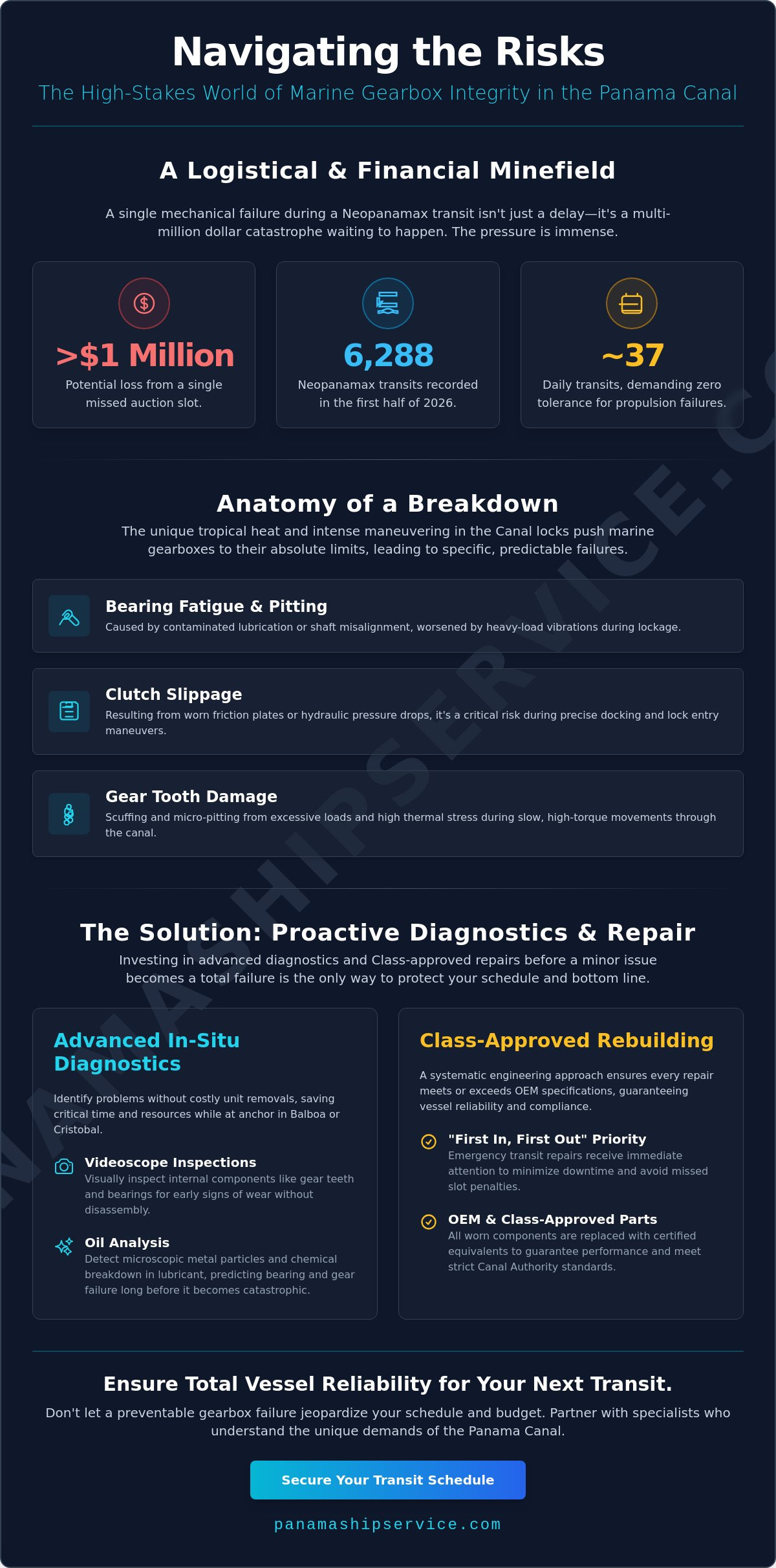
A single mechanical failure during a Neopanamax transit doesn’t just stall a vessel; it triggers a logistical nightmare involving potential auction slot losses that can exceed $1 million. In this high-stakes environment, specialized marine gearbox repair services are the only barrier between a successful passage and a devastating financial hit. You understand that every hour spent idle at the Balboa or Cristobal anchorages erodes your profit margins. With the Panama Canal recording 6,288 transits in the first half of 2026, the pressure to maintain a strict schedule is at an all-time high.
We agree that the risk of mechanical failure during critical maneuvers is a variable you can’t afford to ignore. This article provides the roadmap to mastering the technical and logistical essentials of gearbox maintenance to eliminate transit delays and ensure total vessel reliability. You’ll learn how to secure fast turnaround times, obtain class-approved repair quality, and get clear cost estimations before the work begins. We will preview the specific steps required to coordinate mechanical ship repairs that keep your operations efficient and fiscally responsible while navigating the world’s most critical shortcut.
Key Takeaways
- Understand how gearbox health directly impacts propulsion control and prevents the heavy fines associated with lock-side mechanical failures.
- Learn how advanced diagnostic tools like videoscopes and oil analysis allow for in-situ assessments, reducing the need for costly unit removals.
- Identify the technical requirements for class-approved marine gearbox repair services to ensure your vessel meets the Canal Authority’s strict operational standards.
- Discover how to leverage the strategic locations of Balboa and Cristobal to coordinate mechanical ship repairs without disrupting your transit schedule.
- Explore how a consolidated technical partner manages complex mechanical overhauls alongside transit agency needs to optimize your operational budget.
The Critical Role of Marine Gearbox Integrity for Panama Canal Transits
The gearbox is the functional heart of marine propulsion systems. It manages the extreme torque required for the precise, low-speed maneuvering essential for safe canal lockage. Unlike open-sea voyaging, canal transits demand constant engine load variations and frequent clutching maneuvers. Any hesitation in the transmission during these critical moments compromises the safety of the vessel and the canal infrastructure itself. When your propulsion fails in a narrow channel, you lose the ability to counteract currents or maintain steerage, turning a routine transit into a high-risk liability.
Panama’s unique environment adds layers of mechanical stress that many operators overlook. The combination of high ambient tropical temperatures and a relentless transit schedule puts immense pressure on gearbox cooling systems. When lubrication oil temperatures rise beyond design limits, viscosity drops, leading to accelerated wear on internal components. Specialized marine gearbox repair services involve the precise process of diagnosing, refurbishing, or replacing internal transmission components to OEM or Class standards. This ensures the unit can handle the specific thermal and mechanical loads found at the Isthmus.
A breakdown inside the locks is more than a technical failure; it’s a financial catastrophe. It leads to massive fines, immediate salvage costs, and significant maritime traffic disruption. With daily transits reaching 37 vessels as of March 2026, the Panama Canal Authority maintains zero tolerance for vessels that cannot maintain their own propulsion. If your gearbox fails mid-transit, the resulting delays ripple through the global supply chain, and the costs of clearing the channel fall squarely on the ship owner.
Common Failure Points in Commercial Marine Gearboxes
Several specific issues frequently arise in high-traffic hubs like Panama due to the intense operational cadence:
- Bearing fatigue and pitting: This often occurs due to contaminated lubrication or shaft misalignment, which is exacerbated by the vibration of heavy-load transits.
- Clutch slippage: Worn friction plates or sudden hydraulic pressure drops can prevent the gearbox from engaging properly, a critical risk during docking or lock entry.
- Gear tooth damage: Scuffing and micro-pitting result from the excessive loads required to move massive tonnage through the locks under tropical heat conditions.
The True Cost of Transit Delays
The fiscal impact of a mechanical failure is immediate and punishing. Daily hire rates for large vessels often exceed tens of thousands of dollars. Every hour spent at anchor represents lost revenue that can never be recovered. Rescheduling a missed slot involves complex logistics and substantial additional fees, with some last-minute booking costs reaching $200,000 in high-demand periods. To mitigate these risks, proactive mechanical ship repairs in Panama are essential. Investing in marine gearbox repair services before a minor vibration becomes a total failure is the only way to protect your schedule and your bottom line.
Comprehensive Marine Gearbox Repair and Rebuilding Procedures
Restoring a heavy-duty marine gearbox requires more than just swapping parts. It demands a systematic engineering approach to meet factory standards and comply with federal vessel repair regulations. At strategic hubs like the Panama Canal, time is the most expensive commodity. To manage this, we utilize a “First In, First Out” priority system specifically designed for emergency transit repairs. This ensures that vessels facing critical mechanical failures receive immediate attention to minimize downtime and avoid the steep costs of missed transit slots.
Quality marine gearbox repair services depend on a controlled, sterile environment. Every internal component undergoes a rigorous cleaning process using specialized mineral spirit solutions to remove carbon deposits, metallic debris, and degraded oil. Once cleaned, we replace all worn components with OEM or Class-approved equivalents. Using substandard parts is not an option when the vessel must handle the high-torque demands and frequent clutching maneuvers of canal lockage. Every component must be verified to ensure long-term reliability in demanding tropical waters.
Tear Down, Inspection, and Failure Analysis
A complete rebuild begins with total disassembly to the housing level. We don’t just look at the gears; we inspect the housing for structural cracks or warping that could lead to future misalignment. Our technicians use Magnaflux or dye-penetrant testing to identify invisible fractures in gear teeth that standard visual inspections miss. Every repair includes a comprehensive root cause analysis. We determine if the failure stemmed from operator error, maintenance neglect, or simple component age. This data allows you to adjust operational protocols and prevent a recurrence of the same mechanical issues.
Precision Assembly and Load Testing
Precision is the hallmark of professional marine gearbox repair services. Assembly involves meticulous re-shimming and setting the correct backlash to prevent premature gear wear. We perform comprehensive pressure and temperature testing of the hydraulic system to verify cooling flow, ensuring the unit remains stable in Panama’s humid climate. Finally, the exterior is primed and painted with marine-grade enamel to resist corrosion. If you require expert oversight for your vessel’s machinery, our specialized mechanical ship repairs ensure your next transit remains seamless and safe.
Advanced Diagnostics: Videoscopes, Oil Analysis, and Alignment
Modern diagnostic protocols allow for comprehensive in-situ assessments that were once impossible without total disassembly. For vessels transiting the Panama Canal, where every hour of downtime at Balboa or Cristobal anchorages translates to lost revenue, these non-invasive techniques are vital. By analyzing the transmission system while it remains installed, we often avoid the logistical burden and high cost of full component removal. This proactive approach ensures that marine gearbox repair services are targeted and efficient, focusing only on the components that require immediate attention.
The financial incentive for early detection is undeniable. Some industry professionals report that preventive maintenance is typically five times cheaper than emergency reactive repair. Beyond the immediate fiscal savings, diagnostic data provides the essential documentation required for Class approval surveys. Accurate records of oil analysis and component wear ensure your vessel remains compliant with the Panama Canal Authority’s rigorous safety standards. This data-driven strategy allows superintendents to make informed decisions about whether to proceed with a transit or schedule a brief stop for mechanical ship repairs.
Videoscope and Borescope Inspections
High-definition internal viewing allows technicians to inspect gear teeth, bearings, and oil galleries without breaching the casing. This method provides digital evidence essential for insurance claims and superintendent reviews. It’s the ideal solution for quick assessments during a brief bunker stop or while waiting for a transit slot. By capturing clear images of micro-pitting or scuffing early, we can determine the remaining operational life of a component without delaying your schedule. This level of transparency is critical for maintaining trust between the ship’s crew and technical service providers.
Laser Alignment and Vibration Analysis
Alignment remains the most overlooked factor in gearbox longevity. We use laser alignment to identify thermal growth and hull deflection that impacts the engine-to-gearbox coupling. Correcting these issues reduces parasitic loss and vibration, which are leading causes of seal failure and bearing fatigue. Because alignment issues often correlate with propeller and shaft health, we frequently integrate these findings with our underwater hull services to ensure total propulsion efficiency. Reducing vibration doesn’t just protect the gearbox; it improves the overall mechanical health of the entire drivetrain, ensuring a smoother and more reliable transit through the locks.
Strategic Logistics: Minimizing Vessel Downtime in Panama
Panama’s ports, specifically Balboa on the Pacific side and Cristobal on the Atlantic, serve as more than just transit markers. They function as strategic “pit stops” where complex mechanical overhauls can be executed without deviating from the global trade route. Coordinating marine gearbox repair services within these hubs requires a deep understanding of the Panama Canal Authority (ACP) transit windows. Because late arrival fees can reach 50% of the reservation tariff, and missed auction slots can cost upwards of $1 million, the logistical precision of your repair partner is just as critical as their mechanical expertise.
The efficiency of a repair project often hinges on the speed of customs clearance for heavy machinery and specialized components. Tocumen International Airport provides a vital link for the rapid arrival of spare parts from global manufacturers. A professional service provider manages the interface between air freight logistics and dockside delivery, ensuring that specialized tools and components are ready before the vessel reaches the anchorage. This level of coordination is the only way to navigate the high-stakes, time-sensitive environment of the 2026 maritime landscape, where daily transits have increased to an average of 37 vessels.
Emergency Response and Mobile Repair Teams
Deploying mobile repair teams equipped with specialized machining tools allows for on-board interventions that bypass the need for time-consuming dry-docking. By performing repairs at the pier or while the vessel is at anchor, operators can maintain their operational readiness and avoid the logistical complexity of moving a disabled ship. Panama Ship Service optimizes the 24-48 hour transit window by deploying technical teams directly to the vessel, ensuring that critical gearbox adjustments are completed before the scheduled lockage begins. This proactive approach allows you to delegate mechanical complexity to experts while you focus on the vessel’s primary mission.
Sourcing Marine Spare Parts in the Hub
Success in heavy mechanical repair depends on immediate access to high-quality components. We leverage a robust local inventory of seals, bearings, and friction plates for major industry brands such as ZF, Reintjes, and Renk. When a specific gear set or housing isn’t available locally, our global logistics network facilitates expedited shipping to prevent extended delays. This capability works in tandem with our comprehensive ship supplies at the Panama Canal, providing a single-source solution for both technical parts and operational provisions. For immediate technical support that protects your transit schedule, consult our mechanical ship repair division to secure your vessel’s reliability.
Panama Ship Service: Your Partner for Specialized Mechanical Repairs
Panama Ship Service positions itself as a singular point of contact for all technical and operational requirements at the Isthmus. We recognize that managing multiple vendors during a high-pressure transit window creates administrative friction and increases the risk of scheduling errors. Our mechanical division focuses on high-precision marine gearbox repair services, providing the technical depth required to handle Neopanamax-scale propulsion systems. We combine this technical proficiency with an intimate understanding of 2026 Canal logistics, ensuring that every repair aligns perfectly with your allotted transit slot.
Efficiency in maritime operations is driven by the ability to delegate complexity. When you partner with us, you’re not just hiring technicians; you’re engaging a team that understands the fiscal weight of every hour spent at anchor. We ensure all marine gearbox repair services are performed to meet international maritime standards and Class requirements. This rigorous adherence to quality ensures that your vessel remains compliant with the Panama Canal Authority’s new risk-based inspection models, which became mandatory on January 1, 2026. Our goal is to minimize your overhead while maximizing the reliability of your drivetrain.
Integrated Mechanical and Technical Solutions
Our facility is designed to handle simultaneous technical tasks, allowing for the concurrent execution of gearbox overhauls, engine maintenance, and steel fabrication. Consolidating these services under one management structure reduces administrative overhead and eliminates the communication gaps that often delay complex projects. This integrated approach is particularly valuable for vessels facing tight turnaround times between the Pacific and Atlantic terminals. For a comprehensive overview of how we manage these multi-faceted projects, refer to our mechanical ship repairs guide. We provide the technical infrastructure to resolve diverse mechanical issues in a single port stay.
Class-Approved Surveys and Inspections
Beyond mechanical work, we facilitate essential bunker, damage, and pre-purchase surveys to ensure your vessel is fully documented for continued operation. Every gearbox repair is meticulously logged, providing the transparency required for superintendent reviews and insurance compliance. We act as your eyes on the ground, ensuring that all work is approved by relevant Class societies before the vessel resumes its voyage. This level of diligence protects your asset and your reputation as a reliable operator. Contact Panama Ship Service today for a ship repair quote and secure your transit schedule with the Canal’s most dependable mechanical partner.
Secure Your Propulsion for Seamless Canal Passage
Maintaining the integrity of your drivetrain is the most effective way to prevent the catastrophic financial penalties of a stalled transit. You’ve seen how advanced diagnostics and precision rebuilding procedures eliminate mechanical uncertainty before your vessel enters the locks. By leveraging the strategic locations of Balboa and Cristobal, you turn a mandatory wait into a productive maintenance window. This proactive management of marine gearbox repair services ensures your vessel remains compliant with the Panama Canal Authority’s 2026 maritime regulations.
Panama Ship Service delivers the technical expertise and logistical coordination required for complex mechanical overhauls. We offer comprehensive support, including MARPOL disposal and Class-approved surveys, to ensure your vessel meets every operational standard. Our 24/7 emergency response teams deploy directly to your anchorage, providing the specialized skills needed to protect your schedule. Secure your vessel’s transit with expert marine gearbox repair from Panama Ship Service. We’re ready to ensure your next transit remains efficient and reliable.
Frequently Asked Questions
What are the first signs of marine gearbox failure?
Increased vibration, unusual noise, and rising oil temperatures are the primary indicators of potential failure. Operators should also monitor for metal shavings in the oil filters or a drop in hydraulic pressure during clutching maneuvers. These symptoms suggest bearing wear or gear tooth fatigue that requires immediate technical inspection. Addressing these early warning signs prevents a minor mechanical issue from developing into a catastrophic failure during a critical canal lockage.
Can a marine gearbox be repaired while the vessel is in the Panama Canal?
Repairs are generally conducted at the Balboa or Cristobal anchorages rather than inside the locks or channels. The Panama Canal Authority (ACP) requires vessels to maintain their own propulsion during transit. If a failure occurs mid-transit, the vessel is typically towed to a safe anchorage where mechanical ship repairs can begin without obstructing traffic. This prevents the massive fines and traffic disruptions associated with a total propulsion loss in the waterway.
How long does a typical marine gearbox rebuild take?
A typical gearbox rebuild takes between five and ten days, depending on the extent of component damage and parts availability. Minor repairs or seal replacements might be completed within a 48-hour window. Our 24/7 emergency response teams utilize a priority “First In, First Out” system to help technical teams meet the demanding schedules of vessels waiting for their transit window. This ensures the vessel returns to service with minimal disruption to its trade route.
What brands of marine gearboxes can you service in Panama?
Technicians in the Panama hub service major commercial brands including ZF, Reintjes, Renk, and Twin Disc. They maintain a local inventory of critical seals and bearings for these manufacturers to expedite marine gearbox repair services. For less common brands, parts are typically flown in via Tocumen International Airport to ensure a fast turnaround. This localized parts availability is a key factor in reducing the time your vessel spends at anchor.
Is it better to repair or replace a damaged marine gearbox?
Repair is often the most fiscally responsible choice for large-scale commercial gearboxes because a full replacement can take months to source. Rebuilding a unit to OEM specifications restores it to factory performance at a fraction of the cost. Replacement is usually reserved for cases where the housing is cracked or the internal damage is catastrophic beyond structural salvage. Our mechanical division focuses on high-precision refurbishments that extend the life of your existing machinery.
How does laser alignment prevent gearbox failure?
Laser alignment prevents failure by ensuring the engine and gearbox are perfectly coupled to eliminate parasitic vibration. This process accounts for thermal growth and hull deflection that occurs under heavy load. Proper alignment reduces the stress on bearings and seals, significantly extending the operational life of the transmission during high-torque canal maneuvers. By correcting these misalignments early, you prevent the accelerated wear that leads to sudden and expensive mechanical breakdowns.
Does Panama Ship Service provide Class-approved repair documentation?
Yes, all mechanical work is documented to meet the requirements of major classification societies and international maritime standards. This documentation is essential for maintaining your vessel’s risk profile under the 2026 Panama Canal inspection models. Every stage of the repair, from the initial failure analysis to the final load test, is recorded for superintendent review. This transparent reporting ensures your vessel remains compliant and ready for its next scheduled passage.
What is the cost difference between preventive and emergency gearbox repair?
Preventive marine gearbox repair services are significantly more cost-effective than emergency reactive repairs. Industry professionals often find that addressing minor issues during a scheduled stop is five times cheaper than managing a mid-transit failure. Emergency repairs involve additional costs for salvage, potential Canal fines, and the loss of expensive reservation slots. Investing in maintenance before a transit is the only way to avoid these unpredictable and substantial financial hits.