
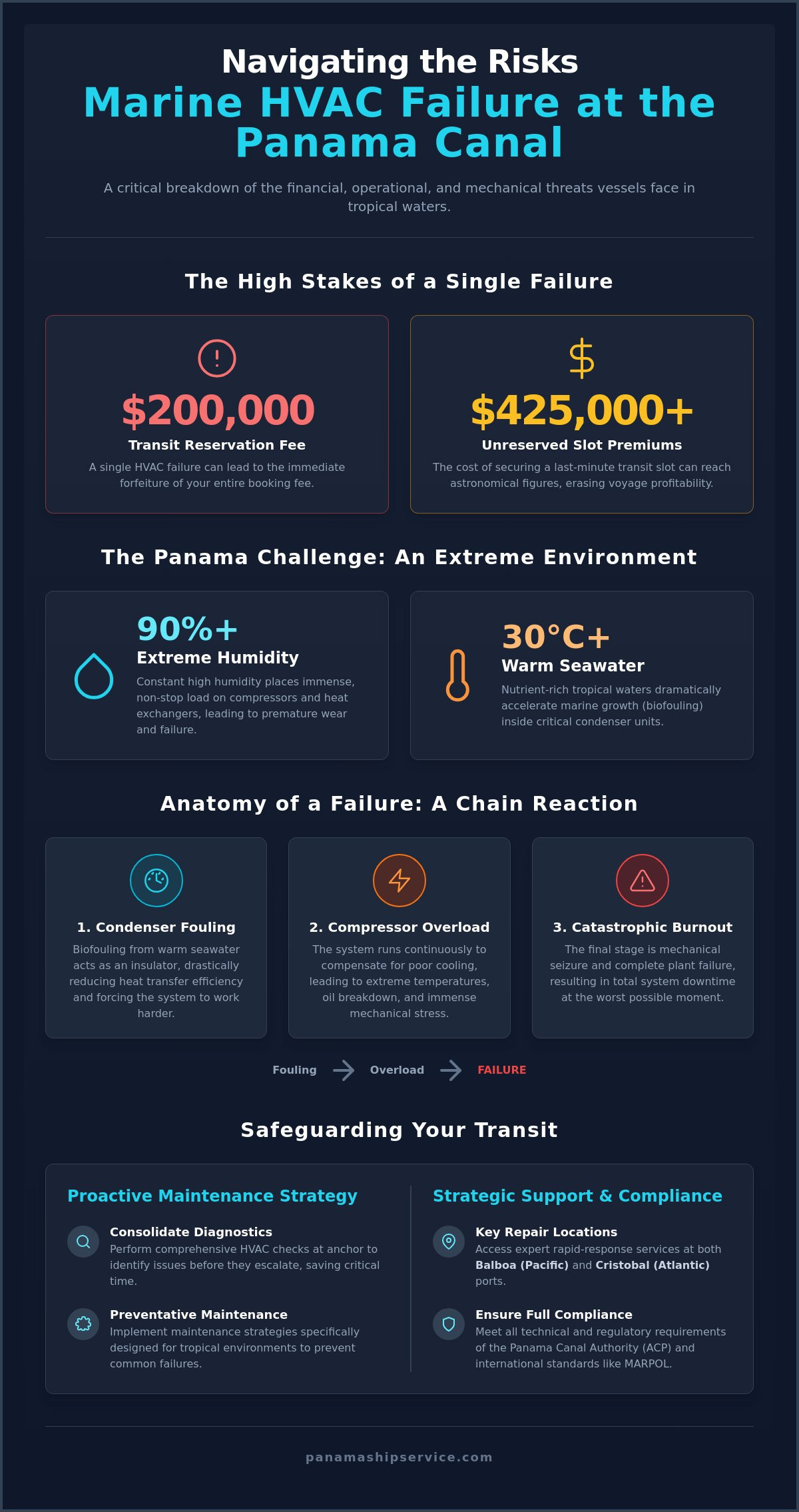
A single HVAC failure during your approach to the Panama Canal doesn’t just threaten crew comfort; it risks a $200,000 transit reservation fee and immediate cargo spoilage. With unreserved transit slots reaching premiums of $425,000 in early 2026, there’s absolutely no margin for mechanical delays. You understand that maintaining climate control in Panama’s extreme humidity is an uphill battle for any vessel. System downtime isn’t just a minor inconvenience; it’s a critical operational risk when transit schedules are fixed and penalties for cancellation can reach 100% of your booking fee.
Securing expert marine HVAC repair Panama services is the only way to ensure your vessel remains fully operational and compliant with international maritime health standards. This article explains how to restore your refrigeration systems immediately while minimizing downtime during your Canal transit. We’ll explore the technical challenges of tropical moisture, the financial impact of missed slots, and the rapid-response solutions available at the ports of Balboa and Cristobal to keep your voyage on schedule and your cargo protected.
Key Takeaways
- Understand how Panama’s extreme humidity and warm seawater accelerate mechanical failures like condenser fouling and compressor burnout.
- Learn the strategic importance of accessing expert marine HVAC repair Panama services at both Balboa and Cristobal to safeguard your transit schedule.
- Discover how to consolidate HVAC diagnostics with other mechanical ship repairs at anchor to eliminate unnecessary vessel downtime.
- Identify the specific regulatory and technical requirements for commercial chiller plants to ensure full compliance with international maritime health standards.
- Explore proactive maintenance strategies designed to prevent the catastrophic financial penalties associated with missed or delayed Canal transit slots.
Marine HVAC Repair in Panama: Critical Support for Canal Transits
Marine HVAC is a broad technical category that encompasses far more than simple cabin cooling. It includes complex ventilation systems and industrial-scale refrigeration plants essential for vessel operations. In the tropical environment of Central America, these systems face constant mechanical stress. Panama regularly experiences humidity levels exceeding 90%, which places an immense load on compressors, fans, and heat exchangers. When a vessel prepares for a Panama Canal transit, every system must perform at peak capacity. Any failure in climate control leads to a domino effect of operational risks that the Panama Canal Authority (ACP) monitors closely for safety compliance.
Commercial operators can’t afford the risks associated with mechanical failure during their scheduled slots. With daily transit averages reaching 37.06 vessels in May 2026, the canal operates near its maximum sustainable capacity. This high-traffic environment leaves no room for technical errors. Expert marine HVAC repair Panama services provide the necessary technical intervention to ensure that ventilation and cooling systems meet the rigorous demands of a high-draft transit. Proactive repairs prevent the financial catastrophe of a forfeited slot or a safety-related rejection at the locks.
The Role of Climate Control in Maritime Safety
Climate control is a safety-critical component for any deep-sea vessel. High ambient temperatures in the engine room or on the bridge cause sensitive navigation and control electronics to overheat and fail. Additionally, crew health is directly tied to HVAC performance. Fatigue and heat stress significantly reduce focus during the high-intensity maneuvers required within the locks. To further support crew wellness during these physically demanding operations, you can learn more about specialized compression garments that provide comfort and support. Effective ventilation also maintains air quality in enclosed spaces; this ensures the vessel meets international sanitary standards and prevents the buildup of hazardous gases or mold in the humid Panamanian climate.
Refrigeration Systems: Protecting Perishable Cargo
Refrigeration is equally vital for operational readiness and fiscal responsibility. A failure in the ship’s galley refrigeration during a long-haul voyage is a logistical nightmare that compromises crew welfare. More critically, for container ships, managing reefer container issues while at Balboa or Cristobal ports is essential to prevent massive cargo loss. We provide specialized marine HVAC repair Panama to address these emergencies before they escalate into total system burnouts. Ensuring these systems function correctly is also a matter of MARPOL compliance, as modern refrigeration units must operate without leaking ozone-depleting substances. Maintaining these systems reduces overhead and protects the vessel’s commercial viability during its time in Panamanian waters.
Common HVAC Failures in Tropical Maritime Environments
Tropical maritime environments introduce severe mechanical stress that standard HVAC systems aren’t designed to handle without constant maintenance. In Panama, the combination of high ambient temperatures and nutrient-rich seawater creates a perfect storm for system failure. Commercial vessels must maintain operational readiness to meet the Panama Canal Authority vessel requirements, which demand that all equipment be in good working condition to avoid transit delays. Failure to address these issues before arriving at the locks can result in costly penalties or even a denied transit.
Condenser fouling is perhaps the most frequent issue encountered in this region. Panama’s warm coastal waters accelerate marine growth and scaling inside heat exchangers. This biofouling acts as an insulator, preventing efficient heat transfer and forcing the system to run longer to achieve the same cooling effect. When this happens, compressor burnout becomes inevitable. Operating continuously in 30°C+ ambient temperatures without adequate cooling leads to oil breakdown and mechanical seizure. It’s a chain reaction that starts with a few barnacles and ends with a complete plant failure.
Vibration-induced fractures are another common culprit. High-pressure refrigerant lines, subject to the constant thrum of massive marine engines, often develop hairline cracks. These leaks are difficult to detect without specialized equipment but lead to rapid loss of cooling capacity. For vessels experiencing these symptoms, seeking professional marine HVAC repair Panama is vital before a minor leak turns into a total system shutdown at the locks. Early detection during a technical survey can save thousands in emergency repair costs and lost time.
Electrical control failures also plague vessels in this region. Saline, high-humidity air quickly corrodes contactors, circuit boards, and sensors. If your crew notices erratic system behavior, it’s often a sign that corrosion has compromised the control logic. You can schedule a technical survey to identify these electrical vulnerabilities before they cause an emergency during your next voyage. Proactive replacement of corroded components is far more efficient than troubleshooting a dead system in the middle of a transit.
Seawater Cooling System Issues
Blocked sea chests and strainers are a constant threat in the debris-heavy waters of the Canal. When intake flow is restricted, cooling pumps often cavitate or fail entirely, causing immediate system shutdowns to prevent overheating. Regular descaling of the heat exchangers is not just a recommendation; it’s a necessity for maintaining the efficiency required for heavy-duty commercial operations. Our technicians focus on clearing these obstructions and restoring full flow to your cooling circuits.
Air Handling and Ventilation Challenges
The high humidity in Panama promotes rapid mold and bacteria growth within ducting, which compromises air quality and crew health. Blower motors and fan belts also wear out faster under the heavy load of moving dense, moisture-laden air. Short-cycling occurs when a compressor turns on and off too frequently due to faulty sensors or improper sizing, which dramatically shortens the lifespan of expensive marine compressors. Addressing these air-side issues is critical for maintaining a safe and productive environment for your crew.
While maritime systems are specialized, the need for rapid response to moisture-related crises is universal; for shore-side facility support, you can explore Emergency Plumbing and Water Restoration Services through Tip Top Plumbing & Restoration.
Strategic Repair Locations: Balboa and Cristobal Port Services
Operational efficiency at the Panama Canal depends entirely on geographic readiness. Maintaining technicians at both the Pacific and Atlantic entrances is a strategic necessity for commercial shipping. Balboa Port, located on the Pacific side, serves as the primary technical hub for Northbound vessels. Performing critical maintenance here ensures that climate control systems are fully stabilized before the ship enters the locks. Conversely, Cristobal Port on the Atlantic side provides essential support for Southbound vessels. This dual-port coverage allows for a seamless response regardless of your vessel’s transit direction.
Many operators choose to conduct repairs at offshore anchorages rather than dockside. This approach avoids high berth costs and bypasses the increasing congestion within the terminal areas. Our teams mobilize quickly to these anchorages to perform marine HVAC repair Panama while the vessel waits for its scheduled transit window. By handling technical issues at anchor, we help you maintain your position in the queue without incurring the additional overhead of port fees. It’s a pragmatic solution for busy fleets that need to balance technical reliability with strict fiscal responsibility.
Logistics of Ship Repair at the Panama Canal
Executing repairs within the Canal zone requires precise coordination with local ship agents and the Panama Canal Authority (ACP). We manage the complex boarding logistics, including the necessary customs and security clearances required for technical personnel. Our teams often perform repairs during bunkering or cargo operations to ensure zero impact on your schedule. This proactive coordination is vital because the ACP has moved toward machine-validated compliance systems; any delay in technical readiness can lead to an automatic rejection of your transit slot.
Emergency 24/7 HVAC Response
The financial stakes of a Canal transit are immense. With Neopanamax booking fees ranging from $100,000 to $200,000, a mechanical failure isn’t just a comfort issue; it’s a massive liability. We provide 24/7 Emergency Ship Repair Services in Panama to address these high-pressure situations. Our logistics network enables us to mobilize specialized tools and spare parts to offshore anchorages at any hour. Reliable marine HVAC repair Panama ensures that your vessel remains in full compliance with safety standards, protecting you from the 100% cancellation penalties associated with last-minute slot forfeitures.
Commercial vs. Recreational HVAC: Why Expertise Matters
Technical scale is the primary differentiator between commercial and recreational marine cooling. While a yacht might rely on small split units or self-contained air conditioners, commercial vessels utilize massive centralized chiller plants. These industrial systems operate on three-phase power and rely on sophisticated PLC (Programmable Logic Controller) logic to manage load balancing and system redundancy. A technician skilled in residential-style units is often ill-equipped to troubleshoot the complex electrical and mechanical logic of a commercial marine plant. For these high-stakes systems, specialized marine HVAC repair Panama is the only way to ensure operational reliability during a Canal transit.
Safety protocols also vary significantly between these environments. Working within a high-temperature, high-noise industrial engine room requires specific training and protective equipment that differs from recreational cabin service. Commercial HVAC systems are integrated into the vessel’s broader machinery, meaning a single error in a cooling pump or a ventilation fan can trigger alarms in the engine control room. We maintain the technical proficiency required to work on these complex systems while adhering to the strict safety standards demanded by international fleet managers and the Panama Canal Authority.
Class Approval and Surveys
Maintaining compliance with Class societies like Lloyds, ABS, or DNV is mandatory for commercial shipping. Any significant repair or modification to your HVAC or refrigeration systems must meet these rigorous standards to satisfy marine insurance requirements. We provide comprehensive documentation for all technical interventions, including refrigerant logging to comply with MARPOL environmental regulations. For vessels requiring broader compliance checks, our team coordinates with specialists in Marine Surveys in Panama to ensure every onboard system meets international maritime law. This level of oversight prevents administrative delays that could jeopardize your transit window.
Specialized Tools and Spare Parts
Industrial-scale repairs require specialized tools that aren’t found in a standard mechanic’s kit. We utilize thermal imaging to diagnose insulation failures and identify overheating electrical components before they lead to a total system burnout. Sourcing industrial compressors and expansion valves is also more efficient through our network in the Panama Free Zone, which allows for rapid delivery of critical components to the ports. Because specialized marine refrigerants like R134a or R404a require certified handling, our technicians ensure that all gas recovery and charging processes are performed safely and legally. You can contact our technical team to secure the specialized parts and expertise your commercial vessel requires for its next voyage.
Rapid Marine HVAC Solutions with Panama Ship Service
Panama Ship Service provides a centralized technical solution for vessels transiting one of the world’s most demanding maritime corridors. By consolidating your climate control needs with other mechanical ship repairs, you eliminate the logistical friction of managing multiple contractors. Our localized presence in Balboa and Cristobal allows us to respond immediately; this significantly reduces mobilization costs compared to flying in overseas technicians. We focus on rapid diagnostics to ensure your vessel remains on its strict transit schedule, which is vital given the high-stakes nature of Canal scheduling and the massive penalties for missed slots.
Environmental responsibility is a core component of our technical service. We maintain a strict commitment to MARPOL-compliant refrigerant handling and disposal, ensuring that all marine HVAC repair Panama operations meet international environmental standards. Our technicians are trained to handle high-pressure gases safely, preventing leaks that could lead to environmental fines or vessel detention. This proactive approach protects your vessel from regulatory scrutiny while maintaining peak operational efficiency in the high-stress tropical climate. We handle the technical complexity so your crew can focus on the transit itself.
Your One-Stop Shop at the Panama Canal
Efficiency is maximized when technical services are integrated. We often combine HVAC diagnostics with underwater hull services to provide a comprehensive technical overhaul while your vessel is at anchor. This strategy reduces the administrative burden on your crew and shore-side management by utilizing a single, reliable provider for all technical requirements. It’s a pragmatic way to reduce overhead while ensuring every system is ocean-ready.
Our teams have a proven track record of supporting diverse fleets, including container ships, chemical tankers, and bulk carriers. For container vessels, we prioritize reefer power and cooling stability to protect perishable cargo from spoilage. For tankers, we ensure that ventilation systems meet the safety standards required for hazardous cargo handling. By delegating these complexities to us, you simplify your operations and ensure that your vessel meets all Panama Canal Authority requirements without unnecessary complication.
Requesting a Quick Response
To ensure the fastest possible turnaround, please provide our technical team with detailed system data during your initial inquiry. We require information on the system type (e.g., centralized chiller or split unit), the specific refrigerant used (such as R134a or R404a), and your vessel’s current or expected location. This allows us to mobilize the correct spare parts and specialized tools to the offshore anchorage before our technicians even board. Don’t risk your transit slot due to a cooling failure. Contact the Panama Ship Service technical team today to secure a rapid response and ensure your vessel remains fully operational for its next voyage.
Ensure Operational Readiness for Your Next Canal Transit
Panama’s tropical climate remains an unforgiving environment for vessel climate control and refrigeration systems. As we discussed, biofouling in warm waters and extreme humidity levels lead to rapid mechanical failure. These technical issues don’t just compromise crew comfort; they threaten your transit schedule and financial bottom line. By addressing these vulnerabilities at strategic anchorages in Balboa or Cristobal, you avoid the massive penalties associated with missed slots and regulatory non-compliance.
Expert marine HVAC repair Panama services are essential for maintaining the high-draft operational standards required by the Panama Canal Authority. Panama Ship Service acts as your one-stop-shop for canal technical services. We provide a 24/7 emergency response at both entrances of the Canal, utilizing certified commercial marine technicians who understand the complexity of centralized chiller plants and industrial PLC controls. Don’t let a cooling failure disrupt your voyage. Contact Panama Ship Service for Immediate Marine HVAC Support and ensure your vessel stays on schedule. We’re ready to handle the technical details so your transit remains efficient and safe.
Frequently Asked Questions
Do you provide HVAC repair for commercial vessels at Balboa anchorage?
Yes, we provide full HVAC repair services at the Balboa anchorage for all types of commercial vessels. Our technicians use specialized launches to reach ships at anchor, allowing technical work to proceed without the need for a berth. This approach minimizes port fees and keeps your vessel in the transit queue while we address mechanical or electrical cooling issues.
Can you handle MARPOL-compliant refrigerant recovery and disposal in Panama?
We manage the full lifecycle of refrigerant recovery and disposal in accordance with MARPOL and local Panamanian environmental regulations. Our process includes the safe extraction of gases like R134a and R404a into certified recovery cylinders. We ensure that all ozone-depleting substances are documented and disposed of through authorized channels to maintain your vessel’s environmental compliance during its stay.
How quickly can an HVAC technician board my vessel at the Panama Canal?
Our technicians are available for boarding 24/7 at both the Balboa and Cristobal ports. Depending on launch availability and ACP security clearances, we typically mobilize a team to your vessel within hours of receiving a service request. Rapid response is a priority to ensure that marine HVAC repair Panama services are completed before your scheduled Canal transit window begins.
Do you carry spare parts for major marine HVAC brands like Carrier or Daikin?
We maintain a strategic inventory of industrial compressors, expansion valves, and electrical components compatible with major brands like Carrier and Daikin. Through our network in the Panama Free Zone, we can quickly source specialized parts that aren’t available in local retail markets. This logistical advantage is critical for restoring centralized chiller plants and reefer systems during short port stays.
Can HVAC repairs be performed while the vessel is in transit through the locks?
Repairs are generally conducted at the anchorages or during cargo operations rather than while the vessel is moving through the locks. The Panama Canal Authority has strict regulations regarding personnel on board during the actual transit for safety reasons. We coordinate with your agent to perform all necessary technical work while the ship is stationary at the Pacific or Atlantic entrances.
What information is required to get an emergency HVAC repair quote?
To provide an accurate emergency quote, we require the system manufacturer, the type of refrigerant used, and a detailed description of the fault symptoms. You should also include your vessel’s current location and expected ETA at the Balboa or Cristobal anchorages. Providing photos of the nameplate and the malfunctioning components helps our technical team prepare the correct tools and parts for immediate boarding.
Are your technicians certified for work on large-scale centrifugal chillers?
Our technical team is certified to work on industrial centrifugal chillers and complex three-phase power systems used on large commercial vessels. We understand the specific PLC logic and load-balancing requirements of centralized plants. This specialized expertise ensures that marine HVAC repair Panama meets the rigorous standards of Class societies like ABS and Lloyds, preventing administrative delays during insurance surveys.
Do you offer 24/7 support for refrigeration failures in the galley or reefer hold?
We offer round-the-clock emergency support for critical refrigeration failures in the galley and reefer holds. Protecting perishable provisions and cargo is a priority for maintaining operational readiness and crew welfare. Our teams are equipped to handle urgent compressor replacements or leak repairs at any time, day or night, ensuring your voyage continues without the risk of significant cargo loss or logistical interruptions.