
A vessel’s hydraulic fault can affect more than one system. Marine hydraulic repair in Panama may involve cylinder, hose, hydraulic, or pneumatic equipment, depending on the fault and the vessel’s needs. Identifying the affected equipment and defining the repair scope are essential first steps.
When equipment is under pressure, clear information matters. Knowing which systems are affected and how they support vessel operations helps focus the inspection and repair plan.
This article explains practical ways to assess cylinders, hoses, hydraulic systems, and pneumatic systems. It also covers factors that shape repair planning and how Panama Ship Service’s Mechanical Ship Repairs support vessels needing technical assistance in Panama.
Key Takeaways
- Learn which cylinder and hose conditions can signal a need for inspection or maintenance.
- Understand how to assess hydraulic and pneumatic equipment issues before planning repair work.
- See what factors help determine whether a hydraulic hose needs repair or replacement.
- Explore how pump, motor, and valve problems can affect vessel systems and repair planning.
Cylinder and hose maintenance
Start with the cylinder’s function: identify what it moves, the symptoms, and when they occur. Slow or uneven movement, visible fluid leakage, or a rod that does not retract fully can point to different faults. Record the affected equipment and operating conditions before inspection. This helps distinguish a cylinder issue from a hose leak, a control problem, or another fault in the hydraulic circuit.
Inspect the cylinder body, rod, seals, mounting points, and nearby hose connections. Look for scoring, corrosion, damaged seals, loose fittings, and fluid traces. A bent or scored rod can damage replacement seals, so replacing seals alone may not resolve the underlying cause. A hydraulic cylinder inspection should establish whether the fault is limited to sealing components or also involves the rod, barrel, or mountings.
- Record the symptom: note whether the cylinder drifts, sticks, leaks, or moves unevenly.
- Identify the assembly: capture its location, function, and available equipment details.
- Trace related lines: check hose routing and connections around the cylinder for wear or leakage.
Marine hydraulic repair near the Panama Canal needs to be planned around the vessel’s location and transit schedule. When requesting a repair assessment, identify the vessel, equipment location, symptoms, and planned timing.
For emergency 24-hour marine hydraulic repair in Panama, treat around-the-clock attendance as a specific scheduling requirement, not an assumed service feature. Send the fault description, vessel position, and operational deadline when arranging urgent work.
When assessing marine hydraulic technicians and certifications in Panama, match the technician’s relevant experience to the equipment and repair scope. Distinguish practical cylinder and hose skills from any project-specific documentation required by vessel management.
To arrange repairs during a Panama Canal transit, provide the vessel’s name, position, transit timing, affected system, and symptoms. Include equipment records or photographs when available, then coordinate access and work timing around the vessel’s schedule.
Hydraulic and pneumatic equipment service
Hydraulic and pneumatic equipment can show similar symptoms, but the systems work differently. Hydraulics use pressurized fluid to move actuators; pneumatic equipment uses compressed air. First identify the affected equipment, such as a steering actuator, deck winch control, or air-operated valve. Then record when the fault occurs, whether movement is weak or interrupted, and any visible leakage or unusual sound.
For hydraulic equipment, trace the circuit from the power source through control valves to the actuators. Check fluid condition, connections, filters, and signs of leakage. A slow actuator may result from restricted flow, a control fault, or internal leakage, so replacing a component before diagnosis can miss the cause. For pneumatic equipment, inspect air lines, filters, regulators, valves, and actuators. Moisture or a pressure drop can affect an air-operated control’s response.
- Identify the system: record whether the equipment uses hydraulic fluid or compressed air.
- Describe the fault: note intermittent motion, delayed response, pressure loss, or leakage.
- Trace the circuit: follow the line from its source to the affected actuator or valve.
- Share equipment details: provide labels, diagrams, and photographs where available.
Keep hydraulic and pneumatic symptoms distinct in the repair report. For example, a slow deck control may involve the air supply or a valve, while a hydraulic actuator may have a fluid-flow or sealing issue. The circuit and observed symptoms help define the inspection scope. A clear equipment description also helps technicians prepare for diagnostics and coordinate work around vessel access.
Mobile marine hydraulic repair and dockside service in Panama depend on the vessel’s location, equipment access, and the fault being assessed. Include berth details, system symptoms, and the affected equipment when arranging attendance, so the work can be planned for the vessel’s situation.
For a vessel transiting the Panama Canal, provide the planned schedule and describe which systems affect operations. This helps organize equipment access and focus diagnostics without confusing hydraulic faults with pneumatic control problems.
Hydraulic hose repair and replacement
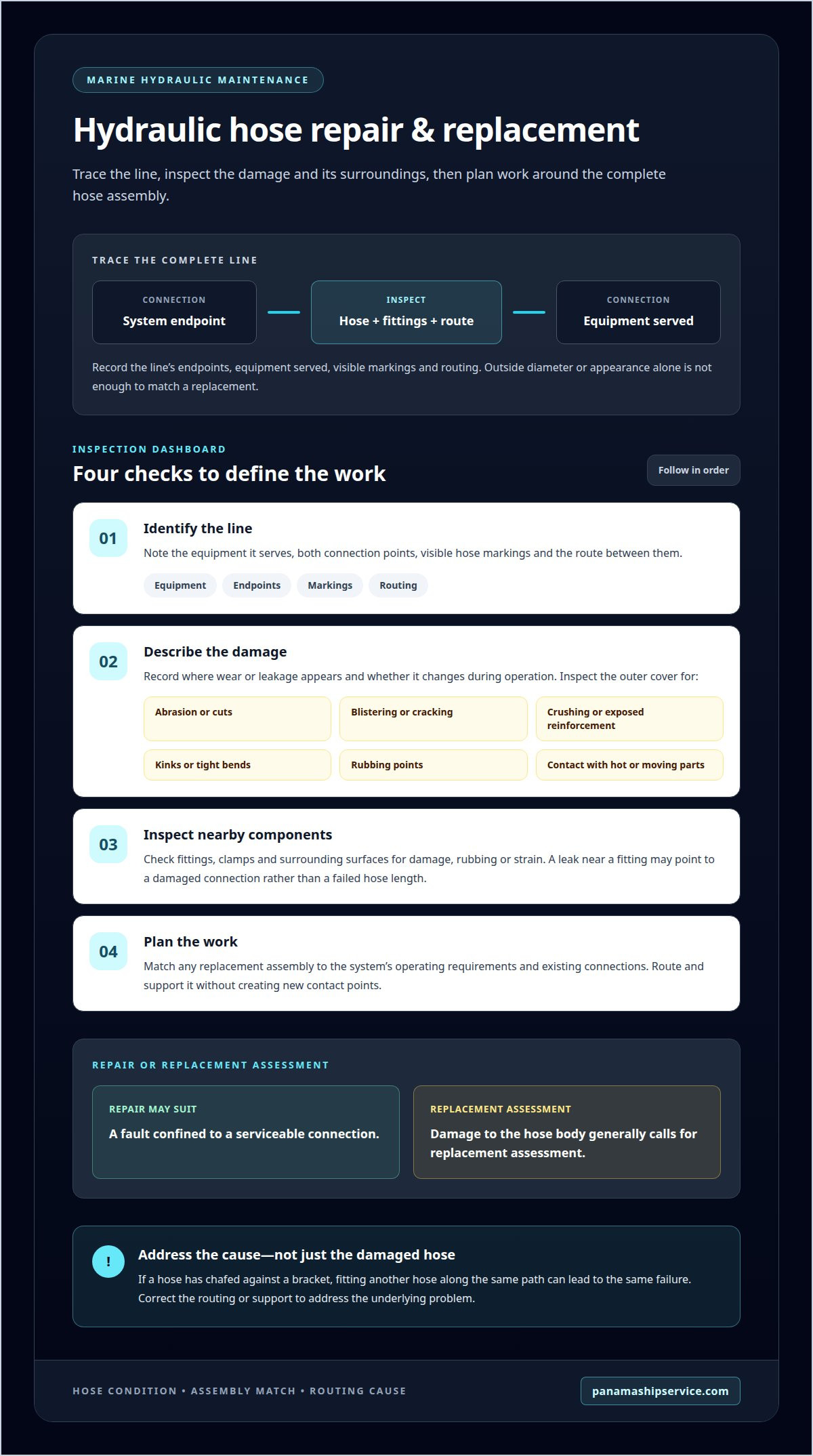
A hose fault can interrupt flow, leak fluid, or restrict movement in connected equipment. Locate the affected line and note which system it serves. Inspect the outer cover for abrasion, cuts, blistering, cracking, crushing, or exposed reinforcement. Check for kinks, tight bends, rubbing points, and contact with hot or moving components. A leak near a fitting may indicate a damaged connection rather than a failed hose length.
Before choosing repair or replacement, trace the hose between its connection points and document its routing. Record visible hose markings, fitting types, and the equipment served. These details help match a replacement to the system’s operating requirements and existing connections. Don’t rely on outside diameter or appearance alone: hoses that look alike may differ in construction or pressure capability. Assess a damaged hose as part of the complete assembly, including its fittings and surrounding supports.
- Identify the line: note its equipment, endpoints, markings, and route.
- Describe the damage: record where leakage or wear appears and whether it changes during operation.
- Inspect nearby components: check clamps, fittings, and surfaces that may have caused rubbing or strain.
- Plan the work: match the replacement assembly to the system and route it without creating new contact points.
Repair may suit a fault confined to a serviceable connection, while damage to the hose body generally calls for replacement assessment. The cause matters: if a hose has chafed against a bracket, installing another along the same path can lead to the same failure. Correcting the routing or support helps address the underlying problem.
For vessel work in Panama, provide the system location, hose markings, fitting details, and photographs when arranging an inspection. Describe whether the fault is an active leak, visible wear, or a suspected restriction. A clear record helps technicians assess the affected assembly and plan the repair scope around equipment access.
Hydraulic pump, motor, and valve repair
Pumps, motors, and valves have different roles in a vessel’s hydraulic circuit. A pump supplies fluid flow, a motor converts hydraulic power into rotation, and valves direct or regulate flow. A winch with inconsistent movement, for example, may involve its motor, pump supply, or control valve. The symptom indicates where to investigate, not necessarily which component to replace.
Begin diagnosis by recording the affected equipment, operating conditions, and changes in performance. Note whether a pump makes unusual noise, a motor turns unevenly, or a valve responds slowly or sticks. Then trace the circuit connections and compare the fault with the equipment’s operating records. Fluid condition, restrictions, leakage, and control signals can all affect component behavior.
- Pump: document loss of flow, inconsistent operation, noise, or leakage around connections.
- Motor: describe changes in rotation, speed, or torque under the same operating task.
- Valve: note delayed response, sticking, or difficulty directing movement through the circuit.
- System: include equipment labels, diagrams, and maintenance history with the fault report.
Repair planning should distinguish a component fault from a wider circuit problem. A valve that fails to direct flow may affect an actuator even when the pump works normally. A motor with weak output may need inspection alongside its supply and connected load. Recording how symptoms relate to equipment operation helps define a focused inspection scope.
For vessel operators in Panama, share the system diagram, component identification, fault description, and operating context when arranging an assessment. These details help connect the reported symptom to the pump, motor, valve, and related circuit. Clear records also support repair planning around machinery access and the vessel’s schedule.
For support with vessel machinery repairs, discuss your repair requirements and provide the affected equipment details.
Panama Ship Service: Mechanical Ship Repairs
Panama Ship Service provides Mechanical Ship Repairs for vessel operators addressing hydraulic equipment faults in Panama. Use this service when a pump, motor, valve, cylinder, or connected system needs mechanical assessment as part of wider vessel repair work. Share the affected equipment, observed symptoms, and relevant system records to help define the repair scope.
Hydraulic problems may coincide with other vessel requirements. Underwater Hull Services, Marine Surveys, and MARPOL Disposal address separate operational needs, helping operators coordinate relevant work during a vessel’s time in Panama. Each service meets a distinct need, so identify the issue requiring attention and provide details to plan around vessel operations.
For hydraulic machinery or related ship repairs, contact Panama Ship Service to discuss your vessel’s requirements.
Plan the next repair step with confidence
For marine hydraulic repair in Panama, a clear handoff helps move from fault identification to repair planning. Prepare a concise description of the affected equipment, the operational issue, and the vessel’s schedule. This gives the repair discussion a practical starting point while keeping wider vessel needs in view.
Panama Ship Service provides Mechanical Ship Repairs for shipboard repair needs, alongside Underwater Hull Services and MARPOL Disposal for other vessel requirements. Keeping related operational needs in view can help you coordinate the work that matters during your vessel’s time in Panama.
Share the details of your repair requirement and the equipment involved. Contact Panama Ship Service to discuss the next step for your vessel. With a focused repair plan, your team can move forward with greater clarity.
Frequently Asked Questions
Marine hydraulic repair services in Panama City, Panama?
Marine hydraulic repair in Panama City should start with identifying the failed circuit and arranging an onboard assessment. Panama Ship Service lists Mechanical Ship Repairs, but hydraulic work isn’t named as a separate service. Send the vessel’s location, equipment type, symptoms, and any photos or model details when requesting assistance. This helps establish whether the job fits the mechanical repair scope and what access may be needed.
Marine hydraulic hose and cylinder repair Panama?
Hose and cylinder repair should be requested as a specific assessment, since Panama Ship Service lists Mechanical Ship Repairs but doesn’t identify hydraulic hoses or cylinders as separate services. Describe whether a hose is leaking, abraded, or damaged, or whether a cylinder is drifting or failing to hold a load. Include equipment details and vessel availability so the scope can be reviewed before work is arranged.
Marine hydraulic pump and motor repair Panama?
Pump and motor problems can be raised as a Mechanical Ship Repairs request, but Panama Ship Service doesn’t list hydraulic pump or motor overhaul as a named service. Report symptoms such as pressure loss, abnormal noise, or overheating, and provide the unit’s make, model, and system details if available. That information helps clarify whether the fault fits the repair scope and what work may be appropriate.