
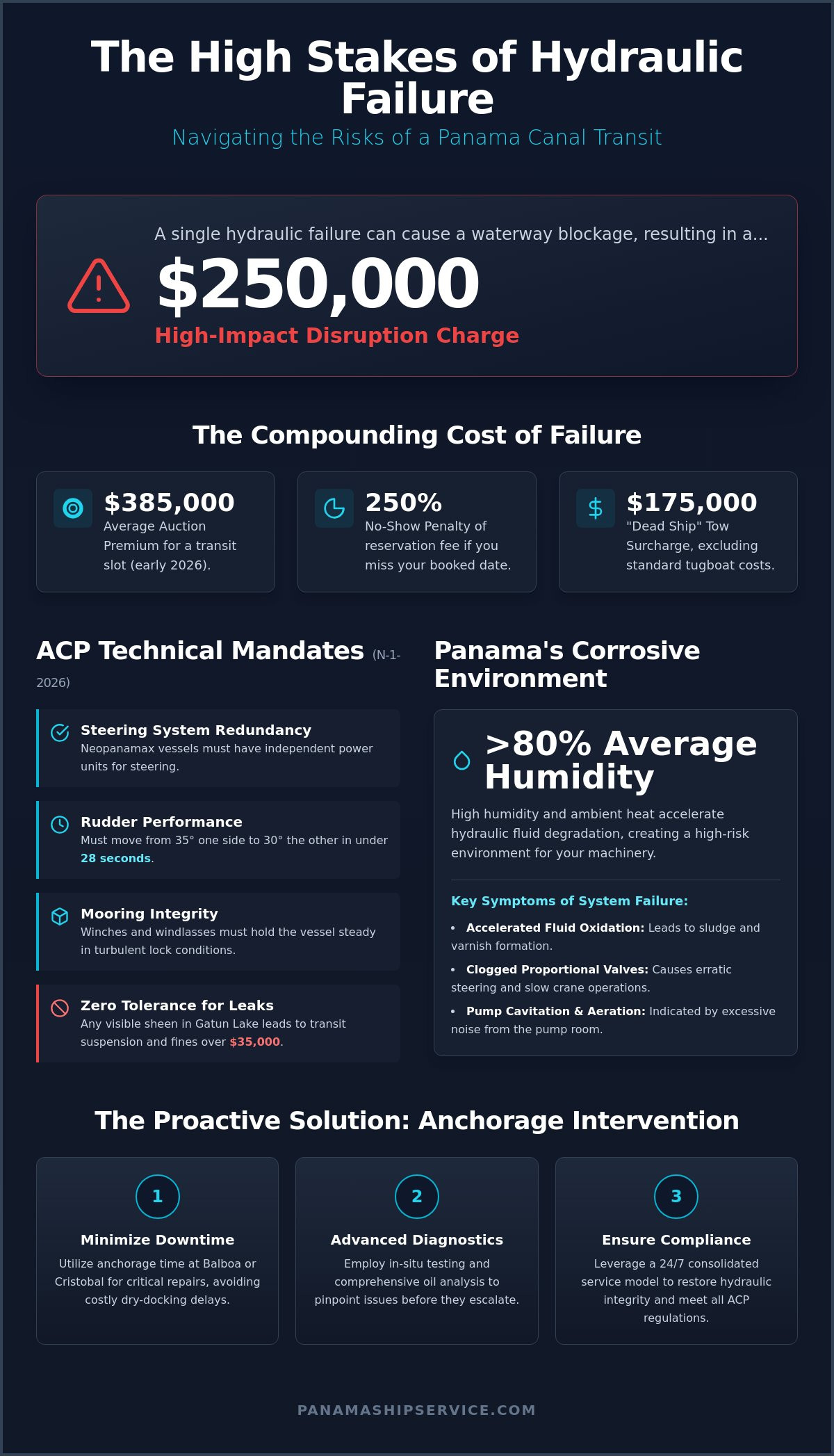
A single hydraulic failure in your steering gear or deck machinery can trigger a $250,000 high-impact disruption charge if it causes a blockage in the waterway. In the high-stakes environment of the Panama Canal, where auction premiums for transit slots reached an average of $385,000 in early 2026, there’s no margin for mechanical error. Securing a reliable marine hydraulic system repair panama service is not just about routine maintenance; it’s a critical step in protecting your vessel from the 250% no-show penalties that apply if you miss your booked date.
We understand that the pressure to maintain ACP compliance while managing operational overhead is a constant challenge for ship owners. You need a partner who can handle complex repairs at the Balboa or Cristobal anchorages to avoid the delays of dry-docking. This article provides a clear roadmap for mastering the logistics of hydraulic interventions in the Canal watershed. You’ll learn how to navigate the technical requirements of Notice to Shipping N-1-2026, ensure your systems meet strict environmental standards to avoid fines, and obtain the expert diagnostic reports required for class approval.
Key Takeaways
- Understand why the Panama Canal Authority enforces strict hydraulic standards and how to avoid the financial penalties of a “Dead Ship” designation.
- Identify how Panama’s high humidity accelerates hydraulic fluid oxidation and learn to recognize early symptoms of system failure before they disrupt operations.
- Navigate the complex logistics of coordinating a marine hydraulic system repair panama at Balboa or Cristobal anchorages to minimize your vessel’s downtime.
- Establish an emergency response protocol and pre-arrival data checklist to ensure technical teams can begin critical repairs immediately upon boarding.
- Leverage a 24/7 consolidated service model to restore hydraulic integrity and ensure compliance with the latest ACP technical regulations for 2026.
The Strategic Importance of Hydraulic Reliability for Panama Canal Transits
The Panama Canal Authority (ACP) maintains zero tolerance for mechanical instability. Every vessel approaching the locks must demonstrate total control over its propulsion and directional systems. If your steering gear or mooring winches fail during the approach, the ACP will likely designate your vessel as a “Dead Ship.” This isn’t just a technical label; it’s a massive financial liability. A dead tow surcharge now carries a $175,000 fee, independent of standard tugboat costs. When you consider the high stakes of Panama Canal transits, the necessity for a specialized marine hydraulic system repair panama service becomes a matter of operational survival. Reliable hydraulics ensure that pilots can navigate the tight tolerances of the locks with absolute confidence in the vessel’s response time.
ACP Requirements and Power Redundancy
ACP regulations, specifically the 2026 updates to Notice to Shipping N-1-2026, mandate strict redundancy for steering systems. Neopanamax vessels must have independent power units capable of moving the rudder from 35 degrees on one side to 30 degrees on the other within 28 seconds. Mooring winches and windlasses are equally critical. They must hold the vessel steady against the turbulent water flow within the locks during the filling and emptying process. Even a minor hydraulic leak is treated as a major environmental threat in Gatun Lake, the primary freshwater source for the region. Any visible sheen can result in immediate transit suspension and fines for failing a pre-transit inspection that can exceed $35,000.
The Cost of Transit Delays
Missing a transit slot is a logistical disaster. If a mechanical failure forces you to reschedule, you face reservation fees that range from $100,000 to $200,000 for last-minute bookings. If you don’t arrive within seven days of your original date, the penalty is 250% of your reservation fee. Proactive marine hydraulic system repair panama at the Cristobal or Balboa anchorages is the only way to avoid these compounding costs. Addressing erratic steering or slow crane response before the ACP inspector boards ensures you maintain your slot and avoid the $250,000 disruption charge applied to vessels that cause a blockage in the waterway. Technical diving teams and mechanical experts at the entrances are your last line of defense against these catastrophic overhead increases.
Strategic hubs like Balboa on the Pacific side and Colon on the Atlantic side serve as essential checkpoints. Vessels often utilize the wait time at anchorage to conduct comprehensive hydraulic inspections. Sourcing parts through the Colon Free Zone allows for rapid component replacement, ensuring that even complex repairs don’t result in a missed window. By delegating these technical complexities to experienced local partners, you safeguard your schedule and your bottom line. Much like how Pahrump Rentals & Hardware serves as a vital resource for industrial equipment and tool rentals for local projects, having a reliable technical partner in Panama is essential for maintaining operational continuity.
Diagnosing Critical Marine Hydraulic Failures in Tropical Environments
Panama’s average humidity often exceeds 80%, creating an environment where hydraulic fluid oxidation accelerates rapidly. High ambient temperatures in the Canal region degrade the chemical stability of the oil, leading to the formation of sludge and varnish. These contaminants clog sensitive proportional valves, resulting in erratic steering responses or slow crane operations. If you notice excessive noise coming from the pump room, it’s often a sign of cavitation or aeration. Aeration is the presence of undissolved air in the hydraulic fluid, which compromises steering precision by making the fluid compressible.
Addressing these issues requires specialized diagnostic expertise. Technical teams utilize flow meters and pressure gauges for in-situ testing at the anchorage to pinpoint pressure drops without a full teardown. While there are discussions about a future ship repair yard in Panama, immediate technical intervention at the Balboa or Cristobal anchorages remains the most efficient way to manage unexpected failures. A comprehensive oil analysis is the first step in any marine hydraulic system repair panama project, as it reveals the precise level of metallic wear and moisture content affecting your machinery.
Fluid Cleanliness and Contamination Control
Modern hydraulic systems rely on ISO 4406 cleanliness standards to function. Even microscopic particles can cause catastrophic failure in high-pressure pumps. During the tropical rain season, water ingress into hydraulic reservoirs is a frequent problem. Water doesn’t just cause rust; it destroys the lubricity of the oil and leads to additive depletion. We implement rigorous system flushing protocols after any component failure to ensure no residual debris remains to damage new parts. If your fluid hasn’t been tested recently, it’s worth scheduling mechanical ship repairs to verify your system’s integrity before your transit window opens.
Component-Specific Troubleshooting
Steering gear rams require meticulous inspection for scoring or alignment issues that indicate seal wear. In the high-temperature maritime zones of the Pacific and Atlantic entrances, seals can become brittle and fail, leading to internal leakage. Deck crane hydraulic motors often suffer from torque loss due to internal bypass. We check for these issues by measuring case drain flow under load. This level of detail ensures that once the technical team leaves the vessel, the machinery is fully restored to ACP-compliant performance levels. Identifying these failures early prevents the transition from a minor repair to a “Dead Ship” emergency. This level of technical precision is also critical in other sectors; for example, Equipcon provides specialized support for high-pressure hydraulic machinery within the construction industry.
Logistics of Hydraulic Repairs: Balboa vs. Cristobal Anchorage
Executing a successful marine hydraulic system repair panama depends heavily on which side of the Isthmus your vessel is currently anchored. Technical teams must mobilize quickly to either the Pacific entrance at Balboa or the Atlantic entrance at Cristobal. While both hubs offer 24/7 access, the logistical approach differs. Transporting heavy hydraulic cylinders to a vessel at anchorage requires specialized launch services and heavy-lift equipment. We coordinate these movements with precision to ensure that technical personnel and components arrive simultaneously, minimizing idle time on deck.
Sourcing specialized spare parts is significantly faster in Panama due to the proximity of the Colon Free Trade Zone. This hub allows us to bypass the delays of international air freight for many common hydraulic components. Rapid delivery of seals, valves, and fittings is essential when you’re racing against a transit clock that penalizes no-shows at 250% of the reservation fee. Our 24/7 repair schedule relies on a seamless chain of launch services that operate regardless of the hour, ensuring that emergency interventions begin the moment a failure is reported.
Anchorage-Side Repair Capabilities
Most hydraulic issues, such as seal replacements or valve overhauls, can be resolved without pier access. Performing these tasks at sea requires a high level of organization and strict adherence to safety permits, especially for “hot work” involving hydraulic lines. We integrate marine surveys in Panama into our workflow to provide the necessary certification for ACP compliance. This ensures that once the repair is complete, the vessel is officially cleared for transit without further delay.
Balboa and Cristobal Workshop Support
There are instances where a component’s damage exceeds the limits of on-board repair. When a hydraulic pump or motor requires precision machining or extensive testing, we move the unit to our land-based workshops in Balboa or Cristobal. These facilities allow for full-load testing and calibration before the component is re-installed. Leveraging local expertise for mechanical ship repairs ensures that even the most complex failures are handled within the strategic geographical hub of the Canal. This approach provides a reliable alternative to the high costs and logistical hurdles of international dry-docking.
Emergency Response: Minimizing Downtime and Avoiding ‘Dead Ship’ Status
When a hydraulic alarm sounds during the approach to the Gatun or Miraflores locks, the priority shifts immediately to containment and communication. A “Dead Ship” status is often avoidable if the technical team can demonstrate a clear repair timeline to the Panama Canal Authority. To facilitate a rapid marine hydraulic system repair panama, Chief Engineers should provide the technical team with the vessel’s hydraulic circuit diagrams and a detailed history of recent pressure fluctuations before the launch arrives. This pre-arrival data ensures that the mobilization includes the correct specialized tools and seal kits, preventing wasted trips back to the land-based workshop.
Transitioning from an emergency temporary fix to a long-term, class-approved repair is a delicate process. While the immediate goal is to restore enough integrity for the transit, the final repair must meet the rigorous standards of your classification society. We manage this transition by documenting every step of the repair process, providing the expert diagnostic reports required for official approval. This documentation is essential for maintaining the vessel’s long-term compliance and insurance eligibility.
The Emergency Repair Protocol
Our rapid-response workflow follows a structured three-step process to resolve critical failures under pressure. First, the technical team focuses on immediate system stabilization. This includes containing any active leaks to prevent environmental contamination and isolating the failed component to protect the rest of the hydraulic circuit. Second, we conduct an accelerated diagnostic to identify the exact parts required. By leveraging our strategic access to the Colon Free Zone, we can often source critical valves or pumps within hours. Third, we mobilize 24/7 technical shifts to work through the night. This ensures the machinery is back online before the next scheduled pilot boarding time.
Safeguarding the Transit Slot
Constant coordination with ship agents is vital to keep the ACP informed of the repair progress. If the technical team can prove that the vessel will be operational within a specific window, the Authority may allow you to maintain your original slot. In some cases, external issues like fouled bow thruster grates or leaking external seals require underwater hull services to complete a full inspection. Once repairs are finished, we conduct functional load tests under the supervision of the engineering staff. These tests simulate the high-stress conditions of lockage, providing the pilot with the assurance needed to proceed.
If your vessel is experiencing erratic steering or deck machinery failure, contact us immediately for mechanical ship repairs at the Panama Canal anchorages to protect your transit schedule.
Panama Ship Service: Your Technical Partner for Marine Hydraulics
Panama Ship Service operates a specialized hydraulic and mechanical division designed specifically for the high-stakes environment of the Panama Canal. We recognize that technical failures don’t follow a schedule. That’s why our teams maintain 24/7 availability for emergency interventions at both the Balboa and Cristobal anchorages. Our technicians possess deep experience with leading steering gear brands, including Rolls-Royce, Hatlapa, and Porsgrunn. By choosing a partner with this level of technical proficiency, you ensure that your marine hydraulic system repair panama is handled by experts who understand the nuances of specific machinery and ACP compliance.
Our consolidated service model distinguishes us from fragmented providers. We combine technical hydraulic repairs with marine surveys and ship supplies to create a one-stop-shop experience. This approach eliminates the need to coordinate multiple vendors, which is essential when every hour at anchorage increases your operational burn rate. Whether you need a simple seal replacement or a complex pump overhaul, we provide a unified solution that addresses the mechanical, regulatory, and logistical requirements of your vessel. Integrating these services under one technical partner simplifies your operations and ensures accountability throughout the repair process.
Why Choose Our Specialized Teams?
Our teams possess a deep understanding of the unique operational pressures associated with Canal transits. We don’t just fix machinery; we manage the entire technical process to prevent the “Dead Ship” designations discussed earlier. We have a proven track record of minimizing downtime for global shipping lines by delivering rapid, class-approved resolutions. Our marine hydraulic system repair panama services are backed by a commitment to fiscal responsibility and schedule optimization. For a broader look at our capabilities, you can explore our comprehensive support for mechanical ship repairs in Panama.
Requesting a Technical Inspection
To provide an accurate and fast repair quote, our technical team requires specific data points. Please include hydraulic circuit diagrams, a description of the failure symptoms, and the vessel’s current position at the Balboa or Cristobal anchorage. This information allows us to mobilize the correct specialized tools and parts on the first launch, ensuring we hit the deck running. We prioritize clear communication and quick turnaround times to keep your vessel moving.
Contact our 24/7 emergency response team today to schedule an immediate inspection. Securing your transit schedule requires proactive technical management and a partner who understands the urgency of the waterway. Don’t let a hydraulic failure compromise your slot or lead to costly ACP penalties. We are ready to restore your vessel’s integrity and ensure a seamless transit through the Panama Canal.
Safeguarding Your Vessel Against Canal Transit Disruptions
Navigating the Panama Canal requires more than just careful piloting; it demands mechanical perfection in your steering and deck machinery. We have detailed how tropical humidity accelerates hydraulic degradation and why the ACP maintains such rigorous standards for Neopanamax vessels. By addressing erratic system behavior at the Balboa or Cristobal anchorages, you avoid the $175,000 dead tow surcharge and protect your transit slot from 250% no-show penalties.
Successful marine hydraulic system repair panama projects rely on a combination of technical precision and local logistical expertise. Our consolidated service model provides 24/7 emergency technical support and ensures all work meets ACP-compliant repair standards. With strategic locations at both Canal entrances, we are positioned to mobilize as soon as your vessel arrives at anchorage. This proactive approach minimizes downtime and keeps your operational overhead under control.
Request an Emergency Marine Hydraulic Repair Quote in Panama to ensure your systems are ready for the locks. We are committed to keeping your fleet moving efficiently through this critical waterway.
Frequently Asked Questions
What are the most common hydraulic failures for ships transiting the Panama Canal?
Common hydraulic failures include steering gear pump cavitation and degraded seals in deck machinery. These issues often arise from high-pressure demands during lockage and the impact of tropical humidity on older systems. Promptly identifying erratic rudder response or slow winch operation is essential to avoid “Dead Ship” status during the approach to the locks.
Can major hydraulic repairs be performed while the vessel is at the Balboa anchorage?
Major hydraulic repairs are frequently performed at the Balboa anchorage to minimize vessel downtime. Technical teams utilize specialized launches to transport heavy components like cylinders and pumps directly to the vessel. This afloat repair strategy allows for a marine hydraulic system repair panama without the high costs and logistical delays associated with a scheduled dry-docking.
What are the ACP requirements for steering gear redundancy during transit?
The Panama Canal Authority requires Neopanamax vessels to maintain independent steering gear power units. These systems must be capable of moving the rudder from 35 degrees on one side to 30 degrees on the other within 28 seconds. Failure to meet these redundancy standards during pre-transit inspections will result in the vessel being denied entry until the system is certified as operational.
How does high humidity in Panama affect hydraulic fluid quality?
High humidity in Panama leads to accelerated oil oxidation and moisture ingress in hydraulic reservoirs. When water mixes with hydraulic fluid, it destroys lubricity and causes additive depletion. This chemical breakdown creates sludge that clogs sensitive proportional valves, eventually leading to system sluggishness or total mechanical failure if the fluid isn’t professionally managed.
How quickly can a technical team be mobilized for an emergency hydraulic repair?
Technical teams are available for mobilization 24/7 to handle emergency hydraulic interventions. In most cases, a repair crew can be dispatched to the Balboa or Cristobal anchorages within hours of a service request. Rapid mobilization is critical for vessels facing tight transit windows and the threat of high-impact disruption charges from the Canal Authority.
What documentation is required by the ACP after a significant hydraulic repair?
The ACP requires a comprehensive diagnostic report and a certificate of functional readiness after any significant repair. This documentation must prove that the system meets the technical standards outlined in Notice to Shipping N-1-2026. Expert marine hydraulic system repair panama services include providing these detailed reports to ensure your vessel receives immediate clearance for transit.
Is it possible to source specialized hydraulic seals in Panama on short notice?
Specialized hydraulic seals and components are readily available through the strategic hub of the Colon Free Zone. This tax-free area allows for the rapid sourcing of parts that would otherwise require international air freight. Local access to these inventories ensures that technical teams can complete seal replacements and valve overhauls without causing significant delays to the vessel’s schedule.
What is the impact of a hydraulic leak in Gatun Lake on vessel liability?
A hydraulic leak in Gatun Lake results in immediate transit suspension and significant environmental fines. Because Gatun Lake is a vital freshwater source, the ACP enforces a zero-tolerance policy for oil sheens. Vessel owners face liability for both cleanup costs and the potential $250,000 disruption charge if the leak causes a blockage in the waterway.