
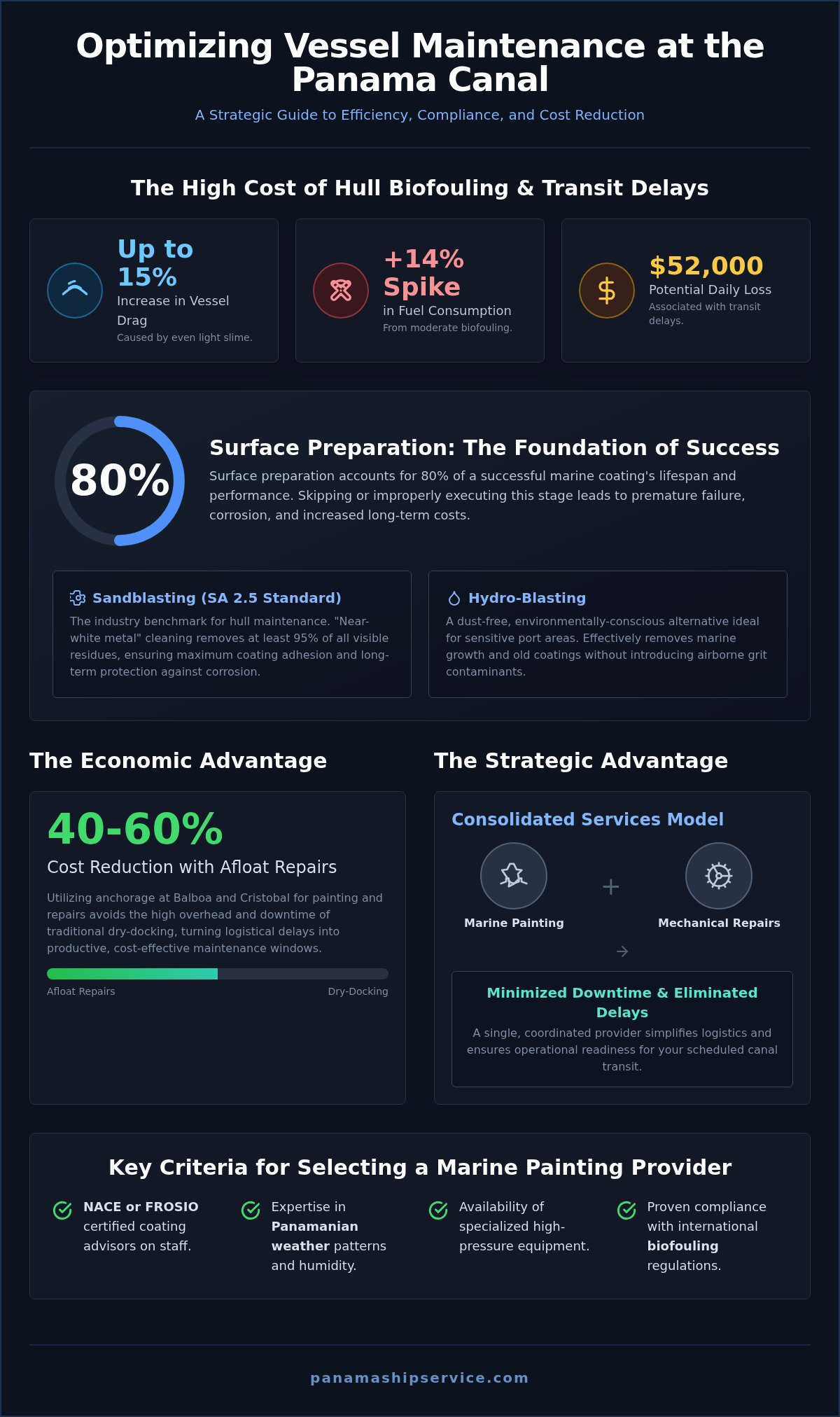
Did you know that even light slime on a hull can increase vessel drag by up to 15%, while moderate biofouling often triggers a 14% spike in fuel consumption? For ship operators navigating the Panama Canal, these inefficiencies aren’t just technical issues; they’re direct hits to the bottom line during a period of reduced daily transits and strict draft restrictions. Securing reliable marine painting services panama is no longer just about aesthetics. It’s a critical operational decision to prevent corrosion in harsh tropical maritime environments and avoid the $52,000 daily loss associated with transit delays.
You likely recognize that vague quotes and the threat of unexpected downtime make maintenance planning a major logistical headache. This article promises to show you how to optimize vessel maintenance and maximize fuel efficiency through professional marine painting and coating services at the Panama Canal. We’ll explore high-performance coatings that extend dry-dock intervals, strategies to minimize transit delays, and how to maintain strict compliance with international biofouling regulations.
Key Takeaways
- Learn how to synchronize maintenance with your Canal transit schedule to eliminate operational downtime and maximize vessel readiness.
- Understand why surface preparation constitutes 80% of coating success and how to choose between sandblasting and hydro-blasting for your hull.
- Discover the financial benefits of professional marine painting services panama in reducing hull roughness and ensuring compliance with international biofouling regulations.
- Identify critical selection criteria for contractors, including NACE or FROSIO certifications and the availability of specialized high-pressure equipment.
- Optimize your budget by consolidating technical coatings, sandblasting, and mechanical repairs with a single provider at the Panama Canal hub.
The Strategic Role of Marine Painting at the Panama Canal
The Panama Canal represents the most critical maintenance window in global shipping. With daily transits reduced to 32 as of September 2026, vessel operators face longer wait times at anchorages. Smart operators use this forced downtime to address hull integrity. Professional marine painting services panama allow you to transform a logistical delay into a productive maintenance interval. This proactive approach is essential because Panama’s tropical environment is unforgiving. High humidity and volatile weather patterns require strict adherence to technical data sheets. Expert contractors must monitor dew points and surface temperatures to avoid coating failure. Local knowledge of Panamanian weather windows is a non-negotiable asset for any technical superintendent.
Balboa and Cristobal: Key Hubs for Vessel Maintenance
Balboa and Cristobal serve as the primary hubs for these operations. Balboa, located on the Pacific side, offers extensive anchorage areas suitable for afloat painting and hull cleaning. For vessels entering from the Atlantic, Cristobal provides similar capabilities. Choosing between anchorage and berth-side painting depends on your vessel’s draft and the specific scope of work. Afloat repairs at these hubs can reduce maintenance bills by 40% to 60% compared to traditional dry-docking. This makes it a fiscally responsible alternative for implementing Advanced Surface Preparation and Coating Technologies without the overhead of a shipyard stay.
Minimizing Transit Delays Through Consolidated Services
Efficiency is the priority when transit slots are at stake. A single day of delay for a Neopanamax vessel can cost over $52,000 in lost charter hire and rescheduling fees. You can mitigate these risks by consolidating your technical needs. Scheduling hull coating alongside mechanical ship repairs ensures that your vessel remains operationally ready without multiple mobilization charges. This consolidated model simplifies logistics. Instead of managing several vendors, you rely on a single partner to handle the complexities of marine painting services panama while your mechanical systems are serviced. This streamlined approach minimizes the risk of missing a transit window due to contractor delays.
Advanced Surface Preparation and Coating Technologies
Surface preparation accounts for approximately 80% of a successful marine paint job. If the substrate isn’t properly cleaned and profiled, the coating will fail prematurely, leading to increased maintenance costs and potential hull corrosion. High-quality marine painting services panama prioritize technical precision during the initial cleaning phase to ensure maximum adhesion. This stage is where technical standards like SA 2.0 and SA 2.5 become critical benchmarks for vessel integrity. Skipping these steps often leads to delamination, which can spike fuel costs and compromise the steel structure over time.
Marine Sandblasting and Hydro-Blasting Standards
Standard SA 2.0, or thorough blast-cleaning, is suitable for less critical areas, but most commercial ship operators require SA 2.5 for hull maintenance. SA 2.5 near-white metal cleaning ensures that at least 95% of each square inch of the surface is free of all visible residues. Environmental regulations at the Panama Canal often dictate the choice of equipment to prevent local contamination. Hydro-blasting serves as a dust-free alternative for sensitive port areas where grit contamination must be avoided. To ensure these standards are met, verify that your service provider employs NACE or FROSIO certified coating advisors available for the 2026 season. These experts oversee the application process to prevent issues like osmosis or premature coating degradation.
Specialized Tank Cleaning and Internal Coatings
Internal structures like ballast and fuel tanks present unique challenges due to restricted access and constant exposure to corrosive elements. Ballast tanks are particularly susceptible to oxidation, requiring high-solids epoxy systems that provide long-term barrier protection. These systems reduce the frequency of dry-docking by extending the service life of internal steel. Maintaining these coatings is also a key component of Biofouling Compliance, as smooth internal surfaces prevent the accumulation of invasive species.
Corrosion prevention for internal steel structures requires meticulous salt removal and dehumidification before paint application. Using specialized equipment like high-pressure pumps and industrial dehumidifiers ensures the environment remains within technical specifications. If you are planning an upcoming transit, consulting with an experienced partner for technical ship management solutions can help you select the most durable coating systems for your specific vessel type. This proactive approach ensures your tanks and topsides remain protected against the aggressive Panamanian maritime climate.
Economic Impact: Anti-Fouling and Biofouling Compliance
A smooth hull isn’t just a matter of maintenance; it’s a financial necessity. Hull roughness, even at a microscopic level, significantly increases hydrodynamic drag. This friction forces engines to work harder, leading to the Economic Impact of higher fuel expenditures and increased carbon emissions. Investing in premium marine painting services panama provides a measurable return on investment by restoring the hull to its original design efficiency. When you consider that fuel accounts for a major portion of voyage costs, a high-quality coating job often pays for itself within the first few months of operation. Beyond fuel, a fouled hull increases the risk of mechanical failure. An engine failure during a Canal transit can trigger an immediate $250,000 ACP disruption charge, making proactive hull maintenance a critical insurance policy against operational disasters.
Anti-Fouling Solutions for Global Transits
Selecting the right anti-fouling system depends on your vessel’s operating profile. Biocidal coatings use controlled release of active ingredients to prevent growth, making them effective for vessels with varying speeds or those prone to longer idle periods. In contrast, foul-release coatings use silicone-based technology to create a non-stick surface, which is ideal for high-speed, high-activity vessels. Maintaining these coatings requires regular underwater hull services to remove light slime before it hardens into calcareous growth. In Panama’s warm tropical waters, barnacles and tube worms colonize unprotected steel rapidly, making the choice of coating a critical defense against invasive species.
Regulatory Compliance and Environmental Responsibility
Environmental stewardship at the Panama Canal is strictly enforced. The International Convention on the Control of Harmful Anti-fouling Systems on Ships (AFS Convention) prohibits the use of harmful organotin compounds. Compliance isn’t just about what’s on the hull, but how it’s handled during maintenance. Proper MARPOL compliance during the disposal of old paint chips and blasting grit is mandatory to prevent heavy metals from entering the marine ecosystem. Port State Control (PSC) inspectors frequently verify coating documentation and application records. Failing to provide accurate logs can lead to detention or significant fines. By partnering with a local expert for marine painting services panama, you ensure that every stage of the process meets both IMO standards and local Panamanian environmental mandates.
Selecting a Marine Painting Provider in Panama: Key Criteria
Selecting a partner for hull maintenance at the Panama Canal requires a rigorous vetting process. Unlike recreational boatyards, commercial marine painting services panama must possess the heavy-duty infrastructure and port authority clearances necessary to service large-scale tonnage. You need a provider that understands the difference between a cosmetic touch-up and a high-performance industrial coating application. Technical expertise is the primary differentiator. Verify that your chosen contractor employs coating advisors with NACE or FROSIO certifications for the 2026 season. These professionals ensure that every layer of paint is applied under the correct environmental conditions, which is vital in Panama’s volatile tropical climate.
Evaluating Technical Proficiency and Safety
Safety and liability are paramount when your vessel is at anchorage or berth. A reputable provider must maintain comprehensive insurance and liability coverage that specifically includes port operations and third-party risks. Their teams should be trained in strict safety protocols for working at significant heights and within the confined spaces of ballast or fuel tanks. Engaging a certified coating inspector is mandatory to ensure Class approval and verify that the application meets the manufacturer’s technical specifications. This oversight prevents future disputes with paint suppliers and ensures your warranty remains valid. Without these certifications, you risk premature coating failure and the high cost of re-application during your next dry-docking.
Turnaround Time and Operational Flexibility
The Panama Canal operates on a 24/7 schedule, and your maintenance partner must do the same. Resource mobilization speed is a critical factor, especially if you need emergency repairs or have a tight transit window. Look for a partner that provides real-time progress updates and detailed reporting. This transparency allows technical superintendents to manage schedules effectively and avoid costly delays. Following the coating application, professional marine surveys are essential to document the Dry Film Thickness (DFT) and surface profile. These reports serve as a permanent record of the vessel’s condition and are often required for Port State Control inspections or insurance renewals.
To secure your transit schedule and ensure your hull remains protected, it’s essential to work with a provider that consolidates logistics and technical execution. You can streamline your next maintenance window by booking a technical consultation for marine painting and mechanical repairs with an experienced local partner.
Panama Ship Service: Your Partner for Vessel Integrity
Panama Ship Service operates at the intersection of technical proficiency and logistical necessity. By offering marine painting services panama at both Balboa and Cristobal, we eliminate the need for ship operators to manage multiple service providers. Our team handles the complexity of ACP regulations and Canal transit schedules so you don’t have to. We understand that with daily transits reduced to 32 as of September 2026, every hour at anchorage must count toward your vessel’s operational readiness. Our strategic presence at both ends of the Canal ensures we can respond to your needs regardless of your transit direction or arrival window.
Our consolidated service model addresses a significant gap in the local market. Instead of coordinating separate contractors for hull maintenance and engine work, you can delegate the entire technical scope to a single, reliable partner. This integration reduces mobilization costs and prevents the scheduling conflicts that often lead to missed transit windows. Given that a single day of delay can cost over $52,000 in lost charter hire, our ability to synchronize specialized coatings with mechanical repairs is a critical financial safeguard for your fleet. We ensure your vessel leaves Panamanian waters in peak condition, both internally and externally, without the administrative burden of vendor fragmentation.
Why Panama Ship Service is the Preferred Local Choice
We combine localized knowledge with global shipping standards to protect your vessel’s integrity. Our proactive approach focuses on reducing your operational overhead by identifying maintenance overlaps that others might miss. For example, while our painting teams are active on the topsides, our mechanical technicians can perform essential engine room overhauls or underwater hull services. This synchronized workflow is designed to get your vessel through the Canal and back to sea without unnecessary complications or the risk of an engine failure that could trigger a $250,000 ACP disruption charge.
Getting Started: Requesting a Technical Quote
To provide an accurate estimate for marine painting services panama, our technical team requires specific data points to evaluate the scope of work. Please provide your vessel’s current coating history, the required surface preparation grade, and the Technical Data Sheets (TDS) for your preferred paint system. Clear technical specifications are the foundation of a successful project and help us ensure that the final Dry Film Thickness meets your Class requirements. Contact our technical team today to discuss your upcoming transit and schedule your maintenance window. We’re ready to provide the professional oversight and technical excellence your vessel requires.
Optimizing Hull Performance for the Future of Canal Transit
Operating in the Panama Canal requires a strategic approach to technical maintenance. High-quality hull coatings are essential for reducing fuel consumption and ensuring compliance with evolving biofouling regulations. By prioritizing advanced surface preparation and certified application, ship operators can extend dry-dock intervals and protect their vessels from the aggressive tropical environment. It’s a proactive investment that prevents costly disruptions and preserves long-term asset value.
Selecting a partner that provides marine painting services panama with NACE and FROSIO standard technical advisors ensures your vessel meets strict Class requirements. This technical oversight, combined with 24/7 emergency repair availability and comprehensive MARPOL and ACP compliance, allows you to navigate Canal logistics with confidence. Consolidating your technical needs under one reliable provider remains the most effective way to minimize overhead and avoid the high costs of transit delays at Balboa or Cristobal.
Ready to enhance your vessel’s operational readiness? Request a Technical Quote for Marine Painting in Panama today. We look forward to supporting your fleet’s success at this global maritime hub.
Frequently Asked Questions
How long does a full hull painting take at the Panama Canal?
A full hull painting operation typically requires three to five days depending on the vessel’s size and the required surface preparation grade. We prioritize rapid mobilization to minimize downtime because a single day of transit delay for a Neopanamax vessel can cost over $52,000 in lost charter hire. Our teams work 24/7 to ensure the application meets technical specifications while staying within your scheduled anchorage window at the Canal.
Can marine painting be performed while the vessel is at anchorage?
Yes, marine painting and surface preparation can be performed afloat at major anchorages like Balboa and Cristobal. This approach allows ship operators to avoid the high overhead of a dry-dock facility. Afloat repairs can reduce maintenance bills by 40% to 60%. It’s an efficient way to address hull integrity while waiting for a transit slot, provided the weather conditions and humidity levels are within the coating manufacturer’s limits.
What is the difference between sandblasting and hydro-blasting for ship hulls?
Sandblasting uses abrasive grit to achieve a specific surface profile like SA 2.5, which is essential for the adhesion of heavy-duty industrial coatings. Hydro-blasting uses high-pressure water and serves as a dust-free alternative that is often required in sensitive port environments. While sandblasting provides a better mechanical bond for new systems, hydro-blasting is highly effective for removing marine growth and loose paint without creating airborne grit contamination.
Does Panama Ship Service provide NACE-certified coating inspectors?
Panama Ship Service employs technical advisors who maintain NACE and FROSIO certifications for the 2026 season. These experts oversee the entire application process to ensure the surface profile, environmental conditions, and dry film thickness meet Class approval standards. Having a certified inspector on-site prevents premature coating failure and ensures that your vessel’s warranty with the paint manufacturer remains valid throughout the service life of the coating system.
Are the paints used compliant with Panama Canal Authority (ACP) environmental rules?
All coatings applied by our teams comply with the International Convention on the Control of Harmful Anti-fouling Systems (AFS Convention) and the latest ACP Notice to Shipping N-1-2026. We ensure that the paints used are free of organotin compounds and other prohibited substances. This compliance is critical for passing Port State Control inspections and avoiding the substantial fines associated with non-compliant anti-fouling systems in Panamanian waters.
Can I combine painting with underwater hull cleaning and propeller polishing?
Consolidating marine painting services panama with underwater hull cleaning and propeller polishing is a core part of our one-stop-shop model. This strategy maximizes fuel efficiency by addressing both above-water corrosion and underwater biofouling simultaneously. Since light slime can increase vessel drag by 10% to 15%, performing these tasks together ensures your vessel operates at peak hydrodynamic efficiency. It also reduces mobilization costs by using a single local partner.
What information do I need to provide for a marine painting quote?
To provide an accurate estimate, you should submit the vessel’s general arrangement plan, current coating history, and the Technical Data Sheets (TDS) for the products to be applied. We also need the specific surface preparation requirements, such as SA 2.0 or SA 2.5. Providing clear technical specifications allows our team to calculate the necessary quantities of paint and grit, ensuring a transparent quote that reflects the true scope of work.
How often should a commercial vessel’s anti-fouling be renewed in tropical waters?
Commercial vessels operating in tropical waters should generally renew their anti-fouling every 36 to 60 months, though local conditions often dictate a more frequent schedule. Panama’s warm waters accelerate biofouling, where moderate growth can cause a 14% spike in fuel consumption. Regular inspections and maintenance are necessary to prevent barnacles and tube worms from compromising the hull’s smoothness. High-performance foul-release coatings can help extend these intervals by providing a non-stick surface.