
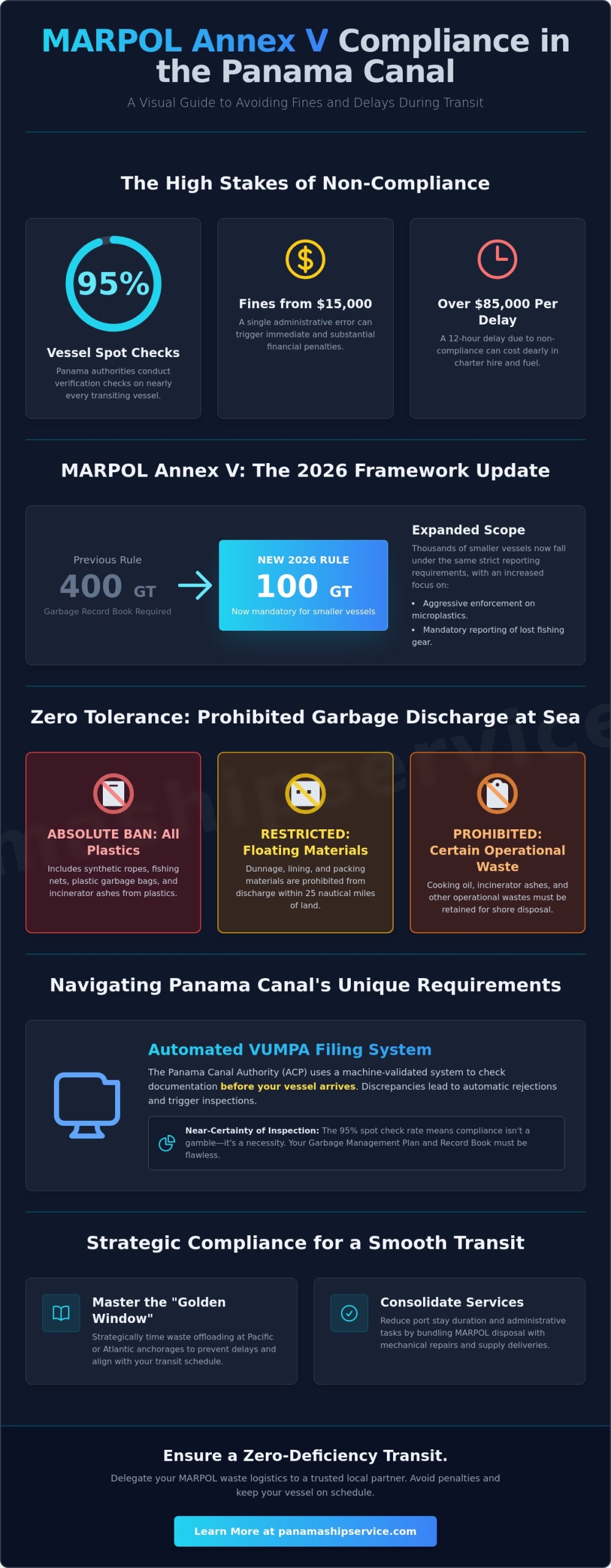
Panama maritime authorities now conduct spot checks on 95% of transiting vessels to verify Garbage Management Plans and Record Books. For a master or fleet manager, this high level of scrutiny means that a single administrative error in your documentation can trigger fines starting at $15,000. We understand that managing shipboard waste while maintaining a strict transit schedule is an exhausting, high-pressure balancing act. You don’t want to risk a 12-hour delay that could cost your operation over $85,000 in lost charter hire and fuel consumption. It’s a logistical challenge where the stakes for non-compliance have never been higher.
This MARPOL Annex V compliance guide provides the technical roadmap you need to master the latest requirements and ensure seamless, penalty-free garbage disposal during your Panama Canal transit. By following these updated protocols, you’ll secure zero-deficiency inspections and optimize your waste logistics before reaching the locks. We will examine the 2026 IMO amendments, explain the Panama Canal Authority’s machine-validated VUMPA filing system, and identify the specific “Golden Window” for offloading waste at the Pacific or Atlantic anchorages. Our guide ensures you have the clarity required to handle complex MARPOL disposal requirements without unnecessary operational friction.
Key Takeaways
- Understand the updated requirement for all vessels of 100 gross tonnage and above to maintain a mandatory Garbage Record Book.
- Review the MARPOL Annex V compliance guide for strict protocols regarding the total prohibition of plastic discharge and floating dunnage.
- Identify the specific documentation required by the Panama Canal Authority to prevent automatic VUMPA filing rejections and administrative fines.
- Master the logistics of the “Golden Window” for waste offloading at Pacific or Atlantic anchorages to maintain your transit schedule.
- Learn how consolidating MARPOL disposal with mechanical repairs and ship supplies reduces port stay duration and administrative complexity.
Understanding MARPOL Annex V: The 2026 Regulatory Framework
MARPOL Annex V serves as the International Maritime Organization’s (IMO) primary mechanism for eliminating ship-generated garbage pollution. For vessel operators, this MARPOL Annex V compliance guide clarifies that the regulation applies to all ships, including commercial vessels, fixed platforms, and yachts. As of 2026, the regulatory landscape has tightened significantly. Specifically, ships of 100 gross tonnage (GT) and above are now required to maintain a Garbage Record Book, a threshold lowered from the previous 400 GT limit. This change brings thousands of smaller vessels under the same strict reporting requirements as large tankers and bulkers.
Understanding what constitutes garbage is critical for avoiding accidental discharge. The IMO defines it as all kinds of food, domestic, and operational waste, including cargo residues and animal carcasses. It specifically excludes fresh fish and parts thereof. In 2026, the focus has shifted toward aggressive enforcement regarding microplastics and the mandatory reporting of lost fishing gear. You must classify and record every kilogram of waste generated during your voyage to remain compliant. There’s no room for interpretation during a port inspection.
The Core Objective: Protecting the Marine Environment
The Marine Environment Protection Committee (MEPC) has accelerated updates to address the long-term impact of non-biodegradable plastics on marine ecosystems. Because these materials persist for centuries, zero-discharge policies have become the standard within designated Special Areas. For example, the Red Sea Special Area restrictions that took effect in early 2025 now impose total bans on most garbage discharges. These regions require total containment of waste until a vessel reaches a port with adequate reception facilities. Failing to manage these materials correctly doesn’t just harm the environment; it creates significant legal liability for the shipowner.
Vessel Applicability and Enforcement Agencies
Compliance is verified through rigorous Port State Control (PSC) boardings. Inspectors scrutinize every entry in your records to ensure they align with the physical waste on board. In Panama, the Panama Canal Authority (ACP) takes enforcement a step further. Under the current 2026 regulatory climate, the ACP utilizes machine-validated VUMPA filings to catch discrepancies before a vessel even arrives. Since the ACP conducts spot checks on 95% of transiting vessels, the probability of an inspection is nearly certain.
The financial consequences of non-compliance are severe. Documentation violations in the Panama Canal start at $15,000, while administrative errors in the Garbage Record Book can exceed $10,000. Beyond these immediate fines, a vessel risks detention and long-term reputational damage. Efficient waste management is no longer an afterthought; it’s a core component of your operational strategy. This MARPOL Annex V compliance guide serves as your baseline, but real-world success depends on local expertise. If you’re transiting the Canal, delegating your waste logistics to a partner specializing in MARPOL disposal and marine surveys ensures you avoid these costly pitfalls.
Key Requirements for Garbage Management and Prohibited Materials
The total prohibition of plastic discharge remains the most critical pillar of the IMO MARPOL Annex V Regulations. This ban is absolute. It covers everything from synthetic ropes and fishing nets to plastic garbage bags and foam insulation. If a waste item contains any plastic component, it must stay on board for shore-side disposal. This MARPOL Annex V compliance guide also highlights that floating materials, such as dunnage, lining, and packing materials, are prohibited from discharge within 25 nautical miles of the nearest land. Even beyond that distance, modern environmental standards encourage total retention to prevent marine debris accumulation.
Operational wastes like cooking oil and incinerator ashes require specialized handling. You cannot discharge these into the sea under any circumstances. Cooking oil must be collected in leak-proof containers, while incinerator ashes, which may contain heavy metal residues or toxic compounds, must be treated as hazardous waste and offloaded at authorized port facilities. Managing these materials requires a systematic approach to storage and documentation to pass Port State Control inspections.
Managing Food Waste and Cargo Residues
Food waste discharge is strictly regulated based on the vessel’s distance from land. You can only discharge ground or comminuted food waste, capable of passing through a screen with openings no greater than 25mm, when the ship is at least 3 nautical miles from the nearest land. For non-comminuted food waste, the minimum distance increases to 12 nautical miles. Cargo residues present a different challenge. You must classify residues as Harmful to the Marine Environment (HME) or non-HME. If the cargo or the cleaning agents used in hold washing are classified as HME, you cannot discharge the wash water into the sea. By early 2026, many operators have shifted to certified non-HME products to simplify their discharge logistics.
Special Areas and Their Stricter Limitations
Designated Special Areas, including the Mediterranean, Baltic, and the Red Sea (where new restrictions took effect on January 1, 2025), enforce zero-discharge mandates for almost all garbage categories. In these ecologically sensitive zones, even comminuted food waste discharge is restricted. While the Panama Canal is not a Special Area, it is a high-scrutiny zone where local authorities expect rigorous adherence to these international standards. If your route crosses into the Wider Caribbean Region, you must adjust your disposal plan immediately. Coordinating with a partner for professional MARPOL disposal during your transit stay ensures you don’t carry prohibited waste into these restricted waters.
Discharge is only permitted in rare, emergency scenarios. These exceptions include situations where discharge is necessary to secure the safety of the ship and those on board or to save life at sea. Accidental loss resulting from damage to the ship or its equipment is also exempt, provided you took all reasonable precautions before and after the damage occurred to minimize the impact. Every instance of emergency discharge must be recorded with precise coordinates and a detailed justification in the Garbage Record Book.
Operational Compliance: Management Plans and Record Books
Ships of 100 gross tonnage (GT) and above must now maintain a Garbage Record Book (GRB), a significant shift from the previous 400 GT threshold that took effect in 2024. This MARPOL Annex V compliance guide emphasizes that documentation isn’t just a clerical task; it’s your primary defense against Port State Control (PSC) detentions. A single administrative error can trigger fines starting at $15,000 in high-scrutiny zones like the Panama Canal. You must also carry a written Garbage Management Plan (GMP) that provides clear, localized instructions for the crew. These documents must be kept on board for at least two years after the last entry and remain available for inspection at all times.
Education on deck is equally critical. Vessels of 12 meters or more in length are required to display standardized placards. These must be posted in prominent locations, such as the galley, mess rooms, and bridge, to remind the crew of the specific discharge requirements. By 2026, the transition to Electronic Record Books (ERB) has become the industry standard. These digital systems reduce the risk of manual entry errors and ensure your data aligns with the Panama Canal Authority’s machine-validated VUMPA filings. Digital records allow for faster verification, which is essential for maintaining your transit schedule.
Developing an Effective Garbage Management Plan
An effective GMP designates a specific officer, usually the Chief Officer, to oversee the entire waste stream. It’s not enough to have a generic document in a binder. Your plan must detail step-by-step procedures for minimizing, collecting, and storing every category of waste. It should include specific instructions on the use of equipment like compactors or incinerators. Regular crew training sessions are mandatory to ensure that every member understands the difference between non-HME cargo residues and prohibited plastics. Clear communication prevents accidental discharges that lead to heavy fines.
Maintaining the Garbage Record Book (GRB)
Precision is the priority when logging waste. You must categorize every entry into groups A through K, which include plastics, food waste, and operational waste. Every discharge event, whether to sea, a port reception facility, or an incinerator, requires a precise timestamp, vessel coordinates, and an estimated volume in cubic meters. Referencing the US Coast Guard Annex V Guidelines helps operators understand how global authorities evaluate these logs. Common errors, such as missing signatures or vague volume estimates, are the most frequent causes of vessel detention. Accurate record-keeping demonstrates a culture of compliance that inspectors respect.
Navigating Panama Canal Special Requirements and Disposal Logistics
The Panama Canal Authority (ACP) enforces a unique layer of environmental oversight that often exceeds international standards. Under ACP OP Notice N-1-2026, vessels must adhere to specific local protocols that govern waste management during the transit. Since the Neopanamax lock expansion in 2016, the volume of waste generated by transiting vessels has increased by nearly 35%, leading to even stricter enforcement. This MARPOL Annex V compliance guide highlights that managing garbage in Panama is a high-stakes logistical operation where errors result in immediate financial penalties. With a 95% spot check rate on transiting vessels, you cannot afford to leave your waste strategy to chance.
Coordinating with Panama Canal Authority (ACP)
Efficiency begins with the Vessel Universal Measurement and Pre-Arrival (VUMPA) filings. The ACP utilizes a fully machine-validated system that automatically rejects incomplete declarations. You must provide pre-arrival notifications at least 48 hours in advance to align with the Canal’s strict scheduling. Utilizing marine surveys panama before you arrive can identify critical compliance gaps in your Garbage Management Plan. Vessels that demonstrate superior environmental performance may also qualify for the ACP’s “Green Connection” program, which provides recognition for ships with high environmental ratings.
Port-Side Logistics: Offloading Efficiently
The logistical challenge of a continuous transit means you must time your offloading perfectly. The Port Reception Facilities (PRF) at Balboa on the Pacific side and Cristobal on the Atlantic side are the primary hubs for waste removal. The ideal time for offloading is during the “Golden Window” while your vessel is at the anchorages awaiting a pilot. Scheduling barge services for garbage and sludge removal during these periods prevents delays to your transit slot. For a Neopanamax vessel, forfeiting a transit slot can cost over $65,000 per day in lost time and fuel.
Integrating your waste disposal with other essential technical tasks, such as mechanical ship repairs, optimizes your port stay and reduces administrative overhead. Always ensure you receive a formal receipt from the PRF for every offloading event. These receipts are vital for verifying your Garbage Record Book entries during a PSC inspection. If you need to streamline your operations, contact us for professional MARPOL disposal services to ensure a zero-deficiency transit.
Strategic Compliance with Panama Ship Service: Streamlining Your Transit
Panama Ship Service provides the localized expertise needed to navigate the complexities of the Panama Canal’s environmental regime. We act as a single point of contact for vessels, ensuring that every aspect of the MARPOL Annex V compliance guide is executed with precision. By delegating waste logistics to a seasoned partner, you eliminate the risk of documentation errors that trigger ACP fines. Our team synchronizes MARPOL disposal with other critical tasks, such as mechanical ship repairs or the delivery of ship supplies. This approach allows your vessel to maintain its schedule without unnecessary port stay extensions or logistical friction.
Efficiency in the Panama Canal requires more than just following a checklist. It requires a partner who understands the rhythm of the waterway and the specific expectations of local inspectors. We provide the technical proficiency and local authority needed to handle high-stakes environmental logistics, allowing your crew to focus on the safe navigation of the vessel. Our presence at both ends of the Canal ensures that your requirements are met regardless of your transit direction.
Comprehensive MARPOL Disposal Solutions
Our operational framework covers the certified removal of slops, sludge, and all categories of ship-generated garbage. We manage the entire chain of custody, ensuring that waste is offloaded at authorized Port Reception Facilities (PRF) in Balboa or Cristobal. Crucially, we provide the formal certificates and receipts required to validate your Garbage Record Book entries. For a deeper look at our specific capabilities, see our full MARPOL disposal panama guide. This service ensures that your vessel remains compliant with both international IMO standards and the ACP’s machine-validated VUMPA system.
Minimizing Expenses and Transit Delays
The financial benefit of consolidating services is measurable. When you bundle marine surveys, underwater hull services, and waste disposal, you reduce the administrative burden on your crew and the logistical costs of multiple barge movements. A 12-hour transit delay for a Neopanamax vessel can result in a financial risk exceeding $85,000 in lost charter hire and fuel consumption. Our proactive compliance planning recently saved a bulk carrier from exactly this scenario. By identifying a documentation gap during a pre-arrival audit and coordinating a synchronized waste offloading at the Pacific anchorage, we ensured the vessel met its pilot window without delay.
Proactive management is the only way to avoid the significant fines and slot forfeitures associated with non-compliance. Contact Panama Ship Service today to schedule your compliance audit and secure a seamless, zero-deficiency transit for your fleet.
Securing Your Transit through Proactive Waste Management
Achieving a zero-deficiency transit requires more than just following international rules; it demands a precise understanding of the Panama Canal Authority’s rigorous local standards. As this MARPOL Annex V compliance guide has detailed, the shift to a 100 GT threshold for record-keeping and the implementation of machine-validated VUMPA filings have made administrative accuracy non-negotiable. Vessels that fail to align their shipboard practices with these digital requirements risk significant financial penalties and costly schedule disruptions.
Efficiency in the maritime industry is built on reliability and expert coordination. By consolidating your waste disposal with technical services and repairs, you reduce the complexity of your port stay and ensure your vessel remains in full regulatory alignment. Our team provides the authoritative support needed to handle the high-pressure environment of the Canal locks. Ensure 100% MARPOL Compliance – Schedule Your Disposal Service in Panama with an authorized provider that offers 24/7 operational support and deep expertise in ACP regulatory standards. We look forward to facilitating your next seamless transit.
Frequently Asked Questions
What is the primary objective of MARPOL Annex V?
The primary objective is the total elimination of ship-generated garbage discharge into the marine environment. It specifically targets the prohibition of plastics and regulates the disposal of food, operational, and domestic waste. By following a structured MARPOL Annex V compliance guide, operators ensure they protect marine ecosystems while avoiding legal liabilities. The regulation focuses on the containment of waste on board until it reaches adequate shore-side reception facilities.
Can food waste be discharged into the sea under MARPOL Annex V?
You can discharge food waste into the sea provided you meet specific distance-from-land requirements. Comminuted waste capable of passing through a 25mm screen is permitted at 3 nautical miles from the nearest land. Non-comminuted waste requires a minimum distance of 12 nautical miles. These rules change within Special Areas, where discharge is often restricted to comminuted waste at distances exceeding 12 nautical miles from land; otherwise, total retention is required.
What are the requirements for a Garbage Management Plan in 2026?
Every ship of 100 gross tonnage and above must now carry a written Garbage Management Plan. The plan must be written in the working language of the crew and include English, French, or Spanish. It identifies the officer in charge and provides detailed procedures for minimizing, collecting, and storing waste. This document is a critical component of any MARPOL Annex V compliance guide used during Port State Control inspections to verify operational readiness.
Is it legal to incinerate garbage on board according to MARPOL Annex V?
Incineration is a legal method for managing shipboard waste, but it carries its own set of regulatory burdens. The incinerator must be an IMO-type approved model that meets Annex VI air pollution standards. You cannot discharge the resulting incinerator ash into the sea because it contains concentrated heavy metals and toxins. All ash must be collected, logged in the Garbage Record Book, and offloaded at a port reception facility during your next port call.
What happens if a vessel is found non-compliant during a Panama Canal transit?
Non-compliance results in heavy financial penalties and operational delays. The Panama Canal Authority imposes fines starting at $15,000 for documentation violations and over $10,000 for administrative errors in the Garbage Record Book. If the non-compliance leads to a transit delay or slot forfeiture, the daily cost for a Neopanamax vessel can exceed $65,000. These costs emphasize the need for total precision in your environmental logistics and pre-arrival preparations.
How long must the Garbage Record Book be kept on board?
You must keep the Garbage Record Book on board for at least two years from the date of the last entry. It must be accessible at all times for inspection by maritime authorities. For vessels using Electronic Record Books, the digital data must be backed up and capable of being presented in a standardized format that matches the requirements of Port State Control or the Panama Canal Authority’s machine-validated VUMPA system.
Are there special garbage disposal rules for the Wider Caribbean Region?
The Wider Caribbean Region is a designated Special Area under MARPOL Annex V. This status means that the discharge of almost all garbage into the sea is prohibited. Even food waste discharge is more restricted than in standard waters; it must be comminuted and discharged at least 12 nautical miles from the nearest land. Operators must plan for total waste retention until they reach a compliant port facility with adequate reception capabilities.
How can a local ship service provider assist with MARPOL compliance?
A local ship service provider manages the entire waste logistics chain to ensure a zero-deficiency transit. They provide certified MARPOL disposal and the necessary receipts for your record-keeping. By synchronizing waste offloading with mechanical ship repairs or ship supplies, they reduce your vessel’s downtime. This coordination allows you to delegate complex environmental tasks to experts who understand the specific requirements of the Panama Canal Authority and local maritime laws.