
Did you know that a single missing signature on a bilingual form can trigger an immediate $15,000 fine before your vessel even enters the first lock? With auction premiums for transit slots reaching as high as $425,000 in 2026, utilizing a MARPOL compliance checklist 2026 is a vital commercial strategy to protect your bottom line. You understand that regulatory delays don’t just cost time; they threaten your entire voyage’s profitability. Managing the complexity of evolving Annex VI air emission standards and the new 100 GT threshold for Garbage Record Books creates a high-pressure environment for even the most experienced masters.
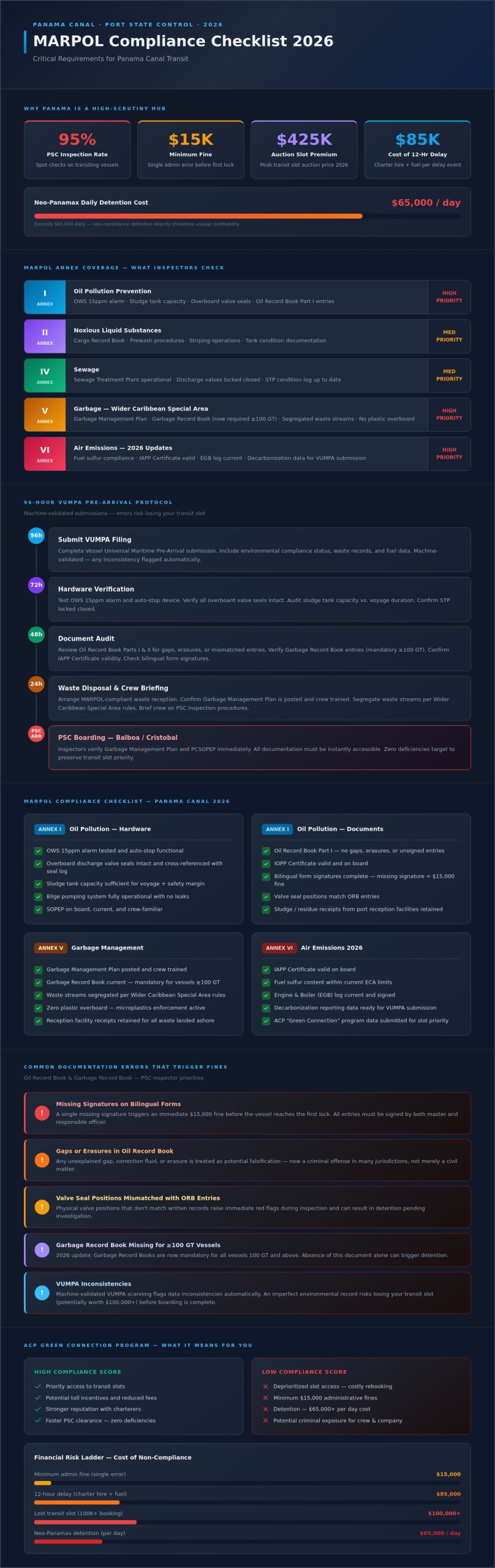
This guide provides the technical clarity you need to master the latest regulations and ensure your vessel avoids detentions. We’ll show you how to achieve zero deficiencies during Port State Control inspections and maintain an efficient schedule while transiting the Panama Canal. We’ll examine the critical 96-hour VUMPA submission deadline, updated waste disposal protocols in the Wider Caribbean Special Area, and the specific documentation required to keep your operations running with total proficiency.
Key Takeaways
- Understand why the Panama Canal is a high-scrutiny zone and what Port State Control inspectors prioritize during 2026 transits.
- Identify the specific Annex I and Annex V hardware requirements that must be verified and tested before arrival at the anchorage.
- Access a practical MARPOL compliance checklist 2026 to streamline your mandatory 96-hour pre-arrival protocol.
- Learn to spot the common documentation errors in Oil and Garbage Record Books that frequently trigger heavy administrative fines.
- Discover how to consolidate MARPOL disposal services and marine surveys to optimize your transit timeline and reduce operational overhead.
Understanding MARPOL Compliance in 2026: Why Panama is a Critical Hub
MARPOL serves as the primary international framework for preventing marine pollution. Formally known as the MARPOL 73/78 Convention, it governs everything from oily bilge water to plastic waste. For vessels transiting the Panama Canal in 2026, these rules aren’t suggestions. They’re strict entry requirements. Panama is a high-scrutiny hub where Port State Control (PSC) conducts spot checks on 95% of all transiting vessels. A single administrative error in your paperwork can trigger a $15,000 fine before you even reach the locks. Utilizing a comprehensive MARPOL compliance checklist 2026 is no longer optional; it’s a commercial necessity.
The 2026 regulatory landscape focuses heavily on decarbonization and microplastics. Authorities now use machine-validated systems to scan Vessel Universal Maritime Pre-Arrival (VUMPA) filings for inconsistencies. If your vessel’s environmental record isn’t perfect, you risk losing a transit slot that may have cost $100,000 or more to book. Compliance is now directly linked to your vessel’s transit priority and overall profitability. You can’t afford a 12-hour delay when the cost of lost charter hire and fuel consumption exceeds $85,000.
The Role of the Panama Canal Authority (ACP) in Environmental Oversight
The ACP integrates MARPOL standards directly into its operational maritime regulations. Their “Green Connection” program uses an Environmental Recognition Program to rank vessels. High-performing ships gain better access to transit slots and potential toll incentives. When you arrive at Balboa or Cristobal, expect a systematic inspection flow. Inspectors verify your Garbage Management Plan and PCSOPEP status immediately. They prioritize efficiency, and they expect your crew to do the same. This oversight ensures that the Canal remains a sustainable corridor, but it places a heavy burden of proof on the ship’s command.
Commercial Implications of Non-Compliance in 2026
A detention in Panama is exceptionally expensive. Daily delay costs for a Neo-Panamax vessel frequently exceed $65,000. Beyond the immediate loss of hire, non-compliance damages your reputation with charterers who demand seamless logistics. Securing reliable MARPOL disposal panama ensures your waste streams are handled correctly without delaying your schedule. There’s also a growing trend toward the criminalization of pollution violations. Authorities in major jurisdictions now treat deliberate record-book falsification as a serious criminal offense, not just a civil matter. Professional management of your environmental obligations is the only way to protect your crew and your company’s fiscal health.
The 2026 MARPOL Annex Checklist: Key Requirements for Every Vessel
The regulatory framework maintained by the International Maritime Organization (IMO) evolves constantly. By 2026, the complexity of these requirements has reached a peak, particularly for vessels navigating the Panama Canal’s strict environmental zones. A comprehensive MARPOL compliance checklist 2026 must account for hardware functionality, crew proficiency, and precise record-keeping across all technical annexes. Neglecting a single valve or log entry is a calculated risk that often ends in costly detentions and administrative fines starting at $15,000.
Annex I & IV: Liquid Waste Management
Operational readiness begins in the engine room. Port State Control (PSC) inspectors in Panama prioritize the integrity of your oily water separator (OWS) and the accuracy of its 15ppm alarm. You must verify that all overboard discharge valves are fitted with intact seals and that their positions match the entries in your Oil Record Book Part I. Before arriving at the anchorage, ensure your team completes these critical checks:
- Verify seal integrity on all overboard discharge valves and cross-reference with the seal log.
- Test the OWS 15ppm alarm and the automatic stopping device to ensure immediate shutdown.
- Confirm sludge tank capacity is sufficient for the planned voyage duration plus a safety margin.
- Audit the Sewage Treatment Plant to ensure it’s operational and that discharge valves are locked in the closed position.
If you identify leaking pumps or faulty separators during your pre-arrival inspection, securing mechanical ship repairs before reaching the locks is essential to prevent a terminal deficiency. Proactive maintenance is always more cost-effective than a forced detention.
Annex VI: Decarbonization and Air Emissions in 2026
The 2026 focus has shifted significantly toward the Carbon Intensity Indicator (CII) and EEXI compliance. Your MARPOL compliance checklist 2026 must include a dedicated verification of the CII logbook to ensure data is updated and accurate. Panama’s inspectors now routinely check Bunker Delivery Notes (BDNs) for the last three years to confirm the use of compliant Low Sulfur Fuel Oil (LSFO). For vessels equipped with Exhaust Gas Cleaning Systems (scrubbers), you must demonstrate full functionality and provide continuous monitoring records. Any discrepancy in NOx emission records or engine parameter certificates can lead to immediate delays. Proactive management of these systems is the only way to ensure a seamless transit through the Canal’s high-traffic corridor.
Annex V: Garbage Management and Plastic Prohibitions
As of 2026, the threshold for maintaining a Garbage Record Book has dropped to include all vessels of 100 gross tonnage (GT) and above. This is a major change from the previous 400 GT limit. Within the Wider Caribbean Special Area, the discharge of almost all garbage is strictly prohibited. You must verify that your Garbage Management Plan is current and that your crew understands the absolute ban on plastic discharge, including synthetic ropes and plastic bags. If your vessel requires professional assistance to manage accumulated waste streams, you can coordinate MARPOL disposal alongside your arrival to maintain a clean record and avoid Port State Control issues.
Beyond the Hardware: Mastering MARPOL Documentation and Record Keeping
While your oily water separator might be in peak condition, Port State Control (PSC) inspectors in Panama often find their strongest evidence for detention in your paperwork. In 2026, maritime authorities conduct spot checks on 95% of transiting vessels, and they prioritize the accuracy of your logs over almost everything else. Your MARPOL compliance checklist 2026 must emphasize the administrative trail. A single administrative error, such as a missing signature or a single missing signature on a bilingual form, can lead to immediate fines starting at $15,000. These logs are the legal proof of your vessel’s environmental stewardship.
The Oil Record Book (ORB): Avoiding Fatal Errors
The Oil Record Book (ORB) Part I is the legal proof of bilge management and the first document any inspector will request. You must record every internal transfer of oil or sludge, even if it remains within the engine room. According to U.S. Coast Guard MARPOL guidance, which heavily influences PSC practices in the region, consistency is paramount. Physical tank levels must match your log entries exactly. If an inspector finds more sludge in a tank than your records indicate was transferred or incinerated, they’ll suspect an illegal discharge.
Correcting errors in 2026 requires strict adherence to protocol. Never use white-out or attempt to erase an entry. Draw a single line through the mistake, initial it, and write the correct data below. With the industry shifting toward electronic record books (E-logs) in 2026, ensure your digital certificates are valid and that your crew is trained on the specific software interface used on board. Reliability in documentation is just as critical as the reliability of your machinery.
Garbage and Sewage Logs: Compliance at the Panama Canal
As of 2026, all vessels of 100 gross tonnage (GT) and above must maintain a Garbage Record Book. This expanded requirement means more ships are under scrutiny in the Wider Caribbean Special Area. Your Garbage Management Plan must be vessel-specific; using a generic template is a common cause of deficiencies. You must document the incineration of food waste and the storage of plastic waste with precise volume estimates. When you utilize professional MARPOL disposal services in Panama, ensure the receipt is filed immediately with a corresponding entry in the Garbage Record Book. This documentation proves your compliance with the absolute prohibition on plastic discharge and maintains your standing within the Panama Canal’s environmental oversight programs.
Pre-Arrival Protocol: Preparing for Port State Control (PSC) in Panama
The 96-hour countdown before reaching the Panama Canal anchorage is your final opportunity to rectify operational gaps. You must submit your Vessel Universal Maritime Pre-Arrival (VUMPA) documentation at least 96 hours before arrival; failing to meet this deadline results in the immediate forfeiture of your transit slot. During this window, your team must execute a rigorous MARPOL compliance checklist 2026 to ensure the vessel is ready for the high-scrutiny environment of the Panama Canal Authority (ACP). Port State Control (PSC) inspectors in Panama look for reasons to detain, and they have no tolerance for administrative or technical oversights.
To ensure a seamless transit, your crew should follow these essential preparation steps:
- Conduct a full internal MARPOL audit exactly 96 hours before arrival at the anchorage.
- Test the functionality of all pollution prevention equipment, specifically the OWS, incinerator, and sewage plant.
- Review all record books for signature gaps, missing dates, or logical inconsistencies.
- Perform a comprehensive visual ‘walk-around’ to identify oil leaks in the engine room or improper waste storage on deck.
- Schedule necessary marine surveys in Panama to provide third-party verification of your vessel’s compliance status.
Identifying and Fixing Deficiencies Before the Inspector Boards
If your oily water separator (OWS) malfunctions during the approach, transparency is your only defense. You should notify the ACP and your flag state immediately. Attempting to conceal a failure is a high-risk strategy that often leads to the criminalization of the voyage. Professional underwater hull services can be utilized to verify that overboard discharge outlets are clean and free of oily residue before the inspector arrives. Regular crew drills are also vital; your team must demonstrate they can operate MARPOL equipment on demand without hesitation.
The Panama Canal “Clean Hull” Requirement
Biofouling management is a critical component of local environmental regulations in 2026. The ACP monitors hull condition to prevent the introduction of invasive species into the sensitive Gatun Lake ecosystem. Hull cleaning in Panama reduces fuel consumption by up to 15% while ensuring compliance with biofouling guidelines. This proactive maintenance supports your Carbon Intensity Indicator (CII) rating and prevents delays related to environmental oversight. Ensuring your hull is free of significant growth is now a MARPOL-adjacent necessity for any efficient transit; to explore advanced non-toxic coating solutions that minimize fouling, discover Seacoat SCT, LLC.
Don’t risk a transit delay or heavy fine; book a professional marine survey today to ensure your vessel is fully prepared for Panama Port State Control.
Streamlining MARPOL Compliance with Panama Ship Service
Managing a MARPOL compliance checklist 2026 while coordinating a canal transit is a high-stakes balancing act. Ship owners and operators face immense pressure to keep schedules tight while meeting the Panama Canal Authority’s uncompromising environmental standards. Panama Ship Service acts as your strategic partner on the ground, allowing you to delegate these complex obligations to a team that understands the local regulatory environment. We provide a comprehensive “one-stop-shop” advantage that consolidates waste disposal, technical repairs, and maritime surveys into a single, efficient window during your transit.
Our local expertise is a critical asset when dealing with Port State Control (PSC) inspectors in Balboa and Cristobal. We don’t just provide services; we provide the reliability that comes from knowing your vessel’s environmental profile is managed by professionals who interact with these authorities daily. Whether it’s a routine inspection or a high-pressure audit, our presence ensures your vessel meets every requirement without unnecessary complications or administrative delays. We prioritize your schedule, ensuring that compliance never comes at the cost of your operational momentum.
Integrated Disposal and Technical Support
Our sludge and garbage disposal services are designed to integrate seamlessly with your canal schedule. We understand that time is your most valuable commodity in this corridor. By coordinating disposal alongside other essential services, we eliminate the need for multiple stops or extended anchorage times. If your pre-arrival audit reveals a technical failure, our teams provide immediate support. Utilizing mechanical ship repairs in Panama ensures that leaking pumps, faulty separators, or malfunctioning incinerators are fixed before they trigger a PSC detention. All waste handled by Panama Ship Service is processed through certified, compliant channels, providing the documentation you need to close out your record book entries with total proficiency.
Contact Us for 2026 Compliance Support
Operational efficiency in the Panama Canal requires a proactive approach to environmental management. Our specialized technical teams are stationed at both ends of the Canal, ready to assist with emergency MARPOL repairs or scheduled surveys 24 hours a day. We provide the expertise and fiscal responsibility needed to protect your vessel from the rising costs of non-compliance and the risk of heavy fines. Don’t leave your transit to chance; delegate the complexity of your environmental obligations to a seasoned industry veteran that handles the details without complication.
Contact Panama Ship Service for MARPOL Compliance Support today to secure your transit and ensure a deficiency-free inspection during your next Panama Canal operation.
Securing Your Transit: Reliable Compliance for 2026 and Beyond
Navigating the Panama Canal in 2026 requires more than technical readiness; it demands a strategic commitment to environmental excellence. You’ve seen how administrative oversights lead to penalties and lost transit slots. By implementing a rigorous MARPOL compliance checklist 2026, you protect your vessel and ensure your schedule remains optimized. Efficiency in this hub is built on the foundation of accurate record-keeping and functional systems.
Panama Ship Service provides the localized support necessary to maintain these standards. As an authorized MARPOL waste handler with strategic locations at both Canal entrances in Balboa and Cristobal, we handle the logistics of disposal so you can focus on your voyage. Our expert mechanical teams provide rapid compliance repairs, ensuring your equipment meets every Port State Control requirement before you reach the locks. Delegate the technical complexity to a partner you can trust.
Ensure Your Vessel Stays Compliant: Book MARPOL Services Now
We are ready to help you navigate these regulatory complexities with confidence and proficiency. Your successful transit is our priority.
Frequently Asked Questions
What are the major MARPOL changes for vessels in 2026?
Major changes include the expansion of Garbage Record Book requirements to all vessels over 100 gross tonnage and stricter enforcement of Carbon Intensity Indicator (CII) ratings. Authorities also now focus heavily on microplastics and the mandatory reporting of lost fishing gear. Using a comprehensive MARPOL compliance checklist 2026 helps your crew track these evolving documentation standards to avoid administrative deficiencies during high-scrutiny Panama Canal inspections.
How much are the fines for MARPOL violations at the Panama Canal?
Fines for MARPOL violations at the Panama Canal start at $15,000 for simple administrative errors, such as a missing signature on a bilingual document. More severe technical violations or evidence of deliberate pollution can lead to fines exceeding $250,000. These costs don’t include the potential $65,000 daily delay cost for Neo-Panamax vessels or the loss of expensive transit slots due to detention.
Can a vessel be detained for minor errors in the Oil Record Book?
Yes, Port State Control inspectors in Panama frequently detain vessels for minor errors in the Oil Record Book. They view inconsistent entries or improper correction methods, such as using white-out, as evidence of poor management or potential concealment. Inspectors prioritize the administrative trail because it serves as legal proof of your vessel’s environmental stewardship. Ensure all internal transfers are recorded correctly to prevent an audit.
Is underwater hull cleaning required for MARPOL compliance in Panama?
While not a direct MARPOL Annex requirement, underwater hull cleaning is essential for compliance with Panama Canal biofouling guidelines and Carbon Intensity Indicator (CII) ratings. The Panama Canal Authority monitors hull condition to protect the sensitive Gatun Lake ecosystem from invasive species. Maintaining a clean hull also reduces fuel consumption by up to 15%, directly improving your vessel’s environmental performance and transit priority.
How do I arrange for MARPOL-compliant sludge disposal in Balboa?
You can arrange for MARPOL-compliant sludge disposal in Balboa by coordinating with an authorized local handler like Panama Ship Service. We integrate waste removal with your canal schedule to prevent operational delays at the anchorage. Our team handles the technical logistics and provides the required disposal receipts for your record books, ensuring your vessel remains fully compliant with Annex I requirements during the transit.
What is the CII rating and how does it affect my 2026 MARPOL status?
The Carbon Intensity Indicator (CII) measures how efficiently a ship transports goods and is a key part of MARPOL Annex VI decarbonization targets. In 2026, your CII rating directly influences your vessel’s ranking within the Panama Canal’s environmental recognition programs. Low ratings can lead to increased scrutiny from inspectors and may affect your priority when booking transit slots during high-demand periods or auction cycles.
What happens if our Oily Water Separator (OWS) fails just before entering the Canal?
If your Oily Water Separator (OWS) fails, you must notify the Panama Canal Authority and your flag state immediately. Transparency is the only way to avoid the criminalization of the voyage and potential detention for concealment. Once notified, you can coordinate emergency mechanical ship repairs in Balboa or Cristobal to rectify the deficiency before the Port State Control inspector boards for a formal transit audit.
Are electronic logbooks mandatory for MARPOL Annex VI in 2026?
Electronic logbooks are widely adopted in 2026 and are often required by specific flag states to manage MARPOL Annex VI data accurately. While the IMO provides a framework for their use, you must ensure your specific software interface is approved by your administration and that the crew is proficient in its operation. Digital certificates must be valid and readily available for inspection to satisfy Panama’s Port State Control requirements.