
Relying solely on onboard retention is the fastest route to a Port State Control detention. For ship operators and technical managers, complying with MARPOL special areas regulations has become a high-stakes operational challenge. You already know that entering sensitive zones like the Wider Caribbean or the Red Sea leaves zero margin for technical error. When oily sludge, bilge water, and shipboard garbage accumulate faster than planned, holding tanks reach critical limits and routine voyaging quickly turns into an acute compliance risk.
Mastering the exact discharge restrictions and regional boundaries across MARPOL Annexes is vital to safeguarding your fleet against catastrophic fines, vessel arrests, and costly voyage delays. Real compliance requires coordinated onshore waste reception, not just passive onboard containment. In this guide, we break down specific Annex discharge thresholds, examine critical sea boundaries, and outline practical port disposal protocols to ensure seamless transits and immediate port clearance.
Key Takeaways
- Understand the legal framework and strict oceanographic criteria defining designated zones under IMO conventions.
- Differentiate mandatory discharge limits and equipment requirements across MARPOL Annexes I through VI to prevent non-compliance.
- Navigate complex geographic boundaries, including newly enforced zones and the Wider Caribbean Region, to plan compliant voyages.
- Implement robust holding tank management, pre-voyage calculations, and precise recordkeeping in line with MARPOL special areas regulations.
- Coordinate shore-side MARPOL disposal in key hubs to manage waste accumulation bottlenecks during high-traffic transit delays.
Understanding MARPOL Special Areas: Definition, Legal Framework, and Core Objectives
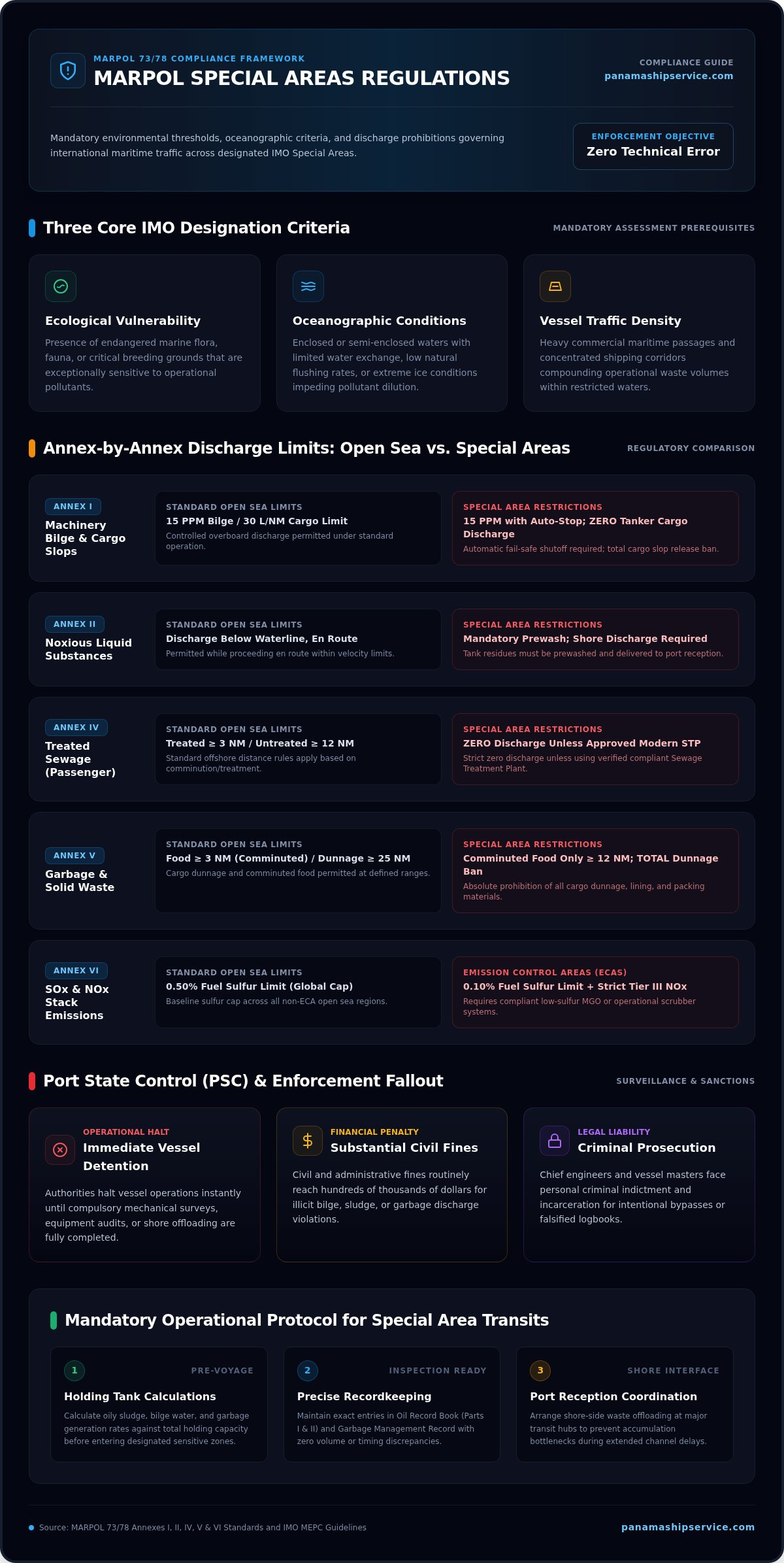
MARPOL Special Areas are designated ocean regions subject to strict mandatory discharge prohibitions. Established under the foundational framework of the MARPOL 73/78 convention, these zones safeguard enclosed or semi-enclosed sea regions that cannot handle routine operational waste. While open ocean waters permit controlled overboard discharges under baseline technical limits, entering an active Special Area immediately enforces zero-discharge or significantly lower concentration thresholds.
The International Maritime Organization (IMO) establishes these geographic boundaries based on three critical prerequisites:
- Ecological vulnerability: The presence of endangered marine flora, fauna, or critical breeding grounds sensitive to pollutants.
- Oceanographic conditions: Limited water exchange, low flushing rates, or extreme ice conditions that impede natural pollutant dilution.
- Vessel traffic density: Heavy commercial maritime passages that compound operational waste volumes within concentrated corridors.
Failing to adapt onboard workflows to these regional thresholds creates acute operational vulnerabilities. For fleet operators, compliance requires verifiable adherence to strict MARPOL special areas regulations rather than assumptions based on standard high-seas permissions.
The IMO Mandate and Regulatory Scope
The IMO structures these protective designations via its Marine Environment Protection Committee (MEPC). The MEPC conducts rigorous technical assessments to verify that coastal states provide adequate reception infrastructure before a Special Area’s discharge prohibitions take effect. Special Areas target operational discharges under technical annexes, whereas Particularly Sensitive Sea Areas (PSSAs) provide broader ecological protections through ship routeing systems and reporting measures. Regional Memorandums of Understanding (MoUs) cross-reference global Port State Control (PSC) inspection records, ensuring flagged deficiencies instantly follow vessels across international trading routes.
Legal Consequences of Non-Compliant Vessel Discharges
Port states actively enforce these protections using satellite surveillance, aerial surveillance, and unannounced dockside audits. If inspectors uncover violations, the legal fallout is swift:
- Immediate vessel detention: Authorities halt operations until mechanical surveys, equipment testing, or offloading occur.
- Substantial financial penalties: Civil fines easily reach hundreds of thousands of dollars for improper bilge or garbage releases.
- Criminal liability: Chief engineers and masters risk criminal prosecution and incarceration for intentional bypasses or falsified paperwork.
PSC inspectors heavily weigh the Oil Record Book (Parts I and II) and the Garbage Management Record. Any discrepancy between tank capacities, processing rates, and documented holdings triggers an expanded inspection. Clear onshore offloading receipts remain your strongest defense during rigorous port examinations.
Annex-by-Annex Discharge Regulations in Designated Special Areas
Complying with MARPOL special areas regulations requires technical officers and deck crews to abandon standard open-ocean assumptions. Operational discharge parameters tighten drastically across every waste stream the moment your vessel crosses a designated boundary.
| MARPOL Annex | Waste Stream | Standard Open Sea Limits | Special Area Restrictions |
|---|---|---|---|
| Annex I | Machinery Bilge & Cargo Slops | 15 PPM bilge / 30 L/NM cargo limit | 15 PPM with auto-stop; zero tanker cargo discharge |
| Annex II | Noxious Liquid Substances (NLS) | Discharge below waterline, en route | Mandatory prewash; shore discharge required |
| Annex IV | Treated Sewage (Passenger Ships) | Treated ≥ 3 NM / Untreated ≥ 12 NM | Zero discharge unless using approved modern STP |
| Annex V | Garbage & Food Waste | Food ≥ 3 NM comminuted; dunnage ≥ 25 NM | Comminuted food only ≥ 12 NM; total dunnage ban |
| Annex VI | SOx & NOx Stack Emissions | 0.50% Fuel Sulfur / Tier II NOx | 0.10% Fuel Sulfur / Tier III NOx |
Annex I (Oil) and Annex II (Noxious Liquid Substances) Controls
Tankers face an outright ban on discharging any cargo residue within Special Areas. For machinery spaces on all ships, bilge effluent must pass through an approved 15 PPM oily water separator fitted with an automatic stopping switch. If oil content exceeds 15 PPM, the discharge valve must shut automatically. Under Annex II, chemical tankers carrying Category X, Y, or Z substances must execute mandatory prewash operations and pump washings directly to shore reception facilities before departure.
Annex IV (Sewage) and Annex V (Garbage) Restrictions
In Special Areas like the Baltic Sea, passenger vessels cannot discharge sewage unless processing it through an advanced wastewater treatment plant that meets strict nitrogen and phosphorus standards. Annex V imposes an uncompromising ban on burning or dumping plastics, cargo dunnage, incinerator ash, and operational wash-water containing cleaning chemicals. Food waste cannot enter the water unless comminuted to under 25 millimeters and discharged while en route at least 12 nautical miles from land.
Consult our detailed MARPOL disposal in Panama compliance guide to prepare waste management plans ahead of demanding transits. If your holding tanks near operational limits, you can schedule verified MARPOL disposal during port calls to offload sludge and solid garbage without risking delays.
Annex VI: Emission Control Areas (ECAs) and Air Pollution Limits
Emission Control Areas mandate a strict 0.10% m/m fuel sulfur cap, contrasting sharply with the 0.50% global ceiling. Tier III NOx emission standards also apply to modern marine diesel powerplants operating in active zones. Bridge and engine teams must accurately document fuel changeover dates, times, vessel coordinates, and tank volumes in the official logbook before entering any ECA perimeter.
Geographic Boundaries: Active Special Areas and Emission Control Zones Worldwide
Precision navigation is vital when operating near protected marine corridors. Navigators cannot rely on rough estimations or open-sea habits. Compliance with MARPOL special areas regulations requires plotting exact polygonal coordinates defined in IMO conventions. Hard-coding these geographic limits into your Electronic Chart Display and Information System (ECDIS) triggers automated boundary alerts, preventing accidental overboard discharges across invisible sea borders.
European and Middle Eastern Waters
European and Middle Eastern waters contain some of the world’s most densely regulated maritime environments. The Baltic and North Seas enforce overlapping restrictions covering oil, sewage, garbage, and emissions. Key regional frameworks include:
- Mediterranean Sea SOx ECA: Enforces a strict 0.10% m/m fuel sulfur limit, active since May 1, 2025.
- Red Sea and Gulf of Aden: Full Special Area status took effect on January 1, 2025, enforcing strict Annex I oil discharge bans in both zones and Annex V garbage bans in the Red Sea.
- Norwegian Sea and Arctic Waters: Antarctic waters maintain total zero-discharge bans, while new NOx and SOx ECAs entered into force on March 1, 2026, across the Norwegian Sea and Canadian Arctic.
The Wider Caribbean Region and Western Hemisphere Corridors
The Wider Caribbean Region encompasses the Gulf of Mexico, the Caribbean Sea proper, and adjacent Atlantic waters extending south to 10 degrees North latitude off French Guiana. Designated as a Special Area under MARPOL Annex V, this vast zone prohibits dumping all operational waste, packaging material, and cargo residue across Central American trade lanes. Food waste can only be released while en route at least 12 nautical miles from land.
Vessels approaching Central American bottlenecks often experience regulatory compounding. They must manage Annex V restrictions while maintaining low-sulfur operations required by the adjacent North American and US Caribbean Emission Control Areas. Managing holding capacities across these overlapping zones requires tight route planning. Before committing to congested canal queues, ship operators frequently schedule independent marine surveys in Panama to audit equipment condition, verify tank soundings, and ensure documentation withstands rigorous port inspections.
Vessel Operational Protocols: Route Planning, Recordkeeping, and Holding Management
Operating inside restricted waters requires systematic voyage preparation. You cannot manage compliance through guesswork once sea passages commence. Maintaining full compliance with MARPOL special areas regulations demands a four-step technical protocol prior to departure:
- Verify physical equipment: Test the oily water separator, 15 PPM alarm monitor, and three-way divert valve.
- Calculate retention margins: Compare available sludge and bilge holding volumes against maximum transit durations, adding a safety reserve.
- Log entry coordinates: Program exact boundary waypoints and fuel changeover positions into ECDIS routes.
- Plan shore offloading: Book certified port reception facilities at terminal gateways ahead of arrival.
Tank Capacity Calculation and Waste Segregation
Sludge production averages 1% to 2% of daily heavy fuel consumption, while bilge accumulation varies widely depending on packing gland conditions and engine room washdowns. Technical teams must audit these generation rates against dedicated tank capacities before approaching restricted perimeters. If total sludge volume exceeds 70% capacity, holding space will quickly run out during protracted transits. Solid garbage management requires equally rigid containment. Crews must separate recyclables, domestic trash, and hazardous materials into designated, color-coded bins to prevent improper mix-ups.
Audit-Proof Recordkeeping for Port State Control
PSC officers look for paper discrepancies to justify expanded physical inspections. Every internal fluid transfer, incineration cycle, and bilge processing run must appear in the Oil Record Book Part I with precise tank soundings, times, and geographic coordinates. For tankers, cargo washing and slop handling require matching accuracy in Part II. Inspectors regularly calculate daily waste production against engine fuel consumption; any mathematical deviation or sudden flatline in holding tank levels suggests an unrecorded overboard discharge.
Equipment Maintenance and Technical Readiness
Reliable hardware prevents accidental contamination. Bilge alarm sensors require regular recalibration using certified test fluids, while automatic recirculating valves must seat tightly without leakage. Physical hull apertures also demand close attention. Worn overboard discharge valves or unverified blanking plates can leak oily residues under sea pressure. Schedule professional underwater hull services to inspect sea chests, confirm blank integrity, and secure hull fittings before port audits.
Ensure your engineering systems and logs are fully prepared before reaching congested waterways. Book an operational survey with Panama Ship Service to verify onboard readiness and prevent costly inspection delays.
Port Reception Facilities: Managing Waste Offloading and Canal Transit Operations
Retention alone cannot guarantee compliance across extended maritime voyages. When transiting strictly policed zones, certified port reception facilities serve as the critical operational bridge between onboard waste management and legal clearance. Adhering to MARPOL special areas regulations requires active offloading strategies to ensure vessels never enter restricted approaches with saturated storage capacities.
Navigating Waste Bottlenecks at Strategic Bottlenecks
Lengthy anchorage delays at strategic canal approaches push engine room storage to its breaking point. Heavy traffic and scheduling congestion frequently leave vessels idling off Pacific or Atlantic entrances for days. Auxiliary generators continuously consume fuel, oily bilge settles in machinery wells, and daily domestic garbage rapidly accumulates. Entering freshwater channels or ecologically sensitive approaches with topped-out holding tanks risks immediate inspection citations. Arranging barge-side offloading while at anchor eliminates these capacity bottlenecks before transit clearance commences.
Certified Slops, Sludge, and Garbage Offloading Protocols
Offloading ship-generated waste requires strict procedural adherence to satisfy flag administration audits:
- Advance Notification: Submit the standard IMO Advance Notification Form (ANF) to port authorities and service operators well ahead of arrival.
- Operator Verification: Ensure barge contractors possess valid environmental licenses and certified equipment to receive oily mixtures and hazardous waste.
- Disposal Documentation: Obtain a signed, stamped Waste Delivery Receipt (WDR) specifying exact volumes and waste categories transferred.
File these WDR slips directly alongside your Oil Record Book Part I and Garbage Record Book. Inspectors cross-reference these official receipts against tank reductions to verify that waste was transferred responsibly rather than discharged illicitly.
Streamlining Full Technical Support with Panama Ship Service
Managing multiple technical service providers while anchored introduces unwanted administrative overhead and increases voyage turnaround times. Panama Ship Service delivers fully certified MARPOL disposal for oily sludge, bilge water, slops, and ship garbage across both Balboa (Pacific) and Cristobal (Atlantic) terminals. We align waste offloading alongside scheduled marine surveys, underwater hull inspections, and mechanical ship repairs, enabling technical superintendents and masters to complete essential port turnaround requirements through a single dependable partner. Delegating reception logistics to an established local provider ensures complete compliance with MARPOL special areas regulations while keeping your sailing schedules firmly on track.
Executing Flawless Voyage Compliance Across Restricted Waters
Navigating protected waterways demands proactive planning, diligent maintenance, and total procedural transparency. Successfully complying with MARPOL special areas regulations requires far more than passive onboard storage; it hinges on aligning pre-voyage retention calculations with certified shore reception. Keeping accurate Oil Record Book entries, maintaining calibrated oily water monitoring equipment, and offloading residues ahead of congested choke points protects your vessels against catastrophic PSC fines and schedule-wrecking detentions.
Don’t allow saturated sludge tanks or accumulating garbage to compromise your commercial sailing schedules. Panama Ship Service delivers certified MARPOL disposal operations across both Balboa and Cristobal anchorages, pairing rapid waste offloading with comprehensive technical support to eliminate canal transit delays. Schedule your MARPOL-compliant slops and sludge disposal with Panama Ship Service today to ensure complete regulatory compliance, smooth port clearance, and absolute peace of mind on every voyage.
Frequently Asked Questions
What is the primary difference between a MARPOL Special Area and an Emission Control Area (ECA)?
Special Areas regulate discharges into the sea, while ECAs control airborne stack emissions. Designated under Annexes I, II, IV, and V, Special Areas prohibit or restrict the operational release of oily waste, chemicals, sewage, and garbage. Conversely, ECAs fall strictly under Annex VI, establishing strict limits on sulfur oxides (SOx), nitrogen oxides (NOx), and particulate matter emitted from vessel exhausts.
Can treated bilge water below 15 PPM be discharged inside an Annex I Special Area?
Yes, but only under strict operational conditions. Machinery space bilge water can be discharged if the vessel is underway, the oily mixture processes through an approved 15 PPM oil filtering system, and the unit features an automatic stopping device. However, this effluent cannot originate from cargo pump-room bilges on oil tankers, and it cannot contain cargo residues or chemical cleaning agents.
What are the food waste discharge rules inside the Wider Caribbean Special Area?
Inside the Wider Caribbean Region, vessels can only discharge comminuted food waste capable of passing through a 25-millimeter screen while navigating at least 12 nautical miles from the nearest land. Discharging uncomminuted food waste or any other shipboard garbage, including packaging and cargo residues, is completely prohibited across the entire area under MARPOL special areas regulations.
What happens if a vessel enters a Special Area with full waste holding tanks?
Arriving with saturated holding tanks creates an immediate compliance failure. Port State Control officers routinely audit tank sounding logs against daily generation rates. If your tanks lack the remaining capacity to hold waste generated during transit, inspectors will conclude an illegal discharge occurred or is inevitable. This routinely triggers vessel detention, heavy civil fines, and mandatory offloading orders at the operator’s expense.
How do port state control inspectors detect illegal discharges made outside territorial waters?
Inspectors rely on satellite imagery, maritime surveillance aircraft, and forensic document audits. International agreements allow member states to share radar data detecting slick wakes trailing specific AIS signatures. Dockside, surveyors reconcile engine room logbooks, oil content meter memory chips, and daily tank soundings against fuel burn records. Any mathematical mismatch exposes unrecorded overboard pumping.
Is an approved exhaust gas cleaning system (scrubber) permitted in all Annex VI ECAs?
Not universally. While IMO regulations recognize scrubbers as an equivalent compliance method to achieve the 0.10% sulfur limit, many coastal jurisdictions and port authorities ban open-loop scrubber washwater discharges in their territorial waters. In these jurisdictions, ships operating scrubbers must switch to compliant low-sulfur marine fuels or operate in a zero-discharge closed-loop mode before crossing port limits.
What specific documentation must a vessel obtain after offloading sludge at port reception facilities?
The ship must receive an official, stamped Waste Delivery Receipt (WDR) signed by the authorized shore terminal or barge operator. This receipt must detail the port location, transfer date, vessel identity, and exact volume of sludge offloaded. Engineers must retain this receipt alongside the Oil Record Book Part I for at least three years to prove compliance with MARPOL special areas regulations.