
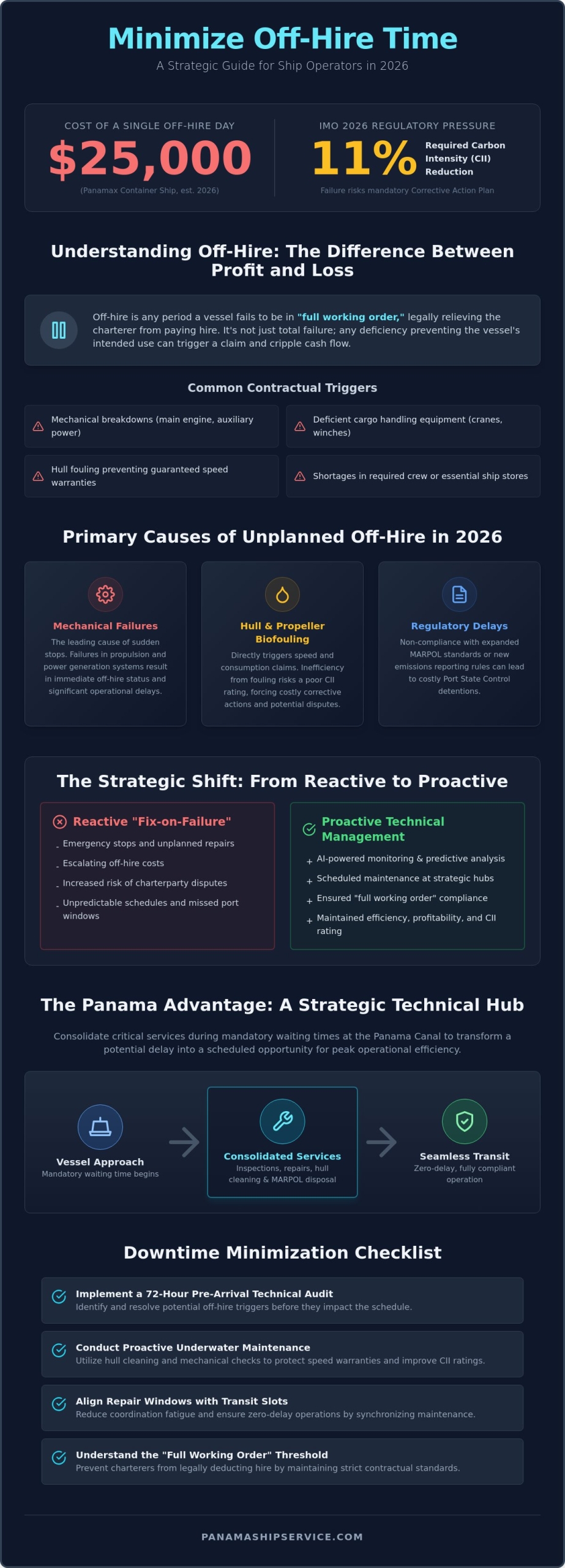
A single day of off-hire for a Panamax container ship in 2026 can drain $25,000 from your bottom line before you even account for missed port windows or contractual penalties. You know that keeping a vessel in “full working order” is more than a technical requirement; it’s a vital legal shield against expensive charterparty disputes. As operating costs rise and IMO CII reduction factors tighten to 11%, the pressure to stay on schedule has never been higher. Minimizing off-hire time requires moving beyond reactive fixes toward a consolidated, proactive strategy at strategic geographical hubs like the Panama Canal.
We recognize the coordination fatigue that comes with managing multiple service providers under tight deadlines. This article delivers practical technical strategies and service consolidation techniques to maintain peak operational efficiency. You’ll discover how to utilize mandatory waiting times for inspections, mechanical repairs, and MARPOL disposal to ensure your fleet remains compliant and profitable. We’ll outline a roadmap for seamless transits and better technical compliance, allowing you to delegate complexity and focus on your core business outcomes.
Key Takeaways
- Understand the “full working order” threshold to prevent charterers from legally deducting hire during periods of technical inefficiency.
- Learn how proactive underwater hull cleaning and mechanical maintenance directly protect your speed warranties and CII ratings.
- Discover how consolidating technical services at the Panama Canal acts as a strategic pit stop for minimizing off-hire time.
- Implement a 72-hour pre-arrival technical audit to identify and resolve potential off-hire triggers before they impact your schedule.
- Align your mechanical repair windows with Canal transit slots to reduce coordination fatigue and ensure zero-delay operations.
What is Off-Hire Time and Why Does It Cripple Operations?
Off-hire time is the period during a time charter when the vessel fails to meet the contractual standard of being “fully efficient.” When this happens, the charterer is legally relieved from their obligation to pay hire. It isn’t just about a complete engine failure; it’s about any deficiency in the ship’s condition, crew, or stores that prevents the charterer from using the vessel as intended. For owners, minimizing off-hire time is the difference between a profitable voyage and a significant financial loss.
The “Full Working Order” standard serves as the primary threshold for these deductions. If a vessel cannot perform the service immediately required, the charterer can declare it off-hire. This calculation often includes not just the lost daily hire rate, which averages $25,000 for a standard Panamax container ship, but also the ripple effects of port fees, wasted bunker fuel, and potential missed transit slots. Hire is the owner’s lifeblood. Losing it cripples cash flow. In 2026, the financial stakes are even higher as insurance and repair costs continue to climb.
Common contractual triggers for off-hire include:
- Mechanical breakdowns in main engines or auxiliary power.
- Deficiencies in cargo handling equipment like cranes or winches.
- Hull fouling that prevents the vessel from maintaining speed warranties.
- Shortages in required crew members or essential ship stores.
The Legal vs. Operational Reality of Downtime
Operators often mistake a minor mechanical glitch for a simple maintenance task, but the legal reality is far harsher. Modern off-hire clauses, such as those found in the NYPE ’46 form, focus on the “net loss of time.” If a technical impairment causes a delay in the voyage, the charterer will seek a pro-rata deduction. This often ties back to the legal definition of seaworthiness, where the vessel must be reasonably fit for the specific service it’s contracted to perform. Even a small deficiency in power generation can trigger a claim if it prevents the vessel from operating cargo gear or maintaining the required speed.
Primary Causes of Unplanned Off-Hire in 2026
The maritime landscape in 2026 presents specific technical challenges that lead to downtime. Unexpected mechanical failures in propulsion and power generation remain the leading cause of sudden stops. However, biofouling has become a critical trigger for speed and consumption claims. With the IMO CII reduction factor set at 11% for 2026, any hull inefficiency doesn’t just waste fuel; it risks a poor rating that requires a mandatory Corrective Action Plan by April 30, 2026. Regulatory delays also play a major role. Non-compliance with expanded MARPOL standards or the inclusion of methane and nitrous oxide in emissions reporting can lead to port state control detentions. Proactive technical management is the only reliable method for minimizing off-hire time in this complex environment.
Technical Strategies for Maintaining ‘Full Efficiency’
Preventing technical failure is the most effective method for minimizing off-hire time. While legal clauses define when hire stops, technical excellence determines if it stops at all. In 2026, the industry has shifted from reactive “fix-on-failure” models to predictive maintenance. Modern sensor data and AI-powered monitoring allow shore-based teams to identify bearing wear or fuel pump degradation before a catastrophic failure forces an emergency stop. This shift is essential because a vessel is only “fully efficient” when every critical system performs at its design capacity.
Effective technical management requires a robust strategy for spares and surveys. Owners should prioritize stocking critical components at strategic hubs where technical expertise is readily available. Implementing comprehensive downtime minimization strategies involves aligning these technical audits with scheduled port calls. This proactive approach ensures that when a vessel arrives for transit or cargo operations, the technical team is ready to address known issues immediately, preventing them from escalating into off-hire triggers.
Mechanical Reliability and Propulsion Integrity
Propulsion failure is a primary cause of unplanned downtime. Ensuring main engine reliability through specialized mechanical ship repairs is critical for maintaining charterparty compliance. Beyond the main engine, auxiliary systems often trigger disputes. A failure in the A/C system or auxiliary power generation can lead to claims of unseaworthiness, especially in sensitive cargo trades. Regular inspections of the rudder and propeller are also vital. Even minor damage to these components can lead to vibration issues that force a reduction in speed, directly violating performance warranties.
Underwater Performance Management
Biofouling is a silent profit killer. It creates significant drag, leading to speed and consumption claims that can result in pro-rata hire deductions. Utilizing specialized underwater hull services is a high-ROI tool for minimizing off-hire time. Propeller polishing and in-water cleaning should be scheduled based on performance data rather than just calendar dates. In 2026, with the 11% CII reduction factor in effect, maintaining a clean hull isn’t just about speed; it’s about regulatory survival. Regular underwater surveys also allow owners to pre-empt Class requirements, identifying potential issues like sacrificial anode depletion or sea chest blockages before they lead to port state control detentions. If you want to ensure your vessel stays in full working order, consider scheduling a technical inspection during your next transit window.
Strategic Service Consolidation: The Panama Advantage
Panama’s strategic position at the crossroads of global trade makes it the most effective “technical pit stop” for minimizing off-hire time. Mandatory arrival deadlines for Canal transit create predictable maintenance windows that savvy owners don’t let go to waste. Northbound vessels must arrive by 14:00 the day before transit, while southbound vessels must be present by 02:00 on the scheduled day. For a Neopanamax vessel, failing to meet these strict arrival windows results in the forfeiture of a $100,000 booking fee. By overlapping repairs with these mandatory waiting periods, you convert idle time into productive maintenance.
The “One-Stop-Shop” model is the primary solution to coordination fatigue. Managing separate vendors for mechanical repairs, hull cleaning, and supplies creates a logistical nightmare that often leads to communication gaps. When you consolidate these tasks with a single local partner, you reduce administrative overhead and ensure that different service teams aren’t competing for deck space or crane time. This systematic approach allows you to delegate complexity, ensuring that all technical requirements are met before the pilot boards for transit.
Consolidating services also provides fiscal benefits. Instead of paying multiple mobilization fees, you can align several critical tasks within a single service window. This includes:
- Coordinating mechanical repairs with spare parts delivery.
- Performing underwater hull cleaning during MARPOL disposal.
- Scheduling crew changes alongside marine surveys.
- Aligning ship supply deliveries with technical audits.
Synchronizing Surveys and Maintenance
Protecting your interests during delivery or redelivery requires accurate documentation. Conducting marine surveys in Panama alongside mechanical fixes ensures that any technical deficiencies are identified and rectified before they trigger an off-hire dispute. Pre-purchase and on-hire survey strategies are vital for establishing the “full working order” baseline. Additionally, utilizing Underwater Inspection in Lieu of Drydocking (UWILD) allows you to extend service intervals and satisfy Class requirements without the massive expense of a drydock stay, further minimizing off-hire time.
Compliance and Disposal Efficiency
Regulatory delays are a growing threat to vessel schedules in 2026. Streamlining MARPOL disposal in Panama is essential to avoid port state control delays and ensure your vessel remains compliant with tightened emissions and waste standards. We ensure that the removal of sludge, bilge water, and garbage happens concurrently with other technical services. This prevents disposal from becoming a standalone reason for delay. We also integrate fumigation and pest control into the service window, meeting international health standards without requiring extra berthing time or interrupting the transit schedule.
The Vessel Downtime Minimization Checklist
Success in minimizing off-hire time depends on rigorous preparation before the vessel reaches the pilot station. A 72-hour pre-arrival technical audit allows the crew to identify potential off-hire triggers while there’s still time to coordinate shore-side support. This proactive window is essential for matching repair needs with specific Canal transit slots. When every hour of downtime costs thousands in lost hire and port fees, a systematic approach to technical readiness is your most effective tool for protecting the bottom line.
Your checklist must focus on both technical integrity and administrative compliance. Selecting partners with 24/7 rapid response capabilities ensures that technical failures don’t turn into multi-day delays. Documentation readiness is equally critical. Ensure all Class and MARPOL certificates are current to prevent administrative detentions that can be just as costly as a mechanical breakdown. Finally, always perform a post-service verification to confirm “full efficiency” before the vessel begins the next leg of its voyage.
A comprehensive checklist includes:
- Reviewing main engine and generator performance data against design specs.
- Staging critical spares for immediate installation upon arrival.
- Verifying the operational status of all cargo handling gear and deck machinery.
- Confirming that all regulatory certificates are valid and accessible for inspection.
- Coordinating with a local partner to align repair windows with transit schedules.
Pre-Transit Technical Readiness
Engine and generator performance parameters must be verified against design specifications 72 hours before arrival. Any deviation in exhaust temperatures or fuel consumption can signal an impending failure. Inspect deck machinery and cargo handling gear for immediate repair needs, as these are common triggers for off-hire claims. If your vessel’s speed has dropped unexpectedly, check the hull condition via remote sensing or diver inspection. These steps ensure the ship meets the “full efficiency” standard required by modern charterparty agreements.
Operational Logistics at the Canal
Operational efficiency is found in overlapping tasks. Coordinate ship supplies at the Panama Canal to occur simultaneously with bunkering or mechanical work. Ensure all mechanical repair teams are cleared for boarding immediately upon arrival to maximize the service window. We recommend optimizing crew changes and provisions delivery to match the transit schedule. This prevents the vessel from waiting for the shore, ensuring a seamless transition through the Canal locks. To streamline your next transit, book a comprehensive technical audit with our 24/7 response team today.
Partnering for Zero-Delay Transits: Why Panama Ship Service?
Panama Ship Service provides the authoritative technical support necessary for minimizing off-hire time at one of the world’s most critical maritime corridors. With a permanent 24/7 presence at both Balboa and Cristobal ports, we offer a level of responsiveness that addresses technical failures before they escalate into contractual disputes. Our teams understand the high-stakes nature of Canal transits, where timing and efficiency aren’t just goals; they’re operational requirements. We position ourselves as a dependable partner that handles the technical complexity of your fleet, allowing you to focus on your core commercial objectives.
Our expertise in specialized repairs ensures your vessel maintains the “full working order” standard required by modern charterparties. We have a proven track record in mechanical ship repairs in Panama, focusing on everything from main engine overhauls to auxiliary system maintenance. By consolidating technical services, marine surveys, and MARPOL disposal under one roof, we eliminate the friction that typically slows down vessel turnarounds. This integrated approach is the most reliable way to ensure your vessel remains “fully efficient” throughout its stay in Panamanian waters.
The One-Stop-Shop Advantage
The primary benefit of our model is the elimination of coordination fatigue. Instead of managing multiple vendors with conflicting schedules, you deal with a single, highly organized entity. This results in direct communication and the rapid mobilization of technical teams. Our cost-effective service bundles reduce overall operational expenditure by removing redundant mobilization fees associated with fragmented service providers. We prioritize fiscal responsibility alongside technical proficiency, ensuring that every intervention adds value to your vessel’s schedule and minimizing off-hire time through sheer operational efficiency—a standard of reliability also upheld by luxury maritime leaders like SailHamptons.
Contact Our Technical Team Today
Don’t leave your next transit to chance. Request a customized maintenance plan tailored to your vessel’s specific needs and arrival window. You can consult with our experienced surveyors to identify and mitigate your specific off-hire risks before they impact your bottom line. We handle the logistical heavy lifting so your crew can focus on a safe transit. Optimize your vessel’s performance with Panama Ship Service and ensure your fleet stays in full working order throughout 2026.
Securing Operational Continuity in 2026
Success in minimizing off-hire time requires a fundamental shift from reactive maintenance to strategic service consolidation at global maritime hubs. By maintaining the “full working order” standard through proactive technical audits and underwater inspections, you protect both your speed warranties and your CII ratings. Utilizing the Panama Canal’s mandatory arrival windows as a technical pit stop allows you to resolve impairments without adding extra days to the voyage. This systematic approach converts potential downtime into a competitive advantage for your fleet—a principle of technical excellence that is just as vital for premium leisure operators like Lisbon Catamaran Tours as it is for the largest container ships.
Panama Ship Service is your dedicated partner for zero-delay transits. We provide 24/7 emergency repair response, class-approved underwater surveyors, and comprehensive MARPOL compliance solutions to eliminate operational friction. Our teams are positioned in Balboa and Cristobal to ensure that your vessel meets every technical and regulatory requirement before the pilot boards. You can delegate the logistical complexity of your next transit to a seasoned veteran in the field. Minimize your vessel’s downtime—Contact Panama Ship Service today. We look forward to supporting your operational excellence and ensuring your vessel remains profitable and compliant.
Frequently Asked Questions
What is the most common cause of off-hire at the Panama Canal?
Mechanical failure and hull fouling leading to speed claims are the primary drivers of downtime in 2026. Propulsion issues or auxiliary engine breakdowns often prevent a vessel from meeting the “fully efficient” standard required by charterers. Additionally, biofouling creates significant drag that leads to speed and consumption disputes. Addressing these technical issues during mandatory waiting periods is a vital strategy for minimizing off-hire time.
Can underwater cleaning be performed while waiting for Canal transit?
Yes, underwater cleaning can often be performed while a vessel is waiting for its scheduled transit slot. This process requires close coordination with the Panama Canal Authority (ACP) and the engagement of approved technical vendors. Scheduling these underwater hull services during idle time allows owners to resolve fouling issues without adding extra days to the schedule or incurring additional berthing costs.
How do I calculate the cost of off-hire time?
You calculate the true cost of off-hire by multiplying the daily hire rate by the total time lost. For a standard Panamax vessel with a $25,000 daily rate, every hour of delay costs over $1,000. You must also add the cost of additional bunkers consumed during the delay and any extra port or agency fees incurred. These cumulative financial losses demonstrate why minimizing off-hire time is critical for fiscal responsibility.
Does a partial breakdown always trigger an off-hire clause?
A partial breakdown triggers an off-hire clause if it prevents the vessel from performing the service immediately required by the charterer. Under the NYPE ’46 “full working order” standard, even a minor impairment in cargo gear or power generation can lead to a pro-rata deduction in hire. The metric that matters most for operators is the net loss of time caused by the technical deficiency.
What MARPOL services are required to avoid delays in Panama?
Vessels must ensure the proper disposal of sludge, bilge water, and garbage according to MARPOL Annexes I and V to avoid regulatory delays. In 2026, expanded reporting requirements for greenhouse gases mean that any non-compliance can lead to immediate port state control detentions. Streamlining these disposal services during a technical stop prevents administrative issues from becoming standalone triggers for off-hire claims.
How can I minimize downtime for a pre-purchase survey?
You can minimize downtime for a pre-purchase survey by consolidating the inspection with other required technical services during a single port call. Aligning the survey with hull cleaning or mechanical repairs ensures that all necessary data is gathered without multiple mobilizations. This integrated approach allows owners to verify the vessel’s condition while the ship is already engaged in mandatory waiting periods for Canal transit.