
With Neopanamax auction slots reaching as high as $4 million in April 2026, the financial penalty for a single scheduling error has never been more punishing. You understand the heavy burden of daily demurrage and fuel costs that mount while your vessel sits at anchorage, waiting for a transit window that feels increasingly unpredictable. In this high stakes environment, minimizing panama canal transit time is no longer just about securing a slot; it’s about total technical readiness and operational precision.
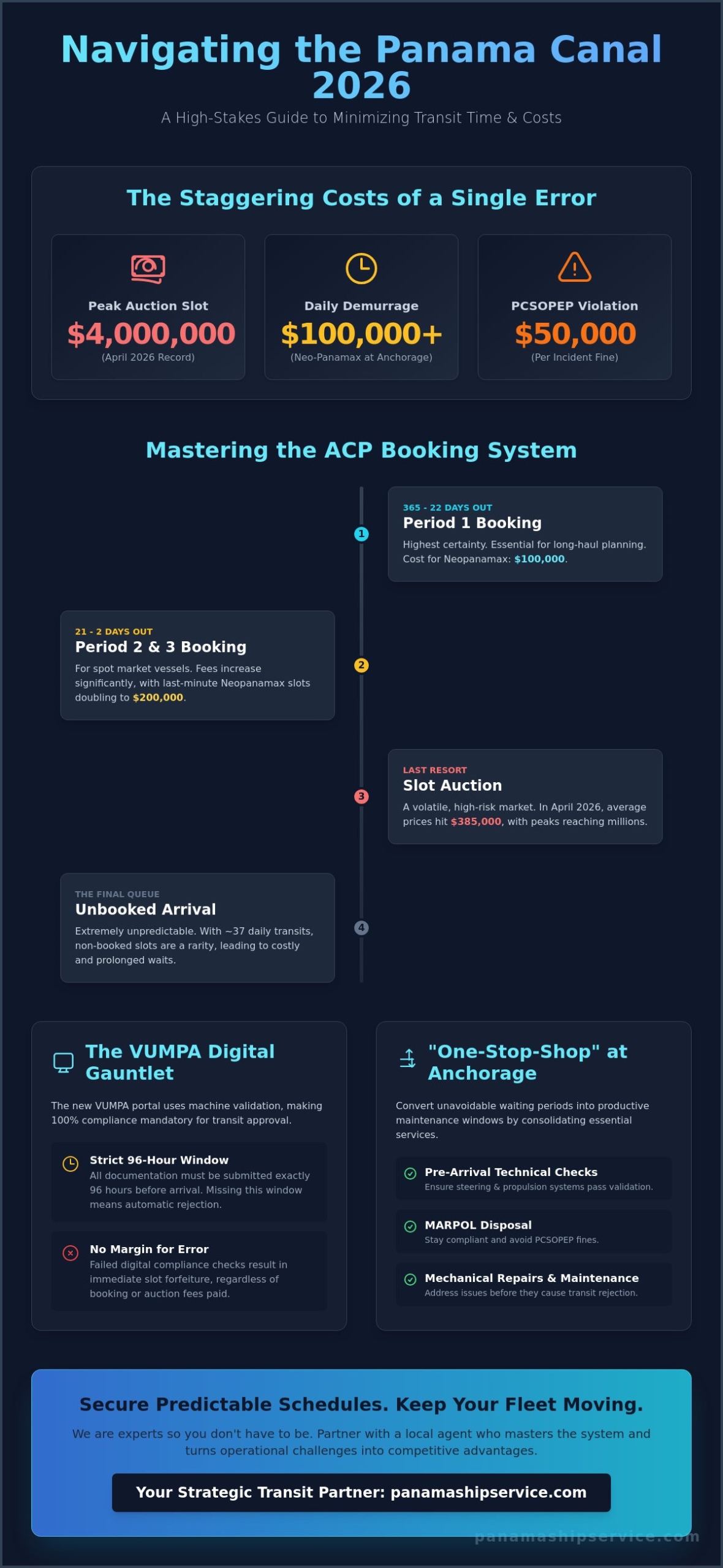
We are experts so you don’t have to be. This guide delivers actionable strategies to help you navigate the Panama Canal Authority’s strict new machine validated VUMPA portal and the LoTSA 2.5 allocation program. You’ll discover how to convert unavoidable waiting periods into productive maintenance windows and ensure 100% compliance to avoid the $50,000 fines associated with PCSOPEP violations. We will walk you through the essential technical checklists and booking tactics required to secure predictable schedules and keep your fleet moving in 2026.
Key Takeaways
- Master the strategic timing of the three ACP booking periods to secure slots and avoid the volatile auction market where prices have recently peaked.
- Implement a rigorous pre-arrival technical checklist for steering and propulsion systems to eliminate the risk of costly transit rejection by the ACP’s new digital validation system.
- Adopt a “One-Stop-Shop” approach at anchorage to complete MARPOL disposal and mechanical repairs, effectively minimizing panama canal transit time by using idle hours productively.
- Navigate the strict 96-hour VUMPA submission window and machine-validated compliance checks to guarantee seamless first-time approval for your vessel and crew.
The State of Panama Canal Transit Delays in 2026
The Panama Canal is operating at a high tempo in 2026. Data from the first half of the fiscal year shows 6,288 transits, which is a 224-vessel increase over the same period last year. While daily averages reached 37 transits in March 2026, the surge in demand from ships avoiding geopolitical instability in the Red Sea has made non-booked slots a rarity. If you arrive without a reservation, you’re entering a high-stakes queue where Neo-Panamax vessels often face longer, more expensive waits than smaller Panamax classes. This wait isn’t just a scheduling gap; it’s a period of technical vulnerability where a single equipment failure can lead to a forfeited slot. Effective strategies for minimizing panama canal transit time must begin with a clear understanding of these 2026 operational pressures.
Environmental and Operational Factors
Gatun Lake water levels are currently optimal as of April 2026, but the Panama Canal Authority (ACP) remains cautious. They’ve already implemented water conservation measures to prepare for potential El Niño conditions later this year. These shifts directly dictate draft restrictions and slot availability. To understand the complex history and operations of the Panama Canal, one must look at how seasonal rainfall patterns interact with ACP maintenance schedules. When the canal moves from Condition 1 to Condition 5, available slots drop and congestion spikes. We monitor these conditions daily so you don’t have to guess about your vessel’s draft limits.
The True Cost of a Delayed Transit
Delays at Balboa or Cristobal anchorage are expensive. Daily demurrage rates for a Neo-Panamax can exceed $100,000 in peak periods, and that doesn’t include the fuel burned while station-keeping. With auction prices for last-minute slots averaging $385,000 and occasionally hitting $4 million, the financial risk of waiting is staggering. Many owners attempt slow steaming to time their arrival, but the new machine-validated VUMPA portal requires a strict 96-hour submission before arrival. Missing this window or failing a digital compliance check results in automatic rejection and slot forfeiture. Beyond the immediate financial loss, these delays disrupt downstream port schedules; this creates a ripple effect across your entire supply chain and damages your reputation with charterers.
Mastering the ACP Booking System and Slot Auctions
The Panama Canal Authority (ACP) manages transit priority through a rigid hierarchy. Pre-booked vessels always take precedence, followed by those that successfully bid in slot auctions. The “first-come, first-served” queue is the last resort. In 2026, relying on that final queue is a high-risk gamble. With daily averages fluctuating around 37 transits, unbooked vessels face the brunt of any congestion. For owners, minimizing panama canal transit time is a calculation of whether a reservation fee is lower than five days of demurrage at anchorage.
Strategic timing is everything. Period 1 reservations for Neopanamax vessels cost $100,000, but they offer the highest certainty. If you wait for a last-minute reservation, that fee doubles to $200,000. We’ve seen auction prices reach an average of $385,000 in April 2026. This volatile market requires constant monitoring. You don’t want to enter an auction blindly. A qualified local agent provides the real-time data needed to decide when to bid and when to wait.
Step-by-Step Booking Strategy
Long-haul planning should utilize the 365-day booking window. The LoTSA 2.5 program, which covers transit dates from July 5, 2026, through January 2, 2027, is a prime example of how the ACP is providing more certainty. Sealed bids for this program opened on April 28, 2026. For spot market vessels, the 21-day and 7-day tiers are more relevant. Be aware that ‘Panamax-plus’ vessels face tighter restrictions. If you miss these windows, your only options are the auction or the standard queue, both of which carry significant financial risks.
Winning the Slot Auction
To win an auction without overpaying, you must know your break-even point. If your vessel’s daily rate is $80,000 and the current queue is six days, a $400,000 bid makes financial sense. Historical data from April 2026 shows that auction prices can more than double in a single month. Avoid the common pitfall of bidding without ensuring technical readiness. If your vessel is rejected at the pier for a technical deficiency, you lose the bid price and the slot. We’ve seen bid packages under LoTSA 2.0 priced at $300,000 per slot for a six-month commitment. These long-term plays offer the predictability needed to stabilize your 2026 operating costs.
Technical Compliance: Eliminating Rejection Risks
Securing a slot is only half the battle. A recent analysis of transit delays highlights that traffic is surging as carriers avoid other global corridors. This pressure makes the Panama Canal Authority (ACP) less tolerant of technical deficiencies. If your vessel arrives with faulty steering gear, malfunctioning mooring winches, or inadequate propulsion, you won’t just face a delay; you’ll be kicked from the schedule entirely. In 2026, minimizing panama canal transit time requires a “zero-defect” approach before you even reach the anchorage.
The ACP pilot will not take command of a vessel that presents a safety risk. This is why all critical mechanical ship repairs must be completed and tested before the boarding window. Common failure points often include mooring winch tensioning and bridge visibility obstructions. Fines for equipment certificate oversights now start at $15,000, and that doesn’t account for the hundreds of thousands lost in forfeited auction bids. We provide the technical oversight to ensure your vessel meets every specific visibility and equipment standard required for a seamless transit.
Pre-Transit Inspections and Surveys
Don’t wait for the ACP inspector to find a problem. Utilizing professional marine surveys in Panama allows you to identify and rectify red flags while at anchorage. Draft surveys and bunker surveys are essential for avoiding weight-related rejections, especially as Gatun Lake water levels dictate strict draft limits. We ensure your class-approved inspections and certificates are valid and ready for machine validation through the VUMPA portal. Remember, the digital portal has eliminated manual review buffers, so your documentation must be flawless.
Underwater Readiness
A fouled hull is a slow hull. Biofouling doesn’t just increase fuel consumption; it can lead to transit rejections if invasive species are detected. Comprehensive underwater hull services, including propeller polishing and cleaning, optimize your speed and ensure compliance with environmental standards. We also conduct In-water inspections (UWILD) to clear any damage-related concerns that might otherwise delay your approval. Taking these proactive steps turns idle anchorage time into a technical advantage, ensuring you pass the first time.
Operational Consolidation: Maximizing Efficiency at Anchorage
Waiting at anchorage doesn’t have to be a total loss of productivity. In 2026, with the average transit wait still influenced by high demand and strict slot allocations, the most efficient operators use this idle time for essential husbandry and technical services. This ‘One-Stop-Shop’ approach is a critical component of minimizing panama canal transit time; it ensures that once your vessel receives the green light from the ACP, it’s fully provisioned, compliant, and ready for the next leg of its journey without needing further stops.
Simultaneous operations (SIMOPS) allow you to consolidate repairs, supplies, and waste management. Coordinating MARPOL disposal in Panama while in the queue is particularly effective. Vessels carrying 400 metric tons or more of persistent oil must maintain a current, ACP-approved PCSOPEP. Managing your sludge and garbage disposal at anchorage ensures you meet these environmental standards and prevents logistical bottlenecks at your destination port. By using a single technical partner, you reduce the friction of managing multiple vendors in a high-pressure environment.
Essential Husbandry Services
Balboa and Cristobal are the primary hubs for logistical support. We manage crew changes and the delivery of ship supplies with precision timing to avoid any interference with your scheduled transit window. Fresh water delivery and provision sourcing are handled proactively. We also facilitate sanitary inspections and pest control to keep your certificates current. Since the ACP strictly enforces the 96-hour VUMPA submission deadline, having your husbandry services coordinated in advance is vital for maintaining your place in the hierarchy.
Consolidating Maintenance and Repairs
The wait at anchorage is the ideal window for executing mechanical ship repairs in Panama. Whether it’s a minor engine adjustment or critical A/C and refrigeration repairs, completing this work before the pilot boards is essential for crew welfare and vessel safety. Our team provides rapid response for technical issues that could otherwise lead to a transit rejection. Don’t let your vessel sit idle; contact a trusted partner to turn your anchorage time into a productive maintenance window.
Why Panama Ship Service is Your Strategic Transit Partner
Operating at the Panama Canal for 20 years has taught us that timing is everything. We understand the specific pressures ship owners and charterers face as costs continually increase and regulations become more stringent. Our role is to act as your trusted partner at the Panama Canal, providing the technical and operational support necessary for minimizing panama canal transit time. We are experts so you don’t have to be; we ensure your vessel meets every ACP requirement before the pilot boards.
Our comprehensive service portfolio is designed to solve problems before they cause delays. Whether you need mechanical ship repairs, underwater hull services, or MARPOL disposal, we coordinate these tasks with a sense of urgency. Rapid response is our standard. If an emergency repair is needed to prevent a transit cancellation, our team is ready to move immediately. We provide the technical certainty you need to navigate a difficult and frustrating environment with total confidence. By consolidating these services, we transform your wait time into a period of high productivity.
Our Commitment to Vessel Efficiency
Efficiency is not just about speed; it’s about reliability and constant communication. We provide daily updates to keep all stakeholders informed of the vessel’s status and technical readiness. Our solutions are cost-conscious and prioritize your bottom line without compromising on quality or safety. With qualified technicians and surveyors available 24/7, we ensure that technical compliance is never a hurdle for your fleet. We focus on minimizing vessel expenses by getting the job done right the first time, preventing the $15,000 fines that often stem from equipment certificate oversights.
Put Your Transit in Our Hands
Consolidating your services with a single partner reduces logistical friction and minimizes your total port stay. We leverage our deep local knowledge to help you navigate the changing regulatory environment, such as the new digital VUMPA requirements and the complex LoTSA allocation programs. From marine surveys and ship supplies to crew changes and cargo handling, we manage the technical details so you can focus on your core business. Put your transit in our hands and experience the difference that two decades of specialized expertise makes in minimizing panama canal transit time. Contact Panama Ship Service for a comprehensive transit support quote to secure your 2026 schedule and protect your operational efficiency.
Secure Your Transit Success in 2026
Success at the Panama Canal this year depends on proactive planning and technical precision. You’ve seen how the 96-hour VUMPA deadline and machine-validated compliance leave no room for error. By mastering the 2026 booking tiers and utilizing idle anchorage hours for essential maintenance, you transform a period of high risk into one of operational gain. Minimizing panama canal transit time is the result of combining these strategic booking tactics with a “zero-defect” technical approach. This ensures your vessel passes the first time without the threat of $15,000 equipment fines or the loss of a multi-million dollar auction slot.
Panama Ship Service provides the specialized expertise required to navigate these complexities. With 20 years of operational excellence, we offer MARPOL-compliant disposal services and 24/7 emergency mechanical repair teams to keep your vessel moving. We handle the technical details so you can focus on your fleet’s broader logistics. We are experts so you don’t have to be. Minimize your vessel’s expenses and transit delays, contact Panama Ship Service today. Put your transit in our hands and stay ahead of the competition.
Frequently Asked Questions
What is the average Panama Canal transit time in 2026?
The actual canal passage typically requires 8 to 10 hours once the vessel enters the locks. However, the total duration from arrival at anchorage to completion depends heavily on your booking status and current traffic. In March 2026, daily transits averaged 37 vessels. For non booked ships, the wait at anchorage can extend for several days depending on the operational condition set by the ACP.
How much does a Panama Canal slot auction cost?
Auction prices for last minute slots reached an average of $385,000 in April 2026. While base reservation fees for Neopanamax vessels start at $100,000, high demand has driven some individual auction bids as high as $4 million. Long term slot allocation programs like LoTSA 2.0 have seen package bids average $300,000 per slot for a six month commitment.
Can I perform ship repairs while waiting for a transit slot?
Yes, you can execute mechanical repairs and underwater services while your vessel is at the Balboa or Cristobal anchorage. This is a highly effective strategy for minimizing panama canal transit time by converting unavoidable idle hours into productive maintenance windows. It ensures your vessel is in peak technical condition before the ACP pilot boards for the transit.
What are the common reasons for the ACP to reject a vessel’s transit?
Rejections often stem from technical deficiencies in steering gear, propulsion systems, or mooring winches. The ACP also strictly enforces the 96 hour VUMPA submission deadline through a machine validated portal. Failure to comply with PCSOPEP requirements or having invalid equipment certificates can lead to immediate slot forfeiture and fines starting at $15,000 for documentation oversights.
How does hull cleaning affect my Panama Canal transit?
Hull cleaning improves vessel maneuverability and ensures you meet environmental standards regarding invasive species. Biofouling can lead to transit rejections if inspectors determine the vessel poses a biological risk. Regular propeller polishing and hull grooming also help maintain the speeds required by the ACP to keep the transit schedule on track during the passage.
What is the difference between Balboa and Cristobal for vessel services?
Balboa is located on the Pacific side and Cristobal is on the Atlantic side; both offer comprehensive husbandry services. Balboa is frequently utilized for complex mechanical repairs due to its proximity to specialized technical workshops. Both ports support MARPOL disposal, crew changes, and ship supply deliveries, allowing you to choose the location that best fits your transit direction.
Are MARPOL disposal services mandatory for Panama Canal transit?
Disposal is not mandatory for every transit, but compliance with MARPOL regulations is strictly enforced during inspections. Vessels carrying 400 metric tons or more of persistent oil must have an approved PCSOPEP. Violations of oil pollution emergency plans can result in fines of $50,000 or more. Completing sludge and garbage disposal at anchorage prevents these costly compliance delays.
How can a local ship agent help minimize my transit delays?
A local agent acts as your direct link to the ACP and manages the complex VUMPA digital submission process. They provide real time data on auction prices and coordinate simultaneous operations like repairs and provisioning. This expert coordination is vital for minimizing panama canal transit time because it ensures your vessel is technically ready and documented correctly well before your scheduled window opens.