
A single undocumented scratch on a hull or a minor discrepancy in fuel logs can evaporate your charter profits in a matter of hours. In the high stakes maritime industry of 2026, assuming that a standard handover will go smoothly is a costly mistake. You likely feel the constant pressure of potential liability for damages you didn’t cause, alongside the frustration of bunker quantity disputes that delay vessel redelivery. A professional off-hire survey damage assessment is your most effective tool to mitigate these risks and secure your financial position.
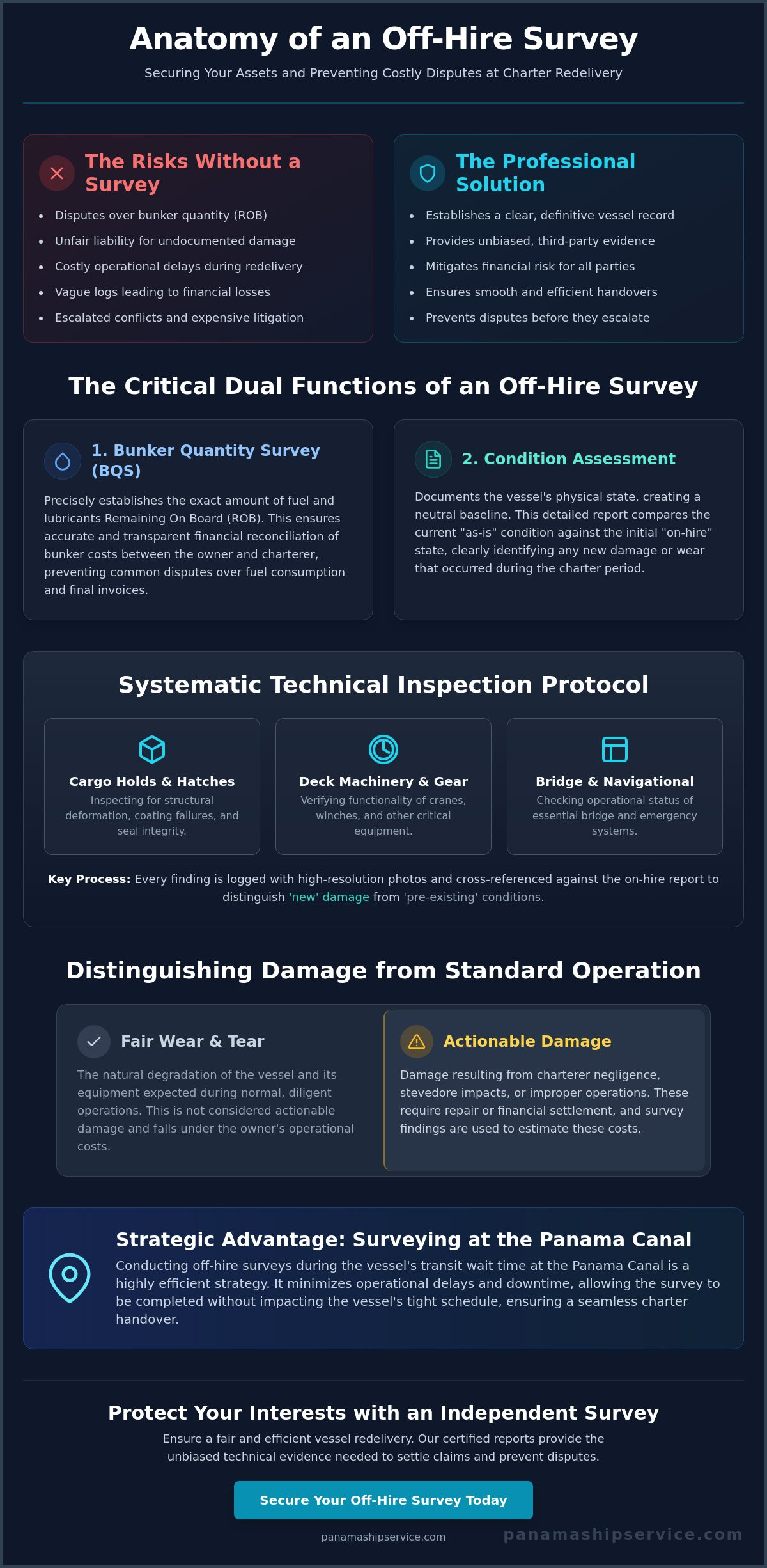
We understand that operational delays and unfair repair charges are more than just nuisances; they’re direct threats to your bottom line. This article explains how a professional off-hire survey damage assessment identifies liability, calculates bunker remainders, and prevents the maritime disputes that often arise during vessel redelivery. We’ll preview the essential elements of a certified report and show you how clear, technical evidence settles charter party conflicts before they escalate. By delegating this technical complexity to experienced surveyors, you can focus on your next fixture with total confidence in your vessel’s documented condition.
Key Takeaways
- Understand the critical dual function of off-hire surveys, combining Bunker Quantity Surveys (BQS) with comprehensive condition assessments to establish a clear baseline at redelivery.
- Learn the technical methodology behind a professional off-hire survey damage assessment, including the systematic inspection of cargo holds, hatch covers, and deck machinery for structural deformation.
- Identify how to convert technical survey findings into estimated repair costs to settle financial claims and prevent unseaworthiness disputes.
- Discover the operational advantages of conducting surveys at the Panama Canal, utilizing transit wait times to minimize vessel delays during the charter handover.
- Gain insights into why independent, third-party reporting is essential for providing unbiased evidence that protects the interests of all maritime stakeholders.
The Critical Role of Off-Hire Surveys in Risk Management
An off-hire survey is a formal technical inspection conducted at the conclusion of a charter period. It’s a vital risk management tool that creates a definitive record of the vessel’s state at the exact moment of redelivery. In the fast-paced maritime industry, this process prevents the costly disputes that often follow a long-term charter. Without a certified off-hire survey damage assessment, owners and charterers are left with conflicting logs and no clear evidence of when specific issues occurred.
A professional off-hire survey damage assessment provides two critical sets of data. First, the Bunker Quantity Survey (BQS) establishes the exact amount of fuel remaining on board (ROB). This ensures the financial reconciliation of fuel costs is accurate and transparent. Second, the Condition Assessment documents the physical state of the vessel. Together, these elements form a neutral baseline. This baseline allows parties to compare the current “as-is” condition against the original “on-hire” state recorded months or years prior. It’s about closing the loop on a contract with precision and speed.
Charter Party Obligations and Redelivery
Every redelivery is governed by a charter party agreement. These contracts distinguish between “fair wear and tear” and actionable damage. Wear and tear is the natural degradation expected during normal operations; actionable damage involves structural impacts or neglect that requires immediate repair. An independent surveyor’s report carries significant legal weight in maritime arbitration. Most operators schedule these surveys 24 to 48 hours before the official redelivery time to ensure all data is current and undisputed.
Protecting Owners and Charterers Alike
Owners rely on these surveys to identify structural damage or maintenance neglect caused by the charterer during the period of hire. Conversely, charterers use the same report to prove they’re returning the vessel in the contractually agreed state. In 2026, the surveyor acts as a professional witness. Their findings provide the technical evidence needed to settle disputes without resorting to expensive litigation. By delegating this task to a third-party expert, both parties ensure that the redelivery process is handled with professional objectivity and operational efficiency.
Technical Methodology of a Damage Assessment
A rigorous off-hire survey damage assessment follows a systematic protocol to ensure no structural or mechanical deficiency is overlooked. Our surveyors begin with a comprehensive visual inspection of the cargo holds, hatch covers, and deck machinery. We specifically look for recent impact damage that may have occurred during the final voyages of the charter. Every finding is backed by high-resolution photographic evidence and logged against the initial on-hire report. This allows us to clearly distinguish between ‘new’ damage and ‘pre-existing’ conditions, which is essential for any financial settlement. If you require a precise marine survey at the Panama Canal, our technical experts are ready to mobilize.
The methodology extends beyond the deck. We verify the functionality of onboard equipment, including the navigational bridge gear and emergency systems. When accessible, we assess the underwater hull condition through visual checks or by coordinating with divers to identify fouling or coating detachment. This level of detail ensures that the final report is not just a summary, but a technical audit that holds up under scrutiny.
- Visual inspection of cargo holds, hatch covers, and deck machinery.
- Documentation of structural deformation and coating failures.
- Photographic logging of ‘new’ vs ‘pre-existing’ damage.
- Bridge gear and navigational equipment verification.
- Underwater hull assessment via divers or visual inspection.
Focus on Cargo Spaces and Structural Integrity
During busy port stays, stevedore damage often goes unreported. We focus on these areas, evaluating the structural integrity of the holds and the tightness of hatch cover seals to prevent future cargo claims. It’s vital to identify coating failures or structural deformations early. Just as property owners prioritize maintenance through services like Chaparro’s Painting, LLC to preserve residential value, shipowners must address maritime coating issues to prevent corrosion. By accurately defining ‘fair wear and tear’ based on the vessel’s age and trade route, we prevent owners from facing unfair repair charges while ensuring charterers aren’t billed for standard operational aging.
Bunker Quantity Surveys (BQS) and ROB Calculations
The Bunker Quantity Survey (BQS) is the second pillar of the technical methodology. Our team performs physical soundings of all fuel tanks to determine the exact Remaining on Board (ROB) quantities. We don’t just rely on gauge readings; we account for fuel density and temperature variables to provide an accurate calculation. Comparing these ROB figures with the vessel’s logbook entries ensures full transparency. This data is critical when fulfilling the requirements of a standard On/Off-Hire Survey Clause in your contract. This systematic approach ensures that both parties have a clear, undisputed record of fuel assets at the time of redelivery.
Financial Implications of Survey Findings
Technical data recorded during an inspection serves as the foundation for financial settlements. Converting an off-hire survey damage assessment into a realistic repair estimate requires deep technical knowledge of current shipyard rates and material costs. When a surveyor identifies structural failures or mechanical deficiencies, the financial impact is immediate. If these issues compromise the vessel’s safety, it may be deemed unseaworthy. In such cases, the vessel is placed in “Off-Hire” status, which stops the charterer’s payment obligations and results in significant revenue loss for the owner. Accurate bunker data is also vital for Preventing Chartering Disputes that often arise from fuel quality or quantity discrepancies.
Beyond immediate repair costs, these reports are essential for secondary financial protections. P&I Clubs and hull underwriters require certified documentation to process insurance claims. Without a professional assessment, proving that damage occurred during a specific charter period becomes nearly impossible. This lack of evidence often leads to denied claims or protracted legal battles that exceed the cost of the initial repair.
Dispute Resolution and Arbitration Support
An off-hire report is the primary piece of evidence used in maritime court or arbitration. When damages are identified, owners and charterers must negotiate redelivery terms quickly to avoid operational standstills. A certified off-hire survey damage assessment provides the necessary leverage for these negotiations. If a party disagrees with the findings, the surveyor must issue a “Notice of Protest” immediately. This document preserves the right to claim damages later and ensures that the technical record remains the central focus of any legal dispute.
Minimizing Financial Exposure
Proactive management can significantly reduce redelivery costs. By identifying minor repairs early in the survey process, operators can often fix issues before the official redelivery time. This prevents the vessel from being declared off-hire for avoidable reasons. It also prevents “double charging,” where a charterer might be billed for a dent or coating failure that was already documented during the on-hire survey. Securing high quality marine surveys in Panama ensures your vessel meets all local compliance standards while protecting your financial interests during this critical transition phase.
Strategic Advantages of Surveying at the Panama Canal
Panama’s status as a global crossroads makes it the premier location for redelivery and charter changes. For ship operators, the ability to conduct an off-hire survey damage assessment while waiting for a transit slot is an unmatched logistical advantage. Instead of diverting to a secondary port, you can utilize the mandatory anchorage time at either end of the canal to finalize the technical handover. This efficiency reduces the total time the vessel spends in a non-earning state, directly protecting your bottom line.
The local expertise available in Panama is specialized for this unique environment. Surveyors here are intimately familiar with the Panama Canal Authority (ACP) standards, including the current “OP Notice to Shipping N-1-2026.” Ensuring your vessel is compliant with these regulations during redelivery prevents operational friction and potential fines. Access to a world-class technical cluster means that any damage identified can be addressed immediately by local specialists.
Timing and Logistics in Panama
Effective scheduling is the key to minimizing downtime. By coordinating surveys to coincide with transit windows, you ensure that the inspection process does not delay your passage. Technical attendance is available at both the Balboa and Cristobal ports, providing flexibility regardless of your vessel’s direction. The Panama maritime cluster operates on a 24/7 basis, allowing for rapid mobilization and report turnaround. This high-speed operational rhythm is designed to meet the demands of modern shipping schedules.
Transitioning from Survey to Repair
A significant benefit of surveying in Panama is the immediate access to remediation services. If an off-hire survey damage assessment identifies structural or mechanical issues that could lead to an off-hire claim, you can deploy repair teams instantly. You can easily arrange for mechanical ship repairs in Panama to resolve deficiencies before the vessel is handed over. Additionally, coordinating underwater inspections with hull cleaning or propeller polishing maximizes the efficiency of your stay. This seamless transition from assessment to action is why Panama remains a strategic hub for vessel interests worldwide. To ensure your next redelivery is handled with this level of precision, partner with Panama Ship Service for your technical survey needs.
Why Panama Ship Service for Damage Assessment
Panama Ship Service is a seasoned veteran in the maritime industry, offering a calm, expert presence in the high-pressure environment of the Panama Canal. We understand that vessel redelivery is a time-sensitive process where every minute of delay impacts your fiscal responsibility. Our team has spent decades navigating the specific operational pressures of this strategic hub. We provide ship managers and owners with the confidence that their interests are protected through a meticulous off-hire survey damage assessment. Because we maintain strict independent, third-party status, our reports are unbiased and respected by all stakeholders, including P&I Clubs and charterers.
One of our primary advantages is the ability to bridge the gap between identifying a problem and implementing a solution. Many surveyors provide a list of damages and then leave the operator to find a repair vendor. We offer a more efficient path. If your off-hire survey damage assessment reveals critical deficiencies, we can immediately mobilize our teams for Mechanical Ship Repairs or Underwater Hull Services. This integrated approach allows you to delegate technical complexity to us, simplifying your operations and ensuring the vessel returns to service without unnecessary complication.
Our Technical Expertise
Our surveyors are highly organized and systematic in their approach. We utilize qualified professionals with deep knowledge of mechanical, structural, and underwater systems to ensure no detail is missed. To provide clear evidence for potential disputes, we use high-definition photography and meticulously structured reporting templates. This level of detail is designed to meet international standards and class approval requirements. Our reports don’t just list findings; they provide a comprehensive technical audit that stands up to the scrutiny of maritime arbitration.
Streamlining Your Redelivery
We’ve designed our workflow to guide busy professionals quickly to the outcomes they need: cost savings and time efficiency. Our one-stop-shop approach minimizes overhead by handling surveys and remediation under a single point of contact. From the moment of your initial inquiry, we maintain proactive and responsive communication to ensure your schedule is optimized. We don’t just identify risks; we provide the technical support to resolve them before they lead to costly off-hire claims. You’re invited to experience a more reliable, professional handover process at the canal.
Contact Panama Ship Service today for a reliable off-hire survey.
Secure Your Redelivery Interests with Professional Oversight
The redelivery of a vessel is a critical financial milestone that requires technical precision and objective documentation. A comprehensive off-hire survey damage assessment ensures that every structural deficiency and fuel discrepancy is recorded before the charter period ends. This proactive approach prevents the costly litigation and operational delays that arise from undocumented liabilities. By utilizing the strategic anchorage time at the Panama Canal, you can transition seamlessly from inspection to any necessary remediation without deviating from your route.
Panama Ship Service provides 24/7 technical attendance at both ends of the canal to support your redelivery schedule. Our independent reports are recognized by international P&I Clubs and insurers, providing the authoritative evidence required for any maritime claim. We offer integrated repair and survey solutions to minimize vessel downtime, allowing you to delegate technical complexity to a trusted partner. Our goal is to protect your bottom line through efficiency and seasoned expertise.
Request an Off-Hire Survey Quote in Panama today to protect your vessel’s interests and ensure a smooth handover. We look forward to supporting your operations with the reliability your business demands.
Frequently Asked Questions
What is the difference between an on-hire and an off-hire survey?
An on-hire survey documents the vessel’s condition at the beginning of a charter, while an off-hire survey records its state at redelivery. The comparison between these two reports is the primary mechanism used to identify new damages. This process ensures that charterers aren’t held liable for pre-existing issues and that owners receive their vessel in the contractually agreed condition.
How long does a typical off-hire damage assessment take?
A standard inspection usually requires between four and eight hours to complete on board. The exact duration depends on the vessel’s size, the number of cargo holds, and the complexity of the deck machinery. Large bulk carriers or tankers with extensive structural areas may require additional time to ensure a thorough technical audit of all critical systems.
Who is responsible for paying for the off-hire survey?
Responsibility for survey costs is dictated by the specific clauses in the Charter Party agreement. Often, the owner and charterer share the expense of a joint survey to ensure an unbiased result. In other arrangements, each party may hire their own independent surveyor to protect their individual interests during the redelivery process.
Can an off-hire survey be performed while the vessel is at anchor in Panama?
Yes, conducting an off-hire survey damage assessment at the Pacific or Atlantic anchorages is a standard industry practice. This allows the inspection to take place during the mandatory waiting period for a Panama Canal transit. It’s an efficient way to fulfill contractual obligations without adding extra days to the vessel’s operational schedule.
What happens if the owner and charterer disagree with the survey findings?
If a disagreement occurs, the surveyor issues a Notice of Protest to formally document the dispute. This document preserves the legal rights of the aggrieved party for future arbitration or settlement negotiations. In many cases, the technical evidence provided in the off-hire survey damage assessment report serves as the final authority to resolve these conflicts quickly.
Is a bunker quantity survey always included in an off-hire inspection?
A bunker quantity survey (BQS) is almost always performed alongside the condition assessment, though they are technically distinct services. Combining them ensures that fuel remainders (ROB) and physical condition are documented at the exact same moment. This integration simplifies the financial reconciliation process for both the shipowner and the charterer at the end of the hire.
Does a damage assessment include underwater hull inspections?
A standard assessment focuses on the visible areas above the waterline, but underwater hull inspections can be included as a specialized add-on. These require diving teams to check for fouling, paint detachment, or mechanical damage to the propeller and rudder. Including this service provides a complete picture of the vessel’s state at redelivery for total risk mitigation.
How does an off-hire survey help with insurance claims?
The survey report acts as the primary evidence needed to prove when and where a specific damage occurred. Insurance underwriters and P&I Clubs require this certified documentation to process claims for structural repairs or mechanical failures. Without a professional off-hire report, it’s difficult to demonstrate that damage happened during the specific period of insurance coverage.