
A compliant logbook doesn’t make an unlawful discharge legal. Under the oily bilge water log book requirements, ships of 400 GT or more must meet MARPOL Annex I Regulation 15 conditions, according to the International Maritime Organization. Discharge must take place while the vessel is en route, through an onboard oily water separator, and oil or oily mixtures must never be discharged in the Antarctic area.
That distinction matters: crews need to know both when discharge is permitted and how to document the handling of bilge water and oil residues. Clear, accurate entries link the operational record to the vessel’s actual waste-handling practices.
This guide explains discharge conditions and the records that go with them. It covers routine retention entries, sludge collection and oil-residue handling, tank transfers, and overboard discharge. It also outlines equipment and sign-off details that help keep the Oil Record Book complete and consistent.
Key Takeaways
- Keep routine retention entries to no more than once a week, and make sure the record reflects actual tank contents and handling.
- Use the relevant Oil Record Book codes to distinguish total oil residues retained, manually collected residues, and disposal methods.
- Record internal tank transfers as they happen, with clear details that match the vessel’s related operational records.
- Ships of 400 GT or more must meet MARPOL Annex I Regulation 15 conditions for legal bilge-water discharge, according to the International Maritime Organization.
- Keep Oil Record Book Part I onboard for 3 years from the date of its last entry.
1. Frequency of retention entries
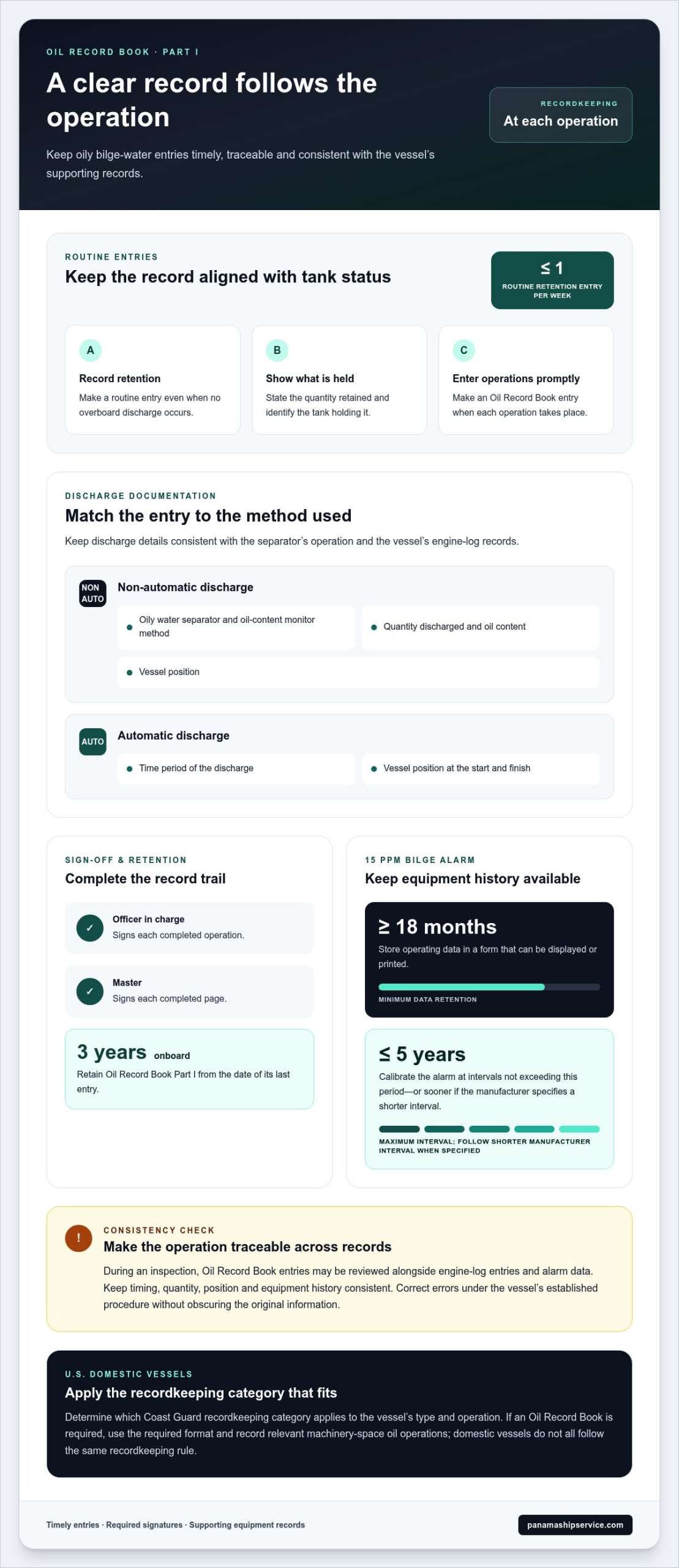
Record oily bilge-water retention regularly, even when no overboard discharge occurs. Make the routine retention entry no more than once a week. Show the quantity retained and identify the tank holding it, so the record reflects the vessel’s actual bilge-water status. The oily bilge water log book requirements include a retention record, not only entries for discharge events.
Make an Oil Record Book entry when each operation takes place. Each completed operation must be signed by the officer in charge, and the Master must sign each completed page. Retain Oil Record Book Part I onboard for 3 years from the date of its last entry. In practice, record the operation promptly, obtain the required signatures, and preserve Part I for the full retention period.
For a U.S. domestic vessel, determine which Coast Guard recordkeeping category applies to its type and operation. If an Oil Record Book is required, use the required format and record relevant machinery-space oil operations. Do not assume that every domestic vessel follows the same recordkeeping rule. Apply oily bilge water log book requirements to the vessel’s actual operating context.
For a bilge-water discharge, match the entry to the method used. For a non-automatic discharge, identify the oily water separator and oil-content monitor method, quantity discharged, oil content, and vessel position. For an automatic discharge, record the time period and the vessel’s position at the start and finish. Record separator operation in the engine logbook and reflect it in the Oil Record Book, keeping the details consistent.
Keep the alarm record available alongside discharge records. Store the 15 ppm bilge alarm’s operating data for at least 18 months in a form that can be displayed or printed. Calibrate the alarm at intervals not exceeding 5 years, or sooner if the manufacturer specifies a shorter interval. These equipment records help establish the operating history behind a discharge entry.
During an inspection, records may be reviewed alongside engine-log entries and alarm data. Differences in timing, quantity, position, or equipment history can make an operation difficult to trace. There is no single penalty for every incomplete or inaccurate record; consequences depend on the conduct and applicable law. Keep entries legible and consistent, and correct errors under the vessel’s established procedure without obscuring the original information.
2. Oil Record Book entries for sludge and oil-residue collection
Oil Record Book Part I covers machinery-space oil operations, including bilge-water discharge, sludge handling, and bunkering. Enter each operation when it occurs, then ensure the entry is accurate, complete, and consistent with related records. Timely entries connect the recorded quantity and action to the vessel’s actual operation.
For a U.S.-flag vessel subject to MARPOL Annex I, Part I is the relevant record for machinery-space oil operations. It includes entries for bilge-water discharge and oil-residue handling. Record each operation in the appropriate category and keep the Oil Record Book consistent with supporting records.
Use the Oil Record Book codes to distinguish residue quantities and collection methods. Code C 11.3 records the total quantity of oil residues retained. Code C 11.4 records the quantity collected through manual operation. That distinction matters: the first gives the retained total, while the second identifies an operator-initiated collection.
Code C 11.4 came into force on 1 January 2011. For a manual collection, record the quantity collected under that code at the time of the operation. Then ensure the retained-residue total reflects the operation. For example, a manual collection can change the amount retained, so related entries should tell a consistent account.
For sludge disposal, use the appropriate Oil Record Book code C 12 method. The listed methods are disposal to shore facilities, internal transfer, incineration, and burning in a boiler. Select the method that describes what actually happened. Record the operation when it occurs, and keep the quantity and destination consistent with related records.
- Collection: distinguish the total retained quantity from manually collected residue.
- Disposal: identify the applicable code C 12 method.
- Consistency: compare each entry with related operational records.
When correcting an entry, make the intended information clear and keep it consistent with related records. An amendment must not obscure what operation took place. Electronic Oil Record Books should also preserve complete, accurate details and a usable history. The standard is the same for paper and electronic records: each entry should clearly describe the operation performed.
When sludge must leave the vessel, MARPOL Disposal is a relevant operational next step for shore-side residue handling.
3. Internal transfers between tanks
An internal transfer moves oily water or oil residue from one onboard tank to another. Record it as a distinct operation, not as a discharge from the vessel. Oil Record Book code C 12 includes internal transfer as a disposal method for oil residues. The entry should make clear that the material remained onboard and identify the transfer’s operational details.
Start by identifying the tank the material left and the tank that received it. Use the vessel’s actual tank names or identifiers, then record the quantity transferred and when the operation took place. These details make the movement traceable and explain why the recorded quantity decreased in one tank and increased in another.
Before completing the entry, compare it with the vessel’s tank soundings or other relevant operational records. For example, a transfer from the sludge tank to a designated holding tank should appear as an outflow from the first tank and an inflow to the second. If figures or tank names differ between records, reconcile the discrepancy through the vessel’s established process. Do not record an internal movement as shore disposal or overboard discharge.
Ships aren’t required under the Convention to have oily bilgewater holding tanks. However, any such tanks provided must be listed in Oil Record Book Table 3.3. Use the table’s tank details when recording a transfer, so the entry refers to the vessel’s documented arrangement. A tank list and an operation entry serve different purposes: Table 3.3 identifies tanks, while the transfer record describes what happened between them.
For a clear transfer entry, capture the details that allow another officer to follow the movement:
- The operation type, identified as an internal transfer under code C 12.
- The source tank and receiving tank, using their onboard identifiers.
- The quantity moved and the operation’s date and time.
- Any related record that helps reconcile the tank contents.
Enter the transfer when it occurs, not later from memory. Oil Record Book entries should be accurate, complete, and consistent with related records. A transfer may form part of a larger residue-handling sequence, such as collection followed by movement into a holding tank. Record each operation separately so the sequence is clear and the final tank contents can be traced through the vessel’s records.
Use this approach for both routine transfers and movements made before sludge disposal. Matching the code C 12 entry to the actual tank movement keeps onboard retention distinct from disposal ashore, incineration, or burning in a boiler.
4. MARPOL bilge-water discharge conditions
Legal discharge depends on the vessel’s status, equipment, location, and operating conditions. Ships of 400 GT or more must meet the stated MARPOL Annex I Regulation 15 conditions for legal bilge-water discharge, according to the International Maritime Organization. Meeting only one condition isn’t enough. The discharge must satisfy the applicable requirements as a whole. The oily bilge water log book requirements help document how the crew applies those conditions during an operation.
The vessel must be proceeding en route, and bilge water must pass through an onboard oily water separator. MARPOL 73/78 Annex 1 requires an oily water separator for bilge-water discharge. These are operational prerequisites, not substitutes for monitoring oil content. Before discharge, confirm that the separator and oil monitor are operating as intended, and that the discharge route is controlled.
The oil monitor must alarm if the discharge limit exceeds 15 ppm. When the oil monitor reads less than 15 ppm, the separator activates the overboard discharge valve. If oil content exceeds 15 ppm, the automatic stopping device must halt overboard discharge within 20 seconds. The alarm, monitor reading, valve response, and stopping device work together to prevent an over-limit discharge from continuing.
Location also determines whether discharge is prohibited. MARPOL Annex I prohibits any discharge of oil or oily mixtures in the Antarctic area, regardless of oil content or treatment. An operating separator or a reading below 15 ppm doesn’t make discharge lawful there. The location restriction applies even when equipment is operating properly. Treat the vessel’s position as a separate condition from the oil-content reading.
Use a clear pre-discharge sequence so the crew can assess each condition before opening the overboard route:
- Confirm the vessel is proceeding en route.
- Confirm the oily water separator and oil monitor are operating.
- Check that the discharge location isn’t in the Antarctic area.
- Monitor the oil-content reading and the alarm or stopping response.
For a non-automatic overboard discharge, record the oily water separator and oil-content monitor method, quantity, oil content, and vessel position. For an automatic discharge, record the time period and the vessel’s position at the start and finish. These entries connect the applicable conditions to the operation. Oily bilge water log book requirements guide the record, but an entry cannot make a prohibited discharge legal.
If the conditions are not met, retain the oily bilge water onboard for appropriate handling instead of discharging it overboard. Discharge eligibility depends on equipment performance, vessel location, and operating status. Assess these factors before the operation so the crew can distinguish a permitted discharge from a situation that requires onboard retention.
5. Which vessels must maintain an Oil Record Book under U.S. and international regulations?
Oil Record Book applicability depends on the vessel and the rules governing its operation. For international voyages, start by identifying whether the vessel falls under MARPOL Annex I requirements. Ships of 400 GT or more must meet the stated MARPOL Annex I Regulation 15 conditions for legal bilge-water discharge, according to the International Maritime Organization. That discharge threshold doesn’t, by itself, establish every vessel’s Oil Record Book obligation.
For a U.S.-flag vessel, distinguish the international framework from U.S. requirements. Review the vessel’s flag, gross tonnage, type, and operating profile against the applicable rules. These details determine which recordkeeping provisions apply. Do not assume that a domestic voyage automatically removes a vessel from international or U.S. obligations.
Oil Record Book Part I covers machinery-space oil operations, including bilge-water discharge, sludge handling, and bunkering. A vessel required to keep Part I needs records that follow these operations. Make entries when each operation occurs, and keep them accurate, complete, and consistent with related records. This makes the book an operational record, not just a discharge diary.
Apply the same vessel-specific review to oily bilgewater holding tanks. The Convention doesn’t require ships to have these tanks, but any such tanks provided must be listed in Table 3.3. A tank’s presence alone doesn’t answer whether a vessel must maintain an Oil Record Book. Instead, identify the applicable rule first, then ensure the required records reflect the vessel’s equipment and operations.
Use this practical sequence when establishing the vessel’s recordkeeping basis:
- Identify the flag state and whether the voyage is domestic or international.
- Record the vessel’s gross tonnage and type for the applicability review.
- Determine whether MARPOL Annex I and relevant U.S. rules apply.
- Match required Oil Record Book entries to machinery-space oil operations.
- List any provided oily bilgewater holding tanks in Table 3.3.
For vessels maintaining Oil Record Book Part I, preserve it onboard for 3 years from the date of its last entry. Each completed operation must be signed by the officer in charge, and the Master must sign each completed page. These controls make the record traceable across routine operations, transfers, and discharge events.
Keep the applicability decision with the vessel’s compliance records, alongside its flag, tonnage, and operating details. Revisit the assessment if the vessel’s operational profile changes. A clear basis helps officers use the right Oil Record Book format and avoid treating one vessel’s requirements as universal across the fleet.
Domestic operation alone does not determine whether a vessel must keep an Oil Record Book; review its flag, gross tonnage, type, operating profile, and applicable U.S. rules. If Part I is required, record machinery-space oil operations, including bilge-water discharge, and keep the book onboard for 3 years from its last entry, with the officer in charge signing each completed operation and the Master signing each completed page.
Panama Ship Service: Mechanical Ship Repairs
Panama Ship Service provides Mechanical Ship Repairs when machinery issues need attention during a port call or transit. If a problem affects oily water separator operation, address it as an equipment issue. Discharge decisions and Oil Record Book entries must still follow the applicable requirements.
For oily residues requiring shore-side handling, Panama Ship Service’s MARPOL Disposal service is a relevant next step. Marine Surveys support vessel inspection needs, while Underwater Hull Services address hull-related work. Each service addresses a distinct operational need, so select the one that matches the vessel’s requirement.
For mechanical repairs or oily-residue handling, contact Panama Ship Service or visit panamashipservice.com.
Build compliance into the next voyage plan
Use the vessel’s next operational review to connect recordkeeping with equipment condition and waste-handling arrangements. A clear process helps the crew identify when an operational issue needs attention, who is responsible for resolving it, and how the work fits the vessel’s schedule. Oily bilge water log book requirements are one part of broader operational readiness, alongside machinery upkeep and responsible residue handling.
Panama Ship Service supports vessels with Mechanical Ship Repairs, Underwater Hull Services, and MARPOL Disposal. Use the relevant service when machinery needs repair, hull work is required, or oily residues need handling. Coordinating these needs with voyage planning helps organize operational tasks while keeping onboard responsibilities in view.
Contact Panama Ship Service for support with your vessel’s operational requirements. Take the next step with a clear plan and keep your crew focused on safe, compliant operations.
Frequently Asked Questions
1. The Legal Framework: When Can You Discharge?
Discharge is permitted only when the applicable MARPOL Annex I conditions are met. For example, the vessel must be en route, use an oily water separator, and control oil content through the monitoring system. The Antarctic area is an absolute exception: oil or oily mixtures cannot be discharged there, regardless of treatment or reading. Check the vessel’s location and equipment status separately before any discharge.
2. What are the Oil Record Book requirements for oily bilge water discharge and disposal?
Record machinery-space oil operations in Oil Record Book Part I when the vessel is required to keep it. Distinguish bilge-water discharge from sludge or oil-residue handling so that disposal is not confused with an overboard release. For U.S.-flag vessels, apply relevant U.S. requirements alongside applicable MARPOL provisions. Review the vessel’s required recordbook, operation type, and supporting records together.
3. Which Oil Record Book sections and entries apply to machinery-space bilge water?
Oil Record Book Part I covers machinery-space operations, including bilge-water discharge, sludge handling, and bunkering. For residues, code C 11.3 records the total quantity retained, while C 11.4 captures residue collected manually. Code C 12 identifies disposal methods, including shore reception and internal transfer. Use the code that reflects the operation, rather than treating every residue movement as a discharge.
4. What information must be recorded when oily bilge water is transferred, treated, or discharged?
For an internal transfer, identify the source and receiving tanks and connect the movement to the vessel’s tank records. For non-automatic overboard discharge, record the separator and monitor method, quantity, oil content, and position. For automatic discharge, capture the period and the vessel’s positions at the start and finish. These details distinguish a tank movement from treatment or release overboard.
5. What are the discharge limits and special-area restrictions for oily bilge water?
The discharge limit is 15 ppm, and the oil monitor should alarm if that limit is exceeded. The automatic stopping device must halt discharge within 20 seconds after oil content exceeds the limit. The Antarctic restriction is broader than the numerical limit: no oil or oily-mixture discharge is allowed there, even after treatment. A compliant reading alone therefore doesn’t override the location-based prohibition.
What inspections, penalties, and risks apply to incomplete or inaccurate oily bilge water records?
During inspections, records may be checked against engine-log entries and 15 ppm bilge-alarm data. Mismatches in timing, quantity, position, or equipment history can make an operation difficult to trace; consequences depend on the conduct and applicable law, and no single penalty applies to every incomplete or inaccurate record.