
On March 12, 2025, a bulk carrier captain watched his transit schedule evaporate as Port State Control (PSC) inspectors flagged a minor seal discrepancy on the OWS discharge line. You know that the Panama Canal Authority and PSC inspectors don’t accept excuses when it comes to bilge water management. The pressure to maintain perfect oily water separator compliance is constant. A single deficiency can trigger massive MARPOL fines or weeks of detention. It’s frustrating to manage complex ORB entries while your crew focuses on the physical transit.
As your trusted partner at the Panama Canal, we believe you shouldn’t have to worry about technical bottlenecks. We are experts so you don’t have to be. This guide provides the technical and regulatory roadmap to ensure your 2026 transits remain zero-deficiency and cost-effective. You will learn the latest ACP requirements, common ORB pitfalls, and operational best practices for a seamless voyage through the Isthmus.
Key Takeaways
- Navigate the technical evolution from MEPC 60(33) to current MEPC 107(49) standards to ensure your oil content meters meet modern data-recording requirements.
- Master oily water separator compliance by implementing rigorous maintenance and monitoring protocols that prevent costly 15 ppm discharge violations.
- Protect your fleet from the severe financial and operational risks of MARPOL detentions by identifying the common pitfalls that trigger “Magic Pipe” investigations.
- Ensure your Oil Record Book remains audit-ready by synchronizing physical tank soundings with logbook entries to eliminate red flags during inspections.
- Optimize your Panama Canal transit by leveraging specialized MARPOL disposal services to manage bilge water efficiently and ensure a zero-delay passage.
Understanding Oily Water Separator Compliance Standards
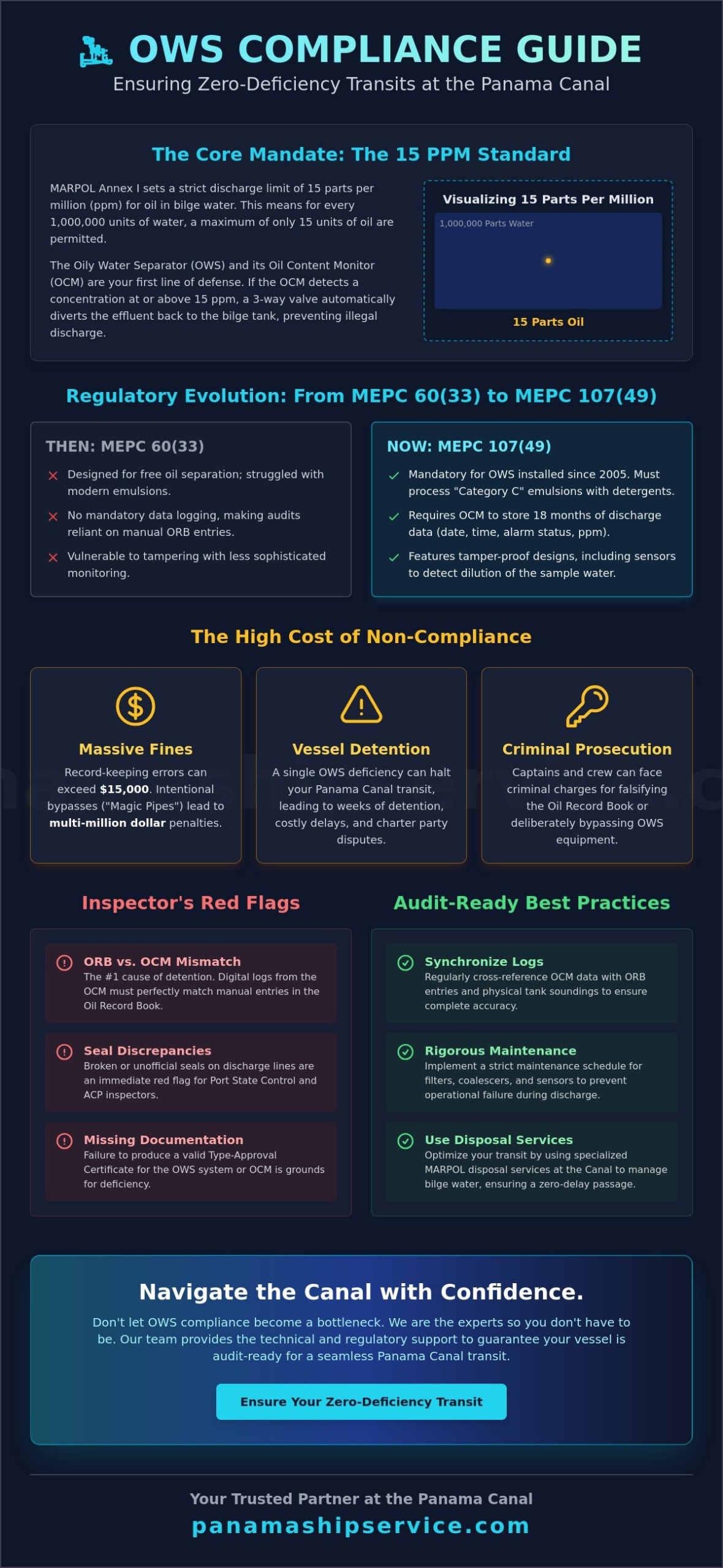
Achieving oily water separator compliance is a non-negotiable requirement for every vessel preparing for a Panama Canal transit in 2026. This standard is strictly defined by the 15 parts per million (ppm) oil-in-water discharge limit. MARPOL Annex I established these global regulations to prevent the discharge of bilge water containing oil into the marine environment. The Oily Water Separator (OWS) is the primary technical barrier that ensures these limits are met before any liquid leaves the ship. For operators in the Panama Canal, the Panama Canal Authority (ACP) enforces these rules with zero tolerance to protect the local watershed and the Gatun Lake ecosystem.
Failure to maintain these standards leads to immediate operational shutdowns. The consequences of non-compliance range from heavy administrative fines to vessel arrest and criminal prosecution for the crew. We are experts in these requirements so you don’t have to be. Our team ensures your equipment meets every local and international benchmark before you reach the locks.
The 15 PPM Standard Explained
Visualizing 15 ppm helps clarify the precision required. It represents just 15 units of oil for every million units of water. To ensure this accuracy, an Oil Content Monitor (OCM) continuously samples the effluent during discharge. If the oil concentration reaches 15 ppm, the OCM triggers a three-way valve. This valve immediately diverts the water back to the bilge holding tank instead of allowing it to pass overboard.
Standards in 2026 are significantly more demanding than those of previous decades. While the 1973 MARPOL convention initially allowed higher concentrations in certain zones, modern MEPC.107(49) regulations require systems to handle emulsified oils and surfactants. Modern OCM units now include data recording functions that store 18 months of discharge data. Discrepancies between these digital logs and the manual Oil Record Book (ORB) are the most common cause of detention during transit inspections.
Regulatory Bodies and Enforcement
The International Maritime Organization (IMO) sets the global framework, but local enforcement determines your transit success. Port State Control (PSC) officers prioritize OWS inspections because they are frequent sources of MARPOL violations. During a Panama Canal transit, the ACP exercises specific oversight that goes beyond standard port calls. They verify that the OWS is fully operational and that all seals are intact.
- IMO: Establishes the technical specifications for OWS equipment and OCM accuracy.
- PSC: Conducts unannounced inspections of the piping, valves, and discharge records.
- ACP: Enforces strict environmental protocols within the Canal Zone to protect fresh water supplies.
Non-compliance is expensive and time-consuming. Fines for record-keeping errors frequently exceed $15,000, while hardware bypasses can lead to multi-million dollar penalties and long-term vessel blacklisting. Panama Ship Service is your trusted partner at the Panama Canal, providing the technical expertise needed to navigate these high-stakes inspections without delay.
Technical Requirements: IMO MEPC 107(49) and Beyond
Vessel operators must recognize that MARPOL Annex I standards underwent a fundamental shift with the implementation of MEPC 107(49). The older MEPC 60(33) systems were designed to handle free oil, but they often fail when faced with the complex emulsions found in modern engine rooms. Since January 1, 2005, all oily water separator (OWS) installations must meet the 107(49) criteria, which specifically requires the equipment to process “Category C” fluids containing detergents and surfactants. Your oily water separator compliance depends entirely on the system’s ability to break these chemical bonds and maintain a discharge of less than 15 parts per million (ppm).
Modern units feature mandatory tamper-proof designs. These systems include sensors that detect if the sample water is being diluted with fresh water to “trick” the monitor. If the system detects interference or an oil concentration above the 15 ppm limit, the three-way valve must automatically redirect the fluid to the bilge holding tank. Every component on the OWS skid, including the pumps and the monitor, must have a valid Type-Approval Certificate. Missing documentation is one of the fastest ways to fail a Port State Control inspection in Panama.
Filtration and Separation Technologies
Gravity separation is no longer sufficient for modern maritime operations. While gravity-based systems are simple, they can’t handle the fine oil droplets found in stabilized emulsions. Centrifugal separation is more reliable for vessels with high bilge water production, though it requires more frequent mechanical maintenance. Most 2026-compliant systems now utilize multi-stage adsorption filters. These filters use specialized media to attract and hold microscopic oil particles. Chemical pre-treatment has also become a standard requirement. By adding flocculants or coagulants before the filtration stage, the system can effectively separate stable emulsions that would otherwise bypass traditional filters.
The Oil Content Monitor (OCM) Functionality
The OCM is the most scrutinized component during any transit inspection. You must calibrate the OCM at least once every five years, or more frequently if the manufacturer specifies. The “White Box” or secure data logging system is now a critical part of oily water separator compliance. It records the date, time, GPS location, and the functional status of the discharge valve. This data must remain stored and accessible for 18 months.
Common OCM failure points often involve fouled optical sensors or air bubbles trapped in the sample line. These issues trigger false alarms and stop discharge operations. Regular lens cleaning and ensuring a steady, bubble-free flow to the sensor are essential maintenance tasks. If your crew identifies technical discrepancies before reaching the canal, we provide expert technical support to resolve equipment issues and ensure a smooth transit. We are experts so you don’t have to be, allowing you to focus on the voyage while we handle the technical details of MARPOL compliance.
The High Cost of Non-Compliance: Fines and Detentions
MARPOL enforcement has reached an all-time high in 2026. Global authorities no longer view oily water discharge violations as simple administrative errors; they treat them as serious environmental crimes. The “Magic Pipe” remains a primary target for Port State Control (PSC) officers during inspections. These unauthorized bypass systems are frequently discovered during routine checks, leading to immediate vessel arrest and lengthy criminal investigations. Maintaining strict oily water separator compliance is the only way to protect your assets and your crew from these aggressive enforcement trends.
Financial penalties for MARPOL Annex I violations are staggering. In 2024, maritime authorities in various jurisdictions issued fines ranging from $750,000 to over $4 million for illegal discharges and record-book falsification. Beyond the fine itself, the operational impact of a PSC detention is devastating. A ship held in port for a MARPOL investigation will miss its Panama Canal transit window. This causes a breach of charter party agreements. It leads to off-hire periods that can cost owners upwards of $35,000 daily in lost revenue and additional port fees.
The whistleblower factor adds another layer of risk to your operations. Under the Act to Prevent Pollution from Ships (APPS), crew members who report illegal activity can receive up to 50% of the government’s collected fine. This financial incentive has turned crew training into a vital compliance tool. If your crew doesn’t feel confident in the equipment or the company’s commitment to the law, the risk of an internal report increases exponentially.
Legal Implications for Ship Owners and Officers
Non-compliance carries heavy criminal weight. Masters and Chief Engineers face personal criminal liability; this often results in prison sentences and the permanent loss of sailing licenses. Civil penalties are equally harsh. A single violation can lead to a company being barred from specific ports or entire national waters for years. From an insurance perspective, P&I Clubs typically refuse to cover fines arising from intentional misconduct or gross negligence. You’ll likely pay these costs out of pocket.
Environmental and Brand Damage
The ecological impact of oil discharge is long-lasting. Even small amounts of untreated bilge water damage sensitive marine ecosystems for decades. In the current market, Corporate Social Responsibility (CSR) is a mandatory requirement for doing business with major charterers. A public record of environmental violations ruins a shipping company’s reputation instantly. Vetting organizations will flag your vessels, making it nearly impossible to secure high-value contracts. One mistake can end 20 years of built-up trust in a single afternoon.
Best Practices for OWS Maintenance and Logbook Accuracy
Maintaining oily water separator compliance is a matter of strict operational discipline. In 2026, Port State Control (PSC) inspectors at the Panama Canal have increased their focus on system integrity and record consistency. You must implement a “No-Bypass” policy that is reinforced through regular internal audits. This policy isn’t just a rule; it’s a culture. Engineering teams must understand that any unauthorized pipe modification or seal tampering results in immediate detention and heavy fines. We recommend a weekly verification of all lead seals on overboard valves and the 3-way return valve to ensure no tampering has occurred.
Effective management starts with a tiered maintenance schedule. Daily checks should focus on the Oil Content Monitor (OCM) for any error codes. Weekly tasks must include testing the 15 ppm alarm’s functionality. Monthly, the chief engineer should review the entire system’s performance against the manufacturer’s specifications. Before you arrive at the Cristobal or Balboa anchorages, manage your inventory of slops and sludge. If your tanks are above 80% capacity, you’re at risk. Proactively schedule MARPOL disposal services to avoid the pressure of running the OWS under tight deadlines during the 50-mile transit.
Oil Record Book (ORB) Management
Discrepancies in the Oil Record Book Part I are the most frequent cause of vessel delays. Under MARPOL Annex I, every bilge water transfer or OWS operation must be logged immediately. Inspectors check if the OCM electronic log timestamps align with your manual ORB entries. Common mistakes include mismatched tank codes or failing to record the “stop” time of a discharge. Ensure your physical tank soundings taken at 08:00 daily match the figures in the logbook. A variance of even 1% can lead to a detailed inspection that halts your transit.
Physical System Maintenance
Technical reliability is non-negotiable for oily water separator compliance. Clean the coalescer beds regularly to prevent oil carry-over and replace filter elements based on the pressure differential, not just the calendar. You must verify the integrity of the sampling points; they should be clean and provide a representative sample of the effluent. Test the automatic stopping device to ensure it diverts flow back to the bilge tank within seconds of a 15 ppm alarm. If the 3-way valve is sluggish, it’s a failure in the eyes of the ACP.
We are experts so you don’t have to be. Put your transit in our hands and ensure your vessel is fully prepared for inspection by contacting Panama Ship Service for professional MARPOL coordination and technical support.
Ensuring Compliance at the Panama Canal with Panama Ship Service
The Panama Canal remains one of the highest-scrutiny zones for environmental regulations globally. Panama Canal Authority (ACP) boarding officers conduct rigorous inspections of engine room logs and equipment functionality. Maintaining oily water separator compliance is not just a regulatory hurdle; it’s a prerequisite for a successful transit. A failed 15-ppm alarm or an inconsistent Oil Record Book can result in immediate delays or heavy fines. Panama Ship Service has spent 20 years helping ship owners avoid these pitfalls by providing a comprehensive, one-stop-shop solution for all maritime needs.
We understand that timing is everything in the shipping industry. Our team coordinates technical support and logistics to ensure your vessel meets every ACP requirement. By leveraging professional MARPOL disposal Panama, you can manage bilge water levels effectively before entering the canal. We also integrate specialized mechanical ship repairs Panama to troubleshoot OWS components. This proactive approach ensures your equipment works perfectly when the inspector arrives, saving you from the stress of last-minute failures.
Pre-Transit Compliance Inspections
Proactive monitoring is the best defense against transit delays. We recommend scheduling a marine survey in Panama at least 24 to 48 hours before your scheduled arrival. Our surveyors identify potential OWS failures, such as faulty sensors or clogged filters, that would otherwise trigger an ACP deficiency. If our survey reveals a problem, we deploy emergency repair teams in Balboa or Cristobal. These technicians are qualified to handle complex OWS systems, ensuring your oily water separator compliance is verified before the vessel approaches the locks.
Professional Sludge and Slop Disposal
Managing oily waste is a critical part of the compliance puzzle. The logistics of MARPOL-compliant disposal at the Panama Canal require precision and speed. We handle the entire process, from barge coordination to the issuance of official disposal certificates. Having these documents ready for the next port of call is essential for maintaining your vessel’s clean record. Our efficient waste management services minimize transit delays by clearing your tanks quickly and safely. We focus on cost-conscious solutions that keep your vessel moving without the burden of administrative errors or environmental violations.
Put your transit in our hands. We are experts so you don’t have to be. Panama Ship Service provides the constant daily communication and rapid response needed to navigate the complexities of the Panama Canal. Contact us today to secure your compliance and protect your bottom line.
Secure Your 2026 Panama Canal Transit Through Proactive Compliance
Navigating the Panama Canal requires more than just expert seamanship; it demands total technical readiness. Maintaining strict oily water separator compliance is essential to avoid the heavy fines and detentions that follow an ACP inspection failure. As maritime regulations like IMO MEPC 107(49) become more stringent, your vessel’s environmental systems must operate at peak performance. Accurate logbook records and verified equipment calibration are no longer optional for any ship owner looking to protect their bottom line.
Panama Ship Service provides the localized knowledge you need to stay ahead of these requirements. With 20+ years of expertise at the Panama Canal, our team offers 24/7 emergency mechanical and MARPOL support. We understand the nuances of ACP and international maritime regulations, ensuring your ship passes every check without delay. We’re the experts so you don’t have to be. Put your transit in our hands and let us handle the technical complexities while you focus on the voyage ahead.
Ensure your vessel is compliant. Get a MARPOL service quote today
We look forward to being your trusted partner at the canal.
Frequently Asked Questions
What is the 15 ppm limit for Oily Water Separators?
The 15 ppm limit means that treated bilge water must contain less than 15 parts of oil per million parts of water. This MARPOL Annex I standard ensures that any overboard discharge doesn’t leave a visible oil sheen on the ocean surface. Vessels use type-approved equipment to reach this threshold, and it’s the global benchmark for maintaining oily water separator compliance during international voyages.
How often should an Oily Water Separator be tested for compliance?
You should test your Oily Water Separator for basic functionality daily and perform a comprehensive calibration of the 15 ppm monitor every five years. IMO resolution MEPC.107(49) dictates these strict intervals to prevent equipment drift. We recommend weekly performance checks to identify potential issues before they cause a failure during a Port State Control inspection or a scheduled Canal transit.
What happens if my OWS fails during a Panama Canal transit?
If your OWS fails during a transit, you must notify the Panama Canal Authority (ACP) immediately through your shipping agent. The ACP will typically prohibit all discharge and require the vessel to retain its bilge water in holding tanks until it leaves Canal waters. Failure to report a malfunction can lead to significant fines, so it’s vital to have a repair team ready at Balboa.
Can I discharge treated bilge water inside the Panama Canal?
No, you’re strictly prohibited from discharging any treated bilge water within the Panama Canal boundaries, even if it meets the 15 ppm standard. ACP OP Notice to Shipping N-1-2026 mandates that all overboard discharge valves remain closed and sealed during the entire transit. Vessels must store all oily waste in dedicated tanks until they’re at least 12 nautical miles from the coast.
What are the most common Oil Record Book errors?
The most common errors include missing signatures and discrepancies between the OWS electronic log and the manual Oil Record Book entries. Industry statistics show that 40 percent of MARPOL detentions result from mismatched coordinates or incorrect tank sounding data. You must ensure every entry is precise, as the ACP inspectors verify these logs against the vessel’s actual GPS positions and bilge levels.
Is a 15 ppm alarm mandatory for all vessels?
A 15 ppm alarm and an automatic stopping device are mandatory for all vessels of 400 gross tonnage and above. This system must automatically redirect the flow back to a holding tank if the oil content exceeds the limit. We ensure these fail-safe mechanisms function correctly so you don’t face delays. It’s a critical component for oily water separator compliance in 2026.
How do I choose between OWS repair and replacement?
You should replace your OWS if the repair costs exceed 50 percent of the price of a new unit or if the system isn’t type-approved under MEPC.107(49). Older units often can’t process the complex emulsions found in 2026 fuel blends. We provide expert technical assessments to help you choose the most cost-effective path, ensuring your vessel avoids the high expenses of unexpected breakdowns.
Does the Panama Canal Authority have specific OWS requirements?
The ACP requires all transiting vessels to strictly follow MARPOL Annex I regulations and the specific guidelines in the 2026 ACP Notice to Shipping. Inspectors frequently board vessels to check for valid International Oil Pollution Prevention certificates and functional 15 ppm monitors. We’re experts in these local requirements, so we help you prepare all technical documentation to ensure a smooth, problem-free transit.