
In the high-stakes world of maritime chartering, clarity and documentation are paramount. On-hire and off-hire surveys serve as the critical, impartial record of a vessel’s condition, protecting both owners and charterers from potential disputes and financial loss. This guide will help you understand the purpose, process, and importance of these surveys, ensuring you can control costs and protect your vessel with confidence.
What Are On-Hire and Off-Hire Surveys?
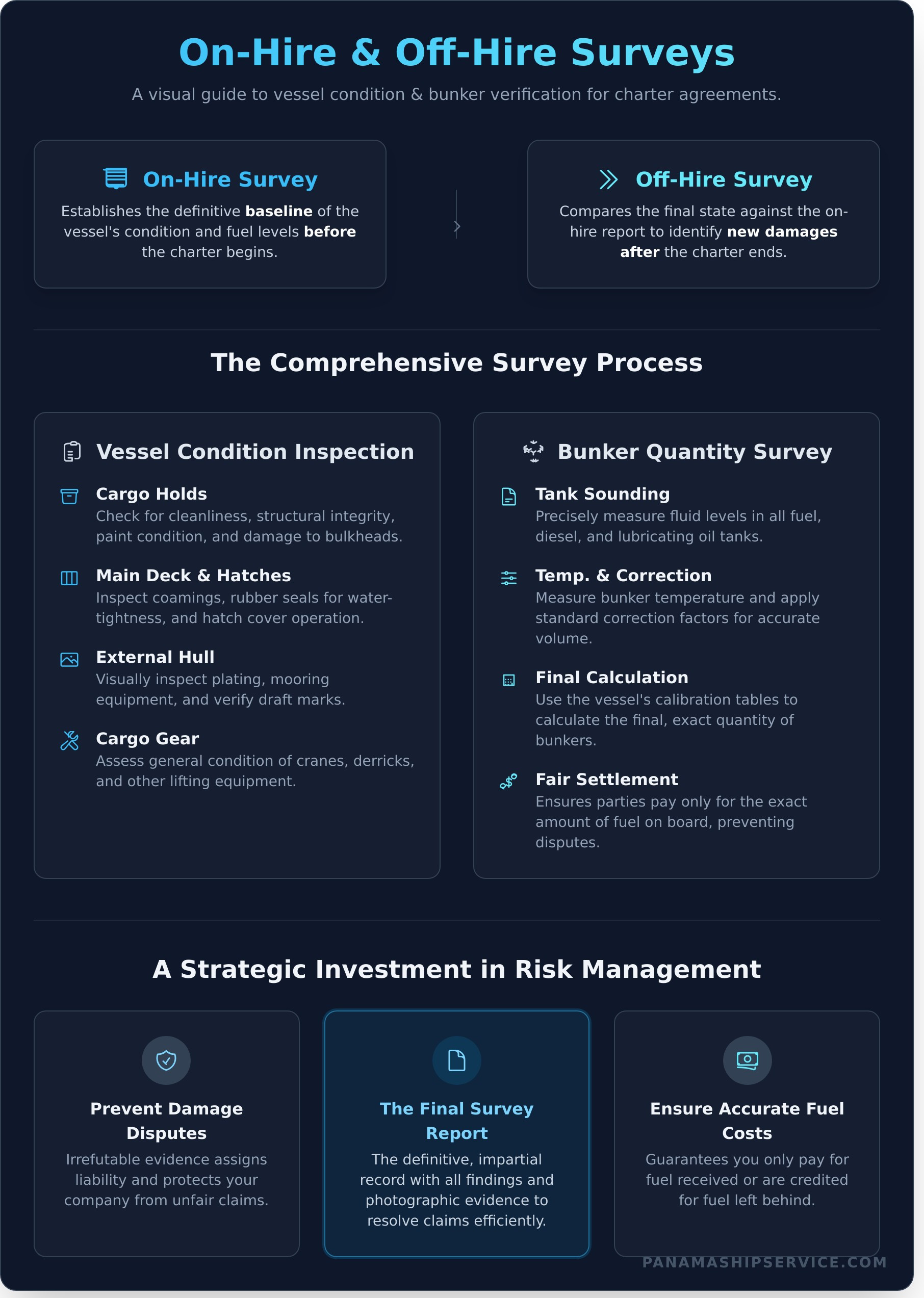
An on-hire or off-hire survey is a detailed, independent inspection and verification of a vessel’s state at two key moments: the beginning and the end of a charter period. The main purpose is to meticulously record the vessel’s structural condition and accurately measure the quantity of fuel and oils on board. This process establishes an official baseline, allowing all parties to fairly assess any changes that occur during the charter, from new damages to fuel consumption.
The On-Hire Survey: Establishing the Baseline
The on-hire survey is performed at the port of delivery, precisely when the charterer takes operational control of the vessel. A qualified marine surveyor thoroughly inspects the ship to document its condition before the charter officially begins. This includes the state of cargo holds, decks, hatches, and hull plating. The resulting detailed report, complete with photographic evidence, provides a definitive baseline for future comparison.
The Off-Hire Survey: Assessing the Final Condition
Conversely, the off-hire survey is conducted at the redelivery port, just as the vessel is returned to its owner. The surveyor uses the original on-hire report as a reference to perform a comparative inspection. The primary goal is to identify any new damage, such as dents in cargo holds or wear on equipment, that may have occurred during the charter period, clearly distinguishing it from pre-existing conditions.
Condition vs. Bunker Survey: What’s Included?
While often performed together, it’s useful to understand the two core components. The Condition Survey focuses entirely on the vessel’s physical and structural state. The Bunker Survey is a technical measurement to determine the exact quantity of fuels, diesel, and lubricating oils remaining on board (ROB). For maximum efficiency and to provide a complete picture of the vessel’s status at handover, these two surveys are typically combined into a single, comprehensive service.
The Survey Process: A Step-by-Step Checklist
At Panama Ship Service, our qualified surveyors provide a thorough and impartial inspection designed to protect the interests of all parties. We focus on key areas of the vessel to create an accurate and indisputable record.
Vessel Condition Inspection Checklist
- Cargo Holds: We inspect for cleanliness, structural integrity, paintwork condition, dents or damages to bulkheads, and the state of ladders and access points.
- Main Deck and Hatches: This includes checking hatch coamings, rubber seals for water-tightness, and the operational condition of hatch covers and closing mechanisms.
- External Hull: A visual inspection of the hull plating above the waterline is conducted to note any visible damages, the condition of mooring equipment, and to verify draft marks.
- Cargo Gear: We assess the general condition of cranes, derricks, and other lifting equipment to ensure they are in a proper state.
Bunker Quantity Survey Checklist
- Tank Sounding: Our surveyors take precise soundings of all fuel, diesel, and lubricating oil tanks to measure fluid levels.
- Temperature & Correction: We accurately measure the temperature of the bunkers and apply standard correction factors to account for volume changes.
- Final Calculation: Using the vessel’s calibration tables, we calculate the final, accurate quantity of bunkers on board, providing a clear figure for settlement.
- Fair Settlement: This meticulous process ensures that the incoming or outgoing party pays only for the exact amount of fuel on board, preventing commercial disputes.
The Final Survey Report: Your Proof
Following the inspection, a detailed and comprehensive report is prepared. This document includes all findings, measurements, and extensive photographic evidence of the vessel’s condition and any notable damages. This report serves as the definitive, impartial record that is essential for resolving any potential claims or disputes fairly and efficiently. Trust our experts for accurate reporting. Get a quote today.
Why These Surveys are a Crucial Investment
Viewing an on-hire or off-hire survey as a mere operational cost is a mistake. It is a strategic investment in risk management. A small, predictable cost upfront can prevent major, unpredictable financial disputes later, and it is a fundamental component of any professional charter party agreement.
Preventing Costly Damage Disputes
An independent survey report provides clear, irrefutable evidence that helps assign liability for any damages that occur during the charter. This avoids lengthy, costly arguments between owners and charterers, protecting your company from being held responsible for damage it did not cause. The survey report transforms subjective claims into objective facts.
Ensuring Accurate Fuel Cost Settlement
Bunker fuel represents a significant operational expense. A professional bunker survey guarantees that you only pay for the fuel you actually receive or are credited for the fuel you leave behind. It prevents over or underpayment at the start and end of a charter, providing precise data that is crucial for operational accounting and budget control.
Why a Survey at the Panama Canal is Vital
As one of the world’s most critical maritime crossroads, the Panama Canal is a common handover point for chartered vessels. Conducting a timely and efficient survey here is vital to prevent costly delays to transit schedules and subsequent voyages. Our deep local expertise at the Canal ensures a fast, compliant, and professional service that keeps your operations moving. Ensure a smooth handover at the Canal. Contact us.
Frequently Asked Questions
Who is responsible for arranging and paying for the on-hire/off-hire survey?
Typically, the survey is arranged and paid for jointly by the owner and the charterer, with each party often appointing their own surveyor or agreeing to use a single, neutral company. The exact terms are usually specified in the charter party agreement.
How long does a typical on-hire or off-hire survey take?
The duration depends on the size and type of the vessel, but a standard survey on a bulk carrier or tanker can often be completed within a few hours, minimizing any potential for operational delays.
Can the survey be performed while cargo operations are in progress?
Yes, in many cases. Bunker surveys can almost always be conducted during cargo operations. Condition surveys of holds can be done as they become empty or before they are loaded, requiring coordination with the vessel’s port activities.
What happens if new damage is discovered during the off-hire survey?
If new damage is identified and documented in the off-hire report (by comparing it to the on-hire report), the charterer is typically held responsible for the cost of repairs, as per the terms of the charter party agreement.
Is a survey still necessary if the vessel is from a reputable owner?
Absolutely. The survey is not about a lack of trust; it’s about professional due diligence. It provides an objective, third-party record that protects both the reputable owner from unsubstantiated claims and the charterer from liability for pre-existing conditions.
Protecting your assets and ensuring fair, transparent operations is essential in the shipping industry. An on-hire and off-hire survey is a non-negotiable tool for risk management, providing the clarity and proof needed for smooth handovers. Don’t leave your vessel’s condition or your company’s finances to chance. Request Your On-Hire or Off-Hire Survey in Panama and let our experts provide the peace of mind you need.