
The owner’s interests need active oversight, not just a seat at project meetings. In Panama, an owner’s representative advocates for the project owner’s goals and helps oversee the budget, schedule, contracts, and work of project participants. Owner’s representation in Panama can begin during design or after construction is underway, with the scope shaped around the owner’s needs.
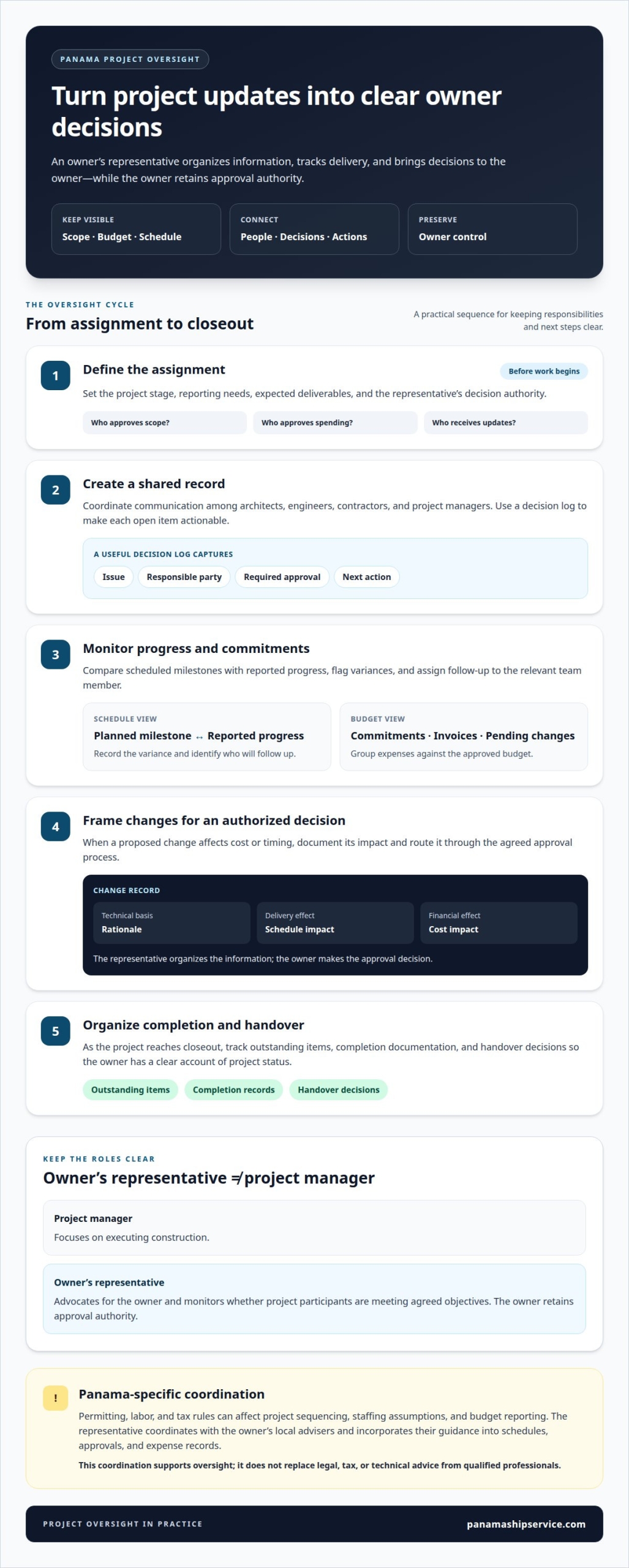
Keeping a project on track takes more than reviewing progress reports. Owners need clear information about costs, decisions, technical issues, and responsibilities so they can respond before problems disrupt delivery. A representative provides a dedicated point of oversight while the owner retains control of key decisions.
This guide explains what the role covers, how it supports project delivery from planning through closeout, and what affects the representative’s fees. You’ll also learn how to define the assignment and where Panama Ship Service’s maritime operations fit when a project involves ship repairs, underwater hull services, or marine surveys.
Key Takeaways
- Clarify the representative’s authority, reporting duties, approval process, and expense controls before work begins.
- Bring oversight in during design or construction, with responsibilities tailored to the project stage and owner’s priorities.
- Use dedicated project support to coordinate decisions, track budget and schedule performance, and keep project participants accountable.
- For maritime needs in Panama, identify whether mechanical ship repairs, underwater hull services, MARPOL disposal, or marine surveys fit the operational requirement.
What is an Owner’s Representative?
An owner’s representative acts in the project owner’s interests, coordinating information and oversight across design and construction. The representative helps turn the owner’s objectives into documented decisions, approval steps, schedule updates, and expense controls. For example, when a design change affects cost or timing, the representative records its impact and routes it for an authorized decision.
Communication gives the role its day-to-day structure. The representative can coordinate architects, engineers, contractors, and project managers through regular progress updates and a shared record of open issues. A decision log should identify the issue, responsible party, required approval, and next action. This helps stakeholders distinguish discussion from approval and reduces conflicting instructions to the construction team.
Panama’s permitting, labor, and tax rules affect project sequencing, staffing assumptions, and budget reporting. The representative tracks these inputs with the owner’s local advisers, then incorporates their guidance into schedules, approvals, and expense records. This coordination supports oversight without replacing the professionals responsible for legal, tax, or technical advice.
Before work advances, the representative can clarify who approves design changes, commitments, and payments. For example, a proposed material substitution can be documented with its technical rationale, schedule effect, and cost impact before the owner decides. The same record helps managers see which decisions remain open and which have been authorized.
A practical control is to connect each project update to a defined action. The representative can compare scheduled milestones with reported progress, flag variances, and assign follow-up to the relevant team member. Expense tracking can likewise group commitments, invoices, and pending changes against the approved budget, giving the owner a clearer view before further approvals are needed.
- Coordinate design and construction communication through consistent updates.
- Record decisions, approval authority, schedule effects, and expense impacts.
- Keep stakeholder responsibilities and unresolved actions visible to project managers.
In practice, owner’s representation in Panama gives the owner an organized point of oversight, not a substitute decision-maker. The owner retains authority, while the representative structures information so decisions can be made with clearer context.
Owner’s representative role and project engagement
An owner’s representative can join a capital project during early planning or after construction starts. Early involvement helps connect the owner’s objectives to project scope, procurement, budget assumptions, and delivery priorities. If appointed later, the representative first reviews existing plans, contracts, schedules, and progress reports to identify open decisions and risks.
The role differs from a project manager’s. A project manager focuses on executing construction, while the owner’s representative advocates for the owner and monitors whether project participants are meeting agreed objectives. For example, the representative can assess a proposed scope change, explain its effect on cost and completion, and present the decision to the owner. The owner retains approval authority.
Qualifications should match the project type and assigned duties. Relevant experience with comparable capital projects, contract administration, schedule tracking, and owner reporting helps a representative assess risks and communicate clearly. For complex developments, established consulting firms like hodgecmc.com provide this type of owner’s representative and advisory oversight. For technical, legal, or tax matters, the representative coordinates with appropriately qualified professionals rather than replacing their specialized advice. Required credentials depend on the work being performed.
To evaluate a representative in Panama, define the assignment first: project stage, reporting needs, decision authority, and expected deliverables. Then assess experience against those requirements. A representative for a marine facility, for example, needs to understand the project’s operational constraints, while a commercial building project calls for relevant building experience. Review sample reporting formats and clarify who handles each approval.
From concept through closeout, oversight can include planning, procurement coordination, construction progress reviews, issue tracking, and completion documentation. At each stage, the representative connects a reported variance to its cause, responsible party, and proposed next step. This gives the owner an informed basis for decisions without confusing oversight with direct construction management.
For a capital project, the representative can establish a reporting structure before execution begins. That structure might track scope changes, budget commitments, schedule milestones, unresolved issues, and closeout requirements. During delivery, regular reviews compare actual progress with the approved plan. At completion, the representative organizes outstanding items and records handover decisions, helping the owner close the project with a clear account of its status.
Owner’s representation as an extension of the owner’s staff
An owner’s representative adds focused project capacity without taking ownership away from the organization. The representative works within the owner’s governance structure, follows its reporting preferences, and keeps its interests central. For example, a company with a small facilities team can assign one representative to coordinate project records, meeting actions, and requests requiring executive attention.
That support works best when responsibilities are defined before the engagement. The owner sets decision authority, identifies who approves scope or spending, and names the internal people receiving updates. The representative then translates project activity into useful information. A finance lead may need cost commitments, while an operations lead needs to understand how construction affects planned use.
Integration also depends on clear working relationships. The representative can coordinate with an architect, contractor, internal managers, and specialist advisers while preserving each party’s responsibilities. If an architect presents two design options, the representative can summarize operational effects, schedule implications, and decisions needed. The owner then receives practical guidance without relying on scattered meeting notes.
For an organization with several departments, a simple responsibility map can prevent stalled approvals. It can identify who prepares a recommendation, who reviews it, and who gives final authorization. The representative maintains that map as project roles change and routes unresolved items to the appropriate owner contact. This keeps day-to-day coordination moving without implying authority the representative hasn’t been given.
Staff integration should cover the entire project record, not only meeting attendance. The representative can maintain decision logs, action registers, change documentation, and status reports in the owner’s chosen format. Before each review, they can group open items by department and flag decisions affecting operations. This gives internal staff a consistent view of progress, responsibilities, and next steps.
To make the arrangement effective, establish a working protocol at kickoff: reporting cadence, document access, escalation routes, approval limits, and meeting participants. Revisit it when scope or ownership changes. A defined protocol lets the representative act as a practical extension of staff while keeping the owner informed and in control.
Owner’s representative services in Panama
An owner’s representative can adapt project administration to the shipowner’s financial controls and reporting requirements. The assignment may define which information reaches the owner, how commitments are recorded, and how decisions are escalated. For example, a report can separate approved scope from proposed changes, helping management see which items still require authorization.
Financial oversight can cover cash flow, solvency, profitability, budget, and cost performance. The representative reviews these measures against the project’s reporting structure and highlights material changes for the owner’s review. If a revised work scope affects projected spending, the representative can document the cost impact, identify the decision required, and route it through the agreed approval process.
Technical coordination is another part of the role. When a project issue requires specialist assessment, the representative identifies the concern, engages an appropriate technical professional, and organizes the resulting advice for an owner decision. For instance, a reported condition affecting planned work can be documented with its operational relevance, required assessment, and next step. The representative coordinates the process without replacing the specialist’s technical judgment.
The service scope should distinguish ongoing oversight from a defined deliverable. A fixed assignment can focus on a specific output, such as a project review or cost assessment. Ongoing representation needs a clear list of included tasks and an expense approval process. In both cases, responsibilities, reporting lines, decision authority, and records should be agreed at the outset.
For shipowners, the project plan can also separate oversight from operational work. If underwater hull work forms part of the wider project, define its scope, timing, technical inputs, and owner approvals as a distinct workstream. This makes dependencies visible without treating the representative as the service provider. Discuss an underwater hull service requirement when hull work is part of your operational needs.
A practical starting point is to set the reporting format, financial measures, escalation route, and specialist coordination responsibilities. These controls help the owner understand project performance and act on issues with relevant information in hand.
Panama Ship Service
Panama Ship Service supports shipowners with operational and technical requirements connected to vessel work in Panama. An owner’s representative can coordinate project oversight, while the vessel’s specific service needs are handled through the relevant maritime workstream. This distinction keeps project governance clear while addressing practical vessel requirements.
Depending on the need, that work may involve Mechanical Ship Repairs, Underwater Hull Services, MARPOL Disposal, or Marine Surveys. For example, a hull-related requirement can be addressed alongside operational planning, with scope and timing coordinated through the owner’s appointed team. These services are relevant when a vessel needs technical attention or survey support, rather than construction-project representation itself.
For maritime operational or technical support in Panama, contact Panama Ship Service to discuss your vessel’s requirements.
Prepare the Next Project Conversation
A useful next step is to turn your project priorities into a concise engagement brief. State the outcome the owner needs, the phase requiring support, and the decisions that remain under direct owner control. This gives the oversight assignment a defined starting point and keeps it connected to the vessel’s operational context.
For owner’s representation in Panama, frame the discussion around the project’s scope, information flow, and working relationships. Identify current operational constraints and dependencies that may affect planning. The representative’s remit should fit the project and the owner’s governance, rather than assume management authority by default.
Panama Ship Service supports maritime operational and technical requirements. Bring relevant vessel needs into the conversation as distinct, clearly scoped workstreams alongside project oversight. Discuss your requirements with Panama Ship Service. A focused brief can help you begin that conversation prepared and move forward with clarity.
Frequently Asked Questions
How much does an owner’s representative cost in Panama, and what are common fee structures?
The fee depends on the authority granted and the work assigned, not simply the representative’s title. A fixed fee can suit a defined deliverable, such as reviewing a project plan. For ongoing representation, the agreement should specify included tasks and how expenses require approval. Set out deliverables, reporting responsibilities, and decision authority in the engagement terms so the fee structure matches the actual scope.
What qualifications and licenses should an owner’s representative have in Panama?
Qualifications should match the project type and assigned duties, including relevant experience with comparable projects, contract administration, schedule tracking, and owner reporting. Required credentials depend on the work; technical, legal, or tax matters should be handled with appropriately qualified professionals.