
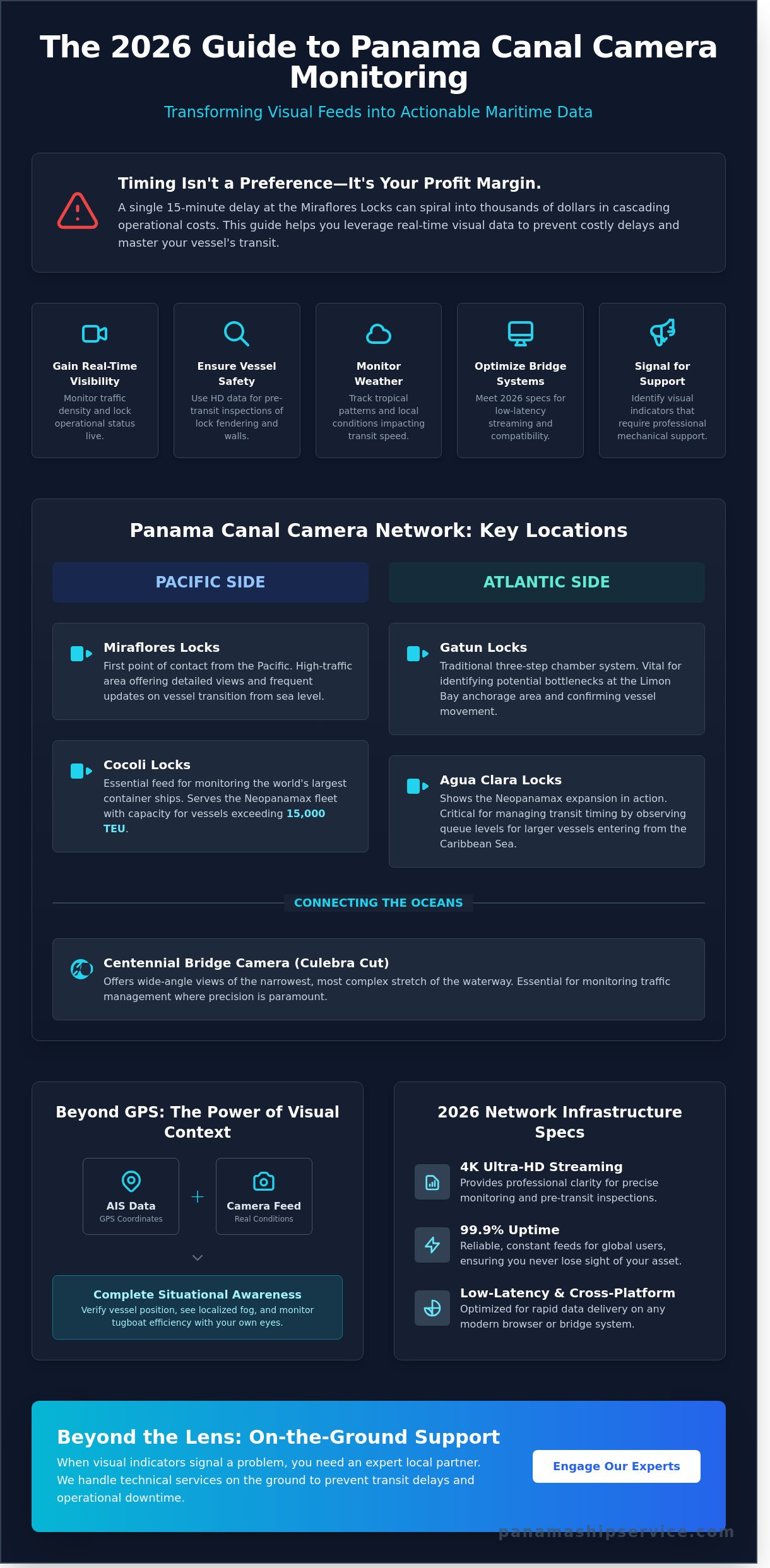
A single 15-minute delay at the Miraflores Locks can spiral into thousands of dollars in cascading operational costs before your vessel even reaches the Culebra Cut. You understand that in the global shipping industry, timing isn’t just a preference; it’s your entire profit margin. It’s frustrating when you have to toggle between broken links and lagging feeds while trying to find a reliable panama canal camera to monitor the Cocoli or Agua Clara Locks.
This 2026 guide consolidates every live feed into one centralized location so you can observe vessel progress and weather conditions with professional clarity. We’ll show you how to turn these visual streams into actionable data for your maintenance schedule and transit timing. You’ll learn how to spot potential issues early and when to engage an expert local partner to handle technical services on the ground. We are experts so you don’t have to be.
Key Takeaways
- Master the use of each live panama canal camera feed to gain real-time visibility into traffic density and lock operational status.
- Learn how to utilize high-definition visual data for pre-transit inspections of lock fendering and approach walls to ensure vessel safety.
- Discover tactical methods for monitoring tropical weather patterns and local conditions that directly impact transit speed and scheduling.
- Optimize your bridge systems with specific 2026 technical requirements for low-latency streaming and cross-platform browser compatibility.
- Identify early visual indicators that signal a need for professional mechanical support to prevent costly transit delays and operational downtime.
Understanding the Panama Canal Camera Network in 2026
The panama canal camera network is a sophisticated high-definition infrastructure managed by the Panama Canal Authority (ACP). It serves as a vital tool for both public transparency and professional maritime monitoring. In 2026, this system has transitioned to ultra-high-definition 4K streaming, providing 99.9% uptime for global users. For mariners and logistics managers, these feeds provide real-time verification of lock operations, traffic density, and localized weather patterns that static data cannot capture.
While the Automatic Identification System (AIS) provides critical GPS coordinates and vessel data, it lacks visual context. A panama canal camera feed complements AIS by showing the actual conditions on the water. This includes the precise positioning of a vessel within the chamber or the presence of localized fog. To grasp the scale of this digital infrastructure, one must consider the history and operations of the Panama Canal. This evolution from manual signaling to 2026’s AI-enhanced visual monitoring ensures that every transit is documented with surgical precision.
Key Locations of the Canal Webcams
The network covers every critical transit point to ensure total visibility. On the Pacific side, cameras monitor the Miraflores and Cocoli Locks, capturing the movement of Neo-Panamax vessels. The Atlantic entrance features feeds from the Gatun and Agua Clara Locks. For a broader perspective, the Centennial Bridge camera offers wide-angle views of the Culebra Cut. This specific viewpoint is essential for monitoring the narrowest stretches of the waterway where traffic management is most complex.
The Importance of Real-Time Visuals for Charterers
Charterers and ship owners use these feeds to protect their bottom line. Timing is everything in this industry. Visual data allows for direct oversight of assets without relying solely on third-party reports. Key benefits include:
- Vessel Position Verification: Confirming exactly when a ship enters the lock chamber to cross-reference against reported transit times and schedules.
- Environmental Assessment: Identifying sudden tropical squalls or visibility drops that regional weather reports might miss.
- Operational Monitoring: Observing the efficiency of tugboat operations and line handling to ensure the crew meets strict safety and speed standards.
We are experts so you don’t have to be. By leveraging these visual tools, we ensure your vessel moves through the canal without unnecessary delays. Put your transit in our hands for a more reliable, data-driven experience. Our team uses these 2026 technological advancements to provide constant daily communication and rapid responses to any operational changes.
Live Feeds by Lock: A Comprehensive Breakdown
Real-time visibility is the backbone of efficient maritime logistics. Relying on a panama canal camera feed isn’t just a novelty for enthusiasts; it’s a critical tool for ship owners and charterers who need to verify vessel positions against strict transit schedules. By monitoring specific lock chambers, operations teams can confirm when a vessel begins its ascent or clears the final gate, allowing for better synchronization with shoreside services.
Miraflores and Cocoli (Pacific Side)
The Miraflores Locks provide the most frequent updates and are often the first point of contact for vessels entering from the Pacific Ocean. These feeds offer detailed views of the visitor center and the high-traffic Pacific mouth, where ships are raised or lowered in two steps. It’s the primary location for observing the transition from sea level to the elevated interior waterways. Directly adjacent, the Cocoli Locks serve the Neopanamax fleet. The Cocoli locks have the technical capacity to handle vessels exceeding 15,000 TEU, making this feed essential for monitoring the world’s largest container ships. These visual data points integrate with the advanced canal navigation system used by authorities to manage the high-density traffic flow entering from the Bay of Panama.
Gatun and Agua Clara (Atlantic Side)
On the Atlantic side, the Gatun Locks utilize a traditional three-step chamber system to move vessels between the Caribbean Sea and Lake Gatun. Monitoring this feed is vital for identifying potential bottlenecks at the Atlantic anchorage area, where vessel clusters can impact scheduled transit times. If a ship is delayed at the Limon Bay anchorage, the Gatun cameras provide the first visual confirmation of movement toward the locks. For larger vessels, the Agua Clara visuals show the Neopanamax expansion in action. We track these feeds to help clients manage their timing. If you’re concerned about delays, our trusted canal experts can provide the necessary operational support to keep your transit on track. Seeing the queue levels at Agua Clara helps in predicting how quickly the Atlantic-side transit will proceed during peak hours.
Pedro Miguel Locks
The Pedro Miguel Locks act as the intermediate point between the Pacific-side locks and the Culebra Cut. This location is unique because it consists of a single lift. The camera feed here is particularly useful for monitoring vessels as they pass under the Centennial Bridge, a major landmark in the canal’s narrowest section. It’s a high-stakes area where precise navigation is required. Operational teams use this view to confirm that a vessel has successfully cleared the Pacific locks and is making headway toward the Atlantic, ensuring that the transit is proceeding without technical hitches or speed reductions.
- Miraflores: Best for Pacific entry and transit start times.
- Cocoli: Exclusive views of Neopanamax vessels over 15,000 TEU.
- Gatun: Critical for Atlantic-side anchorage and three-step lift monitoring.
- Agua Clara: Primary feed for Caribbean-side Neopanamax traffic.
- Pedro Miguel: Intermediate tracking point near the Centennial Bridge.
Tactical Use: How Ship Operators Use Camera Data
Efficiency at the Panama Canal isn’t just about scheduling; it’s about real-time visual intelligence. Ship operators and fleet managers rely on the panama canal camera network to make split-second decisions that prevent costly delays. By viewing live feeds, operators conduct pre-transit inspections of lock fendering and approach walls. This visual check ensures that the infrastructure is ready for the vessel’s specific draft and beam requirements. It’s a proactive step that supplements official ACP notifications.
Incident verification is another critical function. If a vessel experiences a minor scrape or a tugboat positioning error, archived footage provides an objective record. In 2026, high-definition captures allow for detailed analysis of hull contact or line handling issues. This data is vital for insurance claims and internal safety audits. Operators don’t have to guess what happened during a transit; they have the visual proof to back up their reports.
Coordination with local agents becomes seamless through visual confirmation. When a vessel appears on the Pacific or Atlantic entrance feed, shore-side teams trigger the final stages of logistics. This includes synchronizing the delivery of ship supplies to match the exact moment a ship exits the locks. Misjudging this timing leads to idle launch boats and increased hourly fees. We use these feeds to ensure your provisions are ready precisely when needed.
Assessing Environmental Conditions
Tropical weather in Panama changes in minutes. During the rainy season, downpours can reduce visibility to less than 500 meters. Operators use the panama canal camera height and clarity to judge if morning fog will lift in time for scheduled slots. For high-sided vessels like Neo-Panamax container ships, visual cues of wind speed on the water surface help pilots anticipate leeway. Monitoring Gatun Lake water levels is also crucial. Following the 2023 drought, operators now use visual markers to verify the depth and clearance during the 2026 dry season.
Logistical Synchronization
Timing is everything in maritime logistics. Operators reduce idle time by monitoring queue movement at the Miraflores and Agua Clara locks. This real-time tracking allows for the precise scheduling of marine surveys in Panama immediately after a transit. If a vessel is delayed at the Gatun Lake anchorage, survey teams are notified to adjust their boarding times. This level of synchronization minimizes vessel expenses and ensures that technical inspections don’t interfere with the next leg of the voyage. We manage these variables so you can focus on your fleet’s global performance.
Technical Specs and Troubleshooting Your Feed
High-stakes maritime logistics require reliable visual data. By 2026, the Panama Canal Authority has standardized high-bandwidth 4K streaming across all major lock chambers. These feeds typically deliver a refresh rate of 30 frames per second, providing the fluid motion necessary to monitor precise towing locomotive attachments. You should expect a baseline latency of 10 to 15 seconds. This lag is a result of signal processing and global distribution networks. Desktop bridge systems provide the most stable viewing environment, especially when using hardware-accelerated browsers. Mobile users should prioritize 5G or high-speed Wi-Fi to prevent frame drops during critical lockage maneuvers.
Monitoring 24/7 operations is now more effective due to upgraded low-light sensors and thermal imaging capabilities. These systems maintain high contrast during the heavy tropical rainstorms that frequently impact visibility near the Gatun Lake. If a panama canal camera displays a “Down for Maintenance” notification, it usually signifies a scheduled 48-hour hardware calibration or a lens cleaning cycle. These interruptions are vital for maintaining the clarity required for professional vessel identification and draft monitoring.
Optimizing the Viewing Experience
To maintain a stable 4K stream, your local network requires a minimum dedicated bandwidth of 25 Mbps. For professional monitoring, we recommend a multi-window browser configuration. This setup allows you to track a vessel through the sequential locks at Miraflores and Pedro Miguel without losing visual contact. Most modern feeds utilize HTML5 players, which have replaced the problematic Java-based systems of the past. If you encounter a playback error, it’s often caused by an outdated browser cache or conflicting ad-blocking extensions. Disabling hardware acceleration in your browser settings can also resolve common stuttering issues on older hardware.
Data Privacy and Security
The Panama Canal Authority (ACP) acts as the primary gatekeeper for all public and private data streams. You may find that certain feeds are temporarily restricted or blurred during the transit of sensitive cargo or high-value military assets. These restrictions are non-negotiable and prioritize the safety of the canal infrastructure. Live feeds are delayed by several seconds for maritime security protocols. This buffer ensures that real-time positioning data isn’t exploited. We manage these technical complexities daily for our clients. We are experts so you don’t have to be.
Beyond the Lens: On-the-Ground Support in Panama
A panama canal camera feed offers vital real-time visibility, but digital monitoring is only the first phase of effective vessel management. High-definition streams allow shore-side teams to spot issues early. However, a camera cannot tighten a bolt or scrub a hull. Effective transit management requires a transition from observation to action. When a feed shows unexpected drag or visible structural concerns, you need immediate physical intervention to prevent costly delays in the 50-mile corridor. Digital tools identify the “what,” but our team handles the “how.”
Responding to Visual Findings
Visual monitoring frequently reveals issues that require immediate attention before a vessel enters the locks. If you observe significant hull fouling or impact damage on the panama canal camera, delays are inevitable without a plan. We specialize in underwater hull services to restore hydrodynamic efficiency and ensure compliance with canal regulations. Our teams provide emergency response for vessels currently positioned in the Gatun or Miraflores chambers. We coordinate with port authorities to address findings within hours, keeping your schedule intact.
Visual cues often signal deeper technical failures. Excessive exhaust or steering irregularities seen on screen might indicate the need for mechanical ship repairs. By consolidating these technical services under one provider, you minimize the logistical friction of managing multiple vendors. We act as your eyes and ears on the ground, verifying what the camera suggests and executing the necessary repairs before the vessel reaches the next transit milestone. This proactive approach reduces the risk of being denied entry into the locks due to safety or performance concerns.
Your Trusted Partner at the Canal
Panama Ship Service brings over 20 years of expertise to every transit. We bridge the gap between digital monitoring and physical solutions. Our role is to be the authoritative presence that ship owners rely on when time is critical. We are experts so you don’t have to be. Instead of reacting to problems after they cause a bottleneck, we use visual data to proactively deploy resources. Our localized knowledge ensures that technical interventions are performed quickly and cost-effectively.
Don’t wait for a minor observation to become a major operational failure. Contact us for a rapid response quote before your vessel reaches the locks. We provide the technical support required to turn visual insights into successful transits, ensuring your vessel moves through the Panama Canal without unnecessary interruptions.
Master Your Transit Strategy with Real-Time Data
Utilizing the panama canal camera network effectively is a baseline requirement for modern maritime logistics in 2026. High-definition monitoring at the Miraflores and Agua Clara locks provides the visual confirmation needed to manage tight schedules and verify vessel positioning. However, digital visibility is only half the battle. When the feed shows a technical delay or a mechanical fault, you need a partner on the ground who can respond within hours. Relying on remote data without a physical support plan often leads to missed slots and increased operational costs. Timing is everything in this corridor.
Panama Ship Service brings 20 years of maritime expertise to every transit. We provide Class-approved underwater services and mechanical repairs that solve problems before they escalate. As a comprehensive one-stop-shop, we manage everything from MARPOL disposals to critical supplies and technical surveys. We are experts so you don’t have to be. Trust our team to protect your vessel and your bottom line while you navigate the canal’s complex waters. Your successful crossing is our top priority and we’re ready to assist.
Get an Expert Ship Repair Quote in Panama
Frequently Asked Questions
Where can I find the official Panama Canal live camera feeds?
You can find official feeds on the Panama Canal Authority (ACP) website at pancanal.com. These high-definition streams provide real-time views of the Miraflores, Gatun, and Agua Clara locks. Accessing these feeds directly from the ACP ensures you receive the most reliable data for monitoring vessel progress. We recommend bookmarking the multimedia section so you don’t rely on unofficial third-party sites that often experience lag or downtime.
Are the Panama Canal cameras available 24/7?
Yes, the feeds operate 24 hours a day, 365 days a year. While the cameras remain active overnight, visibility depends on the high-intensity LED lighting installed at the locks. During the 12 hours of darkness, you can still observe transit operations, though clarity is reduced compared to daylight hours. This continuous monitoring is essential for ship owners who need to track vessel positioning regardless of the local time in Panama.
Why is the Miraflores lock camera feed sometimes unavailable?
Feed interruptions usually stem from scheduled technical maintenance or hardware upgrades. The ACP maintains a 95% uptime rate, but salt air and tropical humidity necessitate frequent equipment servicing. If the Miraflores feed is down, check the Gatun or Agua Clara views to verify if the issue is localized to one camera. These outages are typically resolved within 4 to 6 hours to ensure operational transparency remains intact for all maritime partners.
Can I see Neopanamax vessels on the live cameras?
You can view Neopanamax vessels specifically through the Agua Clara and Cocoli lock cameras. These expanded locks, which opened on June 26, 2016, handle ships up to 366 meters in length. The panama canal camera at Agua Clara provides the best angle for observing these massive container ships and gas carriers. Monitoring these specific feeds is vital for stakeholders managing larger hulls that cannot fit through the original 1914 locks, providing essential visual confirmation.
Do the cameras show the entire transit process from ocean to ocean?
No, the cameras only cover specific lock chambers and not the full 50 mile transit. You will see vessels entering and exiting the locks, but views of the Culebra Cut or Gatun Lake are limited. The transit takes approximately 8 to 10 hours to complete, so you must switch between different camera locations to track a ship’s progress. We use these specific visual checkpoints to coordinate our technical ship services and ensure timely arrivals.
How can I use the cameras to check the weather at the canal?
You can use the live feeds to visually confirm local weather conditions like heavy tropical rain or fog. Panama receives over 100 inches of rainfall annually, which often impacts visibility for pilots. If the panama canal camera shows heavy downpours, expect potential delays in lockage schedules. Monitoring these visual cues helps ship owners anticipate transit windows, especially during the peak rainy season from May to December. This real-time data is crucial for efficient scheduling.
Is there a mobile app for Panama Canal webcams?
The Panama Canal Authority doesn’t offer a dedicated mobile app for webcam viewing. However, the official website was updated in 2024 to be fully mobile responsive, allowing you to stream feeds directly through a smartphone browser. This ensures you can monitor operations while on the go without downloading third-party software. For the best experience, use a high speed data connection to maintain the 1080p resolution provided by the ACP servers, ensuring you never lose sight of your vessel.
Can I record or download footage from the canal cameras?
The official website doesn’t provide a direct download or recording button for live streams. If you need to archive a specific transit for operational review, you will need to use third-party screen recording software. Remember that all footage remains the intellectual property of the Panama Canal Authority. We recommend documenting vessel times and lockage sequences manually if you don’t have recording tools to supplement your internal logistics reports and transit records.