
A single clerical error in your PCSOPEP submission can trigger a $15,000 fine before your vessel even reaches the locks. If you arrive without an ACP-approved plan, that penalty jumps to $50,000 and results in the immediate forfeiture of your transit slot. You likely already feel the pressure of keeping pace with evolving IMO standards, yet the Panama Canal Authority (ACP) enforces local mandates that are often even more demanding. Managing these two distinct regulatory frameworks is the only way to protect your bottom line from the $65,000 daily cost of a Neo-Panamax delay.
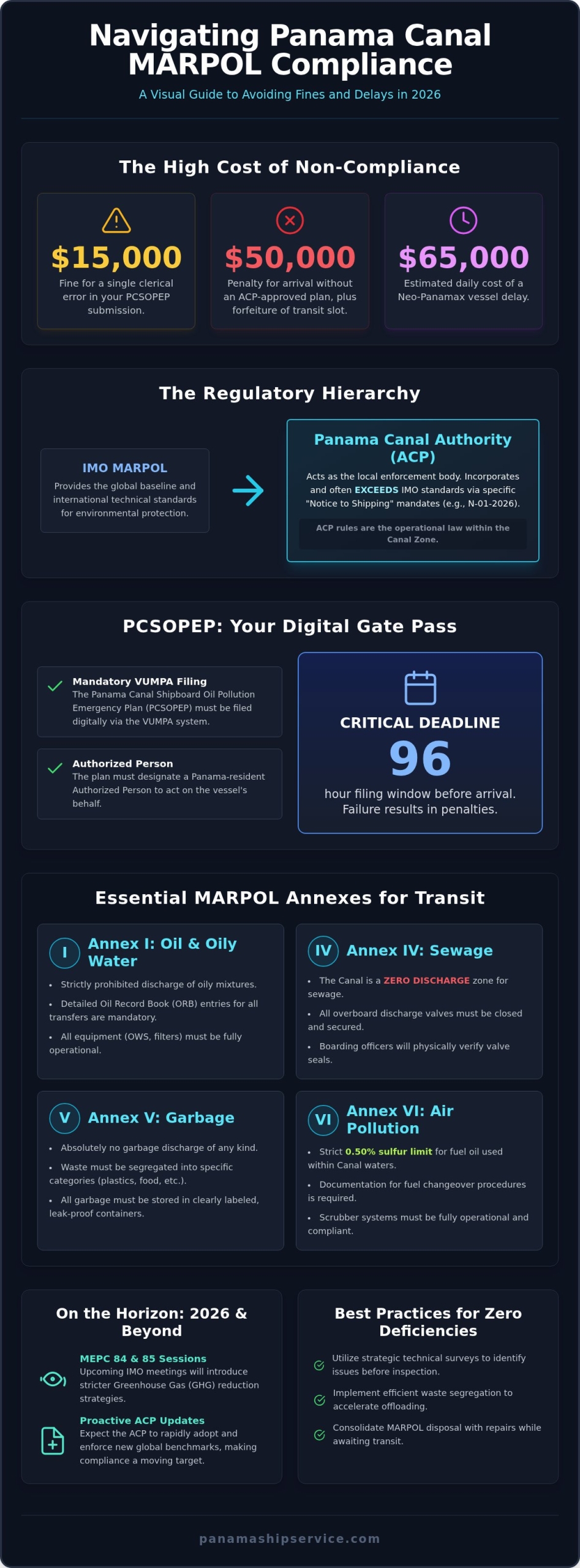
This guide ensures you master the 2026 Panama Canal MARPOL requirements to achieve a seamless, fine-free transit. We’ll provide a clear compliance checklist that bridges the gap between international rules and local ACP expectations. You’ll gain a full understanding of the 96-hour digital VUMPA filing window, Annex I and V disposal protocols, and how to utilize strategic technical surveys to maintain a zero-deficiency record. By the end of this article, you’ll have the technical roadmap necessary to navigate the updated LoTSA 2.0 system and the requirements of the N-01-2026 Notice to Shipping with total confidence.
Key Takeaways
- Identify the critical differences between international IMO standards and local ACP mandates to avoid administrative fines.
- Master the specific Panama Canal MARPOL requirements for Annex I and IV to ensure a deficiency-free inspection by boarding officers.
- Learn the mandatory components of a valid PCSOPEP, including the 96-hour filing deadline and the role of the Panama-resident Authorized Person.
- Implement waste segregation strategies that accelerate garbage offloading and help you maintain a strict transit schedule.
- Discover how to consolidate MARPOL disposal with mechanical repairs to ensure Annex VI compliance while waiting for your transit slot.
The Regulatory Landscape: IMO MARPOL vs. Panama Canal Authority (ACP)
The maritime industry operates under a sophisticated dual-layer regulatory system. On a global scale, the International Convention for the Prevention of Pollution from Ships (MARPOL) sets the baseline for environmental protection. However, once a vessel enters the Canal Zone, it falls under the direct jurisdiction of the Panama Canal Authority (ACP). This transition creates a high-stakes compliance environment where international standards and local mandates overlap. Understanding the Panama Canal MARPOL requirements is essential for avoiding the severe penalties associated with environmental deficiencies.
The ACP doesn’t just suggest compliance; it actively enforces its own set of rules through the Maritime Service Portal and the VUMPA system. While MARPOL provides the framework, the ACP’s OP Notice to Shipping No. N-01-2026 acts as the operational law for all vessels. This local enforcement ensures that the unique ecosystem of the Panama Canal remains protected from ship-generated pollution.
The Hierarchy of Authority at the Canal
The ACP incorporates global MARPOL standards into its specific “Notice to Shipping” (N-1) documents. This means that while a vessel might be compliant with flag state regulations, it could still fail an ACP inspection if it doesn’t meet local specifics. The IMO provides the international technical standard, while the ACP acts as the local enforcement body with the power to deny transit or levy administrative fines. Compliance is non-negotiable for any operator looking to protect their schedule.
Legal and operational consequences for non-compliance are severe. A vessel found in violation of environmental standards faces several immediate risks:
- Immediate forfeiture of reserved transit slots and associated fees.
- Administrative fines starting at $15,000 for clerical or documentation errors.
- Mandatory delays while waiting for technical remediation or authorized disposal services.
Upcoming 2026 Regulatory Milestones
The year 2026 marks a critical juncture for maritime environmental standards. Key sessions of the Marine Environment Protection Committee, specifically MEPC 84 and 85, are scheduled to take place throughout the year. These sessions will focus on the mid-term measures for the IMO’s Greenhouse Gas (GHG) reduction strategy. The outcomes of these global meetings directly influence Panama Canal MARPOL requirements.
As the IMO pushes for stricter carbon intensity indicators and fuel standard regulations, the ACP typically updates its own requirements to mirror or exceed these benchmarks. For operators, this means that compliance is a moving target. Staying ahead of these milestones allows you to integrate necessary technical upgrades into your maintenance schedule before they become a cause for transit rejection. Efficient management of these shifts is the difference between a smooth operation and a costly logistical failure.
Essential MARPOL Annexes for Panama Canal Transit
The ACP conducts rigorous inspections to ensure every vessel meets the Panama Canal MARPOL requirements. While international law allows certain discharges at sea, the Canal is a zero-discharge zone for most waste streams. Compliance centers on Annexes I, IV, V, and VI. Annex IV (Sewage) mandates that all discharge valves must be closed and secured while in Canal waters. Failure to manage these effectively leads to immediate boarding deficiencies. You must ensure your crew is trained on the specific local nuances that differ from standard high-seas operations.
Annex I & V: The Core of Waste Management
Annex I governs oily water and sludge, while Annex V covers garbage management. The ACP requires detailed Oil Record Book (ORB) entries for every transfer or disposal event. Garbage must be segregated into specific categories such as plastics, food waste, and operational waste. Everything must be stored in leak-proof containers. Because discharge is strictly prohibited within Canal waters, securing professional MARPOL disposal panama before or after transit is the only way to clear your tanks and bins legally. This prevents the accumulation of waste that can lead to hygiene issues or a Notice of Deficiency during a boarding officer’s inspection.
Annex VI: Emissions and Scrubber Protocols
Annex VI compliance has become increasingly complex as we approach 2026. The ACP enforces a strict 0.50% sulfur limit for fuel oil, but vessels must also navigate local restrictions on Exhaust Gas Cleaning Systems (EGCS). Open-loop scrubbers are prohibited from discharging washwater within the Canal’s jurisdiction. You must document your fuel changeover procedures meticulously in the engine logbook, showing exactly when the vessel switched to compliant fuel before entering Canal waters. For the most current technical specifications and latest OP notices, consult the Panama Canal Authority Vessel Requirements.
As the IMO targets deeper GHG reductions through MEPC 84 and 85 in 2026, the ACP is expected to monitor Carbon Intensity Indicator (CII) ratings more closely during pre-arrival screening. Vessels with poor environmental ratings may face additional scrutiny or slower processing times. Proactive operators often use their time at anchorage to perform essential maintenance. You can easily coordinate MARPOL disposal with technical surveys to ensure your vessel is fully prepared for the boarding officer’s arrival.
Local Panama Requirements: PCSOPEP and ACP Boarding
While MARPOL provides the global standard, the ACP adds a layer of local enforcement that can catch even seasoned captains off guard. The most critical distinction involves the “Zero Discharge” policy within the Gatun Lake ecosystem. Because this lake serves as the primary drinking water reservoir for the Republic of Panama, the ACP prohibits the discharge of any substance, including treated sewage or gray water. Compliance with Panama Canal MARPOL requirements in these fresh waters is monitored with zero tolerance; any violation results in immediate transit suspension and heavy administrative penalties.
Understanding Panama Canal’s specific fuel rules alongside these local emergency plans is vital for a smooth transit. The ACP’s boarding officers aren’t just checking for international certificates; they are verifying that your vessel is operationally prepared for the unique environment of the locks and the lake.
PCSOPEP Compliance Framework
The Panama Canal Shipboard Oil Pollution Emergency Plan (PCSOPEP) is mandatory for all vessels carrying 400 metric tons or more of persistent oil as fuel or cargo. This plan is entirely separate from your standard MARPOL SOPEP and must be approved by the ACP at least 96 hours before arrival. Vessels are categorized into three tiers based on their oil carrying capacity, which determines the level of response resources required.
A key requirement for 2026 is the mandatory appointment of a Panama-resident Authorized Person (AP) who is available 24/7 to act as a legal liaison. You must also maintain a valid contract with an ACP-certified Oil Spill Response Organization (OSRO). Arriving without an approved plan or a valid AP leads to a minimum fine of $50,000 and the immediate forfeiture of your transit slot. Administrative errors in the plan submission can still trigger fines starting at $15,000.
The Boarding Inspection Checklist
The ACP boarding officer’s inspection is a high-stakes event where documentation accuracy is paramount. Officers perform a machine-level validation of your VUMPA (Ventanilla Única Marítima de Panamá) package, which must be filed digitally 96 hours before arrival. They specifically look for:
- Valid International Oil Pollution Prevention (IOPP) certificates with all supplements.
- Accurate seal logs for all overboard discharge valves, which must be closed and secured.
- The Oil Record Book (ORB) with entries matching the actual tank levels and recent disposal receipts.
- Documentation of fuel changeover procedures to ensure compliance with sulfur limits before entering Canal waters.
Common pitfalls include discrepancies between the digital VUMPA filing and the physical logs found on the bridge or in the engine room. Any mismatch can be interpreted as a failure to meet Panama Canal MARPOL requirements, leading to delays that cost Neo-Panamax vessels over $65,000 per day. Ensuring your documentation is meticulous before the boarding officer arrives is the only way to guarantee a zero-deficiency transit record.
Best Practices for MARPOL Disposal and Documentation
Adhering to Panama Canal MARPOL requirements involves more than just understanding the law; it requires precise logistical execution. Because the Canal operates on a strict “just-in-time” transit model, any delay in waste offloading can result in a missed slot and substantial late cancellation surcharges. You must ensure all MARPOL certificates are not only valid but also uploaded to the VUMPA system at least 96 hours before your arrival. This digital pre-validation allows the ACP to flag potential issues before they become operational bottlenecks.
Efficient waste management starts with rigorous segregation on board. Boarding officers frequently check that garbage is categorized according to Annex V standards. If your crew mixes food waste with plastics or operational garbage, offloading will be delayed or refused by local reception facilities. Proper segregation ensures faster offloading and keeps your vessel in compliance with the zero-discharge mandates of the Canal Zone.
Streamlining Sludge and Garbage Removal
The most efficient way to manage waste is to schedule sludge removal services panama at the Balboa or Cristobal anchorages. While shore-side removal is possible at certain terminals, barge-side disposal is often the preferred choice for vessels waiting for their transit slot. This method minimizes interference with cargo operations and crew changes.
You should never wait until the last minute to request disposal. The ACP has suspended “Last-Minute” service options as of late 2026, meaning all service requests must be finalized well in advance. Late requests often lead to the forfeiture of your transit window, forcing your vessel to wait for a new slot while daily operational costs exceed $65,000 for Neo-Panamax ships. Coordinating these services through a single provider allows you to consolidate MARPOL disposal with other technical needs, saving both time and administrative overhead.
Maintaining Accurate Record Books
Documentation is the primary evidence of your compliance during an ACP audit. Vessels must record the exact time, date, and volume of any transfer, including the signature of the officer in charge and the master, to ensure every cubic meter of waste is accounted for before the ACP boarding. Discrepancies between your physical Oil Record Book (ORB) and the volumes reported in your digital VUMPA filing are a major red flag for inspectors.
As we move into 2026, the ACP is increasingly relying on machine-level validation of digital records. If an audit reveals a mismatch in waste volumes, your vessel may face detention until the records are reconciled. Always obtain and file a formal Disposal Receipt from an authorized provider immediately after any offloading event. These receipts are your only legal defense if the ACP questions your waste management history. To ensure your vessel meets every technical and environmental mandate, you can book MARPOL-compliant disposal services through our strategic hubs at either end of the Canal.
Minimizing Transit Delays with Panama Ship Service
Operational efficiency in the Canal Zone isn’t just about speed; it’s about the strategic synchronization of technical and environmental obligations. Managing Panama Canal MARPOL requirements alongside technical maintenance allows ship owners to maximize their time at anchorage. When you consolidate waste disposal with mechanical inspections, you eliminate the need for multiple service windows. This approach directly addresses the pressure of the 48-hour in-transit time limit effective September 2026, ensuring your vessel remains on schedule.
One-Stop Technical and Environmental Support
Panama Ship Service offers a centralized solution by managing Annex I and V waste while simultaneously performing underwater hull services. Our technical teams are strategically positioned at both ends of the Canal, providing a logistical advantage that reduces administrative overhead. Instead of coordinating with separate entities for sludge removal and hull cleaning, you delegate the complexity to a single, experienced partner. This localized presence ensures that specialized personnel are ready the moment your vessel arrives at the Balboa or Cristobal anchorage.
Ensuring Your Vessel is Transit-Ready
A failed boarding inspection is a costly setback that no operator can afford. Our expert marine surveys panama serve as a pre-emptive audit, identifying potential compliance gaps in your documentation or hardware before the ACP officer steps on board. We focus on the high-risk areas most likely to trigger a deficiency, such as oily water separators or leaking seals. If a survey reveals a fault, our mechanical ship repairs panama team provides fast-track solutions to ensure Annex VI compliance and operational safety.
We provide 24/7 support for both environmental mandates and emergency repairs, ensuring you never face a transit delay alone. Whether it’s a documentation error in your digital VUMPA filing or a mechanical failure at the locks, our proactive response team is equipped to handle the situation without unnecessary complication. Meeting the Panama Canal MARPOL requirements shouldn’t be a source of anxiety. Contact Panama Ship Service for 2026 MARPOL support to secure a zero-deficiency transit and protect your bottom line from avoidable penalties.
Securing Your 2026 Transit Schedule
Navigating the evolving landscape of 2026 maritime regulations requires more than just paperwork; it demands a proactive operational strategy. You now understand that mastering Panama Canal MARPOL requirements involves balancing international IMO standards with the ACP’s strict local mandates, including the mandatory PCSOPEP and zero-discharge policies in Gatun Lake. By integrating waste disposal with technical maintenance, you eliminate the administrative friction that leads to costly transit delays and administrative fines.
As an authorized MARPOL waste reception facility with a strategic presence in both Balboa and Cristobal, we provide the infrastructure needed for a seamless passage. Our expertise in mechanical ship repairs panama ensures your vessel meets all Annex VI technical standards while you wait for your transit slot. Delegate the complexity of environmental compliance to a partner that prioritizes your schedule and fiscal responsibility. This systematic approach allows your crew to focus on safe navigation while we handle the logistics of compliance.
Ensure your vessel is 100% MARPOL compliant; Contact Panama Ship Service today. We look forward to supporting your next successful transit through the Panama Canal.
Frequently Asked Questions
What are the specific Annex VI sulfur limits for the Panama Canal in 2026?
Vessels must use fuel with a maximum sulfur content of 0.50% while transiting the Panama Canal in 2026. This aligns with global IMO standards, but the ACP requires a complete fuel changeover to compliant low-sulfur fuel before entering Canal waters. You must meticulously document this process in your engine room logbook. Mismatches in documentation during an inspection can lead to significant transit delays or administrative fines that impact your operational efficiency.
Can I discharge scrubber washwater while transiting the Panama Canal?
The discharge of washwater from open-loop Exhaust Gas Cleaning Systems (EGCS) is strictly prohibited within Panama Canal jurisdiction. Vessels equipped with hybrid scrubbers must switch to a closed-loop mode before entry. If your vessel only operates an open-loop system, you must use compliant low-sulfur fuel for the duration of the transit. This local mandate is a critical part of the Panama Canal MARPOL requirements designed to protect the local freshwater ecosystem from chemical contamination.
What is the PCSOPEP and does my vessel need one?
The Panama Canal Shipboard Oil Pollution Emergency Plan (PCSOPEP) is a mandatory requirement for all vessels carrying 400 metric tons or more of persistent oil as fuel or cargo. This plan is distinct from the standard MARPOL SOPEP and must be approved by the ACP at least 96 hours before arrival. It requires the appointment of a Panama-resident Authorized Person and a contract with an ACP-certified Oil Spill Response Organization to ensure immediate spill response readiness.
How do I arrange for MARPOL Annex V garbage disposal in Balboa?
You can arrange for MARPOL Annex V garbage disposal in Balboa by contacting an authorized waste reception facility like Panama Ship Service. We coordinate the collection of segregated waste via barge or shore-side services while your vessel is at anchorage. It is essential to ensure all garbage is categorized according to Annex V standards before offloading. Upon completion, we provide the mandatory Disposal Receipts required for your vessel’s environmental record-keeping and ACP audit compliance.
What happens if a vessel fails an ACP environmental boarding inspection?
Failing an ACP environmental boarding inspection results in immediate consequences, including the forfeiture of your transit slot and the assessment of administrative fines. For clerical errors, fines typically start at $15,000, while arriving without an approved PCSOPEP can trigger a minimum $50,000 penalty. Additionally, your vessel will be delayed at anchorage until all deficiencies are remediated, costing Neo-Panamax operators over $65,000 per day in lost time and operational overhead during their transit window.
Are there specific MARPOL requirements for Gatun Lake?
Gatun Lake is a zero-discharge zone because it serves as the primary drinking water source for Panama. This means the discharge of any substance, including treated sewage, gray water, or food waste, is strictly forbidden. All overboard discharge valves must be closed and secured with seals before entering the lake. Compliance with these Panama Canal MARPOL requirements is monitored with total zero tolerance by ACP boarding officers to prevent any risk to the local population.
Does the Panama Canal accept electronic Oil Record Books?
The ACP accepts electronic Oil Record Books (e-ORBs) provided they meet IMO standards and are approved by the vessel’s Flag State or Recognized Organization. For 2026 transits, the digital VUMPA system performs machine-level validation of your pre-arrival filings. You must ensure that the data in your e-ORB perfectly matches the volumes reported in your digital arrival package. Any discrepancies found during a physical audit by a boarding officer can lead to vessel detention or fines.
How far in advance should I book MARPOL disposal services?
You should book MARPOL disposal services at least 96 hours in advance to align with the VUMPA filing deadline. The ACP no longer offers “Last-Minute” service modifications as of late 2026. Early coordination allows for the consolidation of waste removal with other technical needs, such as mechanical repairs or marine surveys. This proactive scheduling is the most effective way to prevent logistical bottlenecks and ensure your vessel remains ready for its assigned transit slot.