
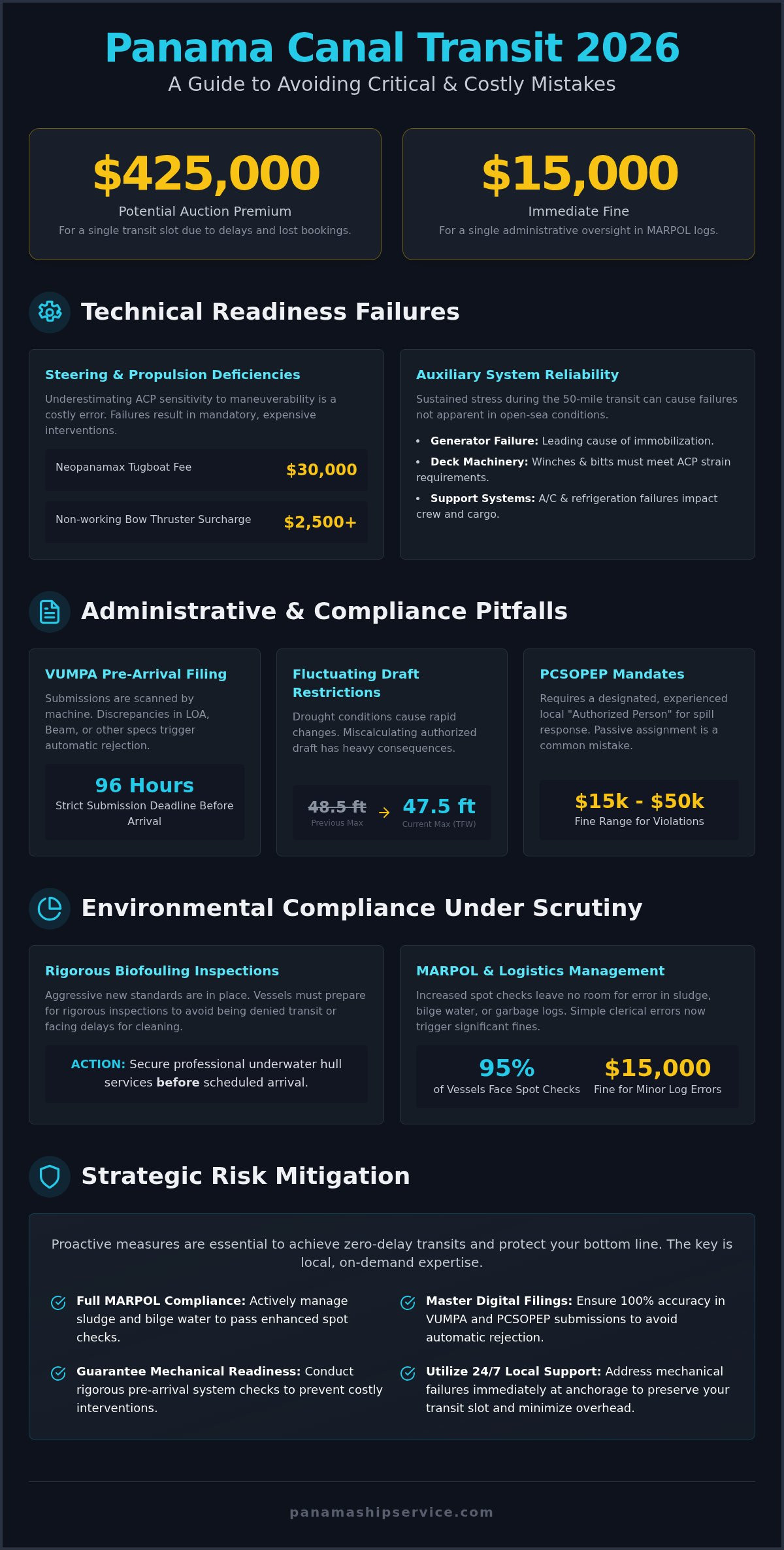
Did you know that a single administrative oversight in your MARPOL logs can now trigger a $15,000 fine before your vessel even reaches the locks? In 2026, the operational margin for error has vanished as the ACP implements machine-level validation for VUMPA submissions and aggressive biofouling standards. Avoiding common Panama Canal transit mistakes is no longer just about saving time; it’s about protecting your bottom line from auction premiums that have reached $425,000 for a single slot.
You likely recognize that the combination of severe El Niño conditions and reduced daily transits has made every minute at anchor more expensive than ever. This operational guide identifies the technical, regulatory, and logistical oversights that cause costly delays and fines in the current climate. We’ll examine how to maintain full MARPOL compliance, manage fluctuating draft restrictions, and ensure mechanical readiness to achieve zero-delay transits. By addressing these factors proactively, you can optimize fuel efficiency through the Isthmus and avoid the staggering surcharges currently imposed by major ocean carriers.
Key Takeaways
- Ensure your steering and mechanical systems meet strict ACP safety criteria to avoid expensive tugboat interventions during lockage.
- Master the 2026 VUMPA and PCSOPEP filing requirements to prevent the most common Panama Canal transit mistakes that lead to administrative fines.
- Prepare for rigorous biofouling inspections by securing professional underwater hull services before your scheduled arrival at the Isthmus.
- Manage sludge and bilge water storage effectively to ensure full MARPOL compliance during the increased environmental spot checks scheduled for 2026.
- Use 24/7 local technical expertise to address mechanical failures immediately, preserving your transit slot and minimizing operational overhead.
Technical Readiness: Ignoring Mechanical and Steering Health
Mechanical readiness is the cornerstone of a safe transit. In the high-stakes environment of the locks, a mechanical failure is not just an inconvenience; it’s a financial catastrophe. One of the most common Panama Canal transit mistakes is underestimating the sensitivity of the ACP to vessel maneuverability and power reliability. If your ship loses propulsion or steering within the lock chambers, the ACP will immediately deploy additional tugs to maintain control. A Neopanamax tugboat fee is $30,000, and a deficiency surcharge for a non-working bow thruster starts at $2,500. Understanding the Panama Canal history and operations reveals that the entire system relies on precise timing; any delay you cause ripples through the entire schedule, leading to massive administrative penalties and potential loss of your transit slot.
Steering Gear and Propulsion Inspections
Responsive steering is the ACP’s primary safety concern during the transit. You must conduct rigorous pre-arrival testing of rudder response times to ensure they meet official specifications. Even minor propeller damage can cause vibrations that compromise control in the narrow channels of the canal. Proactive mechanical ship repairs are essential to prevent lockage incidents. We recommend a full inspection of the steering gear hydraulic systems and propulsion shafts before reaching the Atlantic or Pacific entrances. Detecting a leak or a misaligned bearing early allows for repairs at anchorage, preventing a “dead ship” declaration during the actual transit.
Auxiliary System Reliability
Generator failure is the leading cause of vessel immobilization in the Culebra Cut. The 50-mile journey through the Isthmus puts sustained stress on auxiliary systems that might not be apparent during open-sea steaming. You must ensure your generators are synchronized and that deck machinery, specifically winches and bitts, meet the ACP’s specific strain requirements for towing. Don’t overlook A/C and refrigeration systems. The intense tropical climate of Panama in 2026 can cause these units to fail, impacting crew performance and the stability of temperature-sensitive cargo. We provide 24/7 emergency repair availability in both Balboa and Cristobal ports to address these technical failures immediately, ensuring your vessel remains compliant and operational throughout the transit.
Administrative and Compliance Pitfalls in 2026
Digital documentation is the first hurdle in a modern transit. One of the most common Panama Canal transit mistakes is failing to submit the Vessel Universal Maritime Pre-Arrival (VUMPA) 96 hours before arrival. The ACP now utilizes machine-level validation to scan these submissions for discrepancies. If your technical dimensions, such as Length Overall (LOA) or Beam, don’t match previous records or class certificates, the system triggers an automatic rejection. This doesn’t just cause a delay; it can lead to the forfeiture of your transit slot and force your vessel to the back of a very expensive queue.
Digital Pre-Arrival Compliance
Accuracy in technical reporting is non-negotiable. Miscalculating the maximum authorized draft is a frequent error that carries heavy consequences. While the Neopanamax limit was established at 14.78 meters (48.5 feet) TFW earlier in the year, drought conditions have forced rapid adjustments down to 48 feet and 47.5 feet as of September 2026. You must consult the Official Panama Canal Authority regulations daily to stay ahead of these shifts. To ensure your documentation withstands ACP scrutiny, it’s vital to maintain updated, class-approved marine surveys in Panama that verify your vessel’s current physical condition and technical specifications.
PCSOPEP and Environmental Mandates
Environmental compliance is under intense scrutiny. The Panama Canal Shipboard Oil Pollution Emergency Plan (PCSOPEP) requires every vessel to have a designated “Authorized Person” (AP) who is a local entity. A frequent mistake is assigning an AP who is passive or lacks direct experience with local spill response protocols. In 2026, PCSOPEP violation fines range from $15,000 to $50,000. Additionally, minor administrative errors in MARPOL logs, such as a missing signature in the Garbage Record Book, now result in immediate $15,000 fines. Authorities are conducting spot checks on 95% of transiting vessels, leaving no room for clerical oversights.
Managing these administrative complexities requires a partner who operates on the ground. You can simplify your operations by delegating these regulatory hurdles to a local technical office that ensures every certificate and filing is valid for the duration of your transit.
Biofouling and Underwater Maintenance Oversights
Operating a vessel with a fouled hull during the 50-mile canal passage is among the most frequent and costly common Panama Canal transit mistakes. In 2026, the ACP has intensified its focus on biofouling as both an environmental threat and a safety risk. Hull fouling significantly increases hydrodynamic friction, which forces the main engine to work harder even during the slow-steaming segments of the transit. This added drag doesn’t just waste fuel; it generates unnecessary engine strain that can lead to overheating when navigating the tight tolerances of the locks. Propeller polishing represents a small, proactive investment that prevents this strain and ensures your propulsion system operates at peak efficiency.
Beyond mechanical performance, environmental compliance is now a mandatory entry requirement. Stricter biofouling standards that became effective in 2024 now require vessels to demonstrate their hulls are free of invasive species before entering Gatun Lake. In 2026, the ACP is conducting more frequent unannounced environmental inspections at anchorage. These checks align with broader MARPOL and scrubber regulations that govern vessel emissions and waste. Comprehensive hull cleaning is a prerequisite for fuel efficiency and regulatory compliance in 2026.
The Impact of Hull Fouling on Maneuverability
A fouled hull fundamentally alters a ship’s “feel” and its response to pilot commands. During lock entry, where precision is measured in centimeters, the unpredictable drag from heavy barnacle growth or tubeworm colonies can cause sluggish steering response. This increased drag requires more power for the vessel to maintain steerage way, complicating the delicate balance of forces during the approach. Utilizing professional underwater hull services prior to arrival ensures your vessel responds predictably to every helm order, reducing the risk of a lock-wall strike or the need for emergency tug intervention.
In-Water Inspections and UWILD
Securing Class-approved divers for hull condition assessments is essential for a smooth transit. An Underwater Inspection in Lieu of Drydocking (UWILD) allows you to detect structural damage or propeller cavitation issues below the waterline before they become transit-stopping failures. Our cleaning protocols utilize advanced technology that complies with local Panama environmental regulations, preventing the release of contaminants while restoring the hull’s smooth profile. These inspections provide the technical verification the ACP requires, confirming that your vessel is fit for the transit without the risk of being turned away at the entrance due to excessive growth.
MARPOL and Logistics: The ‘Hidden’ Transit Mistakes
While mechanical failures are obvious, logistical oversights often represent the most insidious common Panama Canal transit mistakes. In 2026, the ACP has expanded Garbage Record Book requirements to include all vessels over 100 gross tonnage. Arriving at the Isthmus with full sludge tanks or improperly segregated waste is a significant operational risk that many operators overlook until they face a pre-transit inspection. You can’t discharge oily water or bilge within the Canal watershed without facing immediate detention and staggering fines. Meticulous planning for waste management is now a prerequisite for a smooth transit through these sensitive waters, especially as environmental spot checks now target 95% of transiting vessels.
MARPOL Compliance and Waste Disposal
Effective waste management requires more than just record-keeping; it demands physical action before entering the locks. Scheduling MARPOL disposal in Panama is the most reliable way to avoid port state control issues and administrative delays. You must handle oily water and sludge in a compliant, documented manner to meet the ACP’s high environmental standards. Illegal discharge within the watershed is monitored via advanced 2026-grade surveillance, and even a minor leak can trigger a response that halts your transit and incurs massive cleanup costs. Proactive disposal ensures your holding tanks have the capacity required for the duration of the passage, preventing the need for emergency services at the locks.
Provisioning and Spare Parts Logistics
Supply chain gaps frequently disrupt schedules when operators wait until the last minute for critical engine spares or provisions. Neglecting to secure ship supplies in Panama before a long Pacific or Atlantic leg is an avoidable error that impacts crew welfare and vessel readiness. You should coordinate crew changes and sanitary inspections well in advance to prevent administrative holds. Sourcing specialized mechanical parts locally is essential to avoid the delays and high costs associated with international air-freight. Additionally, verify your deratting certificate; an expired document can halt a transit just as effectively as a mechanical failure. In the current high-cost environment of 2026, these small logistical details often determine the fiscal success of a voyage.
Don’t let logistical oversights compromise your schedule. Contact our team to coordinate your MARPOL disposal and ship supply requirements to ensure a compliant and efficient transit.
Strategic Risk Mitigation: The Value of Local Technical Support
Navigating the complexities of the 2026 operational environment requires more than just following a checklist; it requires strategic risk mitigation through local technical support. Many operators view transit preparation as a series of isolated tasks, but this fragmented approach is exactly what leads to common Panama Canal transit mistakes. By consolidating mechanical repairs, underwater inspections, and MARPOL disposal under a single technical office, you eliminate the communication gaps that often lead to scheduling conflicts. This “one-stop-shop” model reduces operational friction and ensures that technical readiness is synchronized with your scheduled arrival time.
The financial logic is undeniable. When you compare the cost of proactive local support to the $425,000 auction premiums seen in mid-2026, the value of a “first-time right” transit becomes clear. Local experts also provide an intangible advantage: knowledge of ACP pilot preferences. Whether it’s the specific tensioning of mooring winches or the exact bridge visibility requirements for Neopanamax vessels, understanding these nuances allows you to prepare your vessel to a standard that exceeds the basic regulatory minimums. This proactive stance protects your bottom line and maintains your reputation for reliability in a high-stakes corridor.
Proactive vs. Reactive Maintenance
Reactive maintenance is a gamble that rarely pays off at the Isthmus. Utilizing pre-arrival marine surveys allows you to identify potential deficiencies before the ACP inspector boards your vessel. Having a repair team ready at either Balboa or Cristobal means that even last-minute mechanical issues don’t have to result in a missed slot. Consider a recent case where a vessel identified a leaking hydraulic seal in its steering gear just 12 hours before transit. Because they had engaged local support, they secured rapid mechanical ship repairs in Panama that were completed at anchorage, allowing the ship to maintain its position in the queue and avoid a massive rescheduling penalty.
Choosing the Right Partner in Panama
When evaluating local support, you must distinguish between pure administrative agencies and technical service providers. An agency might handle your paperwork, but they cannot troubleshoot a generator failure or perform a class-approved underwater inspection. You need a partner with the technical proficiency to execute repairs and the 24/7 availability to respond to emergencies. In the 2026 climate of drought-driven transit reductions, time is your most expensive commodity. Choosing a veteran provider ensures that your vessel is handled with the urgency and precision required for the Panama Canal. Contact Panama Ship Service today to secure your 2026 transit readiness and eliminate the technical oversights that lead to costly delays.
Optimizing Your 2026 Transit Strategy
In the volatile maritime environment of 2026, the difference between a successful transit and a multi-million dollar delay lies in technical and administrative precision. We’ve identified how neglecting mechanical health or failing to meet evolving MARPOL and biofouling standards creates catastrophic operational risks. Eliminating common Panama Canal transit mistakes requires a proactive approach that prioritizes local expertise and immediate responsiveness at the Isthmus. By consolidating your technical needs, you ensure your vessel meets every ACP requirement without the friction of multiple vendors or administrative oversights.
Maintaining a zero-delay schedule is achievable when you have the right local infrastructure behind you. You can secure your transit with Panama Ship Service’s 24/7 technical support. Our comprehensive offerings include 24/7 Emergency Mechanical Repairs, Class-Approved Underwater Surveys, and Full MARPOL Compliance Services designed to protect your bottom line. Delegate the technical complexity of the Canal to a partner who understands the high stakes of your schedule. We’re ready to ensure your next passage through the Isthmus is efficient, compliant, and profitable.
Frequently Asked Questions
What are the current Panama Canal draft limits for 2026?
As of September 2026, the maximum authorized draft for Neopanamax locks is 14.78 meters (48.5 feet) TFW, though recent adjustments have lowered this to 47.5 feet due to Gatun Lake levels. These limits fluctuate daily based on water conservation measures and the impact of the current El Niño event. You must verify the latest ACP advisories before arrival to avoid cargo offloading or transit denial.
Can I perform engine repairs while waiting for my transit slot?
Yes, you can perform essential engine repairs at the Atlantic or Pacific anchorages while waiting for your scheduled transit. Our team provides 24/7 mechanical ship repairs to address steering gear, propulsion, or generator issues before they become common Panama Canal transit mistakes that cause delays. Conducting these repairs at anchorage ensures your vessel meets all ACP technical requirements without losing your position in the transit queue.
What happens if my vessel has a mechanical failure inside the Panama Canal locks?
If a mechanical failure occurs within the locks, the ACP will immediately deploy additional tugboats to maintain control of your vessel. This intervention is extremely costly; Neopanamax tugboat fees are $30,000, and you’ll face a deficiency surcharge starting at $2,500. The resulting delay can also lead to administrative fines and the forfeiture of your transit slot, making pre-transit mechanical inspections a financial necessity for every operator.
Is hull cleaning mandatory before transiting the Panama Canal?
While not explicitly mandatory for every vessel, stricter biofouling standards effective as of 2024 require hulls to be free of invasive species before entering Gatun Lake. In 2026, the ACP is conducting unannounced spot checks on 95% of transiting vessels. If excessive growth is detected, your transit may be delayed or cancelled. Professional underwater hull services ensure compliance and prevent the increased drag that compromises maneuverability in the locks.
What is a PCSOPEP Authorized Person and why do I need one?
An Authorized Person (AP) is a local entity designated under the Panama Canal Shipboard Oil Pollution Emergency Plan (PCSOPEP) to coordinate spill responses. You need a proactive, local AP to ensure your vessel complies with specific ACP environmental protocols. Failing to have a valid AP or an updated oil spill response plan can lead to fines ranging from $15,000 to $50,000 and the loss of transit priority.
How do I dispose of MARPOL waste at the Panama Canal?
You must schedule waste disposal through a certified local provider to ensure full MARPOL compliance. Panama Ship Service handles the removal of sludge, oily water, and ship garbage in accordance with international and local regulations. Arriving with full holding tanks is a risk, as illegal discharge within the Canal watershed is strictly prohibited. Scheduling these services at anchorage prevents administrative holds and ensures your Garbage Record Book remains accurate for inspection.
What are the most common reasons for ACP fines in 2026?
The most common Panama Canal transit mistakes leading to fines in 2026 involve administrative and environmental oversights. Documentation errors in the VUMPA submission or missing signatures in the Garbage Record Book now trigger automatic fines starting at $15,000. Other frequent penalties arise from PCSOPEP violations, non-compliant sulfur levels under MARPOL Annex VI, and mechanical deficiencies like non-working bow thrusters, which carry surcharges starting at $2,500. Precision in record-keeping is vital.
Can I change crew members during a Panama Canal transit?
Yes, crew changes can be coordinated at the Atlantic or Pacific entrances or during the transit at designated locations. We provide comprehensive crew change and manning services, including transportation and immigration processing, to ensure smooth transitions without disrupting your schedule. It’s critical to coordinate these logistics well in advance with your agent to ensure all sanitary inspections and documentation are completed before the vessel enters the locks.