
A single missed update from the Panama Canal Authority (ACP) can result in costly delays, failed inspections, and significant financial penalties. For ship owners and charterers, navigating the dense, constantly evolving official documents is a high-stakes and frustrating challenge. A clear, expert understanding of the current panama canal transit regulations is not just beneficial-it is essential for operational efficiency and profitability. Misjudging a requirement is a risk you cannot afford to take when timing is everything.
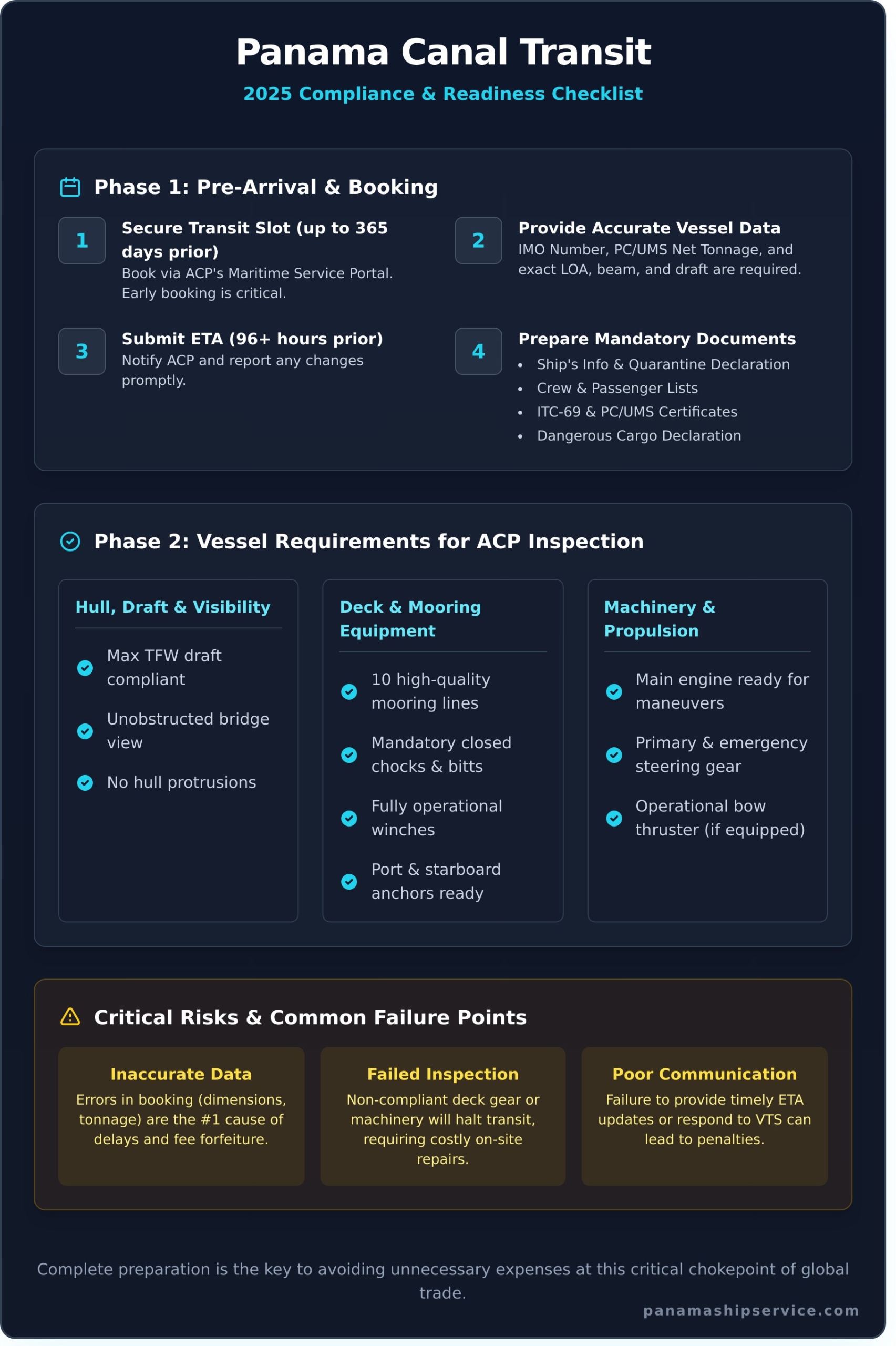
This comprehensive 2025 guide is your solution. We have distilled the complex ACP mandates into a direct, easy-to-navigate resource so you can ensure your vessel is fully compliant. Inside, you will find a practical checklist of all major regulations, a breakdown of the most common points of failure during inspection, and the specific vessel requirements needed for a smooth passage. Put our expertise to work and approach your next transit with the confidence that comes from complete preparation, avoiding unnecessary expenses at this critical chokepoint of global trade.
Pre-Arrival & Booking: Your First Steps to Compliance
A successful and cost-effective transit through the Panama Canal is determined long before your vessel reaches its waters. Meticulous advance preparation is not just recommended; it is essential for avoiding costly delays and operational disruptions. All operations are governed by the Panama Canal Authority (ACP), the entity responsible for enforcing the comprehensive panama canal transit regulations. For a general Panama Canal overview, the waterway’s history is well-known, but for ship operators, compliance begins with mastering the pre-arrival process. Errors made during booking and documentation are the primary cause of transit delays, turning a routine passage into a significant financial liability.
The Transit Reservation (Booking) System
Securing a transit slot is a competitive and time-sensitive process managed through the ACP’s Maritime Service Portal. The system is divided into booking periods, with the first period opening up to 365 days in advance, offering the best chance to secure a desired date. To complete a reservation, you must provide precise information, including the vessel’s name, IMO number, PC/UMS Net Tonnage, and exact dimensions. Missing a reserved slot or providing inaccurate data can result in the forfeiture of booking fees and a loss of your place in the queue, forcing a vessel to wait for an opening among non-booked vessels.
Mandatory Documentation and Information
Accuracy is paramount when submitting pre-arrival information to the ACP. Incomplete or incorrect paperwork is a guaranteed route to delays. Your agent must have all essential documentation prepared for submission, including:
- Ship’s Information and Quarantine Declaration: The foundational form for any transit request.
- Crew List and Passenger List: Required for security and immigration purposes.
- Ship’s Certificates: Including the International Tonnage Certificate (ITC-69) and the PC/UMS certificate.
- Dangerous Cargo Declaration: Any hazardous materials must be declared in strict accordance with regulations.
Of critical importance is the vessel’s dimension data. An error in the reported Length Overall (LOA), beam, or tropical freshwater draft can lead to a re-assessment, potentially disqualifying the vessel from its booked slot.
Arrival Procedures and Communications
Effective communication is a non-negotiable part of the panama canal transit regulations. Vessels must provide an Estimated Time of Arrival (ETA) notice to the ACP at least 96 hours prior to arrival. Any changes to the ETA must be communicated promptly. Upon reaching the Canal entrance, vessels must contact the appropriate Signal Station-Cristobal for the Atlantic side or Balboa for the Pacific-via VHF radio. All vessel movements within Canal waters are monitored and directed by the Vessel Transit System (VTS), ensuring safe and efficient traffic flow.
Vessel Requirements: Technical & Structural Compliance
The Panama Canal Authority (ACP) enforces a strict set of technical and structural standards to ensure safe and efficient passage. These are not mere suggestions; they are mandatory requirements verified by an ACP inspector upon your vessel’s arrival. Failing this inspection can result in significant transit delays and the need for immediate, costly on-site repairs. A comprehensive understanding of these panama canal transit regulations is the first step toward a smooth transit. For a complete and detailed list, vessel operators should always consult the Official Panama Canal Maritime Regulations published by the ACP.
Hull, Draft, and Visibility Standards
A vessel’s physical condition is paramount. The maximum permissible tropical fresh water (TFW) draft is strictly enforced, as it dictates clearance through Gatun Lake. Exceeding this limit will halt your transit. From the navigation bridge, there must be an unobstructed view of the water surface ahead of the bow. Furthermore, vessels must maintain a minimal list and an even keel or be slightly trimmed by the stern. Any protrusions from the hull that could interfere with or damage the lock structures are strictly forbidden.
Deck, Mooring, and Anchoring Equipment
Your vessel’s deck equipment will be heavily utilized during transit and must meet exacting standards. Key requirements include:
- Mooring Lines: A specific number of high-quality lines (typically 10) of required length and strength must be available and in excellent condition.
- Chocks and Bitts: These must be structurally sound and correctly placed to handle the immense forces exerted by Canal locomotives. Closed chocks are mandatory.
- Winches: Mooring winches must be powerful, fully operational, and capable of paying out line under tension.
- Anchors: Both port and starboard anchors and their associated windlasses must be in perfect working order.
Non-compliance in this area is a common source of delays. Need equipment upgrades or repairs? Contact our technical team.
Machinery, Propulsion, and Steering Gear
Reliable machinery is non-negotiable for Canal transit. The ACP requires your vessel’s systems to be fully operational and responsive. This includes a main engine capable of full sea speed and ready for immediate maneuvers, along with sufficient generator capacity. The steering gear must have both primary and emergency systems in excellent condition, supported by a clearly visible rudder angle indicator on the bridge. If your vessel is equipped with a bow thruster, it must be fully functional, as it is a critical component of the transit plan. All navigation and bridge equipment must be operational to comply with panama canal transit regulations.
Safety, Manning & Pilotage Regulations
The Panama Canal Authority (ACP) enforces a stringent set of safety, manning, and pilotage rules designed to protect vessel crews, ACP personnel, and the Canal’s critical infrastructure. Compliance is not optional; it is a prerequisite for a smooth and efficient transit. These specific panama canal transit regulations ensure every vessel meets the high operational standards required for navigating this unique waterway.
Manning and Crew Requirements
A vessel must be adequately staffed to handle transit operations safely. At a minimum, this includes a qualified officer and helmsman on the bridge at all times, along with sufficient seamen to manage mooring lines at the bow and stern. The engine room must also be continuously manned. All officers on the bridge responsible for navigation and communication must be fluent in English. Crew changes are heavily restricted within Canal waters to prevent delays, so all personnel matters must be arranged before or after the transit.
Pilotage and Navigation
Pilotage by a qualified ACP pilot is compulsory for all vessels in transit. The Master is responsible for providing a safe embarkation area, including a SOLAS-compliant pilot ladder, which must be clean, properly rigged, and well-lit. While the ACP pilot directs the navigation of the vessel, the Master retains ultimate command and responsibility for the ship’s safety. A comprehensive information exchange between the Master and the pilot is required before transit begins, covering the vessel’s handling characteristics, equipment status, and intended passage plan.
Lifesaving and Firefighting Equipment
Vessels must be equipped with fully functional, SOLAS-compliant safety systems. Any deficiencies can result in costly delays or denial of transit. For a complete checklist, ship operators must refer to the official Vessel Requirements for Panama Canal Transit document from the ACP. Key equipment includes:
- Lifesaving Appliances (LSA): Lifeboats, life rafts, and lifejackets must be certified and ready for immediate use.
- Firefighting Equipment (FFE): Fixed systems (like CO2 in the engine room) and portable fire extinguishers must be inspected and operational.
- Pilot Shelter: A dedicated shelter must be available to protect the pilot from sun and rain.
Failure to meet these crucial safety standards is one of the most common reasons for transit complications. Ensuring all equipment is in excellent working order is a core component of successful transit preparation.
Environmental & MARPOL Regulations in Canal Waters
The Panama Canal Authority (ACP) enforces a zero-tolerance policy for pollution to protect the region’s vital watershed and delicate ecosystem. These stringent environmental rules are not merely suggestions; they are mandatory requirements for passage. Based on international MARPOL conventions and specific local ACP mandates, these panama canal transit regulations are among the strictest in the world. Failure to comply can result in significant fines, operational delays, and even denial of transit.
Navigating these complex requirements demands expert coordination. Vessels must demonstrate full compliance across several key areas, directly linking environmental responsibility to the need for qualified, efficient vessel services before and during transit.
Ballast Water Management
To prevent the introduction of non-native aquatic species, the ACP mandates strict ballast water management. Vessels must either conduct a full ballast water exchange in the open ocean or utilize an approved onboard Ballast Water Treatment System (BWTS). Detailed records, including a Ballast Water Reporting Form submitted at least 96 hours before arrival, are required. ACP officials may conduct onboard inspections, including sampling and testing, to verify compliance.
Garbage, Sludge, and Waste Disposal
The discharge of any garbage, plastics, or other solid waste into Canal waters is strictly prohibited. All MARPOL Annex I (sludge, oily water) and Annex IV (sewage) waste must be managed according to international standards. Vessels are required to have adequate storage capacity for the entire transit or arrange for disposal with a certified provider. Coordinating these services is critical to avoid violations. Schedule your MARPOL disposal service with us today.
Air Emissions and Fuel Requirements
Air quality is a primary concern within the Canal’s operational boundaries. In line with MARPOL Annex VI, vessels must use fuel with a maximum sulfur content of 0.50% m/m. Furthermore, the use of onboard incinerators is forbidden while in Canal waters or anchored at the terminals. As global standards evolve, the ACP is also increasing its focus on Greenhouse Gas (GHG) emissions, signaling future updates to these critical panama canal transit regulations.
Common Deficiencies & How to Avoid Transit Delays
In the high-stakes environment of the Panama Canal, time is money. A failed pre-transit inspection by the Panama Canal Authority (ACP) can lead to significant delays, unexpected costs, and major schedule disruptions. The most effective way to ensure a smooth passage is through proactive preparation. As your trusted partner at the Canal, we have identified the most common issues that sideline vessels. Understanding these pitfalls is the first step toward a seamless and cost-effective transit.
Top Reasons for Inspection Failures
Most transit delays are preventable. ACP inspectors are meticulous, and their findings often fall into several key categories. Based on our extensive experience, these are the most frequent deficiencies that halt a vessel’s progress:
- Defective Pilot Access: Worn, improperly rigged, or non-compliant pilot ladders and accommodation ladders are an immediate red flag for safety.
- Inadequate Mooring Equipment: Frayed mooring lines, inoperative winches, or damaged chocks and bitts do not meet the stringent requirements for lock operations.
- Inoperative Bridge or Engine Room Machinery: Any failure in critical systems-such as AIS, steering gear, VDR, or main engine controls-will prevent transit until repaired.
- Bridge Visibility Obstructions: Deck cargo, cranes, or other structures blocking a clear line of sight from the bridge wings and conning positions are a common cause for failure.
- Incorrect Documentation or Markings: Discrepancies in paperwork, incorrect declarations, or poorly painted draft marks can lead to delays while clarifications are made.
Proactive Self-Inspection Checklist
Your crew can act as the first line of defense against delays by conducting a thorough self-inspection before arrival. This simple checklist covers the most critical areas and aligns with the official panama canal transit regulations:
- Test Mooring Gear: Operate all mooring winches, check brake holding capacity, and inspect every line for wear.
- Verify Pilot Access: Rig the pilot ladder to confirm it is in excellent condition and meets all SOLAS and ACP standards.
- Confirm Systems Readiness: Test all required navigational equipment, engine controls, and emergency steering systems well in advance.
- Review All Paperwork: Scrutinize every document for accuracy, ensuring it matches the vessel’s actual condition and ACP requirements.
What to Do If a Deficiency is Found
If an ACP inspector identifies a deficiency, your vessel will be ordered to an anchorage until the issue is resolved to their satisfaction. This halt immediately adds anchorage fees, crew costs, and fuel consumption to your operational expenses. Fast, expert intervention is critical to minimize downtime. Panama Ship Service specializes in rapid-response solutions to get your vessel compliant and back on schedule. We are experts so you don’t have to be.
Facing a deficiency? Our 24/7 repair teams are ready to assist.
Ensure Compliance and Efficiency on Every Transit
Navigating the Panama Canal successfully hinges on meticulous preparation and a deep understanding of its complex rules. From pre-arrival documentation to strict adherence to vessel, safety, and environmental standards, every detail matters. Overlooking a single requirement can lead to costly delays and operational disruptions, underscoring the critical importance of mastering the official panama canal transit regulations well before your vessel approaches Canal waters.
The stakes are high, but you don’t have to manage this complexity alone. With over 20 years of dedicated experience, Panama Ship Service is your trusted partner on the ground. We are your one-stop-shop for full compliance, offering 24/7 rapid response for any repairs or services needed to prevent deficiencies and ensure a timely, cost-effective passage. We are the experts so you don’t have to be.
Ensure a Smooth & Compliant Transit. Contact Our Canal Experts Today.
Put your transit in our hands and sail through with confidence.
Frequently Asked Questions About Panama Canal Transit Regulations
What are the most significant recent changes to the Panama Canal regulations?
The most significant recent changes to the Panama Canal transit regulations have been driven by water conservation needs. The Panama Canal Authority (ACP) has reduced daily transit slots and adjusted the booking system to manage traffic. Additionally, new fees, such as the ‘Freshwater Surcharge,’ impact voyage cost calculations. These measures require proactive planning to mitigate delays and unexpected expenses, making expert guidance essential for a smooth and cost-effective transit.
How have the water level and draft restrictions affected transit regulations?
Persistent low water levels in Gatun Lake have forced the ACP to impose strict draft restrictions, particularly for the Neopanamax locks. This directly compels vessels to lighten their cargo loads to comply, impacting payload capacity and profitability. Ship operators must continuously monitor ACP advisories for the latest draft limits, as these are subject to frequent change with rainfall patterns. Navigating these dynamic conditions is critical for operational success and avoiding costly penalties.
What happens if my vessel fails the ACP safety inspection upon arrival?
If a vessel fails its pre-transit safety inspection, it will be barred from entering the Canal until all identified deficiencies are corrected. This results in immediate and costly delays, including anchorage fees and potential re-inspection charges. Common failures relate to mooring equipment, pilot ladders, or sanitary systems. A failed inspection disrupts schedules and increases operational expenses, underscoring the importance of pre-arrival checks by a qualified partner to ensure full compliance.
Are there different regulations for Neopanamax vessels versus Panamax vessels?
Yes, regulations differ significantly based on vessel size. Neopanamax vessels, which use the expanded locks, are subject to greater maximum dimensions and have more stringent requirements for maneuverability. They also require dedicated tugboat assistance throughout the entire transit, unlike Panamax vessels that use locomotives in the original locks. These distinct operational protocols and fee structures are critical for accurate voyage planning and budgeting for either vessel class.
Can a vessel be denied transit through the Panama Canal?
A vessel can absolutely be denied transit. The most common reasons include failure to pay transit tolls in advance, unresolved safety deficiencies found during inspection, or non-compliance with critical MARPOL and sanitary regulations. Any vessel deemed to pose a direct threat to the safety of the Canal, its personnel, or other ships due to its condition or cargo will be refused entry until the issues are fully rectified. Proactive compliance is the only way to guarantee passage.
Who is liable for damages if an accident occurs during transit?
Under ACP regulations, liability for damages rests almost exclusively with the vessel owner. Even while under the control of an ACP pilot, the vessel remains responsible for any accidents or damages to Canal infrastructure or other ships. The ACP assumes liability only in very specific, proven cases of gross negligence by its employees. This policy underscores the critical need for proper vessel maintenance, crew readiness, and comprehensive insurance coverage for every transit.