
With last-minute auction fees hitting a staggering $4 million in April 2026, mismanaging your panama canal transit risks is no longer just a delay; it’s a potential financial catastrophe. You understand that timing is everything in this corridor, and the pressure of rising costs and stricter ACP enforcement feels more intense than ever. We know the frustration of facing unexpected demurrage or technical non-compliance just when your schedule is most vulnerable. Put your transit in our hands.
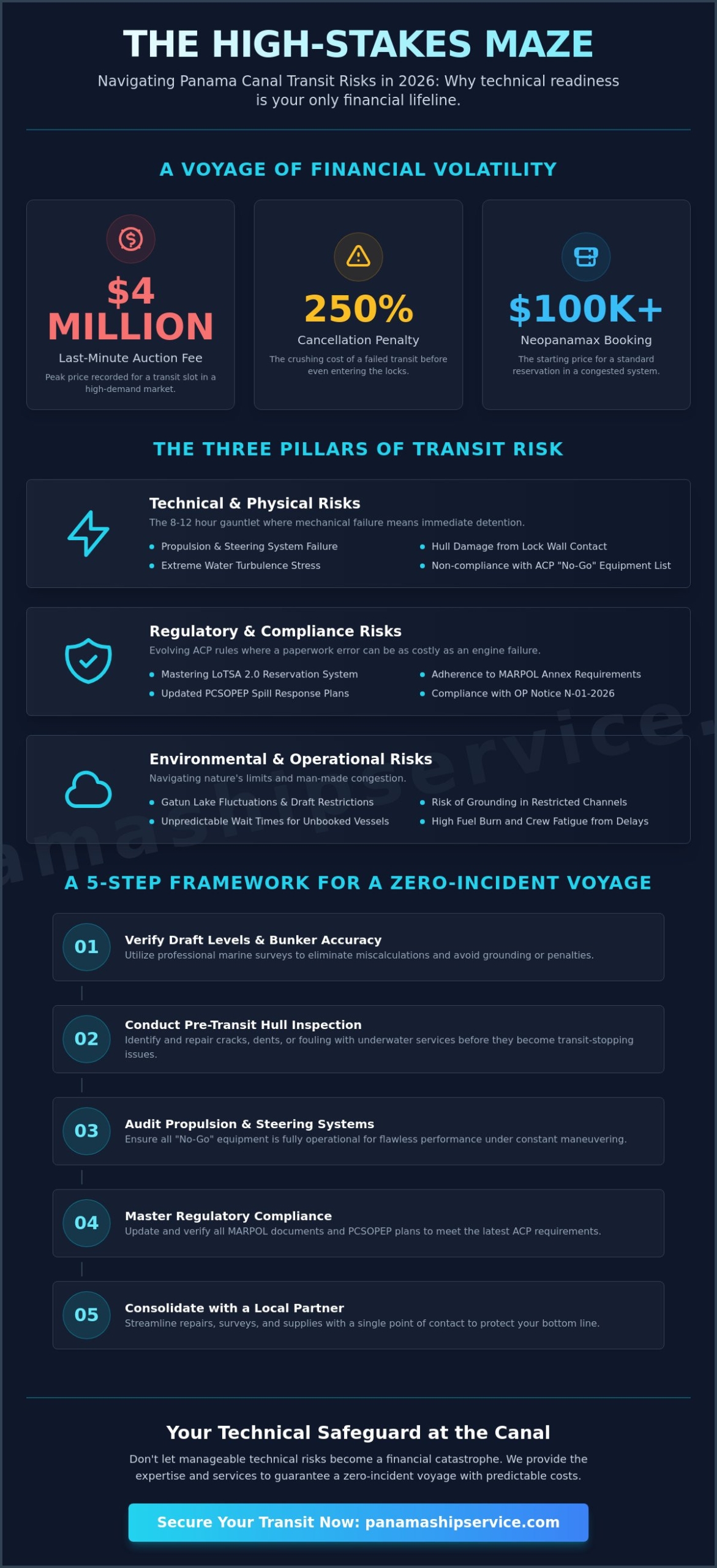
This guide will show you how to treat transit risk as a technical challenge that requires mechanical readiness, ensuring you avoid the $100,000 booking fees or the crushing 250% cancellation penalties. We are experts so you don’t have to be. We’ll break down the mechanical, environmental, and regulatory hurdles of the 2026 shipping climate, including the LoTSA 2.0 system and the latest OP Notice N-01-2026 requirements, to guarantee a zero-incident voyage with predictable costs.
Key Takeaways
- Learn why treating panama canal transit risks as a technical challenge rather than a logistical one is the key to avoiding costly delays and vessel damage.
- Identify the specific physical stressors of lock operations and how to ensure your propulsion system meets the rigorous demands of an 8-12 hour transit.
- Stay compliant with evolving ACP regulations by mastering MARPOL Annex requirements and updating your PCSOPEP spill response plans before arrival.
- Implement a proactive 5-step technical audit to verify draft levels and bunker accuracy, eliminating the risk of high-cost cancellations or penalties.
- Discover the financial advantage of consolidating repairs, surveys, and supplies with a single trusted partner to streamline operations and protect your bottom line.
Understanding the Landscape of Panama Canal Transit Risks in 2026
Managing panama canal transit risks in 2026 requires a shift in perspective. Transit risk is no longer just a logistical box to check; it’s the dangerous intersection of environmental volatility, operational pressure, and technical readiness. The Panama Canal currently sees an average of 37 daily transits. This high volume means the waterway is operating at peak capacity, leaving zero margin for mechanical error or scheduling oversight. We’ve seen auction prices for transit slots climb as high as $4 million due to global trade rerouting. In this high-stakes environment, a single engine failure or a paperwork discrepancy doesn’t just cause a delay. It triggers a financial chain reaction of demurrage, penalties, and lost reputation. We are experts in this “difficult and frustrating” environment so you don’t have to be.
The financial reality of 2026 is unforgiving. With cancellation penalties reaching up to 250% of the booking fee, the cost of a failed transit can easily exceed six figures before a vessel even enters the locks. Geopolitical conflicts have increased the “pressure to perform” on every crew. When global chokepoints elsewhere are restricted, the Canal becomes the only viable route, making every minute at the anchorage a drain on your bottom line. You need a partner who understands that technical reliability is your best insurance policy.
Environmental Volatility and Draft Restrictions
Gatun Lake levels remain the primary driver of operational limits. While water levels are currently stable, seasonal fluctuations can trigger rapid changes in maximum allowable draft for Neopanamax vessels. A Draft Restriction is the specific limit set by the ACP on how deep a vessel may sit in the water to safely clear the Canal’s bottom and lock sills. If you miscalculate your displacement, you risk “bottom-touching” or grounding in restricted channels. This leads to immediate transit suspension and mandatory underwater inspections, turning a routine voyage into a costly repair project.
Congestion and the Transit Reservation System
The implementation of the LoTSA 2.0 reservation system has changed how slots are managed, but it hasn’t eliminated the risks of the “unbooked” queue. Ships without a reservation face unpredictable wait times that exhaust crew resources and burn fuel. The auction system adds another layer of financial volatility for charterers, with standard Neopanamax bookings starting at $100,000. To mitigate these risks, precise technical data is non-negotiable. Utilizing professional marine surveys in Panama allows you to verify cargo weight and bunker levels for strict draft compliance. We provide these essential surveys to ensure your vessel meets every ACP requirement before you arrive at the pilot station.
Technical and Physical Risks: Protecting the Vessel Structure
Logistical planning is vital, but panama canal transit risks are fundamentally rooted in the physical interaction between your vessel and the Canal’s infrastructure. A transit involves an 8 to 12-hour window of constant maneuvering where propulsion and steering systems must perform flawlessly. Inside the lock chambers, your vessel faces extreme water turbulence as millions of gallons are displaced in minutes. This creates massive pressure on mooring lines and hull surfaces. Even a minor miscalculation by the pilot or a slight delay in engine response can result in contact with the lock walls or the “mules” (locomotives) used to steady ships. These physical impacts don’t just cause cosmetic damage; they can compromise hull integrity and lead to immediate ACP-mandated detentions.
Proactive maintenance is your primary defense against these hazards. Ensuring your vessel is clean and structurally sound before arrival is essential. Many operators utilize professional underwater hull services to inspect for cracks, dents, or fouling that could affect performance during the transit. In an environment where the risks of water scarcity can lead to more restricted channels and increased silt concentration, technical readiness isn’t optional. It’s a prerequisite for a safe passage.
Mechanical Failure During Maneuvering
The ACP maintains a strict “No-Go” list of equipment that must be fully operational before a vessel is allowed to enter the locks. This includes steering gear, bow thrusters, and main engine air-start systems. Failure in any of these critical components during transit is a nightmare scenario. A steering failure while transiting the narrow Culebra Cut would likely result in a catastrophic grounding that blocks the entire waterway, leading to millions in liability and salvage costs. You don’t want to be the reason the Canal stops. Regular testing of your air-start capacity is crucial. The frequent “stop-start” maneuvers required in the locks can quickly deplete air reservoirs if the compressors aren’t in top condition.
Rudder and Propeller Vulnerability
The Canal’s shallow-water conditions increase the risk of debris and silt ingestion. This can cause accelerated wear on rudder bearings and propeller blades. Propeller fouling is another silent risk. Even minor biofouling increases fuel consumption and reduces the precision of your maneuverability. If your crew identifies vibration or loss of efficiency, addressing these issues through mechanical ship repairs before you reach the pilot station is the only way to avoid a failed technical inspection. If you suspect mechanical issues, it’s better to consult with a technical partner before your scheduled slot to ensure you’re ready for the transit.
Regulatory and Compliance Risks: Avoiding ACP Fines
Regulatory failures are often the most frustrating panama canal transit risks because they’re entirely preventable with the right technical partner. The Panama Canal Authority (ACP) operates under a zero-tolerance policy for environmental and health violations. If your documentation is incomplete or your waste management systems aren’t compliant, you face immediate fines and transit suspension. Beyond standard MARPOL requirements, you must ensure your PCSOPEP (Panama Canal Shipboard Oil Pollution Emergency Plan) is updated and accessible. This isn’t just paperwork; it’s a legal shield that protects your vessel from the massive liabilities associated with oil spills in the sensitive Gatun Lake ecosystem.
Compliance requires constant vigilance as the ACP frequently updates its requirements. We ensure your vessel meets every mandate, from spill response readiness to the correct handling of bilge water. Utilizing professional MARPOL disposal panama services is the only way to guarantee that your sludge and slop are handled according to international and local standards. Cutting corners on disposal leads to Port State Control issues that can follow your vessel long after it leaves Panamanian waters. We are experts so you don’t have to be.
Waste Management and Environmental Compliance
The ACP strictly enforces rules regarding Annex I (oil), Annex IV (sewage), and Annex V (garbage). Illegal discharge within the Canal Zone or surrounding waters results in heavy fines, detention, and lasting reputational damage. You must coordinate your disposal needs well in advance of your transit window to avoid schedule disruptions. We provide efficient, certified disposal services that allow you to clear your tanks without disrupting your voyage. Our rapid response teams handle the logistics, so your crew can focus on the technical demands of the transit itself.
Health and Pest Control Standards
Sanitary inspections are a critical part of the pre-transit process. Your vessel must carry a valid Deratting Certificate or a Ship Sanitation Control Exemption Certificate. If these have expired, your transit will be delayed for mandatory fumigation or inspection. This isn’t just about pests; it’s about biosecurity. All vessels must submit a maritime health declaration at least 96 hours before arrival to confirm that the crew and vessel are free from infectious diseases. Even a minor oversight in health documentation can lead to quarantine, causing your expensive transit slot to expire while you wait at anchor.
A 5-Step Framework for Minimizing Transit Exposure
Mitigating panama canal transit risks requires a proactive technical strategy rather than a reactive logistical response. Vague voyage planning is insufficient in a 2026 environment where auction prices are volatile and ACP inspections are rigorous. You need a concrete framework to ensure your vessel passes technical scrutiny the first time. Our 5-step approach focuses on technical readiness to protect your schedule and your capital.
- Step 1: Conduct a pre-transit technical audit. Verify the functionality of all critical systems on the ACP “No-Go” list, specifically steering gear and air-start compressors.
- Step 2: Verify actual draft and bunker levels. Use independent surveys to confirm your displacement and fuel reserves, ensuring you don’t exceed seasonal draft limits.
- Step 3: Optimize hull and propeller condition. Remove biofouling to maximize maneuverability and reduce the risk of engine strain during lock operations.
- Step 4: Secure MARPOL and provision supplies. Consolidate waste disposal and provisioning into a single window to avoid multiple stops that drain time and fuel.
- Step 5: Establish a 24/7 technical support link. Partner with a local expert who can provide rapid response repairs or emergency surveys at a moment’s notice.
The Role of Pre-Transit Surveys
Bunker and draft surveys are your first line of defense against financial penalties. An independent survey provides a verified data point that protects you if disputes arise regarding cargo weight or fuel quantity. These surveys often reveal hidden mechanical issues, such as leaking valves or faulty gauges, before the ACP inspector arrives on deck. Addressing these discrepancies early is the most effective way to minimize downtime. For a deeper look at how to handle these technical hurdles, consult our guide on mechanical ship repairs in Panama. We identify the problems so you can focus on the voyage.
Optimizing Vessel Efficiency
Operational readiness depends on the physical state of your vessel. Hull cleaning isn’t just about fuel economy; it’s about safety. A fouled hull creates significant drag, which forces the engine to work harder during the precise maneuvers required within the locks. This increased strain can lead to overheating or mechanical failure at the worst possible moment. Coordinating your technical needs through a single provider for ship supplies panama canal ensures that your crew has the necessary parts and provisions without logistical friction. Achieving “first-time-right” technical preparation is the only way to guarantee your vessel transits without the threat of a $4 million auction slot going to waste. If you’re ready to secure your transit, contact us for a technical consultation today.
Panama Ship Service: Your Technical Safeguard at the Canal
Managing the complexities of the waterway requires more than just a logistical agent. It demands a technical partner who understands the high-stakes environment where a single delay can cost millions. Panama Ship Service brings 20 years of experience to every vessel we serve. We operate as your authoritative expert on the ground, navigating the “difficult and frustrating” realities of the Canal so you don’t have to. By consolidating technical services under one roof, we eliminate the friction that leads to increased panama canal transit risks. Put your transit in our hands and focus on your core operations while we handle the technical hurdles.
Our “One-Stop-Shop” model is designed for efficiency and cost-control. Instead of coordinating with multiple vendors for repairs, surveys, and supplies, you gain a single point of accountability. This streamlined approach is essential in a 2026 shipping climate where timing is everything and costs continually increase. We are the trusted partner that ship owners and charterers rely on to maintain their schedules and protect their assets.
Comprehensive Support for Ship Owners
We provide an integrated suite of services designed to keep your vessel moving without technical interruptions. Our teams handle everything from detailed underwater inspections to complex mechanical fabrication and repairs. We ensure your vessel remains fully compliant with environmental mandates through our MARPOL-compliant disposal services, preventing the Port State Control issues that can arise from improper waste handling. Our commitment to constant daily communication and detailed reporting gives you total visibility over your vessel’s status. We provide the technical readiness you need for a zero-incident voyage.
Strategic Location and Rapid Response
With a strategic presence at both Balboa and Cristobal ports, our rapid-response teams are always within reach. We understand that timing is critical when auction slots are at a premium. Our mechanical experts are ready to intervene at a moment’s notice to resolve technical failures that could stop your transit before it begins. By preventing these delays, we minimize your vessel expenses and protect your bottom line from the volatility of the current reservation systems. We are experts so you don’t have to be. Contact Panama Ship Service for a technical risk assessment to ensure your 2026 transit is safe, efficient, and cost-conscious.
Secure Your Passage with Technical Excellence
Managing panama canal transit risks in the current 2026 climate is a technical endeavor that demands precision and local expertise. You’ve seen how mechanical readiness, environmental awareness, and strict regulatory compliance form the foundation of a successful voyage. Relying on luck in an era of multi-million dollar auction slots is not a viable strategy. Instead, focus on the technical audits and independent surveys that eliminate uncertainty before your vessel reaches the pilot station.
We are experts so you don’t have to be. With 20+ years of maritime experience and our status as a certified MARPOL disposal provider, we provide the technical safeguard your fleet requires. Our 24/7 emergency repair response teams are always ready to ensure your transit remains on schedule and within budget. Put your transit in our hands and avoid the frustration of unexpected delays. We’re here to ensure your vessel moves through the locks with maximum efficiency and zero incidents.
Ready to protect your vessel and your bottom line? Get a Quote for Your Panama Canal Technical Support today. We look forward to being your trusted partner at the Canal.
Frequently Asked Questions
What are the most common mechanical causes of Panama Canal transit delays?
Steering system failures and main engine air-start issues are the leading mechanical causes of delay. The ACP requires redundant functionality for these systems before you enter the locks. If your compressors can’t maintain pressure during the frequent start-stop maneuvers, the pilot will suspend the transit for safety reasons. We recommend a full technical audit of your maneuvering gear at least 48 hours before your scheduled slot.
How do current draft restrictions in 2026 affect Neopanamax vessels?
Draft restrictions directly limit the maximum amount of cargo a Neopanamax vessel can carry through the waterway. In 2026, the ACP adjusts these limits based on the daily water levels of Gatun Lake, often capping drafts at 44 feet or less during dry spells. Failing to account for these fluctuations leads to grounding risks or mandatory cargo offloading, which adds significant expense and logistical complexity to your voyage.
Is it possible to perform hull cleaning while waiting for a transit slot?
Yes, you can perform underwater hull cleaning and propeller polishing at the Pacific or Atlantic anchorages. Utilizing the wait time for these services is a strategic way to mitigate panama canal transit risks related to drag and reduced maneuverability. A clean hull ensures your engine operates within safe parameters during the high-stress lock entries, preventing overheating and mechanical strain.
What happens if a vessel fails a technical inspection by the ACP?
A failed inspection results in an immediate “not ready” status, which typically leads to the loss of your transit reservation and booking fee. The vessel must remain at anchor until the deficiency is corrected and a follow-up inspection is passed. This process often forces owners into the high-priced auction market to secure a new slot, potentially costing millions in additional fees and lost time.
How can I ensure MARPOL compliance during a quick Panama Canal transit?
Coordination is the key to compliance when your time in port is limited. You should arrange for certified MARPOL disposal services well before your arrival at the pilot station. We provide rapid-response barges for sludge, bilge water, and garbage disposal at both Balboa and Cristobal. This ensures your tanks are cleared according to international standards without extending your stay or risking Port State Control detentions.
What are the risks of transiting the Panama Canal without a reservation?
Transiting without a reservation exposes you to unpredictable wait times that can stretch for several days or even weeks. This leads to excessive fuel consumption at anchorage and increased crew fatigue. In the 2026 market, unbooked vessels often find themselves competing for a handful of daily auction slots where prices have surged as high as $4 million, making an unreserved transit a high-stakes financial gamble.
Can Panama Ship Service provide emergency repairs while the vessel is at anchor?
We offer 24/7 emergency mechanical and underwater repairs for vessels at all major Panamanian anchorages. Our teams are equipped to handle urgent steering gear fixes, engine component replacements, and hull damage assessments. By resolving these issues at anchor, we help you pass the ACP technical inspection on the first attempt, protecting your schedule and avoiding the heavy penalties associated with a failed transit.
How does Gatun Lake water level affect the safety of the transit?
Low water levels in Gatun Lake reduce the safety margin between the vessel’s keel and the bottom of the navigation channel. This increases the risk of grounding or “bottom-touching” in narrow sections like the Culebra Cut. Managing panama canal transit risks requires constant monitoring of these levels to ensure your vessel’s displacement matches the current environmental conditions, as restricted water depth also impacts the effectiveness of your rudder and propulsion.