
A single day of delay at the Panama Canal can cost a Neopanamax vessel over $65,000 in lost charter hire and rescheduling fees. Meeting the latest panama canal underwater inspection requirements is no longer just a formality; it’s a critical operational necessity. In an industry where margins are tight and schedules are absolute, a failed inspection is an expensive mistake you can’t afford to make.
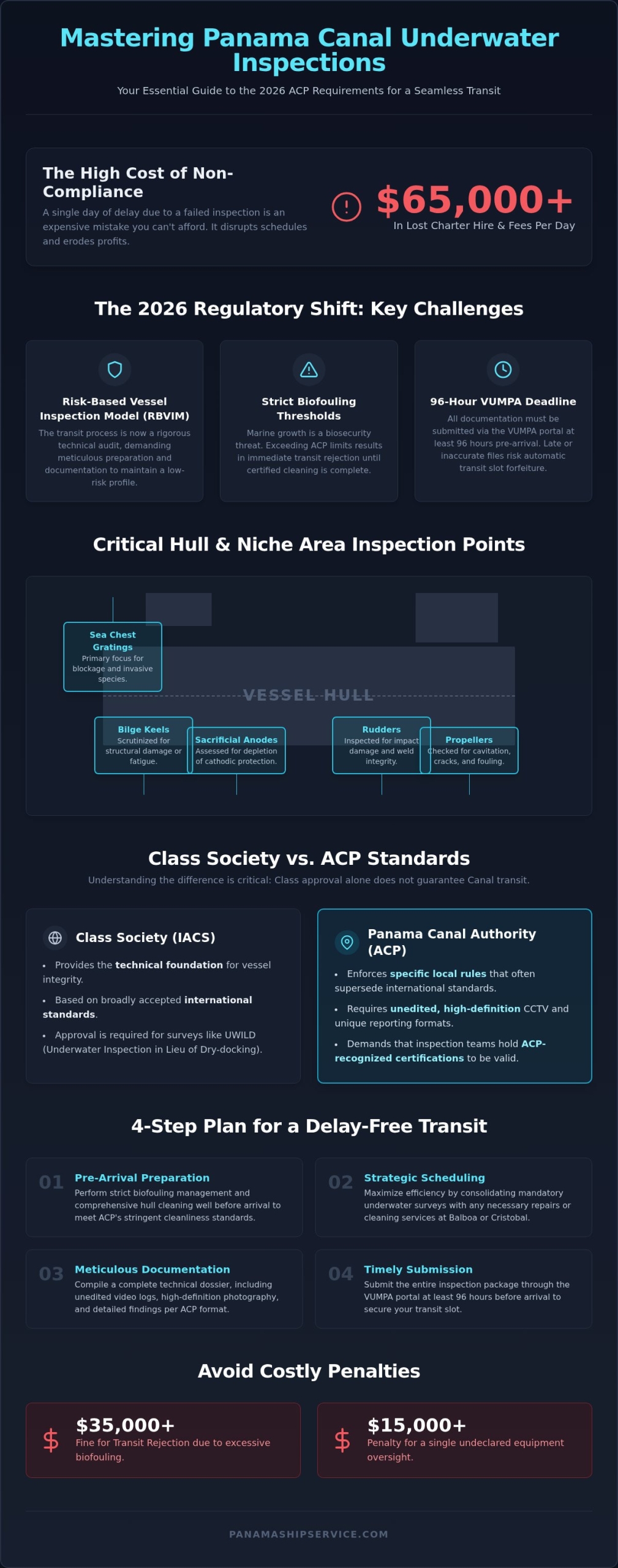
You understand that the 2026 implementation of the Risk-Based Vessel Inspection Model (RBVIM) has transformed the transit process into a rigorous technical audit. The pressure to navigate strict biofouling thresholds while managing the 96-hour VUMPA submission deadline creates significant operational anxiety for even the most experienced fleet managers. This guide helps you master the latest ACP underwater inspection standards to ensure a seamless, delay-free Panama Canal transit. We’ll provide a clear checklist of requirements, explain how to reconcile Class Society standards with local regulations, and show you how hull optimization reduces fuel consumption. By the end of this article, you’ll have a systematic plan to pass your next audit at Balboa or Cristobal with total confidence.
Key Takeaways
- Navigate the 2026 Risk-Based Vessel Inspection Model (RBVIM) by ensuring all technical documentation is submitted through the VUMPA portal at least 96 hours before arrival.
- Master the specific panama canal underwater inspection requirements for visibility and high-definition digital evidence to avoid costly re-inspections or transit delays.
- Determine when to deploy professional diving teams versus ROVs based on the complexity of your vessel’s required technical audit and ACP standards.
- Prevent transit rejection and fines exceeding $35,000 by maintaining strict biofouling management and performing pre-arrival hull cleaning.
- Maximize operational efficiency by consolidating mandatory underwater surveys with repairs or cleaning services at strategic hubs like Balboa and Cristobal.
Understanding the ACP Regulatory Framework for Underwater Inspections
The Panama Canal Authority (ACP) functions as the primary regulator for all maritime activity within the waterway. Their mission centers on two critical pillars: operational safety and environmental preservation. In 2026, these priorities have converged into a rigorous set of panama canal underwater inspection requirements designed to protect the Gatun Lake ecosystem from invasive species and structural failures. Compliance isn’t optional. Every vessel must undergo an initial physical inspection by a Canal Admeasurer, which remains valid for 12 months. Subsequent transits may qualify for digital clearance, but only if the vessel maintains a low-risk profile under the new Risk-Based Vessel Inspection Model (RBVIM). Failure to meet these standards results in immediate transit rejection or heavy fines; a single equipment oversight can trigger penalties exceeding $15,000.
The 2026 Biofouling Mandate
The ACP’s 2026 standards prioritize the management of Non-Indigenous Species (NIS). Marine growth on a vessel’s hull or within niche areas like sea chests isn’t just a fuel efficiency issue; it’s a biosecurity threat to Panama’s freshwater resources. The ACP uses strict thresholds for marine growth. If an audit reveals biofouling beyond acceptable limits, the vessel is barred from transit until a certified cleaning is completed at the Balboa or Cristobal anchorages. These pre-transit audits are now machine-validated through the VUMPA portal. You must submit all required documentation at least 96 hours before arrival. Delays in submission or inaccurate reporting can lead to the automatic forfeiture of your transit slot, costing Neopanamax operators over $65,000 per day in lost charter hire.
Class Society vs. ACP Standards
Operators often mistake Class Society approval for full ACP compliance. While IACS requirements provide a technical foundation, the Panama Canal enforces specific local rules that often supersede international standards. For instance, panama canal underwater inspection requirements for damage verification demand unedited, high-definition CCTV footage and detailed NDT thickness gauging reports. A UWILD (Underwater Inspection in Lieu of Dry-docking) can save up to 75% on survey expenses compared to dry-docking, but it only works if the surveyor is familiar with ACP’s unique reporting formats. Ensuring your diving team holds the correct ACP-recognized certifications is vital. Without this alignment, you risk paying for a survey that the Canal Board of Inspectors will ultimately reject, forcing a costly second inspection during your scheduled transit window.
Technical Requirements for a Valid Underwater Survey
Technical execution determines transit success. To meet panama canal underwater inspection requirements, water clarity must allow for clear, high-definition digital evidence. If visibility at the Balboa or Cristobal anchorages is compromised, the ACP may reject the survey, leading to immediate rescheduling. Real-time CCTV monitoring is mandatory for all damage verification surveys. This allows ACP inspectors to observe the diver’s progress in real-time, directing them to specific areas of interest to ensure no structural anomaly is overlooked. The quality of this footage is paramount; blurred or low-resolution video won’t pass the machine-validated VUMPA submission process.
Hull and Niche Area Inspection Protocols
ACP audits focus heavily on niche areas where biofouling or structural fatigue often hide. Sea chest gratings are a primary concern; they must be inspected for blockage or invasive species that could threaten Gatun Lake’s freshwater ecosystem. Propellers are examined for cavitation, structural cracks, and fouling that increases fuel consumption and reduces maneuverability. Every sacrificial anode is assessed to determine the depletion level of the cathodic protection system. Inspectors also scrutinize rudders and bilge keels for signs of impact damage or weld deterioration. These details are vital for maintaining the vessel’s risk profile and ensuring it doesn’t become a hazard within the Canal’s narrow confines.
Reporting and Documentation Standards
Acceptance depends on the technical precision of the final dossier. An ACP-compliant report includes unedited video logs, high-definition photography, and comprehensive technical findings. These must be submitted according to the latest ACP official Notices to Shipping. The report must clearly document the condition of all critical underwater components and provide NDT thickness gauging data where repairs have been performed. If a vessel receives a ‘conditional pass,’ the ACP may mandate immediate repairs before the transit slot is confirmed. To avoid these high-stakes scenarios, operators often choose to consolidate surveys with underwater hull services to pre-emptively identify and fix issues before the official audit begins. This proactive approach ensures that the vessel presents a clean, compliant profile to the Board of Inspectors, minimizing the risk of a last-minute rejection.
Timing is everything at the Canal. Most documentation must be finalized and uploaded at least 96 hours before arrival. Any discrepancy between the physical condition of the ship and the submitted digital report can trigger Level 3 inspection fees, which start at $5,200. Maintaining a clear, accurate, and professionally prepared technical file is the most effective way to ensure your vessel moves through the locks without administrative friction.
Inspection Technology: Divers vs. ROVs in 2026
Selecting the appropriate technology for a hull survey is a strategic decision that directly impacts transit timing and total operational cost. The Panama Canal’s risk-based vessel inspection model (RBVIM) has shifted the focus toward data-driven compliance. While traditional diver-led inspections remain the benchmark for detailed technical audits, Remotely Operated Vehicles (ROVs) have become essential for rapid screening. It’s a choice that depends on your vessel’s risk profile, the specific panama canal underwater inspection requirements you must satisfy, and the environmental conditions at the anchorage.
Efficiency and Speed of ROV Inspections
ROVs offer a significant advantage in mobilization speed, particularly in the busy ports of Balboa and Cristobal. These units can be deployed almost immediately, providing a high-definition digital footprint that integrates with cloud-based reporting systems. This speed is invaluable for vessels facing tight VUMPA deadlines. However, ROVs have clear limitations. They struggle in high-current scenarios where station-keeping becomes difficult; they also lack the tactile capabilities required to assess niche areas like sea chest interiors. While they’re excellent for general visual inspections, they can’t perform the cleaning or minor repairs often necessary to secure a transit pass.
The Human Element: Expert Divers for Complex Surveys
Human divers provide a level of tactile feedback and problem-solving that current ROV technology can’t match. During a complex survey, a diver can identify structural nuances, feel for thinning metal, or immediately clear minor biofouling from a rudder. ACP standards require that diver-led inspections include a real-time CCTV feed, allowing port captains to direct the survey as it happens. This interactive element is often the difference between a ‘conditional’ pass and a full transit clearance. While diving operations involve more rigorous safety protocols and can take longer than a robotic scan, the thoroughness they provide is the best defense against a transit rejection and the subsequent $35,000 fine.
For many operators, the most effective strategy is a hybrid approach. Using an ROV for a quick initial sweep allows for the rapid identification of major issues. A targeted diving team then follows up to inspect sea chests, propellers, and any anomalies found during the first pass. This dual-layered method ensures that all panama canal underwater inspection requirements are met with the highest degree of accuracy, providing the ACP Board of Inspectors with the unedited, high-definition evidence they demand for 2026 compliance.
Step-by-Step Preparation for an ACP-Compliant Inspection
Preparation is the only way to mitigate the risk of transit rejection. While earlier sections detailed technical standards, the execution phase requires precise coordination between the vessel’s crew, the technical superintendent, and the local agent. Meeting panama canal underwater inspection requirements begins with a thorough review of the vessel’s previous survey logs and technical documentation. If your last dry-docking occurred more than 12 months ago, the ACP will likely prioritize your vessel for a physical audit under the Risk-Based Vessel Inspection Model (RBVIM). It’s far more cost-effective to perform a pre-arrival hull cleaning than to face a forced cleaning at the anchorage under emergency rates.
Strategic Scheduling at Balboa and Cristobal
Choosing between Balboa and Cristobal depends on your transit direction and the location of your service provider. Selecting an anchorage that aligns with your provider’s base reduces mobilization fees and ensures a faster response time. Timing is equally critical. You must sync the inspection with your VUMPA submission to avoid Neopanamax rescheduling fees. These can escalate quickly if a survey reveals unexpected deficiencies. You can also optimize your schedule with mechanical ship repairs in Panama to address minor mechanical issues simultaneously. This consolidation ensures the vessel is in peak condition before entering the locks.
Pre-Transit Checklist for Technical Superintendents
- Verify all sea chest gratings are secured and entirely free of biofouling.
- Confirm that the propeller has been polished and documented within the last 30 days.
- Ensure the selected diving company appears on the current ACP-approved provider list to avoid report rejection.
- Prepare the crew to provide immediate access to the CCTV monitoring station for the ACP inspector.
Once the survey concludes, don’t wait for the official ACP report to begin analyzing findings. Review the diver’s video logs immediately. If the survey identifies “moderate” biofouling or structural anomalies, you have a narrow window to perform corrective actions before your transit slot is forfeited. Fines for failing to transit due to non-compliance can exceed $35,000. This makes pre-emptive cleaning far more economical than a Canal-side rejection. For professional assistance with these audits, secure an ACP-compliant survey team from Panama Ship Service to ensure your documentation is handled correctly the first time.
Optimizing Transit Efficiency with Panama Ship Service
Efficiency at the Canal isn’t just about speed; it’s about the technical precision of your service partner. Panama Ship Service acts as a strategic ally, ensuring that every vessel meets the rigorous panama canal underwater inspection requirements without redundant mobilization costs. By consolidating mandatory surveys with hull cleaning services, we eliminate the need for multiple service windows. Our teams identify biofouling or structural issues during the survey and can pivot immediately to corrective actions. This integrated approach is vital for Neopanamax operators who can’t afford to lose their transit slot due to a failed audit.
If a survey reveals mechanical deficiencies, our expertise in mechanical ship repairs allows us to fix findings on-site. We provide 24/7 emergency response for vessels that have already failed an ACP inspection. We deploy technical diving teams and repair specialists to Cristobal or Balboa within hours to resolve issues before they escalate into long-term delays. Our proven track record with both ACP inspectors and major Class Societies ensures that our technical reports are accepted without administrative friction.
Why Experience at the Canal Matters
Navigating the specific bureaucracy of the ACP requires more than technical skill; it requires a deep understanding of local timing and reporting expectations. Our 20+ years of operational experience at the Canal allows us to proactively monitor vessel status and coordinate directly with agents and port captains. Consider a recent case where a pre-transit survey identified a blocked sea chest grating on a commercial tanker. By clearing the obstruction immediately, we saved the operator from a 48-hour delay and the associated rescheduling fees. We understand the nuances of the panama canal underwater inspection requirements and ensure every digital report is machine-validated for the VUMPA portal before submission.
Get Your 2026 Compliance Quote
We provide tailored solutions for commercial tankers, bulkers, and Neopanamax vessels. Our reporting is transparent, providing the high-definition CCTV evidence and technical NDT data that ACP inspectors and Class Societies demand. We focus on reducing your overhead while optimizing your schedule. We handle the technical complexity so you can focus on your core operations. Contact Panama Ship Service today for an ACP-compliant survey quote to ensure your next transit is seamless and delay-free.
Secure Your 2026 Panama Canal Transit
Navigating the evolving panama canal underwater inspection requirements demands technical expertise and precise timing. The 2026 implementation of the Risk-Based Vessel Inspection Model (RBVIM) means that documentation accuracy and hull cleanliness are now the primary factors in transit approval. You’ve learned that a proactive approach, combining high-definition digital evidence with strategic scheduling at Balboa or Cristobal, is the most effective way to eliminate the risk of costly rejections and fines.
Panama Ship Service provides the specialized support you need to maintain operational momentum. As an ACP-approved service provider with full Class-approved (IACS) survey capabilities, we handle the technical complexity so you can focus on your schedule. We operate at both ends of the Canal to ensure immediate response times and consolidated repair solutions. Don’t leave your transit to chance. Book your ACP-compliant underwater inspection now to ensure your vessel remains on schedule and fully compliant. Your seamless passage through the locks starts with a reliable technical partner.
Frequently Asked Questions
What happens if my vessel fails an ACP underwater inspection?
The ACP denies transit immediately if a vessel fails to meet technical or environmental standards. You must perform certified corrective actions, such as hull cleaning or mechanical repairs, at the Balboa or Cristobal anchorage before scheduling a re-inspection. This failure often results in the forfeiture of your transit slot and significant rescheduling fees. Fines for non-compliance that leads to a transit failure can exceed $35,000.
How often are underwater inspections required for Panama Canal transit?
Every vessel must undergo an initial physical inspection by a Canal Admeasurer, which remains valid for one year. Under the 2026 Risk-Based Vessel Inspection Model, subsequent transits may qualify for digital clearance if the vessel maintains a low-risk profile. Factors like vessel age, flag state, and past deficiency history determine if the ACP requires a new physical survey before your next scheduled transit window.
Does the ACP accept inspections performed at the previous port of call?
The ACP rarely accepts underwater surveys performed outside of Panamanian waters. Local panama canal underwater inspection requirements demand specific high-definition digital evidence and machine-validated documentation through the VUMPA portal. Even with a recent IACS survey, the Board of Inspectors often mandates a local audit to ensure the vessel meets the strict 2026 biofouling and structural integrity standards before entering Gatun Lake.
Can underwater repairs be performed while waiting for Canal transit?
Yes, underwater repairs are permitted at the Balboa and Cristobal anchorages while you await your transit window. Consolidating surveys with repairs is a standard strategy to resolve deficiencies identified during a pre-audit. Professional diving teams can perform propeller polishing, sea chest cleaning, or minor mechanical fixes. This proactive approach ensures the vessel passes its final ACP inspection without causing a delay to the scheduled transit time.
What is the difference between an ACP audit and a Class UWILD survey?
An ACP audit focuses on local transit safety and environmental biosecurity, while a Class UWILD survey satisfies IACS requirements for hull integrity in lieu of dry-docking. While they share technical similarities, the ACP enforces unique reporting formats and stricter biofouling thresholds. You should ensure your service provider can fulfill both sets of standards simultaneously to avoid redundant mobilization fees and conflicting technical documentation for your fleet.
How long does a typical underwater hull inspection take in Panama?
A standard underwater hull inspection typically takes between 4 and 8 hours to complete. This duration varies based on the vessel’s size, the number of niche areas requiring focus, and the prevailing water clarity at the anchorage. Using ROVs for initial screening can reduce this timeline, but a full technical audit involving diver-led CCTV feeds for the ACP usually requires a half-day window for thorough documentation.
Are there specific biofouling requirements for Neopanamax vessels in 2026?
Neopanamax vessels face the most stringent panama canal underwater inspection requirements regarding biofouling in 2026. The ACP enforces a zero-tolerance policy for specific Non-Indigenous Species (NIS) to protect the Canal’s freshwater ecosystem. Even moderate marine growth on sea chest gratings or rudders can trigger a transit rejection. Operators must provide HD video evidence showing that all niche areas are free from significant biological accumulation.
Which ports in Panama are best for conducting underwater surveys?
Balboa and Cristobal are the primary hubs for conducting underwater surveys. Balboa, located on the Pacific side, is often preferred for vessels arriving from the west, while Cristobal serves Atlantic traffic. Both locations offer strategic access to ACP-approved diving teams and repair facilities. Choosing the anchorage that aligns with your transit direction minimizes mobilization costs and ensures your technical reports are submitted before the 96-hour VUMPA deadline.