
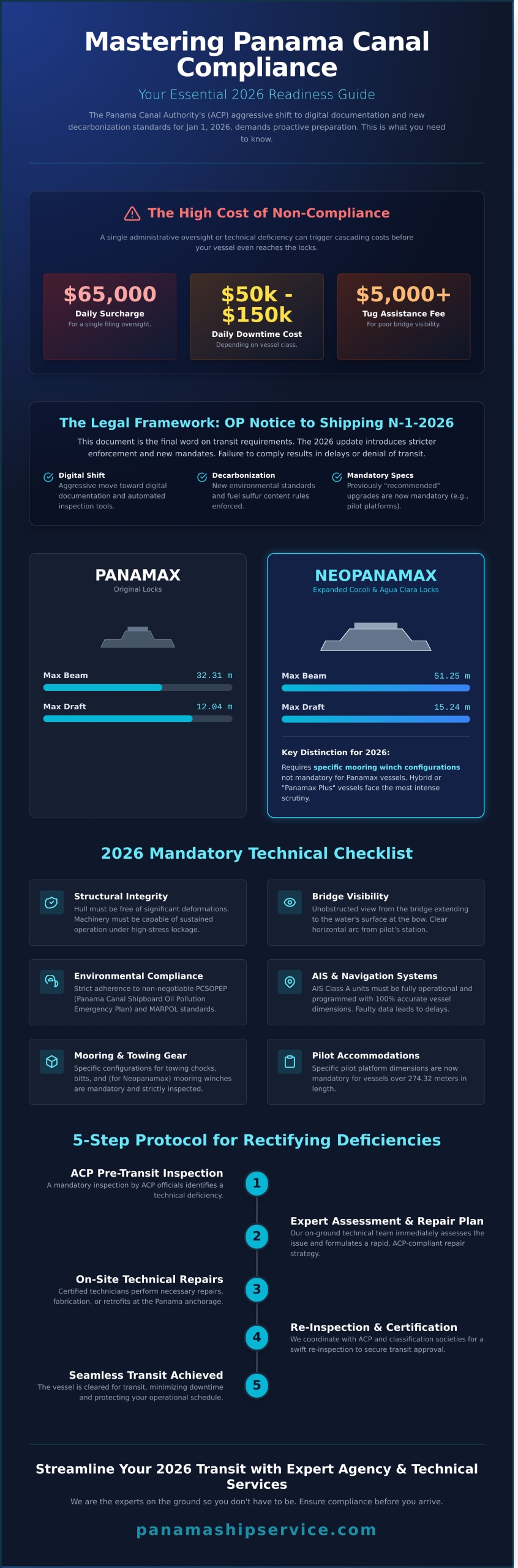
A single administrative oversight in your 2026 transit filing can trigger a $65,000 daily surcharge before your vessel even reaches the Miraflores Locks. Achieving total panama canal vessel compliance is no longer just about following a basic checklist; it’s about anticipating the Panama Canal Authority’s (ACP) aggressive shift toward digital documentation and new decarbonization standards set for January 1, 2026.
We understand that the high-stakes nature of maritime logistics makes dense technical jargon and sudden regulatory shifts a constant source of anxiety for ship owners. You shouldn’t have to guess whether your vessel’s mechanical specifications meet the latest requirements or if your paperwork will pass a last-minute inspection. This guide will help you master the updated ACP mandates and documentation protocols to ensure your transit remains seamless and free from unexpected fines. We’ll provide a clear 2026 readiness checklist and proven strategies to resolve technical deficiencies before they become expensive bottlenecks. We’re the experts on the ground so you don’t have to be.
Key Takeaways
- Gain a clear understanding of the latest ACP Notice to Shipping N-1-2026 to ensure your vessel meets all updated legal and technical entry requirements.
- Identify the specific structural and mooring gear specifications required for Neopanamax locks to prevent costly transit delays or denials.
- Master the essential documentation for panama canal vessel compliance, including non-negotiable PCSOPEP and MARPOL environmental standards.
- Learn the professional 5-step protocol for rectifying technical deficiencies identified during mandatory ACP pre-transit inspections.
- Discover how integrating expert agency services with technical repairs can streamline your 2026 transit and minimize operational expenses.
Understanding Panama Canal Vessel Compliance in 2026
Panama canal vessel compliance is a strict technical and legal mandate that dictates whether your ship moves or waits. It’s not a set of suggestions. It’s a rigid framework of requirements that every operator must meet before arriving at the breakwater. In 2026, these standards have become even more precise. Compliance involves everything from the specific configuration of your towing chocks and bitts to the visibility from your bridge and the sulfur content of your fuel. We are experts so you don’t have to be, ensuring your vessel meets every technical specification before the ACP inspector steps on board.
The Panama Canal Authority (ACP) uses the 2026 cycle to push for higher operational efficiency. Since the History of the Panama Canal began in 1881, the waterway has evolved into a highly regulated corridor where safety and speed are the only priorities. The ACP enforces these rules through the Notice to Shipping N-1-2026. This document is the final word on transit requirements. If your vessel’s equipment doesn’t match the specifications listed in this 2026 update, your transit will be denied or delayed. These delays aren’t just inconvenient; they’re expensive.
Operational delays in the canal ecosystem carry a heavy price tag. A single day of downtime can cost a shipowner between $50,000 and $150,000 depending on the vessel class and market rates. Compliance is the only way to protect your bottom line. By 2026, the ACP has integrated more automated inspection tools, meaning human error in your paperwork or equipment maintenance is caught faster than ever. We focus on the details so you can focus on your cargo.
The Legal Framework: OP Notice to Shipping No. N-1-2026
The primary regulatory document for 2026 transits is the OP Notice to Shipping No. N-1-2026. It’s the legal backbone of the canal. You must distinguish between “mandatory” modifications and “recommended” upgrades. For example, specific pilot platform dimensions are now mandatory for vessels over 274.32 meters. Missing an ACP advisory, which the authority publishes monthly, can lead to sudden non-compliance. We track these changes daily. Our team ensures your vessel stays ahead of the January 1, 2026, enforcement deadlines, preventing costly retrofits at the last minute.
Panamax vs. Neopanamax: Distinct Compliance Paths
Ship owners must recognize that Panamax and Neopanamax vessels follow different compliance tracks. For the 2026 season, Panamax vessels are restricted to a maximum beam of 32.31 meters and a draft of 12.04 meters. Neopanamax vessels, utilizing the expanded locks, can reach a beam of 51.25 meters and a draft of 15.24 meters, though these figures fluctuate based on Gatun Lake water levels. The 2026 standards require Neopanamax ships to have specific mooring winch configurations that are not required for the smaller locks.
Hybrid ships present the most significant inspection challenges in 2026. These are often older vessels retrofitted to meet Neopanamax dimensions or newer ships designed with “Panamax Plus” specifications. They often face scrutiny during the initial 2026 inspections because their structural layouts don’t always align perfectly with standard ACP templates. Ensuring panama canal vessel compliance for these unique hulls requires a deep understanding of both the legacy rules and the 2026 updates. Put your transit in our hands to avoid the technical pitfalls that stop other operators at the entrance.
Mandatory Technical and Structural Requirements for 2026
Achieving full panama canal vessel compliance by 2026 requires more than a standard maintenance log. The Panama Canal Authority (ACP) mandates that every vessel’s hull and machinery meet rigorous structural integrity tests. You must ensure your vessel adheres to the latest Panama Canal Vessel Requirements to avoid costly delays or outright transit refusal. Every hull must be free of significant deformations, and machinery must be capable of sustained operation under the high-stress conditions of lockage. If your vessel shows signs of structural fatigue, inspectors will likely require a dry-dock certification before granting transit rights.
Visibility standards have become a primary point of contention for bridge teams. Pilots now demand an unobstructed view from the bridge that extends to the water’s surface at the bow. If your cargo or deck equipment blocks this line of sight, you’ll face mandatory tug assistance fees that often exceed $5,000 per transit. The 2026 guidelines specify that the horizontal arc of visibility from the pilot’s workstation must remain clear at all times. Additionally, AIS Class A units must be fully operational and programmed with accurate vessel dimensions. Faulty AIS data accounts for roughly 12% of administrative delays at the Gatun anchorage, making real-time tracking accuracy a top priority for your technical team.
Communication systems must be redundant and reliable. The ACP requires dual VHF radios capable of reaching the Canal Operations Control Center from any point in the waterway. It’s not just about having the gear; it’s about the gear working under pressure. We’ve seen dozens of ships held back because of simple radio interference or outdated software in the bridge console. You don’t want to be the reason a transit slot is lost because of a $200 radio part. Proactive technical inspections can identify these weak points before they become expensive failures during your approach.
Propulsion and Maneuvering Equipment
Your engine must respond to bridge commands in under 10 seconds. We’ve seen 15% of transit rejections stem from sluggish engine response or faulty bow thrusters. Steering gear redundancy is a 2026 priority. If one hydraulic pump fails, the secondary system must engage immediately. This isn’t just a safety suggestion; it’s a hard requirement for the narrow confines of the Culebra Cut. Bow thrusters must maintain at least 95% of their rated power to handle the unpredictable crosscurrents in the lake.
Mooring Gear and Chock Specifications
Neopanamax locks use hydraulic mules and tugs that exert immense pressure on a vessel’s hardware. By January 2026, all vessels over 294 meters must feature heavy-duty chocks with a Safe Working Load (SWL) of at least 90 tonnes. Standard 64-tonne chocks are no longer sufficient for the larger locks. If your mooring winches show signs of corrosion or brake slippage, the ACP inspectors will halt your transit. Every winch must be tested to 80% of the line’s breaking strength to ensure it can hold during the rapid water level changes in the chambers.
Timing is everything in this industry, and the 2026 requirements leave no room for error. Panama canal vessel compliance is the difference between a seamless 10-hour transit and a week-long stay at a repair wharf. Ensure your technical superintendent reviews these specific structural mandates at least six months before your scheduled arrival. We are experts so you don’t have to be, and keeping your vessel within these strict parameters is the only way to protect your bottom line in the coming year.
Environmental Compliance: PCSOPEP and MARPOL Standards
Environmental mandates at the waterway are strict and unforgiving. To maintain panama canal vessel compliance through 2026, owners must strictly follow the Environmental Compliance Standards issued in the latest Notices to Shipping. The Panama Canal Authority (ACP) doesn’t just view these as guidelines. They are non-negotiable entry requirements. If your vessel fails an inspection, your transit slot is forfeited. This causes immediate financial loss and scheduling chaos for your entire fleet.
Biofouling regulations have gained significant weight in the last 24 months. A clean hull is now a regulatory necessity rather than a fuel-saving preference. ACP inspectors look for invasive species and heavy growth that could disrupt the local ecosystem. If a hull is deemed “high risk” during a pre-arrival assessment, the vessel may be denied entry until a certified underwater cleaning is completed. Similarly, sanitary inspections remain a top priority. Every vessel must carry a valid Ship Sanitation Control Exemption Certificate (SSCEC) or a Ship Sanitation Control Certificate (SSCC). These certificates expire every six months. Entering 2026, ensure your deratting documentation is updated to avoid being quarantined at the Atlantic or Pacific entrances.
PCSOPEP: Oil Spill Response Readiness
Every vessel exceeding 400 gross tons must have an approved Panama Canal Shipboard Oil Pollution Emergency Plan (PCSOPEP). You cannot simply rely on your international SOPEP. The Panama-specific version must be registered and approved by the ACP before you arrive at the breakwater. A critical component of this plan is the designation of an Authorized Person (AP) based in Panama. This individual acts as the liaison between the ship and the ACP during an emergency. They must be available 24 hours a day and have the authority to commit the shipowner’s funds for cleanup operations.
Documentation errors are the leading cause of delays in the PCSOPEP process. We often see plans rejected because the contact information for cleanup contractors is outdated or the vessel’s technical specifications don’t match the ACP database. Your plan must be reviewed and updated at least every four years, or whenever significant changes occur to the vessel’s management or equipment. Don’t wait until you’re 96 hours out to check your status. We recommend verifying your AP’s credentials and your plan’s approval status at least 30 days before your scheduled arrival.
Waste Management and MARPOL Disposal
Managing sludge, bilge water, and garbage is a logistical challenge that requires expert coordination. Panama enforces MARPOL Annex I and Annex V with heavy fines that can reach $1,000,000 for severe environmental discharges. It’s illegal to discharge any oily water or solid waste into Canal waters. You must use authorized disposal services at the ports of Balboa or Cristobal. These facilities are equipped to handle the high volumes generated by modern Neopanamax vessels. Using a “one-stop-shop” service provider ensures that all disposal receipts are properly logged for your panama canal vessel compliance records.
- Slops and Sludge: Must be discharged to a certified barge or shore facility. Always obtain a Bunker Delivery Note (BDN) and a disposal certificate.
- Garbage Disposal: Separated waste must be handled by ACP-licensed contractors. Improperly labeled bags can lead to immediate fines during boardings.
- Record Keeping: The Oil Record Book and Garbage Record Book must be 100% accurate. Discrepancies between log entries and actual tank levels are a major red flag for inspectors.
Efficiency is key when handling waste. We coordinate these disposals during other husbandry activities like bunkering or crew changes to save you time. Our team ensures all MARPOL-compliant services are documented correctly so your vessel stays in the clear. We are experts so you don’t have to be. Put your environmental compliance in our hands to avoid the “difficult and frustrating” experience of ACP penalties.
Managing Deficiencies: Repairs and Surveys for Non-Compliant Vessels
When a vessel reaches the Panama Canal, the Autoridad del Canal de Panamá (ACP) conducts a rigorous pre-transit inspection at the Atlantic or Pacific anchorages. Statistics from 2024 indicate that approximately 12% of vessels face initial delays due to technical discrepancies found during these boardings. Inspectors focus on critical systems required for safe passage, including steering gear, mooring winches, and bridge navigation equipment. If an inspector identifies a fault, the vessel is flagged as non-compliant. This status puts your transit slot at immediate risk and can lead to heavy fines or a total loss of your booking fee.
Rectifying a deficiency requires a systematic approach to satisfy ACP requirements quickly. We follow a proven 5-step process to restore panama canal vessel compliance and get your ship moving again:
- Notification Analysis: We review the official ACP Deficiency Report to understand the exact technical objection.
- Technical Mobilization: Our experts board the vessel within 2 hours of notification to assess the repair scope.
- ACP Liaison: We submit a formal repair plan and timeline to the ACP Admeasurement unit to protect your transit window.
- Execution: Certified technicians perform repairs afloat, working 24/7 until the fault is corrected.
- Final Clearance: We coordinate the follow-up inspection with the ACP boarding officer to secure a “Ready for Transit” status.
Timing is everything in the shipping industry. A missed slot in 2026 can result in a 5 to 10-day wait for a new opening, depending on seasonal congestion. We provide the technical expertise to ensure your vessel never stays in the anchorage longer than necessary.
Emergency Mechanical and Steel Repairs
Ship owners can’t afford the luxury of waiting for a drydock when a transit is on the line. A 2025 operational analysis showed that missing a scheduled Neo-Panamax transit can cost owners upwards of $165,000 in lost time and rescheduling fees. Our teams provide rapid response for rudder, propeller, or engine room issues. We specialize in afloat steel fabrication to meet ACP structural mandates, ensuring all repairs comply with international class standards. Our 24/7 technical support minimizes downtime by handling complex mechanical fixes while the vessel remains at anchor. We are experts so you don’t have to be.
Underwater Inspections and Cleaning
Biofouling standards became significantly more stringent in January 2024. Vessels must now demonstrate that their hulls are free of invasive species before entering Gatun Lake. We utilize class-approved UWILD (Underwater Inspection in Lieu of Drydocking) surveys to provide clear video evidence of vessel readiness. If the ACP issues an objection regarding hull condition or propeller fouling, our divers deploy specialized equipment for hull cleaning and propeller polishing. We also use underwater welding for immediate structural fixes, ensuring your ship maintains panama canal vessel compliance without needing to deviate to a distant shipyard.
Don’t let a technical deficiency cancel your transit. Contact our repair team for immediate assistance with ACP compliance issues.
Streamlining Your Transit with Panama Ship Service
Achieving panama canal vessel compliance for the 2026 season requires more than just reading a manual. It demands a boots-on-the-ground partner who understands the local nuances of ACP inspections and technical requirements. Panama Ship Service operates as a comprehensive “One-Stop-Shop” for owners and charterers. We eliminate the friction of dealing with multiple vendors by combining agency services, technical repairs, and MARPOL disposals into a single, coordinated operation. This integration ensures that your vessel does not sit idle while waiting for a secondary contractor to arrive; every minute saved in port directly protects your bottom line.
Our 20 years of local presence translates directly into faster transit approvals. We have managed thousands of successful transits, giving us the historical data to anticipate inspection hurdles before they occur. We maintain constant daily communication with vessel masters and shore-side management. This 24/7 feedback loop remains the key to stress-free compliance. Our core promise is simple: we are experts so you don’t have to be. We handle the technical complexities of the new 2026 requirements, allowing your crew to focus on safe navigation while we manage the administrative and logistical heavy lifting.
Timing is everything in the shipping industry. Misjudging your arrival window or failing a last-minute inspection can result in thousands of dollars in daily losses. We mitigate these risks through proactive planning. Our team reviews your vessel’s documentation and physical readiness weeks before you reach the breakwater. By identifying potential panama canal vessel compliance issues early, we provide the necessary repairs or equipment upgrades while the vessel is still in transit or at anchor, preventing costly delays during the actual boarding process.
Integrated Technical and Operational Solutions
We consolidate Bunker Surveys, Draft Surveys, and critical engine repairs into a single window. By managing logistics centrally, we typically reduce vessel expenses by 10% to 15% compared to using fragmented service providers. Our team handles everything from Deratting Certificates to complex MARPOL Disposals with high efficiency. We act as your trusted partner at the Panama Canal, ensuring every technical detail meets the latest 2026 standards without compromising your schedule or budget.
Get Your 2026 Compliance Quote
Preparation for the 2026 season starts with accurate data and professional foresight. Provide us with your vessel specifications, including LOA, beam, and current draft, for a rapid compliance assessment. We offer customized service packages tailored to the specific needs of both owners and charterers. Don’t leave your schedule to chance when the stakes are this high. Put your transit in our hands-Contact Panama Ship Service today for a detailed technical evaluation and a competitive quote.
Our approach is grounded in transparency and reliability. We provide clear, upfront cost structures so there are no surprises when the final disbursement account arrives. Whether you require a routine survey or emergency technical assistance to meet 2026 standards, our qualified technicians are available 24 hours a day. We prioritize your vessel’s readiness, ensuring that every piece of equipment, from mooring lines to navigation systems, aligns with the Canal’s evolving safety and environmental mandates.
Secure Your 2026 Transit and Avoid Costly Delays
The 2026 regulatory landscape demands strict adherence to new structural requirements and evolving MARPOL standards. Mismanaging these technical updates leads to avoidable fines and transit delays that disrupt your operational schedule. You must ensure your vessel meets every PCSOPEP protocol and structural specification before reaching the locks. We are experts so you don’t have to be. With 20+ years of maritime experience in Panama, our team specializes in identifying deficiencies before they become operational bottlenecks.
Achieving total panama canal vessel compliance doesn’t need to be a source of anxiety for your crew or your bottom line. We provide 24/7 rapid response for emergency mechanical repairs and full MARPOL support to keep your schedule on track. Our technicians handle the complex paperwork and technical surveys that can cause weeks of delay for unprepared ship owners. We focus on cost-conscious solutions that prioritize your vessel’s safety and speed. Put your fleet in the hands of a partner that understands the high-stakes nature of the canal.
Request a Comprehensive Compliance & Repair Quote to secure your position in the 2026 transit queue. We’re ready to help you navigate these changes successfully.
Frequently Asked Questions
What are the main changes in Panama Canal vessel requirements for 2026?
The 2026 requirements focus on the mandatory Long-Term Slot Allocation (LoTSA) system and stricter water management surcharges. Ship owners must adapt to the ACP’s new booking methodology that prioritizes vessels with higher water-efficiency ratings. You’ll need to provide certified water-saving equipment documentation to avoid the 15 percent surcharge increase scheduled for January 2026. Maintaining panama canal vessel compliance now requires proactive digital filing of these efficiency certificates.
Does my vessel need a specific underwater survey before transiting the Panama Canal?
Your vessel needs a certified underwater hull survey if it hasn’t been inspected within the last 6 months or shows signs of biofouling. The ACP requires clean hulls to prevent invasive species transfer, especially for Neopanamax vessels. We provide divers who deliver high-definition video evidence that meets the 100 percent visibility standards required by Panama Canal inspectors. Don’t risk a transit denial because of hull growth that’s easily remediated.
What is the PCSOPEP and how do I ensure my ship is compliant?
The PCSOPEP is a mandatory oil pollution emergency plan that you must submit to the ACP at least 96 hours before arrival. It’s separate from your international SOPEP and requires a designated Authorized Personnel representative based in Panama. Our team ensures your plan is updated according to the 2026 revisions; this prevents the 2,500 dollar fine for administrative non-compliance. We act as your local link to ensure the ACP accepts your filing immediately.
Can I perform mechanical repairs while waiting for my Panama Canal transit slot?
You can perform minor mechanical repairs at designated anchorages like Balboa or Cristobal only after receiving explicit ACP authorization under Article 34. Unauthorized immobilization of a vessel can lead to the immediate loss of your transit slot and a 5,000 dollar penalty. We coordinate with the Board of Inspectors to secure the necessary permits for 24-hour repair windows while you wait. It’s vital to have a partner who manages these permissions to avoid scheduling conflicts.
What are the penalties for non-compliance with ACP regulations?
Penalties for failing panama canal vessel compliance range from 5,000 to 100,000 dollars depending on the severity of the violation. Beyond the fines, the real cost lies in transit delays, which currently average 25,000 dollars per day in lost charter hire. Missing your scheduled slot due to equipment failure results in a 100 percent forfeiture of your booking fee. We ensure your vessel meets every standard to avoid these massive financial hits.
How does the Panama Canal Authority verify MARPOL compliance?
The ACP verifies MARPOL compliance through physical inspections of your Oil Record Book and random sampling of fuel oil to check sulfur content. In 2026, inspectors are increasing focus on MARPOL Annex VI, checking that all vessels maintain a sulfur limit below 0.50 percent. We manage your MARPOL disposals and provide the certificates needed to prove your vessel met all discharge regulations during its stay. It’s about having the right paperwork ready when the inspector steps on board.
What visibility requirements must my vessel meet for a safe transit?
Your vessel must provide a clear view from the bridge that allows the pilot to see the water surface within two ship lengths or 500 meters forward of the bow. If cargo or equipment blocks this view, you’re required to install temporary CCTV systems or additional lookouts. We’ve seen 12 percent of transit delays caused by poor visibility configurations that don’t meet the 2026 ACP bridge equipment standards. We help you calculate these blind spots before you reach the canal.
How can a local ship service partner help avoid transit delays?
A local partner prevents delays by pre-clearing your documentation and resolving technical deficiencies before the official ACP inspection. We act as your eyes and ears on the ground, handling everything from bunker surveys to emergency repairs. Our 24/7 presence ensures that if a compliance issue arises, it’s fixed in hours rather than days. We’re experts so you don’t have to be, protecting your schedule and your bottom line.