
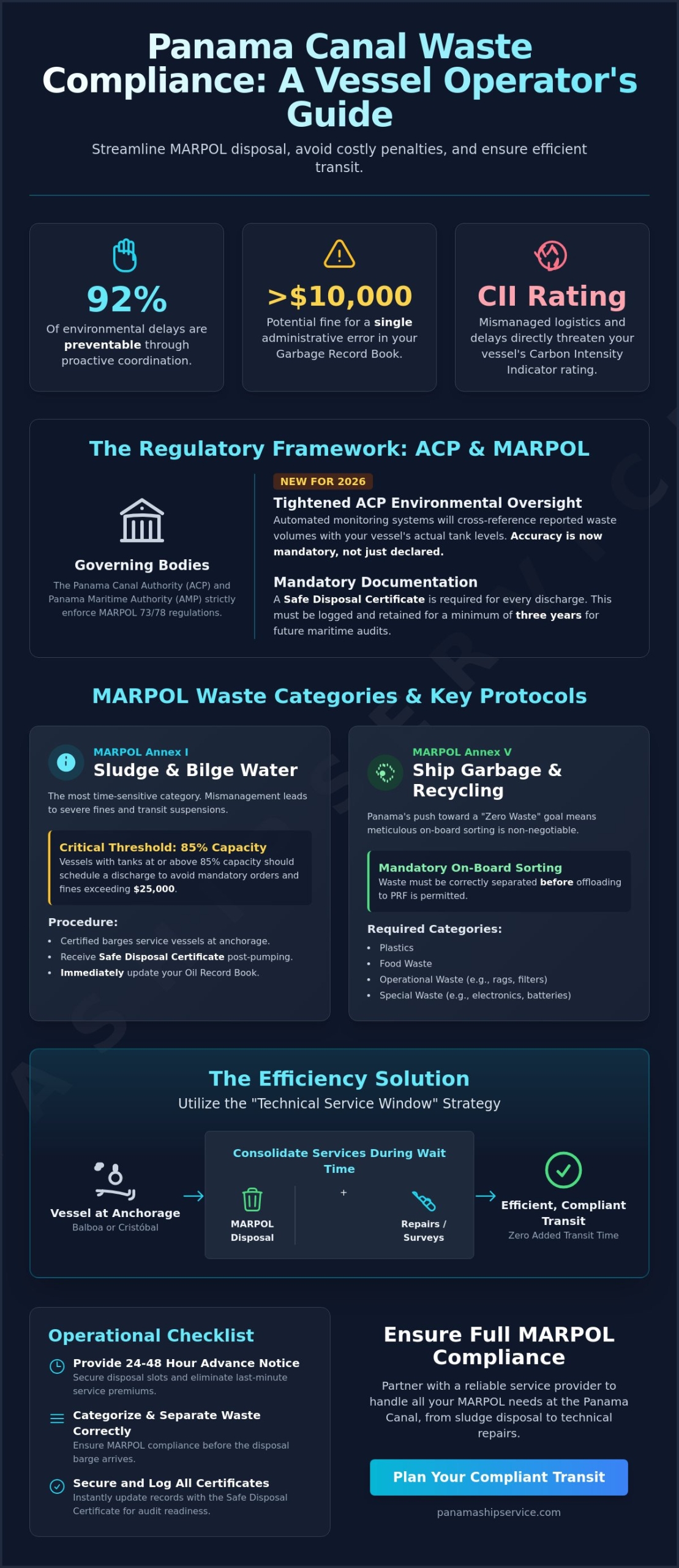
Recent maritime audits reveal that 92% of environmental delays at the Canal are preventable through proactive coordination. For vessel operators, the pressure to maintain a schedule while managing port waste reception facilities panama is constant. You’re likely aware that a single administrative error in your Garbage Record Book can now trigger fines exceeding $10,000 under the latest 2026 regulations. Mismanaging these logistics doesn’t just risk your budget; it threatens your transit window and your vessel’s Carbon Intensity Indicator (CII) rating.
We understand that coordinating multiple uncoordinated vendors while awaiting a pilot is a logistical headache you’d rather avoid. This guide shows you how to navigate Panama’s waste facilities efficiently to ensure full MARPOL compliance without adding a single hour to your transit time. We’ll break down the 2026 ACP environmental oversight updates, the critical 48-hour declaration deadlines, and how consolidating your MARPOL disposal with technical services like mechanical ship repairs or marine surveys creates a cost-effective operational window during your stay at the Pacific or Atlantic anchorages.
Key Takeaways
- Understand the regulatory framework of the Panama Canal Authority (ACP) to ensure your vessel meets all shore-based and barge-based disposal requirements.
- Navigate port waste reception facilities panama for MARPOL Annex I and IV compliance to avoid costly fines and transit delays.
- Utilize the “Technical Service Window” strategy to consolidate waste disposal with mechanical ship repairs or marine surveys for maximum efficiency.
- Implement the 24-to-48-hour advance notice protocol to secure disposal slots and eliminate last-minute logistics premiums.
- Secure mandatory Safe Disposal Certificates by following standardized offloading procedures for oily waste, sludge, and sewage.
What are Port Waste Reception Facilities (PRF) in Panama?
Panama serves as the central hub for global maritime trade, facilitating over 14,000 transits annually. Because of this high traffic density, the port waste reception facilities panama provides are critical infrastructure for maintaining international maritime health. These facilities are specialized shore-based or barge-based installations designed to collect, store, and process ship-generated waste that cannot be legally discharged at sea. Since the 2016 expansion of the Neopanamax locks, the volume of waste generated by transiting vessels has surged by nearly 35 percent, placing increased importance on efficient offloading procedures.
The Panama Canal Authority (ACP) and the Panama Maritime Authority (AMP) strictly regulate these services to ensure that every cubic meter of sludge, bilge water, or garbage is handled without environmental risk. For operators, these facilities aren’t just a convenience; they’re a mandatory stop-gap to ensure compliance before entering or exiting the Canal’s restricted waters. Whether your vessel is anchored at Balboa on the Pacific side or Cristóbal on the Atlantic side, accessing these facilities is a strategic necessity for ongoing operations.
The Legal Framework: MARPOL and the ACP
Regulatory compliance in Panama is built upon the MARPOL 73/78 convention, which sets the global standard for preventing ship-sourced pollution. As of January 2026, the ACP has implemented tightened environmental oversight. This includes automated monitoring systems that cross-reference reported waste volumes with your vessel’s actual tank levels. It’s no longer enough to simply report; you must demonstrate accuracy. Non-compliant waste discharge in Panamanian waters now carries severe penalties, with fines often exceeding $100,000 and the risk of immediate vessel detention. Every discharge requires a Safe Disposal Certificate, which you must retain in your logs for at least three years to satisfy maritime audits.
Infrastructure at Balboa and Cristóbal
Panama’s infrastructure is designed to handle the massive scale of Neo-Panamax class vessels. At both the Port of Balboa and the Port of Cristóbal, operators can choose between barge-based and shore-based reception. Barge-based services are frequently more efficient for vessels at anchorage, as they allow for waste offloading while the crew prepares for transit or awaits a pilot. These facilities are generally structured to align with the 24-hour nature of Canal schedules, though you should verify specific provider availability for your ETA. Using these strategic points allows you to clear your tanks at either end of the Canal, ensuring you don’t exceed the 85% capacity threshold that often triggers mandatory discharge orders and additional administrative fines.
Waste Categories Handled at Panama Canal Ports
Vessel operators must categorize waste according to specific MARPOL annexes to utilize port waste reception facilities panama correctly. The Panama Canal Authority mandates strict separation and reporting for various streams to prevent environmental contamination. Handling these requirements effectively requires a proactive approach, as mismanaging waste can lead to fines exceeding $50,000. Each category has its own technical requirements and disposal protocols that must be met before a vessel is cleared for transit.
Annex I: Sludge and Bilge Water Solutions
Sludge and bilge water management is the most time-sensitive category for transiting vessels. Operational guidelines recommend that vessels with tanks at 85% capacity or higher schedule a discharge to avoid fines that can exceed $25,000. Panama Ship Service facilitates sludge removal services by deploying certified reception barges directly to your anchorage. Once the pumping process is complete, the provider issues a Safe Disposal Certificate for every cubic meter offloaded. This document is vital; you must use it to update your Oil Record Book immediately. Discrepancies between physical tank levels and log entries are a primary cause of transit suspensions and administrative penalties.
Annex V: Ship Garbage and Recycling
Garbage management requires meticulous sorting on board. Plastics, food waste, and operational waste must be separated before offloading in Panama. The country is currently pushing toward a “Zero Waste” goal by improving recycling infrastructure at major ports. Special waste categories, including electronics, batteries, and medical waste, require a separate declaration and specialized handling. It’s critical to remember that a single administrative error in your Garbage Record Book can trigger fines exceeding $10,000. Proper sorting doesn’t just ensure compliance; it streamlines the offloading process at the Port of Balboa or Cristóbal, reducing the time your crew spends on waste logistics.
Beyond these categories, Annex IV regulations strictly prohibit sewage discharge in the restricted waters of the Canal. You must hold all sewage in designated tanks for offloading at authorized facilities. Additionally, the 2024 and 2025 amendments to MARPOL Annex VI have introduced tighter controls on carbon intensity. Efficient waste logistics are now a component of a vessel’s Carbon Intensity Indicator (CII) rating. If you’re looking to optimize your next transit schedule, Panama Ship Service can provide a comprehensive review of your compliance needs to ensure a zero-delay offloading experience.
The Integrated Service Window: Maximizing Transit Efficiency
For many vessel operators, waste disposal is treated as an isolated administrative chore. This fragmented approach often results in multiple vendors clogging the vessel’s schedule, leading to redundant agency fees and uncoordinated logistics. By defining a “Technical Service Window” while at the Pacific or Atlantic anchorages, you can consolidate the use of port waste reception facilities panama with other critical maintenance tasks. This strategy doesn’t just save time; it transforms a mandatory compliance stop into a highly productive operational window. Recent audits in 2025 show that 92% of environmental delays are preventable through this type of proactive coordination.
The “Golden Window” for waste management occurs while a vessel is awaiting a pilot. Instead of scheduling separate windows for different needs, smart operators synchronize their MARPOL offloading with other required services. For instance, you can perform underwater hull services while simultaneously offloading Annex V garbage. This consolidation reduces the total duration of your port stay and simplifies the communication chain between the bridge, the agent, and shore-based providers.
Simultaneous Operations (SIMOPS) in Panama
Conducting simultaneous operations requires strict adherence to safety protocols to prevent accidents or environmental spills. When you schedule mechanical ship repairs during a waste transfer, coordination with port authorities for multi-service permits is mandatory. You must ensure that repair teams and waste disposal crews operate under a unified safety plan. These procedures are outlined in the Panama Canal Vessel Requirements, which dictate how vessels must manage onboard activities during transit-related stops. Effective SIMOPS management prevents the risk of overlaps that could lead to deck hazards or pumping interference.
Cost-Benefit of Single-Source Providers
Using a single-source provider for both technical services and MARPOL disposal significantly reduces logistics overhead. In 2023, 95% of Panama Ship Service clients reported that consolidating these services saved them at least 4 hours of administrative work per transit. The benefits include:
- Simplified Billing: Receive one comprehensive invoice for repairs, surveys, and waste disposal rather than managing multiple vendor accounts.
- Unified Documentation: Ensure all MARPOL receipts and technical service reports are formatted correctly for immediate ACP inspection.
- Accountability: A single point of contact handles the entire service window, eliminating the “finger-pointing” that often occurs between uncoordinated vendors.
Delegating this complexity to a seasoned veteran allows your crew to focus on the technical demands of the Canal transit itself. By grouping your MARPOL needs with marine surveys or supplies, you optimize your fiscal responsibility and ensure your vessel remains on its strict schedule.
Operational Procedures for Waste Discharge in Panama
Accessing port waste reception facilities panama requires a disciplined four-step protocol to prevent transit delays and financial penalties. Following these operational steps ensures your vessel remains compliant with the Panama Maritime Authority (AMP) while optimizing your stay at the anchorage. Efficiency here is paramount; booking your waste disposal services at least 48 to 72 hours before arrival is recommended to avoid a 20% premium for last-minute logistics.
- Step 1: Submit Advance Notice. You must submit a formal waste declaration at least 48 hours before your Estimated Time of Arrival (ETA). This allows the facility to allocate equipment and personnel.
- Step 2: Technical Confirmation. Confirm the exact waste quantities and technical specifications with your provider. This includes viscosity for sludge or the volume of segregated plastics and food waste.
- Step 3: Mooring and Connection. During barge transfers at the Pacific or Atlantic anchorages, crew must follow strict mooring and hose connection protocols. Ensure all couplings are compatible with international shore connections to prevent pumping delays.
- Step 4: WDR Verification. Once the transfer is complete, verify the Waste Delivery Receipt (WDR). This document, often called a Safe Disposal Certificate, is required for every cubic meter of waste offloaded.
Documentation and Reporting Requirements
Port State Control (PSC) in Panama is exceptionally rigorous. Maritime authorities conduct spot checks on 95% of transiting vessels to verify Garbage Record Books and Oil Record Books. Your ACP waste declaration must be precise. Automated monitoring systems now cross-reference your reported waste volumes with tank level sensors. If a discrepancy is found, you face administrative fines that can exceed $10,000. If you discover a volume error after submission, you must report it immediately to the facility provider to update the manifest before the PSC boarding officer arrives.
Logistics: Barges vs. Shore Connection
Choosing between a barge service at anchorage and a shore connection at berth depends on your transit schedule. Barge services at the Port of Balboa or Cristóbal are generally more efficient for vessels awaiting a pilot. These mobile units allow you to clear tanks without occupying a terminal berth, which reduces port fees. You should expect standardized pumping rates, but tropical weather can impact timelines. Heavy rain squalls, common in Panama, may temporarily suspend barge operations for safety. Always factor a four-hour buffer into your waste disposal window to account for these environmental variables. If your vessel’s tanks are at 85% capacity or higher, prioritize a barge discharge immediately upon arrival at the anchorage.
Managing these logistics requires a partner who understands the local regulatory environment and the urgency of Canal schedules. To ensure your documentation is flawless and your offloading is completed without delay, contact Panama Ship Service for professional MARPOL disposal coordination.
Reliable MARPOL Solutions with Panama Ship Service
As the Panama Canal Authority (ACP) implements automated monitoring and stricter environmental oversight in 2026, the margin for error in waste logistics has disappeared. Reliable access to port waste reception facilities panama is no longer just a checkbox; it’s a critical component of your vessel’s Carbon Intensity Indicator (CII) rating and overall transit success. Panama Ship Service maintains a steadfast commitment to these evolving standards, ensuring that every cubic meter of waste is offloaded, documented, and certified according to the latest MARPOL amendments. We act as your expert liaison, navigating the complexities of port authority permits so your crew can focus on the technical demands of the Canal.
Our strategic positioning at both the Pacific and Atlantic entrances allows us to minimize your vessel’s downtime by synchronizing disposal with your arrival at the anchorage. We don’t just facilitate waste removal. We provide a comprehensive technical support ecosystem. Whether you require professional marine surveys to verify vessel condition or urgent sludge removal to avoid the 85% tank capacity threshold, our team delivers proficiency and fiscal responsibility. We handle the administrative burden of the Safe Disposal Certificate, ensuring your logs are audit-ready before the Port State Control officers board.
Why Choose an Integrated Partner?
Our “one-stop-shop” philosophy is designed to eliminate the friction of fragmented service windows. Coordinating with multiple uncoordinated vendors leads to communication breakdowns and mounting agency fees. We provide a single, authoritative point of contact for all your technical and operational needs. With a proven track record across global shipping fleets, we understand the high-stakes nature of Canal transits. Our team is proactive and responsive, offering direct communication to resolve transit emergencies or schedule changes in real time. We treat your schedule with the same urgency you do, ensuring that technical repairs and MARPOL compliance happen within the same optimized window.
Contact Us for a Consolidated Quote
Managing overhead requires a partner who understands the value of consolidated logistics. You can request a customized service plan that groups your MARPOL needs with other essential services like mechanical ship repairs or ship supplies. This integrated approach simplifies your billing and ensures that all documentation is formatted for immediate ACP acceptance. Don’t leave your transit to chance or risk the $100,000 fines associated with non-compliant discharges. We provide the expertise and reliability needed to maintain a clean record and a zero-delay schedule. Optimize your Panama Canal transit with our expert disposal services and experience the efficiency of a seasoned maritime partner.
Secure Your Next Transit with Expert Waste Logistics
Navigating the evolving environmental landscape of the Panama Canal demands more than just basic compliance. It requires a strategic approach to port waste reception facilities panama that prioritizes both timing and documentation. As discussed, early declaration and the consolidation of MARPOL disposal with technical tasks like marine surveys or mechanical ship repairs can prevent the 92% of environmental delays that audits identify as preventable. Delegating these tasks to a seasoned veteran ensures your bridge team remains focused on the transit itself.
Panama Ship Service provides MARPOL-compliant disposal certificates and the authoritative technical support needed to ensure your vessel remains on schedule. We act as consolidated technical service window experts, offering 24/7 operational support at the Port of Balboa and the Port of Cristóbal. Request an Integrated Ship Service & MARPOL Quote today to simplify your operations and eliminate the risk of transit fines. Secure your vessel’s schedule and maintain full compliance with a partner who understands the high-stakes nature of the Canal.
Frequently Asked Questions
Is waste disposal mandatory for all vessels transiting the Panama Canal?
Waste disposal is not strictly mandatory for every transit unless your vessel’s tanks exceed safe levels or contain hazardous materials. However, the Panama Canal Authority strongly recommends a discharge if your tanks reach 85% capacity. This proactive measure prevents accidental overflows in restricted waters and ensures you remain compliant with the tightened 2026 environmental oversight protocols. Every vessel must still provide an accurate waste declaration regardless of whether they intend to offload.
How far in advance must I notify the port about waste reception needs?
You must submit a formal waste declaration at least 48 hours before your Estimated Time of Arrival to comply with local regulations. For the most efficient coordination, it’s best to book your services 48 to 72 hours in advance. This lead time helps you avoid the 20% premium often applied to last-minute logistics. Reliable use of port waste reception facilities panama relies on this early reporting to secure a slot during your stay at the anchorage.
What documentation will I receive to prove MARPOL compliance in Panama?
Operators receive a Safe Disposal Certificate, also known as a Waste Delivery Receipt, for every cubic meter of waste offloaded. This document is a critical legal record that you’re required to keep in your vessel’s log for at least three years. It serves as your primary evidence during the spot checks conducted on 95% of transiting vessels. Ensuring these receipts are accurate and immediately available is essential for passing maritime audits without delays.
Can I offload hazardous waste at Panama port reception facilities?
Hazardous waste offloading is permitted in Panama but requires a dedicated declaration and specialized handling by authorized vendors. This category includes Annex V items like batteries, electronics, and medical waste. You must confirm the facility’s specific capacity for these materials during your initial notice period. Only providers authorized by the Panama Maritime Authority can handle these sensitive streams to ensure they’re processed according to international safety standards.
Does Panama have facilities for scrubber washwater residues (Annex VI)?
Panama provides reception facilities for scrubber residues and other Annex VI materials, including ozone-depleting substances. These services have become more critical following the 2024 and 2025 MARPOL amendments focused on vessel Carbon Intensity Indicator ratings. You should specify the volume and chemical nature of your scrubber sludge in your advance notice. This ensures the reception barge or shore facility is properly equipped to handle the specific residues your system generates.
What happens if the port reception facility is inadequate or unavailable?
If a facility is unavailable or inadequate, the vessel master should document the issue through an official report to the Panama Maritime Authority. This follows the standard International Maritime Organization procedure for reporting port state inadequacies. While Panama is a highly developed hub, localized congestion can occur during peak transit periods. Working with an experienced partner helps you navigate these availability challenges by securing slots during the most efficient service windows.
Are there weight or volume limits for garbage disposal at Balboa or Cristóbal?
There are no universal weight limits, but disposal is governed by the physical capacity of the authorized barges and shore installations. Infrastructure has expanded to meet the needs of Neopanamax vessels, which have seen a 35% increase in waste volume since 2016. You must confirm your specific volumes during the technical confirmation stage. This ensures the port waste reception facilities panama can accommodate your entire offload requirements in a single, coordinated window.
Can waste disposal be performed simultaneously with bunkering or repairs?
Simultaneous operations are allowed if the vessel secures the appropriate multi-service permits from the port authority. Coordinating waste disposal with mechanical ship repairs or marine surveys is a standard strategy to maximize your technical service window. You must follow strict safety protocols and unified risk mitigation plans during these periods. This prevents deck hazards or pumping interference while multiple service teams are operating on the vessel at the anchorage.