
With non-compliance fines for Panama Canal transit starting at $15,000 and slot forfeiture costs for Neo-Panamax operators exceeding $65,000 per day, you can’t afford to leave vessel readiness to chance. A comprehensive pre-charter vessel condition report is your most effective defense against the technical failures and cargo damage claims that stall operations in this critical global hub. You understand that in the maritime industry, time isn’t just money; it’s your reputation. Proactive documentation is the only way to navigate the Panama Canal Authority’s increasingly automated validation systems with confidence.
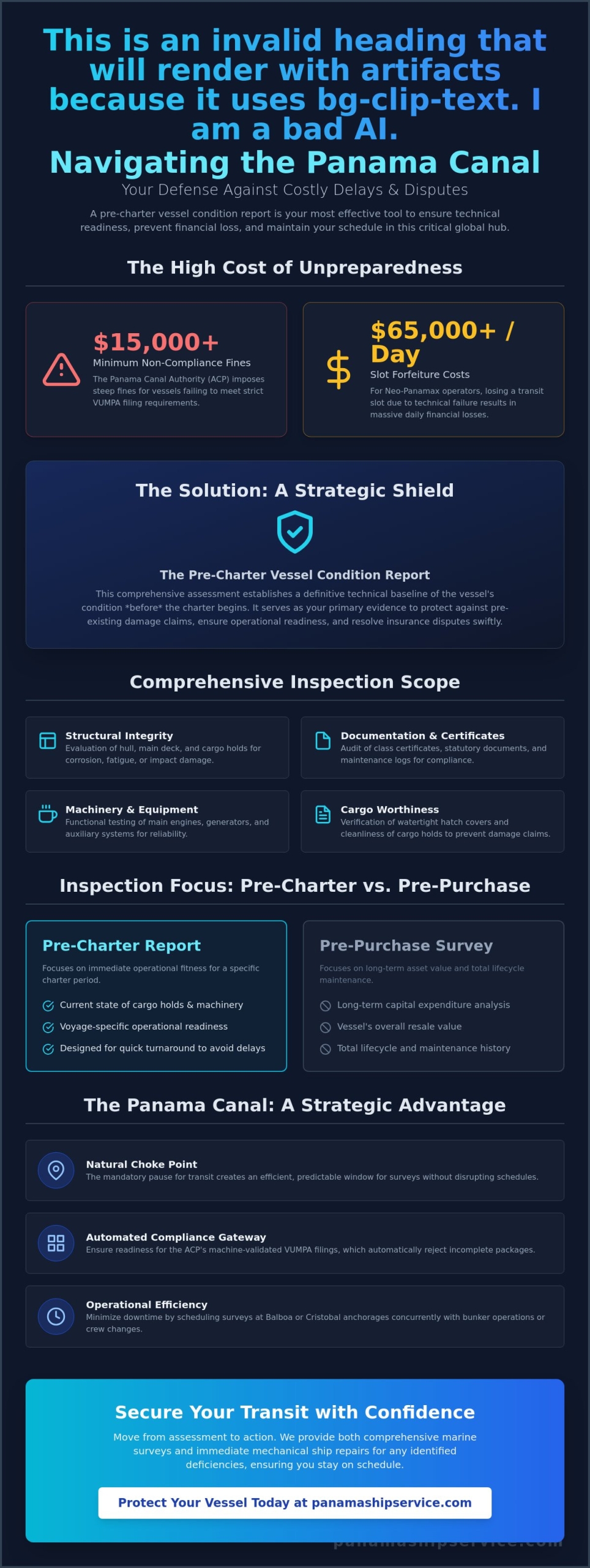
We’ll show you how a professional inspection protects your interests by providing definitive proof of vessel fitness before the charter period begins. This article explores how to use these reports to prevent disputes over pre-existing damage, such as leaking hatch covers, and ensures your technical readiness meets strict VUMPA filing requirements. You’ll discover how a clear, actionable report delivered within hours of inspection minimizes financial risk and ensures your transit stays on schedule under the updated LoTSA 2.0 allocation system.
Key Takeaways
- Understand how a pre-charter vessel condition report establishes a definitive technical baseline to protect your interests throughout the charter period.
- Identify the critical inspection points, including structural integrity and machinery systems, that ensure operational readiness for the Panama Canal.
- Learn how to use professional documentation as a strategic shield against fraudulent cargo claims and disputes during the off-hire transition.
- Discover how to minimize downtime by scheduling surveys at Balboa or Cristobal anchorages while concurrently managing bunker operations or crew changes.
- Transition from assessment to action by leveraging a partner that provides both marine surveys and immediate mechanical ship repairs for identified deficiencies.
Defining the Pre-Charter Vessel Condition Report for Modern Shipping
A pre-charter vessel condition report is a formal assessment of a ship’s technical and operational state. It serves as the definitive baseline for the vessel’s condition at the start of a charter period. This document protects charterers from inheriting pre-existing liabilities and shields owners from unfair wear-and-tear claims. The report serves as the primary evidence used in P&I and insurance claim resolution.
Establishing this baseline requires a systematic approach. A surveyor documents everything from hull coatings to the state of the mooring equipment. If a dispute arises later, this report provides the technical data needed to resolve the issue quickly. It’s about turning physical observations into financial security. Without this record, you’re vulnerable to claims that can cost hundreds of thousands of dollars in legal fees and repair costs.
Why the Panama Canal is the Strategic Hub for Inspections
The Panama Canal acts as a natural choke point where vessels must pause, creating an efficient window for surveys. With approximately 14,000 transits per year, the Canal is the most logical location to conduct these assessments. Ensuring compliance with marine surveys panama standards before transit prevents costly lockage delays. This is especially critical now that the Panama Canal Authority (ACP) uses machine-validated VUMPA filings. Incomplete packages are rejected automatically, and non-compliance fines start at $15,000. Local expertise is required to navigate these strict ACP regulations during the inspection to ensure the vessel is ready for its assigned slot.
The Difference Between Pre-Charter and Pre-Purchase Surveys
It’s easy to confuse different types of inspections, but the scope of work varies significantly. A Marine surveyor conducting a pre-purchase survey looks at long-term asset value and the vessel’s total lifecycle maintenance. In contrast, a pre-charter vessel condition report focuses on immediate operational fitness and cargo-worthiness for a specific voyage.
- Specific Focus: Pre-charter surveys prioritize the current state of cargo holds and machinery rather than long-term capital expenditure or resale value.
- Operational Efficiency: These reports are designed for quick turnaround to avoid delaying the vessel’s schedule or missing a transit window.
- Technical Scope: The inspection verifies that hatch covers are watertight and main engines are ready for the high-stress environment of canal transit.
Understanding these differences ensures you don’t overpay for unnecessary data. You get exactly what you need to mitigate risk for the duration of the charter period. By focusing on the immediate requirements of the voyage, you can secure the vessel with confidence and move forward with your logistics plan.
Technical Scope: What a Comprehensive Pre-Charter Inspection Covers
A pre-charter vessel condition report goes far beyond a simple walkthrough. It’s a rigorous technical audit designed to identify hidden risks before they manifest as operational delays or legal liabilities. The inspection begins with structural integrity; surveyors evaluate the hull, main deck, and cargo holds for signs of fatigue, corrosion, or impact damage. This physical assessment ensures the vessel can withstand the rigors of the intended voyage and the specific stresses of canal lockage operations. A comprehensive pre-charter vessel condition report provides the data-driven confidence needed to proceed with high-value contracts.
Machinery and equipment receive equal scrutiny. Functional testing of main engines, generators, and auxiliary systems is mandatory to confirm that the ship’s heart is beating reliably. We also audit class certificates and statutory documents to ensure the vessel meets international standards enforced by Port State Control. This documentation review includes a deep dive into maintenance logs and previous survey records. Verifying the status of Life Saving Appliances (LSA) and Fire Fighting Appliances (FFA) is non-negotiable for ensuring both crew safety and regulatory compliance during transit.
Hatch Cover Integrity and Ultrasonic Testing
Hatch cover tightness is the #1 factor in dry bulk cargo claims. While visual inspections might catch obvious seal damage, they’re insufficient for modern chartering standards. We use ultrasonic tightness testing to identify microscopic leaks that a human eye would miss. This technology uses sound waves to detect gaps in the sealing arrangements before they allow water ingress. Preventing these leaks is vital; water ingress claims account for a significant percentage of maritime insurance losses and can lead to total cargo rejection at the discharge port.
Evaluating Cargo Readiness and Cleanliness
Cargo holds must meet strict cleanliness standards based on the intended freight. There’s a significant difference between Grain Clean and Hospital Clean requirements; failing to meet the specific criteria can lead to immediate vessel rejection by the charterer’s surveyor. Our inspection includes checking bilge systems and tank tops to ensure they’re functional and free of debris. We also verify that previous cargo residues and waste are managed according to MARPOL disposal panama regulations. If you’re unsure of your vessel’s current state, scheduling a professional marine survey is the most efficient way to confirm readiness. By addressing these technical details early, you eliminate the variables that cause financial friction during the charter period.
Mitigating Financial Risk and Cargo Claims Through Accurate Data
Financial security in the shipping industry depends on the accuracy of your baseline data. A pre-charter vessel condition report provides the technical evidence needed to protect your capital from the moment the contract begins. It establishes the definitive On-Hire state, which is vital for preventing costly disputes at the Off-Hire stage when the vessel is redelivered. Panama serves as the ideal geographic point for this handover. It allows for a clean break in liability while the vessel is already paused for transit operations.
The report serves as a powerful deterrent against friction. Fraudulent or exaggerated damage claims often vanish when confronted with high-resolution photographic evidence and calibrated technical measurements. P&I clubs recognize this level of transparency. There is a direct correlation between high-quality, independent surveys and reduced insurance premiums. Proving you’ve conducted a thorough pre-charter vessel condition report demonstrates a commitment to risk mitigation that underwriters value.
You can use survey data as a strategic lever during contract finalization. If the inspection reveals technical deficiencies that don’t compromise safety but affect efficiency, you have the grounds to negotiate more favorable hire rates. Alternatively, you can require the owner to perform immediate repairs before you accept delivery. This ensures you aren’t paying for a vessel that cannot meet its performance warranties or speed requirements from day one.
The Role of Independent Third-Party Surveys
Impartiality is non-negotiable for reports to be admissible in maritime arbitration. Owners providing their own condition reports creates an inherent conflict of interest that won’t hold up under legal scrutiny. Charterers and financiers require a Right of Reliance. This means the surveying company stands behind the data, providing a layer of professional indemnity that protects all stakeholders involved in the charter party agreement.
Underwater Inspections: The Hidden Risk Factor
What happens below the waterline often determines the profitability of a voyage. Assessing hull fouling is critical because biofouling increases drag and fuel consumption, directly impacting speed warranties. Professional underwater hull services verify the condition of the rudder and propeller to ensure peak efficiency. These inspections identify silent structural damage, such as cavitation erosion or rope guard issues, that could lead to emergency repairs during transit. Catching these problems at the Panama anchorage prevents a minor technical issue from becoming a financially devastating operational failure.
Operational Logistics: Scheduling Inspections at the Panama Canal
Scheduling a pre-charter vessel condition report at the Panama Canal requires precision and deep local insight. Most vessels experience a standard 24-48 hour Canal wait period, which represents a critical window of opportunity to complete technical assessments without disrupting the vessel’s primary schedule. By aligning the survey with the vessel’s arrival at the anchorage, you convert idle time into a period of strategic risk management. This efficiency is vital for maintaining the momentum of global trade routes while securing your financial interests.
Successful logistics depend on a disciplined communication loop between the ship agent, the Master, and the survey team. The agent manages the necessary permissions and launch boat logistics, while the Master ensures the crew is ready to facilitate immediate access to cargo holds and machinery spaces. Minimizing vessel downtime is always the primary goal. We achieve this by conducting surveys concurrently with other necessary tasks like bunker operations or crew changes, ensuring that the inspection never becomes the reason for a missed transit slot.
Balboa vs. Cristobal: Choosing the Right Survey Location
Choosing the right location depends on the vessel’s direction and current anchorage congestion. Balboa, at the Pacific entrance, offers distinct logistical advantages for Northbound transits, providing faster access to technical support and specialized equipment. Conversely, Cristobal serves Southbound traffic from the Atlantic side. Anchorage conditions and seasonal weather factors, such as the heavy tropical rains common in Panama, can affect survey speed. Having a partner with dedicated support craft ensures that surveyors and their testing equipment get on board safely regardless of the anchorage’s operational status.
Rapid Reporting: Turning Data into Decisions
In the fast-paced chartering market, technical data is only valuable if it’s delivered at the speed of business. Preliminary findings must be communicated immediately after the physical survey to allow for instant decision-making regarding the charter party. Modern digital reporting platforms now enable charterers to view high-resolution photos and calibrated data in real-time. This level of transparency ensures the final pre-charter vessel condition report meets the exacting standards required by international commodities traders and P&I clubs.
If you need to secure a reliable survey window for an upcoming arrival, contact our Panama Canal transit agency team to coordinate your next technical inspection. By delegating these logistics to local experts, you ensure your vessel remains compliant and your charter remains profitable.
The Panama Ship Service Advantage: From Survey to Solutions
Most providers deliver a report and exit the scene, leaving you to manage any identified technical deficiencies alone. Panama Ship Service operates differently by providing a seamless transition from condition assessment to technical resolution. If your pre-charter vessel condition report identifies critical machinery failures or structural issues, our team is already on-site to initiate mechanical ship repairs. This integrated approach eliminates the need to source secondary contractors, which often leads to communication breakdowns and missed transit windows.
Consolidating your technical needs under one provider significantly reduces total overhead and prevents the financial catastrophe of Canal transit cancellations. Whether the requirement is immediate steel fabrication for a damaged hatch coaming or underwater cleaning to meet strict speed warranties, we handle the complexity so you can focus on your cargo. Our localized expertise ensures that every solution complies with Panama Canal Authority standards. We turn potential operational delays into manageable technical tasks, ensuring the vessel remains fit for the intended charter period.
By integrating these services, you gain a partner that understands the specific pressures of the Panama Canal. We don’t just identify problems; we provide the mechanical and structural solutions required to keep your schedule intact. This proactive stance is what separates a standard inspection from a strategic risk mitigation plan. You save time, reduce administrative friction, and secure the technical integrity of your maritime assets through a single, reliable point of contact.
Integrated Technical Support for Charterers
We provide a comprehensive one-stop-shop for charterers, combining marine surveys, repairs, and ship supplies panama canal. Our team offers emergency response for technical deficiencies that threaten the integrity of your charter agreement. We maintain deep expertise in both mechanical and structural repairs to ensure immediate cargo-readiness. This holistic support system allows you to delegate technical complexity to a seasoned veteran, simplifying your own operations at this strategic geographical hub.
Ready to Charter? Secure Your Vessel Today
Protecting your capital starts with accurate data and professional oversight. You can request a same-day quote for a pre-charter vessel condition report to move your project forward without delay. We offer customizable survey scopes tailored to your specific cargo types, whether you’re operating dry bulk carriers, tankers, or container ships. Contact our Panama-based team today for a consultation on your next transit and ensure your vessel is fit for the voyage ahead.
Secure Your Technical and Financial Interests at the Panama Canal
A professional pre-charter vessel condition report converts technical data into a strategic shield against cargo claims and operational failures. By establishing a definitive technical baseline at the Panama Canal, you ensure that every stakeholder is protected from the start of the charter period. We’ve explored how identifying risks like hatch cover leaks or machinery fatigue early prevents the financial friction of off-hire disputes and non-compliance fines. Using the window of opportunity at Balboa or Cristobal anchorages allows you to secure these protections without disrupting your primary transit schedule.
Panama Ship Service offers the expertise of class-approved surveyors with 24/7 availability at both Pacific and Atlantic entrances. We provide a unique advantage by combining high-level marine surveys with immediate mechanical and structural repair capabilities. This means you don’t just receive a report; you gain a partner capable of resolving deficiencies before they impact your schedule. Request a Pre-Charter Condition Report Quote from Panama Ship Service to secure your next voyage. We’re ready to protect your assets and streamline your operations in this critical global hub.
Frequently Asked Questions
What is the primary purpose of a pre-charter vessel condition report?
The primary purpose of a pre-charter vessel condition report is to establish a definitive technical and operational baseline of the ship’s state at the start of a charter period. This document protects charterers from inheriting pre-existing liabilities and shields owners from unfair wear-and-tear claims. It serves as the primary evidence used in P&I and insurance claim resolution, ensuring that both parties have a clear record of the vessel’s fitness for its intended voyage.
How long does a standard pre-charter inspection take at the Panama Canal?
A standard pre-charter inspection typically takes between 8 and 12 hours to complete, depending on the vessel’s size and complexity. This timeframe allows for a thorough assessment of cargo holds, machinery spaces, and safety equipment. We schedule these surveys to fit within the standard 24-48 hour wait period at the Panama Canal anchorage, ensuring that the inspection doesn’t delay your scheduled transit slot.
Can a survey be conducted while the vessel is at anchorage?
Yes, surveys are routinely conducted at the Balboa (Pacific) and Cristobal (Atlantic) anchorages. Our team uses specialized launch boats to transport surveyors and testing equipment directly to the vessel. This approach is highly efficient because it utilizes the vessel’s mandatory waiting time before canal lockage, converting idle hours into a productive period for risk mitigation and technical documentation.
Does the pre-charter report include ultrasonic hatch cover testing?
A comprehensive pre-charter vessel condition report for dry bulk carriers includes ultrasonic hatch cover testing to ensure weather-tightness. This technology identifies microscopic gaps in seals that visual inspections often miss. Since hatch cover failure is the leading factor in dry cargo damage claims, providing this data is a critical step in establishing the vessel’s cargo-worthiness before the charter begins.
What happens if the survey identifies a major deficiency before transit?
If a major deficiency is identified, we provide immediate preliminary findings so you can make informed decisions before the transit begins. Because we offer integrated mechanical ship repairs, we can often resolve the issue at the anchorage. This proactive response helps you avoid the $15,000 non-compliance fines and the high costs associated with transit slot forfeiture or emergency repairs during the canal passage.
Is the condition report accepted by major P&I clubs and insurance providers?
Yes, reports conducted by independent, professional surveyors are accepted by all major P&I clubs and maritime insurance providers. These organizations require impartial, third-party data to resolve disputes and assess operational risk. Having a high-quality report on file demonstrates a commitment to risk management, which can be a decisive factor during insurance claim negotiations or when establishing charter party terms.
How much does a pre-charter vessel condition report cost in Panama?
The cost depends on the vessel’s size, type, and the specific technical scope required for the inspection. Factors such as the number of cargo holds, the inclusion of ultrasonic testing, or the need for underwater hull inspections will influence the final quote. We provide customized pricing based on your specific operational needs to ensure you receive the most value without paying for unnecessary data.
Can the survey be combined with hull cleaning or mechanical repairs?
Yes, combining the survey with other technical services like underwater hull cleaning or mechanical repairs is a standard practice for our clients. Consolidating these tasks under a single provider reduces total overhead and simplifies logistics at the anchorage. This integrated model ensures that any deficiencies found during the survey are addressed immediately, keeping your vessel compliant and ready for its Panama Canal transit.