
What if a vessel’s readiness could be documented before the inspector steps aboard, rather than explained after a deficiency is found? A pre-vetting inspection panama helps turn assumptions about vessel condition and records into observations tied to an agreed scope. The preparation needs to fit the vessel’s schedule and the purpose of the review.
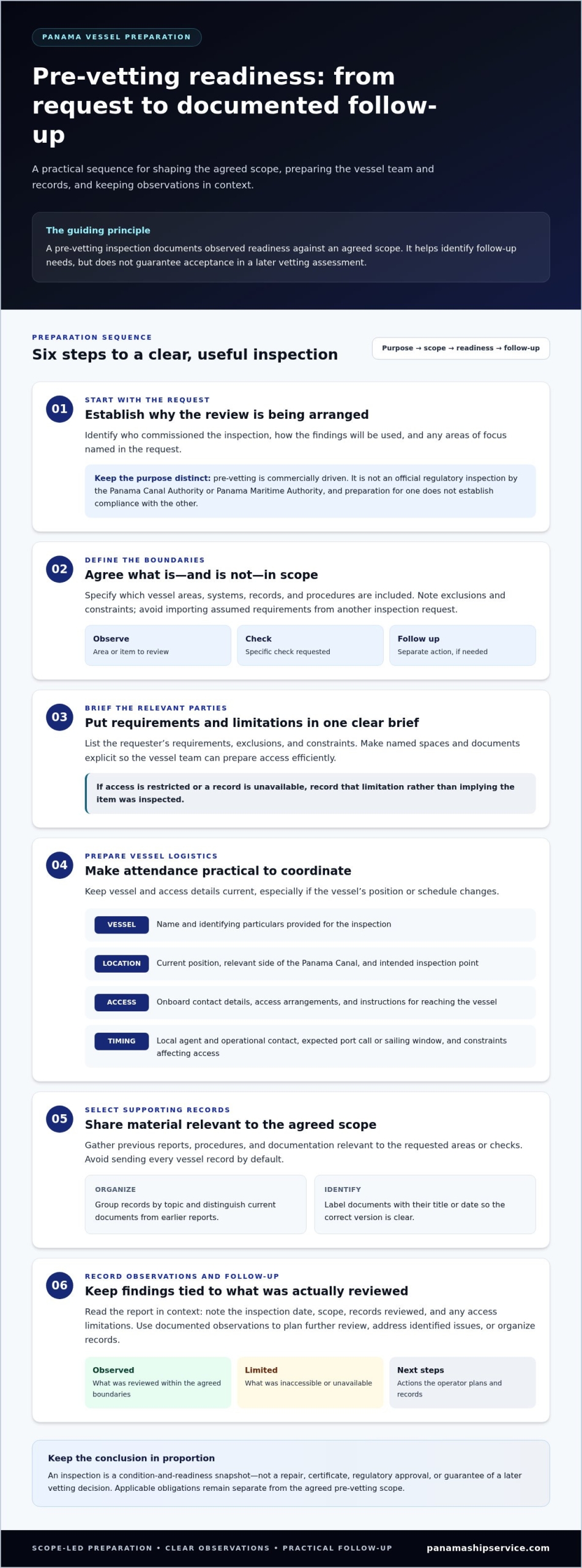
It can be hard to know which areas and documents to prioritize, especially when an inspection must fit around a Panama Canal transit or port call. Pre-vetting is a commercial assessment driven by charterers or oil majors, not an official regulatory inspection by the Panama Canal Authority or Panama Maritime Authority. A vessel may need to meet both commercial expectations and applicable Panamanian requirements.
This guide offers a practical checklist for vessel condition, records, onboard coordination, and follow-up. It also explains how pre-vetting differs from other marine survey purposes, so the scope stays clear. Panama Ship Service provides Surveys, procedures, and documentation support on both sides of the Canal, alongside operational and technical services for vessels.
Key Takeaways
- A pre-vetting inspection panama should follow the requester’s stated purpose and agreed scope, not a generic checklist.
- Organize vessel identity, location, access arrangements, local agent details, and timing before coordinating attendance.
- Distinguish pre-vetting from pre-purchase, class, and general surveys so findings serve the right purpose.
- Adapt the readiness checklist to the agreed scope, then use it to structure preparation and follow-up.
- Panama Ship Service provides Surveys, procedures, and documentation support on both sides of the Panama Canal.
What Panama Pre-Vetting Inspections Establish
A pre-vetting inspection is a focused review of a vessel’s condition and readiness before a commercial vetting assessment. Its value depends on a clear purpose: the requester’s scope guides which areas are examined, which records are reviewed, and how findings are reported. A pre-vetting inspection panama is not a universal checklist applied identically to every vessel.
Quotable definition: “A pre-vetting inspection documents a vessel’s observed readiness against an agreed scope; it helps identify follow-up needs but does not guarantee acceptance in a later vetting assessment.” The report describes what was reviewed, what information was available, and which observations may need attention.
The inspection provides evidence, not a prediction. Operators can use documented observations to plan further review, address identified issues, or organize records before a formal assessment. The scope should identify what is included and note limitations, such as inaccessible areas or records that were unavailable at the time.
Who requests a pre-vetting inspection and when?
Shipowners, charterers, and vessel operators may arrange a review before a forthcoming vetting assessment. Plan timing around practical access, the vessel’s port call, its location, and its sailing window. Start with the request: identify who commissioned the inspection, how the findings will be used, and any stated areas of focus. If the request names particular spaces or records, use those details to shape the scope rather than treating them as universal requirements.
Keep the commercial purpose distinct from official inspections. A vetting review is driven by commercial requirements, while an inspection by a maritime authority serves its own regulatory or administrative purpose. Preparing for one does not, by itself, demonstrate that the vessel has met the requirements of the other. Applicable obligations remain separate from the agreed pre-vetting scope.
What the inspection can, and cannot, tell an operator
Think of the inspection as a condition-and-readiness snapshot. It records observations within agreed boundaries and can highlight matters for follow-up. It cannot guarantee a vetting decision, predict every question a later assessor may raise, or establish readiness in areas outside its scope. Read findings in context, including the inspection date, access limitations, and records reviewed.
An observation is not a repair, certificate, or regulatory approval. If a finding points to a condition that needs attention, the operator can plan the appropriate next step and keep a record of follow-up. Separating the scope, observations, and actions gives owners and operators a practical basis for preparation without overstating what the inspection establishes.
Build a Pre-Vetting Inspection Scope Around the Vessel and Request
A clear scope keeps preparation practical. Before arranging a pre-vetting inspection panama, identify who commissioned it, why the review is needed, and how its findings will be used. Then define the agreed boundaries: which vessel areas, systems, records, or procedures are included, and what falls outside the assignment.
Scope statement: “The inspection will cover the vessel areas, systems, and records agreed for this request; additional checks, repairs, or other services are outside the scope unless separately agreed.” This keeps observations distinct from requested checks and any follow-up work.
Turn the request into a clear inspection brief
Put the requester’s requirements, exclusions, and constraints in one brief for the relevant parties. Avoid adding assumed criteria just because they appeared in another inspection request. If the request identifies specific spaces and documents, list them explicitly rather than presenting a broader inspection category as a requirement. Clear boundaries help the vessel team prepare access efficiently.
For each item, note whether it is an area to observe, a specific check, or a matter requiring separate follow-up. If access is restricted or a record is unavailable, record that limitation instead of implying the item was inspected. This ties the report to the original request and helps operators decide what to do next.
Prepare vessel information and supporting records
Gather the practical details needed to coordinate attendance and understand the assignment. Keep them current, particularly if the vessel’s schedule or position changes.
- Vessel name and identifying particulars, as provided for the inspection.
- Current location, including the relevant side of the Panama Canal, and the intended inspection point.
- Access arrangements, onboard contact details, and instructions for reaching the vessel.
- Local agent details and the operational contact coordinating timing.
- Expected port call or sailing window, including timing constraints that affect access.
- Previous reports, procedures, and documentation relevant to the areas or checks in the request.
Organize records by topic and distinguish current documents from earlier reports. Rather than sending every vessel record by default, select material related to the agreed scope. Label documents with their title or date so the inspector and vessel team can identify the correct version efficiently.
For broader context on how survey purpose and scope can differ, consult this marine surveys guide. If coordination around a Canal transit or port call is part of the plan, Panama Ship Service survey coordination can help organize vessel information and inspection arrangements in Panama.
Pre-Vetting vs. Pre-Purchase, Class, and General Surveys
Survey terms can sound interchangeable, but the assignment’s purpose determines what it examines and how findings should be used. A pre-vetting inspection panama is organized around a forthcoming commercial vetting assessment and the scope set for that request. A pre-purchase survey, class-related survey, or general condition survey has a different commissioning purpose. Findings from one may inform preparation for another, but they do not automatically answer its questions.
The label “pre-vetting” does not establish a universal checklist or acceptance standard. Use the requester’s requirements and agreed scope as the working reference. Define those boundaries before using a report to assess readiness or plan follow-up.
How a pre-vetting review differs from a pre-purchase survey
A pre-vetting review helps an owner, operator, or other commissioning party prepare for a commercial assessment. A pre-purchase survey supports a condition assessment for a potential acquisition, with findings used to inform the buyer’s evaluation of the vessel. The commissioning party, intended use, and agreed scope shape each assignment. A pre-vetting review is not a substitute for acquisition due diligence. For that distinct purpose, the pre-purchase vessel survey article explains why condition assessment matters to a prospective buyer.
How class and general condition surveys fit the picture
A class approval survey addresses a class-related scope. A general condition survey documents condition for its stated purpose. Neither automatically covers a separate commercial vetting request. Earlier survey reports can provide useful background, but compare their scope and findings with the current request rather than assuming they replace it.
Use this comparison to clarify what a report is intended to establish:
| Survey type | Typical purpose | How to use the findings |
|---|---|---|
| Pre-vetting inspection | Prepare for a commercial vetting assessment, within the agreed request | Identify observations and follow-up relevant to that scope |
| Pre-purchase survey | Support condition assessment for a potential acquisition | Inform the buyer’s evaluation, not automatically a vetting decision |
| Class approval survey | Address a defined class-related purpose | Use for its stated class scope; don’t assume it covers commercial vetting |
| General condition survey | Record vessel condition for the commissioning purpose | Use as background where relevant, while noting scope and timing |
Before relying on an existing report, check who commissioned it, what it covered, and when its observations were recorded. It may help focus preparation or identify questions for follow-up, but it does not establish that a different assessment’s scope has been met. Keep each finding tied to its original purpose. This helps prevent one survey from being treated as evidence for work it was not commissioned to address.
Panama Pre-Vetting Inspection Checklist for Vessel Operators
Use this checklist to coordinate a pre-vetting inspection panama around the agreed scope, vessel location, and operating schedule. Adapt each item to the request. This is a preparation tool, not a universal set of inspection requirements.
Before the inspection: align people, place, and scope
Set the practical arrangements first. A clear brief gives the inspection team and vessel personnel the same reference point. Early updates also help local coordination respond to schedule or access changes.
- Confirm the purpose and boundaries. Keep the requester’s brief at hand. Identify the vessel areas, systems, or records included, along with stated exclusions or constraints.
- Verify vessel identity and location. Share current vessel particulars and where the vessel will be available, including whether it is on the Canal’s Atlantic or Pacific side.
- Arrange access and local coordination. Provide access instructions, onboard contact details, local agent information, and the agreed inspection point.
- Align timing with operations. Set an expected attendance window around the port call or sailing schedule. Communicate changes promptly through the established channel.
- Prepare relevant material. Organize procedures, documentation, previous reports, and photographs related to the agreed scope. Label records so the team can locate them efficiently.
During and after the inspection: record and route findings
Keep a vessel representative available to support access and answer factual questions. Record what was observed, what could not be accessed, and which documents were reviewed. These details preserve context when findings are shared and follow-up is assigned.
- Separate observations from actions. Record observed conditions distinctly from recommendations, requested checks, and repair work.
- Review findings against the brief. Note which agreed areas were covered and identify any limitation that affected the inspection.
- Agree documentation and follow-up. Establish how inspection procedures, records, and agreed next steps will be handled within scope.
This distinction supports efficient decisions. A recorded observation may prompt further assessment or repair, but it should not be presented as completed work. Keep responsibility and next steps clear so the vessel team can route each item appropriately.
If findings call for mechanical work, review Panama Canal mechanical repair support as a practical next step. Panama Ship Service coordinates vessel services around the Canal. Discuss inspection coordination and repair needs to keep the follow-up organized.
Coordinate a Pre-Vetting Inspection in Panama with Panama Ship Service
Coordinating a pre-vetting review involves more than setting an attendance time. Vessel location, access, the requester’s scope, supporting information, and the operating schedule all need to align. Panama Ship Service provides Surveys, procedures, and documentation, alongside operational and technical support on both sides of the Panama Canal and internationally.
Local presence supports practical coordination around vessel operations. Clear, personalized communication helps keep the request and arrangements organized, while a cost-conscious approach can help avoid unnecessary duplication of vessel services. Keep the inspection scope as the reference point: observations, records, and follow-up should relate to what has been agreed.
What to include when requesting inspection support
Make the initial request specific enough to support planning. Include the vessel’s identity, current location, expected timing, and operational contact details. Summarize who requested the inspection, its purpose, the areas or records in scope, and any relevant reports or documentation. Describe other operational or technical needs separately so they can be considered for coordinated support.
For example, a vessel preparing for a port call may need inspection arrangements coordinated alongside other planned work. Sharing related needs early can help organize services without confusing them with the inspection itself. Panama Ship Service brings together relevant vessel support, including Surveys, mechanical repairs, underwater work, ship supplies, and MARPOL disposals. Consolidating related requirements can simplify coordination.
Surveys include checks, procedures, and documentation. Follow the inspection requirements set by the requester rather than assuming a standard scope. If a review identifies a matter requiring further attention, keep the finding distinct from any repair or other service arranged afterward. This makes responsibilities and next steps easier to track.
Keep the next step clear and efficient
For a focused discussion, share the vessel details, location, timing, requested inspection scope, and relevant documentation together. Include the operational contact and note any schedule or access constraints. Panama Ship Service provides quotes on request with transparent, cost-efficient pricing. Contact is available 24/7 to support communication around vessel needs.
With the request organized, the inspection team and vessel representatives can work from a shared understanding of purpose, access, and documentation. Panama Ship Service coordinates vessel services on both sides of the Canal and can bring related operational needs into the same planning process. Contact Panama Ship Service to coordinate your vessel’s inspection.
Turn Inspection Preparation into a Clear Next Step
A useful pre-vetting inspection panama plan gives the vessel team a shared reference point before the assessment. Use the agreed scope to guide preparation, keep observations and follow-up distinct, and make sure the right people have the information they need. This clarity helps turn findings into manageable actions rather than last-minute uncertainty.
Before the vessel’s next review, bring the request, vessel particulars, operating schedule, and relevant records together. A coordinated plan can also account for related technical needs, helping teams organize work around vessel operations and avoid unnecessary duplication. Define what support is needed, where the vessel will be, and when access is possible.
Panama Ship Service has supported shipping operations since 1999, with personalized communication focused on practical solutions and cost-conscious efficiency. Contact is available 24/7, and Surveys include checks, procedures, and documentation. Contact Panama Ship Service to coordinate your vessel’s inspection and move forward with a clear readiness plan.
Frequently Asked Questions
What is a pre-vetting inspection for a vessel?
A pre-vetting inspection is a focused review arranged to help an operator prepare for a vetting assessment. It records what was examined and what evidence was available within the agreed scope. For example, an operator can use the observations to assign internal follow-up before the assessment. The review does not guarantee acceptance, replace a class or regulatory survey, or serve as acquisition due diligence.
How is a pre-vetting inspection different from a pre-purchase survey?
A pre-vetting inspection prepares a vessel for a commercial vetting review. A pre-purchase survey supports an assessment of a vessel being considered for acquisition. The distinction affects how the findings are used: a prospective buyer may rely on a purchase survey to understand condition before a transaction, while an operator uses pre-vetting observations to plan readiness. Neither report should be assumed to meet the other assignment’s objectives.
What information should I provide to arrange a vessel inspection in Panama?
To arrange a pre-vetting inspection panama, provide vessel identification, current position, purpose and requested scope, access details, timing, and operational contact information. Include relevant previous reports or records related to the requested work. Send one coordinated request to the parties arranging attendance, then promptly share changes to the vessel’s position or schedule so plans can be adjusted.
Can a pre-vetting inspection guarantee that a vessel will pass vetting?
No. An inspection records observations within its agreed scope, but the final assessment and decision belong to the requesting vetting party, which may apply its own requirements. Operators can still use the report constructively: track each observation, record actions taken, and keep supporting evidence available for the later review.
When should a pre-vetting inspection be arranged in Panama?
Arrange the inspection around vessel access, the port call, and the intended sailing window. There is no single lead time that suits every vessel. Timing depends on the vessel’s location, what the requester wants examined, and the parties involved. Sharing a likely attendance window early, then updating it if operations change, helps keep arrangements aligned with the schedule.
What happens if an inspection identifies a condition that needs attention?
Document the observation and identify who will review or address it. Keep the observation separate from a recommendation and from any repair later authorized, so the status of each item stays clear. If mechanical work is needed, Panama Ship Service provides Mechanical Ship Repairs as a separate vessel service. Operators can coordinate appropriate follow-up without treating repairs as automatic inspection work.