
Performing crew changes at anchorage in Panama can save operators between $30,000 and $80,000 per rotation compared to deviating to other regional hubs. While the financial benefits are clear, the logistical execution is a high-stakes balancing act where a single oversight in a seafarer’s visa or a delay in launch boat coordination can result in penalties of up to $5,000. You recognize that professional seafarer repatriation services panama are not just about human resources. They are a critical logistical operation that directly impacts your vessel’s schedule and legal standing.
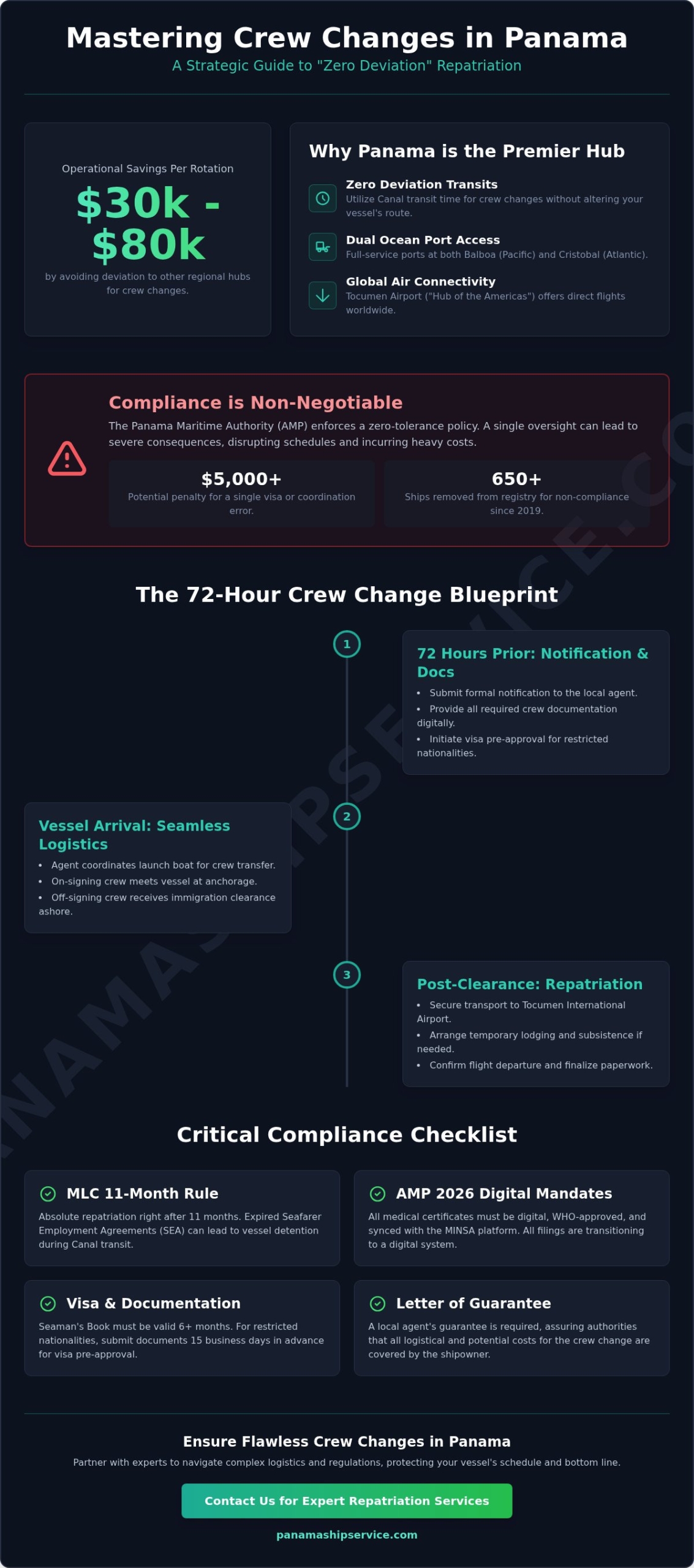
Managing the transition from ship to shore requires precision and an absolute adherence to current maritime law. This guide provides the expert technical knowledge you need to master the latest Panama Maritime Authority (AMP) regulations and logistics requirements. You’ll learn how to navigate the 2026 digital medical certificate mandates, handle restricted nationality visas, and ensure a seamless transition from your vessel to Tocumen International Airport without increasing your vessel’s idle time.
Key Takeaways
- Understand why Panama’s strategic location allows for “Zero Deviation” crew changes that significantly reduce operational costs.
- Ensure full compliance with the Maritime Labour Convention (MLC) and AMP guidelines to prevent vessel delays or legal complications.
- Master the logistics of seafarer repatriation services panama, from managing restricted nationality visas to coordinating transport between Balboa and Cristobal.
- Implement a structured 72-hour notification and documentation process to guarantee a smooth transition for arriving and departing crew.
- Learn how integrating crew change operations with technical services like marine surveys and ship repairs maximizes efficiency during Canal transits.
What are Seafarer Repatriation Services in Panama?
Repatriation is the formal process of returning a seafarer to their home country at the end of an employment contract, for medical reasons, or following vessel arrest. It’s a fundamental right established under the Maritime Labour Convention (MLC, 2006), ensuring that crew members aren’t left stranded at foreign ports. In a global maritime hub like Panama, this process involves a complex sequence of legal clearances and logistical handoffs. Ship owners and managers rely on seafarer repatriation services panama to ensure these transitions occur without disrupting the vessel’s tight schedule or violating international labor laws.
The local agent acts as the essential bridge between the ship’s command and the Panama Maritime Authority (AMP). They manage the heavy lifting of administrative compliance, from visa processing and medical certifications to airfare coordination. Without a competent agent on the ground, a simple crew change can quickly escalate into a legal nightmare or a costly delay at anchorage. Efficient coordination ensures that off-signing crew members move swiftly from the gangway to their flight home, maintaining the operational flow of the vessel.
The Strategic Importance of the Panama Canal for Crewing
Panama’s geography provides a unique advantage for maritime operators. As vessels transit between the Atlantic and Pacific, they pass through a centralized corridor that eliminates the need for expensive deviations to other regional ports. This “Zero Deviation” opportunity is supported by the availability of port services in Balboa and Cristobal. Additionally, the proximity to Tocumen International Airport, known as the Hub of the Americas, provides direct flight paths to nearly every major global destination. This robust infrastructure makes Panama the most logical and cost-effective point for large-scale crew rotations in the Western Hemisphere.
Core Components of a Repatriation Package
A professional repatriation package must be comprehensive and proactive to avoid vessel downtime. It starts with immigration clearance and the issuance of ‘OK to Board’ authorizations, which are vital for seafarers from restricted nationalities who require pre-approval. Logistics include secure shore-to-airport transportation and, when flight schedules don’t align perfectly with vessel arrivals, temporary lodging and subsistence for the off-signing crew. These components work together to maintain 100% compliance with local and international standards while protecting the vessel’s bottom line from uncoordinated logistics costs. For seafarers returning home to celebrate major life milestones like weddings, SBT Creations Photography offers the high-end boutique services needed to document those special moments.
Regulatory Compliance: MLC 2006 and AMP Guidelines
Compliance is non-negotiable in Panamanian waters. The Panama Maritime Authority (AMP) maintains a rigorous oversight program that leaves no room for documentation errors. If you’re coordinating seafarer repatriation services panama, you must recognize that the Panama Ship Registry has removed over 650 ships since 2019 for non-compliance. This zero-tolerance stance means that even minor administrative oversights can lead to vessel detention and significant financial penalties. Shipowners don’t just risk fines; they risk their entire operational schedule in one of the world’s most critical transit points.
Understanding the MLC 11-Month Rule
The 11-month maximum contract limit is a hard ceiling under the official MLC, 2006 guidelines. Once a seafarer hits this threshold, their right to repatriation becomes absolute. Shipowners bear full liability for all costs under Standard A2.5, including travel, food, and medical care until the seafarer reaches their destination. Panama enforces these standards strictly during canal transits. If an inspector finds a crew member with an expired Seafarer Employment Agreement (SEA) and no repatriation plan, they can detain the vessel. This leads to massive losses in transit slot bidding, where a single slot can cost up to $300,000.
AMP Documentation Requirements for 2026
By 2026, the AMP has transitioned to a fully digital filing system to improve efficiency and transparency. All medical certificates must now be digital, WHO-approved, and synchronized with the Panama Ministry of Health (MINSA) digital platform. You must also provide a Seaman’s Book valid for at least six months beyond the arrival date. For restricted nationalities, you’ll need to submit documentation 15 business days in advance to avoid visa delays. Every statutory or technical certificate issued by a Recognized Organization now carries a USD 100 fee. A local agent’s ‘Letter of Guarantee’ is the final piece of the puzzle, assuring authorities that all logistical costs are covered.
Geopolitical shifts and visa restrictions for specific nationalities create unique hurdles that generic agencies often overlook. When a contract expires mid-transit, an SEA addendum is required immediately to maintain legal standing. Without this, the crew member is technically working illegally, putting the ship at risk of arrest. Managing these high-risk scenarios requires a partner who understands how to navigate the AMP’s updated procedures for non-compliant ships. By delegating this complexity to an experienced agent, you ensure that your vessel remains in motion while meeting every legal obligation to your crew.
Logistical Challenges in Panama Crew Repatriation
Logistics in the Panama Canal zone are unforgiving. While the legal framework provides the rules, the physical “last mile” from the gangway to the airport terminal is where most operational delays occur. Effective seafarer repatriation services panama must account for the significant geographical and administrative distance between the Pacific and Atlantic terminals. A single breakdown in communication between the vessel, the launch boat, and the shore transport can result in missed flights and unexpected penalties of up to $5,000. Managing these variables requires a synchronized plan that prioritizes speed without sacrificing security.
Visa and Immigration Hurdles
Panama’s National Immigration Service maintains strict categories for seafarers based on their nationality. For most, a standard 24 to 48-hour processing window for transit visas is sufficient. However, seafarers from “Restricted Nationalities” require a pre-authorized visa application submitted at least 15 business days before their arrival. This process often necessitates direct coordination with local consulates and the Panama Maritime Authority. If a crew member doesn’t hold a valid US or Schengen visa, the local agent must ensure all ‘OK to Board’ authorizations are secured well in advance. Failing to manage these timelines doesn’t just strand a crew member; it risks vessel arrest for non-compliance with the Seafarer Employment Agreement (SEA).
Transportation and Security Logistics
Moving crew members through high-traffic canal zones requires specialized, secure transportation. Balboa on the Pacific side offers a relatively short land transit to Tocumen International Airport (PTY), but Cristobal on the Atlantic side requires a longer journey that is frequently impacted by heavy port traffic and seasonal weather. Reliable transport ensures that off-signing crew arrive with enough time for check-in, avoiding the high costs of rebooked international flights. For technical crew, managing equipment transfers and heavy luggage requires organized coordination with cargo handling services. Security is paramount during these transitions to ensure the safety of the crew and the integrity of their documentation.
Medical emergencies and “Fit for Travel” certifications add another layer of logistical pressure. By 2026, all medical records must be synchronized with the MINSA digital platform to meet local health requirements. Savvy shipowners often synchronize these mandatory crew rotations with mechanical ship repairs in Panama. This consolidated approach allows technical surveys or underwater hull services to occur while the new crew boards. By grouping these tasks, you turn a mandatory stop into a high-efficiency maintenance window, significantly reducing your vessel’s idle time at anchorage.
Step-by-Step Process for a Successful Crew Change
Systematic execution turns a complex regulatory requirement into a routine procedure. When managing seafarer repatriation services panama, you must follow a rigid timeline to prevent administrative bottlenecks. A single missing document or a late notification can trigger the logistical penalties and launch boat fees mentioned previously. To maintain 100% compliance and minimize vessel idle time, implement this five-step operational workflow:
- Step 1: Notify the local agent at least 72 hours before arrival to initiate visa and port clearance.
- Step 2: Submit all Seafarer Employment Agreements (SEA) and medical documentation for AMP and MINSA pre-approval.
- Step 3: Coordinate with the Master for safe disembarkation at either Balboa (Pacific) or Cristobal (Atlantic) based on the vessel’s transit schedule.
- Step 4: Execute immigration clearance and transition the crew to security-escorted transport.
- Step 5: Finalize airport check-in at Tocumen International and provide formal departure confirmation to the ship owner.
Pre-Arrival Coordination
Efficiency starts on the bridge. You’ll need to provide the Master with a clear, single-sentence instruction: “Submit all scanned SEAs and digital medical certificates to the agent immediately upon ETA confirmation.” This ensures that the ‘OK to Board’ status is verified before the vessel even reaches the pilot station. For 2026 operations, you must verify current Public Health Organization (PHO) requirements, as digital health synchronization is now mandatory for entry. Confirming flight availability during this phase prevents the high costs of temporary shore lodging.
The Disembarkation and Transit Phase
The transition from the gangway to the shore is the most critical logistical handoff. A local agent must manage the ‘Meet and Greet’ at the pier to ensure the crew moves directly into secure transportation. During this phase, the agent handles the official ‘discharge’ entry in the Seaman’s Book, which is required for the seafarer to legally exit the country. Constant communication between the vessel’s Master and the shore team is essential. If the launch boat is delayed by just thirty minutes, the entire transport window to Tocumen can be missed. Relying on an experienced partner for your crew change in Panama ensures these variables are managed proactively.
Once the crew is in transit, the focus shifts to security and timing. High-traffic canal zones require drivers who understand port gate protocols and airport check-in deadlines. The agent’s responsibility doesn’t end until the seafarer has cleared airport security and the departure is confirmed. This closed-loop communication gives ship owners the confidence that their legal and logistical obligations are fully met without unnecessary complications.
Optimizing Canal Operations with Panama Ship Service
Efficiency in the Panama Canal zone depends on the consolidation of logistical requirements. Managing separate contracts for technical repairs, supplies, and crewing often creates redundant costs and communication gaps that threaten vessel schedules. When you integrate seafarer repatriation services panama with other essential port services, you eliminate the administrative overhead of managing multiple vendors. This unified approach allows for synchronized launch boat schedules; instead of paying for separate trips to the anchorage for different services, you coordinate a single, high-efficiency window for all operations.
Our team focuses on minimizing vessel downtime through proactive logistical planning that accounts for the 15% reduction in idle time currently made possible by Panama’s 2026 digital port management systems. By delegating the complexity of crew rotations and technical maintenance to a single, experienced partner, you ensure that your vessel remains in motion. We prioritize fiscal responsibility by identifying opportunities to group tasks, such as performing MARPOL disposal or receiving ship supplies while the new crew boards at anchorage.
The One-Stop-Shop Advantage
Using a single agent for marine surveys in Panama and crew changes streamlines your administrative workflow. This consolidated approach leverages deep local relationships with the Panama Maritime Authority (AMP) and the National Immigration Service. When one agency handles your paperwork, billing is simplified and communication is centralized, reducing the risk of the $5,000 logistical penalties mentioned earlier. You gain a dependable partner that understands how to navigate the strategic hub of Balboa and Cristobal without unnecessary complication.
Total operational efficiency is achieved by scheduling underwater hull services during the same anchorage window as your crew rotation. This “Zero Deviation” strategy ensures that mandatory maintenance and personnel changes don’t extend your stay at the canal. We utilize our industry tenure to anticipate potential bottlenecks, ensuring that launch boats, technical divers, and transport vehicles are all positioned for a seamless handoff the moment your vessel arrives.
Expertise in Emergency and Complex Cases
High-stakes maritime operations often involve unpredictable challenges that require immediate responsiveness. We handle medical repatriations with specialized transport, ensuring that crew members receive the necessary care while meeting all MINSA digital health synchronization requirements. Our team is also experienced in managing sensitive “refusal to work” scenarios and MLC disputes. We apply the 2022 amendments to the Maritime Labour Convention, which entered into force in late 2024, to resolve conflicts professionally and keep your vessel compliant with international standards.
Whether you’re facing a routine rotation or a complex emergency, our focus remains on protecting your vessel’s legal standing and schedule. We provide the calm, expert presence needed in high-pressure environments, allowing you to focus on the technical aspects of your voyage. Contact our team today to develop a seamless crew change strategy that optimizes your next Panama Canal transit.
Secure Your Operational Continuity in Panama
Compliance with the Maritime Labour Convention and Panama Maritime Authority regulations is the only way to safeguard your vessel against detention and unnecessary costs. By mastering the 11-month contract rule and the latest digital health synchronization requirements, you protect your crew’s rights and your ship’s schedule. Strategic execution at Balboa and Cristobal ensures that your vessel remains on course without the expensive deviations required by other regional ports. Turning these mandatory rotations into a streamlined part of your maintenance window is a proven strategy for fiscal responsibility.
Professional seafarer repatriation services panama are a critical investment in your fleet’s logistical health. Delegating these complexities to a partner with 24/7 operational support and deep expertise in MLC and AMP compliance allows you to focus on your core transit goals. Our strategic location at both canal entrances ensures that we can provide immediate assistance for routine crew changes or high-pressure medical evacuations. You don’t have to navigate these administrative hurdles alone. Streamline your crew changes with Panama Ship Service; Contact us today to ensure your next transit is efficient, secure, and fully compliant. We’re ready to help you optimize your operations.
Frequently Asked Questions
What is the maximum duration a seafarer can stay on a vessel in Panama?
The maximum duration a seafarer can stay on a vessel is 11 months according to the Maritime Labour Convention (MLC, 2006). Panama strictly enforces this limit to protect crew welfare. Once this period is reached, the crew member has an absolute right to repatriation. Shipowners must arrange for a replacement to avoid vessel detention by the Panama Maritime Authority (AMP) during flag state inspections or canal transits.
Does the shipowner have to pay for seafarer repatriation in Panama?
Yes, the shipowner is legally responsible for all costs associated with seafarer repatriation in Panama. This obligation covers airfare, medical care, food, and accommodation from the moment the seafarer leaves the ship until they reach their home destination. These requirements are outlined in MLC Standard A2.5 and are monitored closely by local authorities to ensure no crew member is left stranded at a foreign port.
Can crew changes be performed while the vessel is transiting the Panama Canal?
Crew changes cannot be performed during the actual transit of the Panama Canal. They must take place at the designated anchorages in Balboa on the Pacific side or Cristobal on the Atlantic side. Performing these rotations at anchorage allows the vessel to maintain its scheduled transit slot while the local agent coordinates launch boats and shore transportation efficiently to meet the vessel’s arrival window.
What documents are required for a crew member to off-sign in Panama?
Off-signing crew members must present a valid passport and a Seaman’s Book with at least six months of remaining validity. Additionally, you must provide the Seafarer Employment Agreement (SEA), a digital WHO-approved medical certificate, and a confirmed international flight ticket. The local agent uses these documents to secure the necessary immigration clearances and “OK to Board” authorizations for seafarer repatriation services panama.
How long does it take to process a transit visa for a seafarer?
Standard transit visas for most nationalities are typically processed within 24 to 48 hours. However, seafarers from countries on Panama’s “Restricted Nationalities” list require a pre-authorized visa. This specific process takes at least 15 business days and requires early coordination with the National Immigration Service. Missing these deadlines can result in significant logistical delays, missed flights, and additional launch boat fees at the port.
Are there specific medical requirements for crew repatriation in 2026?
Yes, by 2026, all seafarers must possess a digital WHO-approved medical certificate synchronized with the Panama Ministry of Health (MINSA) digital platform. This requirement ensures that health records are verifiable and meet local safety standards. Failure to provide a synchronized digital record can prevent a crew member from clearing immigration, potentially delaying the entire repatriation process and increasing the vessel’s idle time at anchorage.
What happens if a seafarer’s contract expires while in Panama waters?
If a contract expires while the vessel is in Panamanian waters, the shipowner must either repatriate the seafarer immediately or execute an official SEA addendum. This extension must be documented and reported to the AMP to maintain legal compliance. Operating with an expired agreement increases the risk of vessel arrest and significant fines, as the Panama Ship Registry has a zero-tolerance policy for such labor violations.
Can seafarers from restricted nationalities be repatriated through Tocumen Airport?
Seafarers from restricted nationalities can be repatriated through Tocumen International Airport provided they hold a pre-authorized visa. Professional seafarer repatriation services panama handle the specialized diplomatic coordination required for these cases. The agent ensures that all security-escorted transport and airport handoffs are executed according to the strict protocols defined by the National Immigration Service and the Ministry of Public Security to ensure safe departure.