
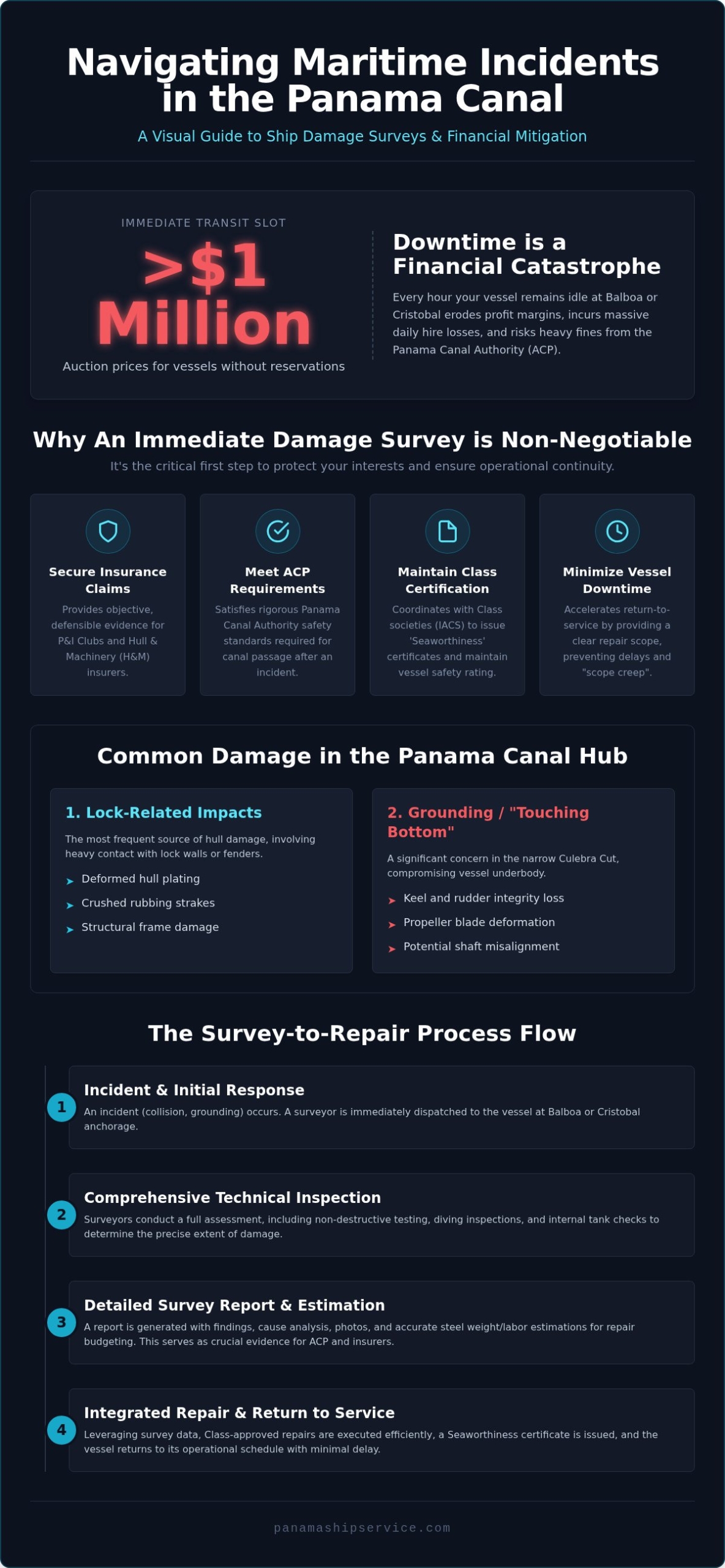
With auction prices for immediate Panama Canal transit slots now exceeding $1 million for vessels without reservations, a single day of unexpected downtime is a financial catastrophe. You understand that every hour your vessel remains idle at Balboa or Cristobal erodes your profit margins and risks heavy fines from the Panama Canal Authority. Securing a professional ship damage survey in Panama is the only way to protect your interests when an incident occurs. It’s the critical first step in obtaining objective evidence for insurance claims and satisfying the rigorous safety standards required for canal passage.
You need a partner who understands that technical precision must meet immediate logistics. This article outlines how to obtain an authoritative ship damage assessment that secures your insurance claims and minimizes vessel downtime. We’ll examine the requirements for class-approved reports, the role of risk-based inspections in 2026, and how integrated repair services can accelerate your return to sea. By the end, you’ll know exactly how to navigate the complexities of emergency response at this strategic maritime hub while keeping your operational schedule intact.
Key Takeaways
- Understand why immediate technical inspections are essential for meeting Panama Canal Authority (ACP) requirements and avoiding catastrophic transit delays.
- Learn how a professional ship damage survey panama identifies critical hull and keel issues through non-destructive testing at Balboa and Cristobal anchorages.
- Discover the role of the surveyor as an impartial liaison between shipowners and P&I Clubs to ensure all evidence is defensible for insurance claims.
- Minimize vessel downtime by leveraging integrated survey and repair solutions that combine expert assessment with immediate technical execution.
The Critical Importance of a Ship Damage Survey in Panama
A ship damage survey panama is a comprehensive technical inspection conducted to determine the precise extent, underlying cause, and projected repair cost of vessel damage. In the strategic hub of the Panama Canal, this assessment is an operational necessity rather than a formality. The Canal handled approximately 390 million PC/UMS tons of cargo between October 2025 and June 2026; any delay here triggers a domino effect across global supply chains. An independent Marine surveyor provides the objective evidence required to protect the owner’s interests and ensures that insurance claims are backed by defensible technical data.
Meeting Regulatory and Class Requirements
The Panama Canal Authority (ACP) frequently mandates damage assessments following lock-related incidents or suspected groundings in the Culebra Cut. These surveys ensure your vessel remains in compliance with International Association of Classification Societies (IACS) standards. You don’t want to risk a transit denial because of unverified hull integrity or a mechanical failure that could have been identified early. Professional surveyors focus on several key objectives during these inspections:
- Identifying structural deformities in hull plating and internal framing.
- Evaluating rudder and propeller integrity after a “touching bottom” event.
- Documenting lock-related impact damage for mandatory ACP reports.
- Providing accurate steel weight and labor estimations for repair budgeting.
Surveyors work closely with Class societies to issue ‘Seaworthiness’ certificates, which are mandatory for vessels to resume their journey. Whether you’re dealing with a minor contact in the locks or a serious structural issue, coordinating with Class for temporary versus permanent repair approvals is the only way to maintain your vessel’s certification and safety rating.
Mitigating Financial Loss from Downtime
The financial risks in the Panama hub are exceptionally high. For vessels without advance reservations, auction prices for immediate transit slots in 2026 have occasionally exceeded $1 million. A delayed ship damage survey panama often leads to a missed transit window, resulting in massive daily hire losses. By performing a rapid, accurate assessment at Balboa or Cristobal, you prevent “scope creep” during the repair phase. You’ll have a clear understanding of what needs fixing before the first welder arrives on site.
A detailed survey report ensures that you only pay for necessary repairs and provides a technical foundation for P&I Club or Hull and Machinery (H&M) insurance recovery. These reports also function as critical evidence in maritime arbitration. Having a professional, third-party assessment helps you avoid unnecessary litigation costs by providing an undisputed record of the incident and the resulting damage. In a high-pressure environment like the Canal, delegating this complexity to an expert allows you to focus on your vessel’s return to service.
Common Types of Maritime Damage in the Panama Canal Hub
The Panama Canal is one of the world’s most demanding maritime environments. With over 10,600 deep-draft vessel transits recorded in the first ten months of fiscal year 2026, the risk of operational incidents is constant. Navigating the locks and the narrow Culebra Cut leaves little room for error. When an incident occurs, a ship damage survey panama is the only way to accurately categorize the damage and satisfy the Panama Canal Authority (ACP) that the vessel is safe to continue.
Lock-related impacts are the most frequent source of hull damage. These usually involve heavy contact with lock walls or fenders, resulting in deformed hull plating and crushed rubbing strakes. In the Culebra Cut, “touching bottom” or grounding events are a significant concern, especially during the 2026 El Niño event which has led to fluctuating draft restrictions. These incidents often compromise keel and rudder integrity, requiring immediate diving inspections at Balboa or Cristobal to check for propeller blade deformation or shaft misalignment.
Structural and Hull Damage
A professional survey identifies specific fracture patterns and steel deformation that indicate the severity of a collision. If a breach is suspected, surveyors conduct internal tank inspections to check for secondary structural failures or fluid ingress. These findings are critical for planning the necessary marine steel fabrication. You need a report that translates visual damage into a precise list of technical requirements for steel replacement and welding. If your vessel has suffered hull damage, our team can provide the technical expertise needed to assess the issue without leaving the anchorage.
Mechanical and Propulsion Issues
Mechanical failures during transit can lead to dangerous power loss or steering gear malfunctions. Surveyors investigate the root causes of engine room issues, such as flooding or cooling system failures, to prevent a recurring breakdown. After a grounding, it’s essential to conduct a ship damage survey panama to check rudder stock and propeller shaft alignment. Surveyors utilize thermal imaging cameras to detect hidden mechanical stress and abnormal heat signatures in propulsion components that are otherwise invisible to the naked eye. This proactive approach identifies potential failures before they result in a total vessel blackout or a costly transit denial. Our team is positioned to handle mechanical ship repairs immediately upon completion of the survey.
The Damage Survey Process: From Inspection to Report
Urgency defines the maritime industry in the Canal. When an incident occurs, you need immediate site attendance to prevent a minor setback from becoming a logistical crisis. Our teams provide a 24/7 response at both Balboa and Cristobal anchorages to begin the ship damage survey panama without delay. The process starts with drafting a “Statement of Fact” (SOF). This critical document establishes a clear timeline of the incident, recording environmental conditions, vessel movements, and initial observations. This SOF is vital for protecting your legal position before more detailed technical work begins.
Technical Inspection Techniques
To move beyond visual observations, we employ non-destructive testing (NDT) to identify hairline fractures or internal structural weaknesses that aren’t visible to the naked eye. Ultrasonic thickness gauging is a standard tool used to determine structural loss in hull plating or bulkheads, providing the data needed to calculate steel replacement needs. For damage occurring below the waterline, we deploy specialized underwater hull services. These teams use high-definition CCTV and photography to provide digital mapping of the damaged area. This allows for a remote review by your technical department or Class surveyors, ensuring everyone has an accurate view of sub-surface conditions.
Drafting the Repair Specification
A survey is only as good as the action it enables. We translate every finding into a detailed repair specification that serves as a blueprint for the technical teams. This work order lists exact material requirements, such as specific steel grades or specialized mechanical parts, to avoid procurement delays once repairs commence. We focus on three key areas during this phase:
- Material Scoping: Identifying the exact tonnage of steel or specific mechanical components required.
- Timeline Projection: Setting a realistic “Return to Service” (RTS) date to assist your port agent with scheduling.
- Cost Accuracy: Providing an estimation that aligns with current market rates in Panama to prevent budget overruns.
The final stage is the delivery of the comprehensive Damage Survey Report. This document is meticulously structured for review by P&I Clubs and H&M underwriters. It provides the technical justification for your insurance claim, ensuring that all proposed costs are substantiated by empirical evidence. By following this systematic process, we reduce the risk of claim denials and help you navigate the administrative burden of a maritime accident in this high-pressure hub.
Managing Insurance and Legal Interests After an Incident
After a maritime incident, the pressure to resume transit is immense. However, rushing past the administrative and legal requirements can jeopardize your insurance recovery. A ship damage survey panama acts as an impartial buffer between the vessel owner and the insurer. The surveyor’s primary objective is to produce evidence that is “defensible” in maritime arbitration, ensuring that every finding is backed by technical data, non-destructive testing results, and high-resolution photography. This objective approach prevents disputes and speeds up the settlement process.
In many cases, multiple parties are involved, including charterers, owners, and P&I Clubs. We manage joint surveys to ensure all stakeholders have access to the same evidence simultaneously. This transparency prevents the issuance of conflicting reports that could delay a settlement for months. If the incident occurred within the Canal, we also navigate the complexities of Panama Canal Authority (ACP) investigations. We provide the technical documentation they require for their accident reports while ensuring your operational interests remain protected throughout the inquiry.
Liaising with P&I and H&M Clubs
Underwriters require specific documentation to process a claim successfully. A successful claim often hinges on a clear “root cause analysis” that distinguishes between pre-existing wear and tear and sudden accidental damage. This distinction is vital for insurance adjusters who must determine the scope of coverage. In major casualties, we also assist in managing “General Average” situations, where costs are shared among all stakeholders involved in the voyage. Providing a detailed, class-approved ship damage survey panama immediately after the incident is the most effective way to satisfy these rigorous documentation requirements.
A Protocol for the Ship’s Master
The moments following an incident are critical for the eventual success of a claim. The Master must focus on securing the scene and preserving logbook entries, as these are the first items an adjuster or ACP investigator will review. Once the surveyor arrives at the anchorage, the Master should coordinate safe access to damaged compartments, ensuring that gas-free certificates are provided for internal tank inspections where necessary. Use the following checklist to manage the immediate aftermath:
- Preserve all VDR (Voyage Data Recorder) data and engine room telegraph logs.
- Take immediate photographs of the damage before any temporary stabilization occurs.
- Ensure all crew statements are documented while the event is fresh.
- Maintain a single point of communication with your Canal transit agency to synchronize technical and legal updates.
By following a strict communication protocol, you reduce the risk of contradictory information reaching the authorities. If you are currently managing an incident and require an immediate assessment, contact our survey team to initiate the evidence collection process.
Panama Ship Service: Integrated Survey and Repair Solutions
Most survey companies stop at providing a technical report. This creates a logistical hand-off where the vessel owner must find a separate repair team, re-explain the findings, and wait for a second mobilization. Panama Ship Service eliminates this friction. By combining a technical ship damage survey panama with immediate execution capabilities, we provide a seamless path from incident to departure. Our dual expertise ensures that the surveyor assessing the damage understands exactly what the repair team requires for a class-approved fix.
Rapid Response at Balboa and Cristobal
We maintain a strategic 24/7 presence at both the Port of Balboa and the Port of Cristobal. This dual-entrance positioning allows us to respond to emergencies regardless of your vessel’s location in the transit queue. Our local knowledge of Panamanian port logistics is essential for avoiding the administrative red tape that often stalls foreign contractors. We mobilize diving teams and specialized engineers within hours of an incident, providing technical coverage for diverse vessel types including Panamax bulkers, tankers, and container ships. You don’t have to wait for separate contractors to arrive when our integrated teams are already on-site.
Your One-Stop-Shop at the Canal
Consolidating your technical needs with a single provider maximizes operational efficiency. We transition directly from damage detection to the execution of mechanical ship repairs. Our workshops provide direct access to advanced steel fabrication and mechanical tooling, allowing us to handle everything from hull breaches to propulsion failures. This integrated approach is designed specifically to minimize vessel downtime and maximize safety in a high-stakes environment where every hour counts. We focus on providing a clear path from damage detection to a class-approved departure.
We’re committed to fiscal responsibility and operational reliability. Instead of delegating different parts of the recovery process to multiple agencies, you can delegate the entire complexity to us. We handle the technical assessment, the Class liaison, and the final repair work under a unified management structure. It’s the most efficient way to manage a ship damage survey panama while maintaining your transit schedule. Contact us today for immediate attendance and professional technical support at the Panama Canal.
Protecting Your Operational Schedule in the Panama Canal
An unexpected incident in the Canal hub requires a swift and authoritative response to prevent catastrophic financial loss. You now understand that a professional ship damage survey panama is the most effective tool for managing insurance interests and meeting the safety requirements of the Panama Canal Authority. By securing objective, technical data immediately after an event, you protect your legal position and ensure that repair specifications are accurate from the start. Our integrated model removes the friction between damage detection and technical resolution.
Our team is positioned at Balboa and Cristobal to provide a 24/7 emergency response. We deliver class-approved technical reports and utilize integrated survey and repair teams to streamline your vessel’s return to service. Don’t let downtime erode your profit margins or risk your transit slot. Contact Panama Ship Service for immediate 24/7 damage survey attendance and delegate the technical complexity of your recovery to the experts. We’re here to ensure your vessel resumes its journey safely and without unnecessary delay.
Frequently Asked Questions
What is the first step I should take after a collision in Panama waters?
You must notify the Panama Canal Authority and your port agent immediately to comply with local regulations. Securing the scene and preserving VDR data are critical legal requirements for any subsequent investigation. You should then contact an independent surveyor to initiate a Statement of Fact. This ensures all technical evidence is documented before any vessel movements occur, protecting your insurance claim and satisfying mandatory safety mandates.
How quickly can a damage surveyor attend my vessel at Balboa?
We provide 24/7 emergency response at the Port of Balboa and the Port of Cristobal. Surveyors typically mobilize within hours of receiving an instruction. Because we maintain local teams at both ends of the Canal, we avoid the logistical delays that external contractors face. Rapid attendance is essential to minimize vessel downtime and prevent the loss of a scheduled transit slot, which is financially catastrophic in the current market.
Does the Panama Canal Authority (ACP) require their own survey?
The ACP conducts its own investigations for incidents occurring within Canal waters to determine liability and safety compliance. However, their report is an internal regulatory document. You must commission an independent ship damage survey panama to protect your own interests. This private report provides the technical evidence required for your P&I Club or H&M insurers, which is separate from the administrative findings generated by the Canal authorities.
Are your damage survey reports accepted by all major P&I Clubs?
Our reports follow class-approved surveying standards and meet the rigorous documentation requirements of all major P&I and H&M underwriters. We provide objective evidence, including NDT results and high-resolution photography, to ensure the report is defensible in maritime arbitration. This technical precision reduces the likelihood of claim denials and assists insurance adjusters in performing an accurate root cause analysis of the damage sustained by your vessel.
Can a damage survey be conducted while the vessel is at anchor?
Most surveys are conducted at Balboa or Cristobal anchorages to avoid the high costs of docking. We utilize mobile technical teams to perform hull inspections, internal tank assessments, and mechanical evaluations while the vessel remains afloat. If sub-surface damage is suspected, we deploy specialized underwater hull services to provide a comprehensive view of the keel, rudder, and propeller without requiring the vessel to leave its assigned position.
What is the difference between an H&M and a P&I survey?
An Hull and Machinery survey focuses on physical damage to the vessel’s structure and equipment for the purpose of repair recovery. A Protection and Indemnity survey is broader, often investigating third-party liabilities, cargo damage, or environmental risks resulting from the incident. Both require a professional ship damage survey panama to establish the technical facts, though the reporting focus differs based on which specific insurance policy is being triggered.
How do you estimate the cost of repairs during a survey?
We translate technical findings into a detailed repair specification that includes required steel tonnage, specialized mechanical parts, and labor hours. Because we operate integrated repair workshops, our estimations are grounded in practical execution costs rather than theoretical figures. This accuracy prevents scope creep and provides insurers with a realistic budget for the necessary restoration of seaworthiness, ensuring that all proposed costs are substantiated by empirical evidence.
Can you provide temporary repair solutions to allow for Canal transit?
We specialize in providing temporary repair solutions that satisfy Class and ACP requirements for safe transit. These measures might include doubler plates, underwater welding, or mechanical stabilization. Our goal is to obtain a Certificate of Fitness that allows the vessel to complete its journey or reach a convenient port for permanent repairs. We coordinate directly with Class surveyors to ensure all temporary measures meet international maritime safety standards.