
A deck-supply gap rarely appears at a convenient time. An unstructured list of deck consumables can leave routine essentials off the requisition, while an unsuitable item may create compatibility or handling concerns just as a port call approaches.
Planning by habit or relying on a generic shopping list can make replenishment harder than it needs to be. Vessel operators need a clear view of what each ship uses, how supplies fit onboard procedures, and when they are needed. This is especially important when coordinating requirements around a Panama Canal call.
This guide explains how to classify deck consumables, build a vessel-specific checklist, and select and handle supplies with compatibility and safety in mind. It also covers practical stock management and replenishment planning, including how to coordinate ship supplies with other vessel requirements. The result is a more organized approach to routine procurement and a clearer plan for keeping deck operations ready.
Key Takeaways
- Separate routine-use supplies from durable deck equipment to build a vessel-specific checklist.
- Choose deck consumables for the task and surface, then consider compatibility, safe handling, and expected usage.
- Group inventory by work area and responsibility, and log stock issued, remaining quantities, and upcoming demand.
- Plan replenishment around the Panama Canal call by prioritizing essential items and specifying quantities and requirements.
- Coordinate ship supplies alongside other vessel needs to simplify procurement and support efficient port-call planning.
What Are Deck Consumables? Shipboard Categories and Uses
For vessel operators, deck consumables are supplies used, replaced, or depleted during routine work on a ship’s deck. They support tasks such as cleaning, surface maintenance, minor repairs, and crew protection. The term refers to shipboard operations, not residential decking materials used to build or renovate outdoor patios.
Featured-snippet definition: Deck consumables are replenishable shipboard supplies for routine deck tasks, including cleaning products, paints and maintenance materials, personal protective equipment, and tapes or adhesives. Unlike durable deck equipment, they are used up, discarded, or replaced as work is carried out.
Here, “deck” means a level or surface of a vessel. For background, see this overview of the ship deck. The supplies required depend on the planned work, the surface involved, and the vessel’s onboard procedures.
Which consumable categories support routine deck work?
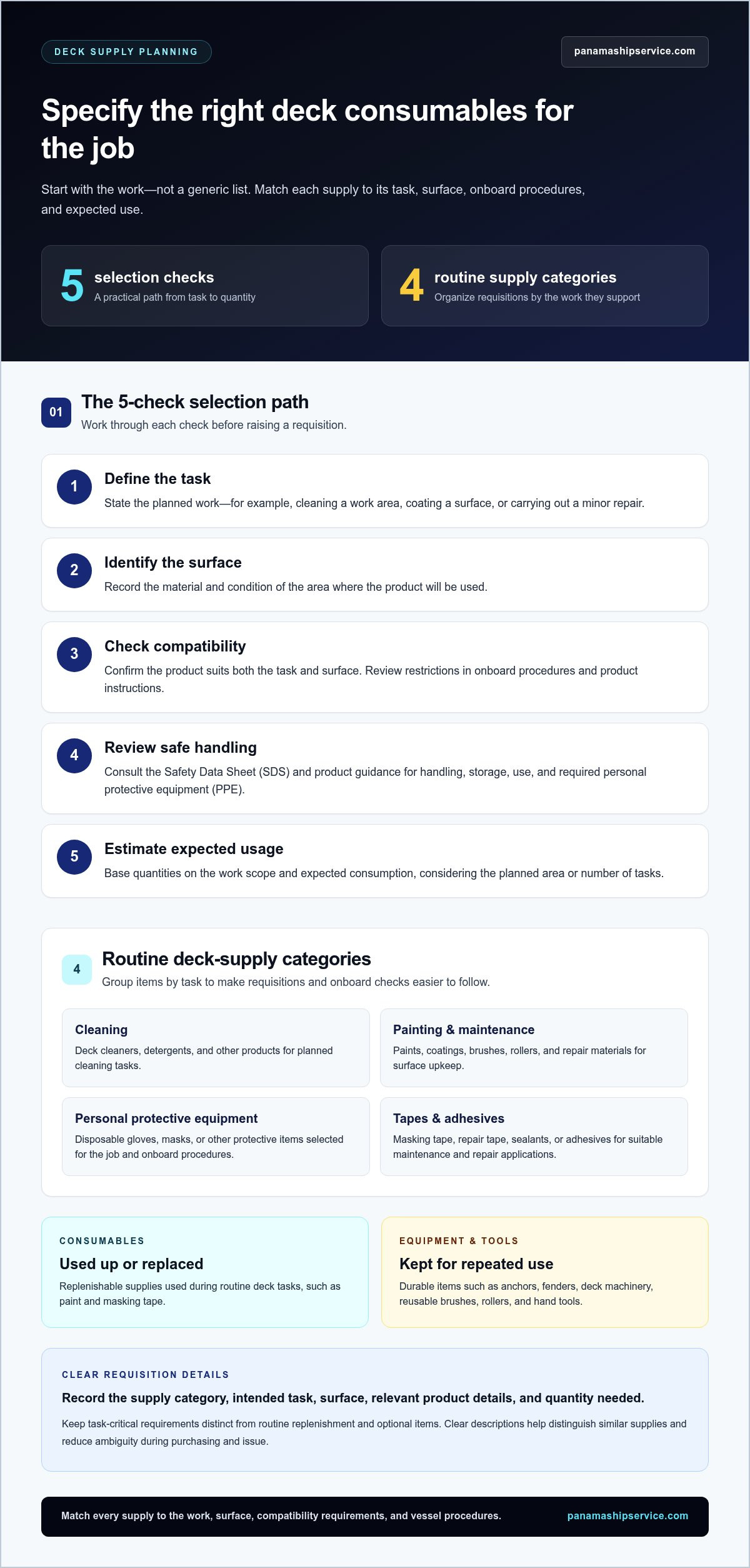
Organizing supplies by task makes requisitions and onboard checks easier to follow. Common marine-supply categories include:
- Cleaning: deck cleaners, detergents, and other products for planned cleaning tasks.
- Painting and maintenance: paints, coatings, brushes, rollers, and repair materials for surface upkeep.
- Personal protective equipment (PPE): disposable gloves, masks, or other protective items selected for the job and onboard procedures.
- Tapes and adhesives: masking tape, repair tape, sealants, or adhesives for suitable maintenance and repair applications.
These are categories, not a universal shopping list. A cleaner or coating suitable for one surface or task may not suit another. Match each item to the work, surface, compatibility requirements, safe-handling guidance, and the vessel’s procedures.
How are consumables different from deck equipment?
Consumables are replenished as they are used. Deck equipment and tools are generally kept for repeated use, subject to inspection, upkeep, and replacement when needed. Anchors, fenders, and deck machinery are durable operational equipment, not consumables. Reusable brushes, rollers, and hand tools also belong in equipment or tool records rather than routine-use supply counts.
Consumables are supplies used up or replaced during a task; equipment is the durable hardware or tool used to carry it out. A maintenance job may need both: paint and masking tape as consumables, plus a reusable brush, roller, or access equipment. Keeping the categories distinct helps operators track replenishment separately from equipment condition and maintenance.
How to Select Deck Consumables for Your Vessel and Task
Selecting supplies by category alone can lead to mismatches. Start with the job, then work through the surface, compatibility, safety, and quantity required. This five-step process helps crews specify deck consumables for the vessel’s actual work instead of relying on a generic list.
- Define the task. State what work is planned, such as cleaning a work area, coating a surface, or carrying out a minor repair.
- Identify the surface. Record the material and condition of the area where the product will be used.
- Check compatibility. Review whether the product suits the task and surface, including any restrictions in onboard procedures or product instructions.
- Review safety. Consult the Safety Data Sheet (SDS) and product guidance for handling, storage, use, and required PPE.
- Estimate usage. Base quantities on the work scope and expected consumption, taking into account the planned area or number of tasks.
Apply the same method across supply types. A cleaning product should suit the surface and cleaning task; a coating should match the intended maintenance work; PPE should reflect the job and vessel procedures; and repair consumables should be appropriate for their application. Vessel conditions and use matter, so do not assume one product or specification suits every ship.
What should the crew check before ordering?
Before raising a requisition, capture the job, work area, surface material, and expected operating conditions. Check the relevant onboard procedures alongside the product instructions and SDS. These documents help clarify use, handling, storage, and protective measures. Confirm compatibility restrictions and required PPE before procurement so the requested supply fits the task and the crew’s established work practices.
How can procurement avoid mismatched supplies?
Use consistent descriptions in requisitions and inventory records. Include the supply category, intended task, surface, relevant product details, and quantity needed. Clear descriptions help distinguish similar items and reduce ambiguity during purchasing and issue.
Separate task-critical requirements from routine replenishment and optional items. This makes priorities visible when schedules are tight and helps prevent essential supplies from being lost in a broad order. Keep records aligned with onboard terminology, and carry forward relevant details when the same task recurs.
For a Panama Canal call, clear task descriptions and coordinated requirements can simplify supply planning alongside other vessel needs. Coordinate ship supplies for your Panama Canal call with Panama Ship Service.
Deck Consumables Inventory: Control Usage and Prevent Shortages
A useful inventory does more than list what is onboard. It shows where supplies are kept, who is responsible for them, how quickly they are used, and which items are needed for planned work. Group deck consumables by work area and task, then record their storage location and responsible department. This makes routine checks more consistent and helps crews spot gaps before maintenance begins.
Keep a simple log for each item. Record opening stock, quantities issued, remaining quantities, and expected demand for upcoming work. Update it when supplies are received or used rather than relying on memory or occasional stocktakes. Set replenishment priorities according to operational importance and the maintenance schedule. Identify items needed for planned tasks separately from supplies that can be reordered as part of routine stock replacement.
Set reorder points around the vessel’s actual usage and available storage. A generic minimum can create unnecessary stock or fail to reflect a ship’s working pattern. Review consumption records alongside upcoming tasks, storage capacity, and the time needed to replenish through the vessel’s procurement process.
Which inventory fields make replenishment easier?
Use consistent records so crew members and procurement teams can identify the right item without interpreting shorthand. A practical entry includes:
- Item description and intended use: identify the supply and the task or work area it supports.
- Storage location and responsible department: show where to find it and who maintains the record.
- Unit and quantities: use a consistent unit, then log opening stock, issues, remaining stock, and expected demand.
- Reorder status: flag whether replenishment is needed, planned, or in progress.
- Documentation or handling notes: record where crews can find relevant product information and storage guidance.
Use the same item names in the inventory and requisitions. Consistent descriptions reduce duplicate entries and ambiguous requests, especially when different departments use different informal terms for the same supply.
How should crews reduce waste and storage risks?
Rotate supplies according to vessel procedures and the product’s storage instructions. Keep materials separated as required by onboard safety procedures, and make handling notes accessible where supplies are stored. These steps help crews manage stock without relying on assumptions about storage conditions or compatibility.
After maintenance periods, compare planned demand with actual issues. Review items that were used quickly, remained unused, or are repeatedly requested at short notice. Use those patterns to adjust future stock levels and replenishment priorities. Regular reviews keep inventory aligned with vessel operations instead of letting old estimates dictate what gets ordered.
Planning Deck Consumables Around a Panama Canal Port Call
A Panama Canal call can bring several vessel requirements into a concentrated operational window. Plan deck consumables alongside maintenance and other services early, then keep the request clear enough to update if the vessel schedule changes. A staged workflow helps the crew distinguish essential task supplies from routine restocking and gives those coordinating the request practical information to work with.
- Review planned work. Identify maintenance tasks, inspections, and other activities expected around the call. Note which require supplies and when they are needed.
- Prioritize the list. Separate items required for scheduled or safety-critical work from routine replenishment that can be managed separately.
- Prepare the requisition. Give each item a clear description, unit, quantity, intended application, and relevant specification or handling requirement.
- Share timing requirements. Pass vessel schedule and coordination details through normal operational channels, and flag changes that could affect the plan.
- Coordinate related needs. Align supply requirements with other planned vessel services to reduce fragmented communication during the call.
Make the request specific without assuming a universal product or quantity. For example, describe the surface or task a coating is intended for and state the quantity needed for the planned work. Keep priority items visibly separate from routine stock so changes to timing can be managed with a clear view of what matters most.
What information helps coordinate a vessel supply request?
Provide a concise requisition with item descriptions, units, quantities, and intended applications. Include relevant product requirements from vessel procedures or existing product documentation. Share the vessel’s timing and coordination needs through established operational channels, and identify which items support scheduled work versus routine restocking. Clear, consistent information helps reduce ambiguity as requirements move between the vessel and those coordinating supplies.
How can supply coordination reduce operational friction?
Consumables are easier to plan when they are considered alongside the work that creates demand. Aligning a supply request with planned maintenance, inspections, and other vessel services gives the team a consolidated view of requirements for the Panama Canal call. This can simplify coordination and support the aim of minimizing transit delays, without treating every request as a separate procurement task.
For additional planning guidance, read the Panama Canal ship supplies guide. Panama Ship Service provides ship supplies alongside repair, survey, underwater, and operational services at the Canal. Plan ship supplies alongside vessel services in Panama to organize requirements around your call.
Coordinate Deck Consumables and Vessel Services with Panama Ship Service
Effective supply planning follows a practical sequence: identify the task, specify what it requires, track onboard stock, and plan replenishment around the vessel’s schedule. This gives operators a clear basis for managing deck consumables and keeps supply requests connected to the work they support.
Panama Ship Service provides ship supplies alongside ship repair, marine survey, underwater, and other operational services at the Panama Canal. Bringing requirements into one operational plan can simplify coordination for a port call. The company’s one-stop service model is intended to help vessels consolidate requirements and minimize transit delays.
How does a coordinated supply approach help vessel operators?
A coordinated plan gives the vessel a single view of supply needs and related work. For example, if planned maintenance requires deck supplies and mechanical work, recording both requirements against the same call can help the team organize requests and timing together. Clear specifications and schedule updates are still essential, but a joined-up plan can reduce fragmented planning.
Where maintenance involves mechanical work, include Panama Ship Service’s mechanical ship repairs in the plan. Keep the supply request task-based, and avoid assuming every vessel needs the same items or quantities.
What are the next steps for planning deck supplies?
Prepare a concise list that separates routine replenishment from supplies tied to planned maintenance. For each requirement, record the task, item description, quantity, unit, relevant specification, and schedule considerations. This gives the vessel and its operations team a practical reference when coordinating supplies and other planned services around the call.
Keep the list current as work plans or vessel timing change. Clear priorities make it easier to distinguish items needed for scheduled tasks from routine stock requirements, while consistent descriptions help avoid confusion as requests are coordinated.
Panama Ship Service supports vessel operators with ship supplies and a broader range of services at the Panama Canal. Organize requirements in one plan to support simpler coordination and the company’s aim of minimizing transit delays. Coordinate vessel supplies with Panama Ship Service.
Make Deck Supply Planning Part of Every Port-Call Plan
A vessel-ready approach to deck consumables starts with the work planned, matches supplies to the task and onboard procedures, and keeps stock records current. Set replenishment priorities around actual usage, available storage, and upcoming maintenance rather than relying on a generic list.
For a Panama Canal call, clear requirements and timely coordination help connect supply needs with the vessel’s wider operational plan. Panama Ship Service provides ship supplies alongside technical and operational services for vessels at the Canal. Its one-stop approach is intended to help consolidate requirements, minimize expenses, and reduce transit delays.
Prepare task-based requests with quantities, relevant specifications, and schedule considerations. Then coordinate supply needs with other planned vessel services to keep procurement organized and support the call. Coordinate ship supplies and vessel services in Panama with Panama Ship Service, and move forward with a clearer plan for your vessel’s operational needs.
Frequently Asked Questions
What are deck consumables on a ship?
On a ship, deck consumables are supplies used, replaced, or depleted during routine deck work. Examples include cleaning products, paint and maintenance materials, personal protective equipment, tapes, and adhesives. They differ from durable items such as anchors, fenders, and deck machinery, which are kept for repeated use. The supplies required depend on the vessel, the task, its surfaces, and onboard procedures.
Which consumables should a ship keep in its deck stores?
Deck stores should reflect the vessel’s planned work, routine usage, storage capacity, and onboard procedures. Common categories include cleaning supplies, painting and maintenance materials, task-appropriate PPE, and tapes or adhesives. Use a vessel-specific checklist rather than assuming every ship needs the same items. Review stock against upcoming maintenance, and record descriptions, locations, quantities, and replenishment status so the crew can identify gaps.
How do I choose the right deck cleaning products for a vessel?
Choose a cleaning product based on the job, the surface, and the vessel’s procedures. Identify the material and condition of the area, then review the product instructions and Safety Data Sheet for use, handling, storage, and protective measures. Check compatibility restrictions and applicable onboard requirements before ordering. Do not assume a product suitable for one deck surface or cleaning task will suit another.
How can a vessel prevent deck consumable shortages?
Prevent shortages by maintaining a simple stock log and reviewing it against planned work. Record opening stock, quantities issued, remaining quantities, and expected demand. Set replenishment priorities around operational importance and upcoming maintenance rather than using generic stock thresholds. Let vessel usage and available storage guide reorder levels. Regularly compare expected and actual consumption so recurring demand or last-minute gaps can inform the next requisition.
What information should be included in a ship supply requisition?
A clear ship supply requisition should include each item’s description, unit, quantity, intended task, and relevant specifications. Add handling or product-documentation notes where they help identify the correct supply. Include vessel timing and coordination requirements through the usual operational channels. Separate items required for planned maintenance from routine restocking, and use consistent descriptions across requisitions and inventory records to reduce ambiguity and duplicate requests.
Can deck consumables be coordinated with other services during a Panama Canal call?
Yes. Vessel operators can plan ship-supply requirements alongside other vessel needs for a Panama Canal call. Panama Ship Service provides ship supplies as well as technical and operational services, including ship repairs, marine surveys, and underwater services. Bringing requirements together in one operational plan can simplify coordination. The company’s one-stop service approach aims to consolidate vessel requirements, minimize expenses, and reduce transit delays.
Are deck consumables the same as residential decking supplies?
No. Shipboard deck consumables are supplies used or depleted during vessel operations and maintenance, such as marine cleaning products, coatings, PPE, tapes, and adhesives. Residential decking supplies are materials or accessories for building, repairing, or furnishing outdoor decks at homes. The word “deck” can refer to different settings, so vessel operators should specify shipboard tasks, surfaces, and requirements when preparing a supply list.