
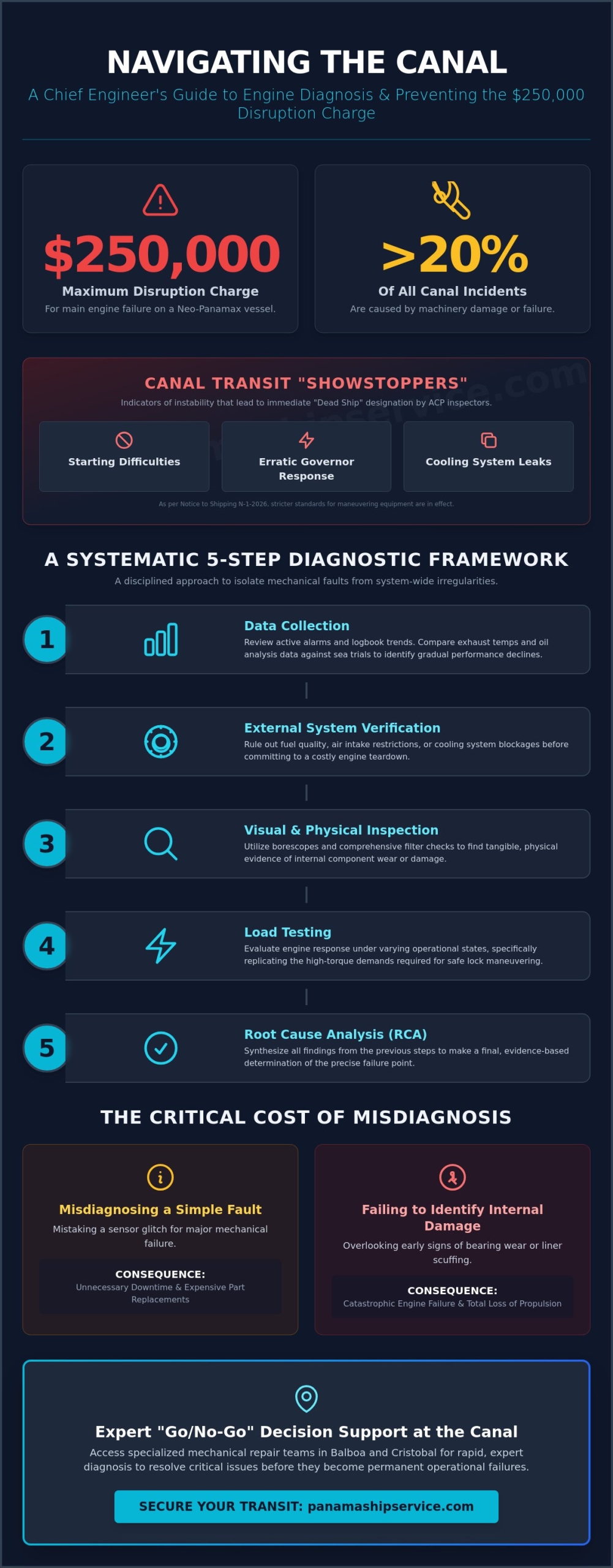
A single machinery deficiency can trigger a Panama Canal disruption charge as high as $250,000. For any technical superintendent or chief engineer, the pressure to maintain propulsion before entering the locks is immense. Machinery failure remains the third most common cause of incidents in the Canal, accounting for over 20% of all reported issues. You likely feel the anxiety of distinguishing between a minor sensor glitch and catastrophic internal damage that could lead to a total loss of propulsion. Implementing a rigorous ship engine failure diagnosis is the only way to protect your schedule and your vessel’s safety.
We understand that missing a transit window isn’t just a delay; it’s a massive financial blow. This guide provides a systematic approach to engine diagnostics to help you identify root causes quickly. You’ll learn how to make a clear go/no-go decision for your transit while adhering to the latest Notice to Shipping N-1-2026 requirements. We will also explore how to access specialized mechanical repair teams in Balboa and Cristobal to resolve critical issues before they become permanent operational failures.
Key Takeaways
- Master a forensic, five-step framework to distinguish between simple system limitations and critical internal damage.
- Implement a rigorous ship engine failure diagnosis to avoid the $250,000 disruption charges levied by the Panama Canal Authority.
- Identify external system issues like fuel restrictions that often mimic expensive piston ring wear or liner scuffing.
- Recognize early warning signs of main bearing and crankpin failures before they escalate into catastrophic engine room incidents.
- Access specialized mechanical repair teams in Balboa and Cristobal for rapid, expert “go/no-go” decision support.
The Critical Role of Ship Engine Failure Diagnosis in Panama
Ship engine failure diagnosis is the technical evaluation of performance data to prevent component destruction. In the high-stakes environment of the Panama Canal, this process is less about routine maintenance and more about forensic precision. For a vessel at the Pacific or Atlantic entrance, the engine room is no longer a private workspace; it’s a critical factor in a complex global logistics chain. The Panama Canal Authority (ACP) views any mechanical irregularity as a potential threat to the waterway’s operational flow. Without a systematic diagnosis, a minor performance lag can quickly escalate into a denied transit.
The Canal serves as the ultimate checkpoint for engine health. Statistics show that machinery damage or failure accounts for over 20% of all incidents in the Panama Canal. With an average of nine major shipping incidents per year, the ACP has intensified its scrutiny of marine propulsion systems. A vessel that cannot guarantee reliable maneuvering is a liability the Authority will not accept. This makes professional ship engine failure diagnosis an essential step for any Chief Engineer before confirming “Canal-ready” status.
The “Showstopper” Conditions for Canal Transit
ACP inspectors look for specific indicators of instability that lead to failed inspections. If your main engine exhibits starting difficulties, erratic governor response, or cooling system leaks, you risk an immediate “dead ship” designation. Safe passage through the locks requires absolute control over propulsion. Early diagnosis at the Balboa or Cristobal anchorages prevents these issues from manifesting during the transit itself. Notice to Shipping N-1-2026 outlines stricter standards for maneuvering equipment, meaning that equipment which passed in 2025 might face rejection today without verified diagnostic proof of its reliability.
Economic Impact of Misdiagnosis
The financial stakes of a technical error in Panama are staggering. Since January 1, 2023, the ACP has levied disruption charges for vessels with deficiencies that cause delays. For a main engine failure, these charges can range from $125,000 to $250,000 for Neo-Panamax vessels. Misdiagnosing a simple sensor fault as a major mechanical failure leads to unnecessary downtime and expensive part replacements. Conversely, failing to identify internal damage can lead to a catastrophic engine room fire or total loss of propulsion mid-transit. Utilizing professional mechanical ship repairs and surveys at the canal entrances ensures you aren’t guessing with your budget or your schedule. Decisions made at the anchorage determine whether you proceed or face a multi-day delay that disrupts your entire chartering agreement.
A 5-Step Systematic Framework for Marine Engine Diagnostics
A disciplined approach to ship engine failure diagnosis prevents the panic often associated with looming transit deadlines. It’s not enough to react to a single alarm; you must understand the narrative the engine is telling through its historical and real-time data. This 5-step framework provides the professional structure needed to isolate mechanical faults from broader system-wide irregularities.
- Step 1: Data Collection. Review all active alarms and logbook trends to identify gradual performance declines over the last several voyages.
- Step 2: External System Verification. Rule out fuel quality issues, air intake restrictions, or cooling system blockages before committing to an engine teardown.
- Step 3: Visual and Physical Inspection. Utilize borescopes and filter checks to find tangible evidence of internal component wear.
- Step 4: Load Testing. Evaluate engine response under the varying operational states and high-torque demands required for lock maneuvering.
- Step 5: Root Cause Analysis (RCA). Synthesize all findings to make a final, evidence-based determination of the failure point.
Analyzing Performance Trends and Alarms
Exhaust gas temperatures provide the most immediate feedback on combustion health. You should compare current readings against baseline sea trial data to identify subtle deviations. Sudden spikes in scavenge air temperature or pressure often indicate air cooler fouling or turbocharger inefficiency. Regular lubrication oil analysis is equally vital in this diagnostic phase. It serves as an early warning system, detecting trace metals that suggest premature bearing wear long before a total seizure occurs. Monitoring these trends allows you to catch issues while they’re still manageable system limitations rather than catastrophic failures.
Visual Inspection Techniques for Chief Engineers
Borescope inspections offer a non-destructive way to evaluate cylinder liners and piston crowns. Vertical scuffing or ring breakage can be identified quickly, providing the data needed for a clear go/no-go decision. You should also check the main lube oil filters for non-ferrous metal particles; this is a critical step in professional ship engine failure diagnosis. Inspect the turbocharger for signs of surging or excessive carbon buildup on the turbine blades, which can impact maneuvering power. If these inspections reveal critical wear, arranging for marine surveys or mechanical support in Balboa or Cristobal is a strategic necessity to ensure your vessel remains Canal-ready. Physical evidence ensures your repair strategy is based on facts, not assumptions.
Load testing is the final practical hurdle. It verifies if the propulsion system can handle the rapid load changes and high-torque demands of the Panama Canal’s locks. A successful test confirms that previous diagnostic steps were accurate and that the engine is fit for service. The process concludes with the Root Cause Analysis, which prevents the same failure from recurring. This systematic logic ensures you don’t waste resources on unnecessary repairs while the clock is ticking toward your scheduled transit window.
Differentiating Internal Mechanical Failure from System Limitations
Misidentifying a system limitation as a major mechanical failure is a costly error that often leads to unnecessary overhauls. While an engine might exhibit symptoms like high exhaust temperatures or reduced RPM, these aren’t always indicators of internal component destruction. Professional ship engine failure diagnosis requires a clear distinction between a component that is physically broken and one that is merely restricted by external factors. Failing to make this distinction before reaching the Panama Canal locks can result in thousands of dollars in wasted labor and parts.
System limitations are often “fake” failures that mimic serious damage. For example, cooling system scaling can cause localized overheating that looks like a cracked cylinder head. Similarly, fuel system restrictions often produce the same power loss symptoms as worn piston rings. Without a forensic approach, you might commit to a multi-day engine teardown when a simple chemical cleaning or filter replacement was all that was required to restore performance.
Fuel and Airflow: The Great Impostors
Fuel and air issues are the most common sources of diagnostic confusion. A fuel pump timing issue often presents as low compression, leading crews to suspect liner wear. Likewise, turbocharger efficiency loss can be mistaken for fuel injector failure. Both issues cause high exhaust gas temperatures and black smoke, yet the solutions are vastly different. It’s also vital to consider the state of the vessel’s hull. Increased drag from marine growth can force the engine into a high-torque, low-RPM state that looks like engine degradation. Before concluding that the main engine is failing, you should rule out drag by utilizing underwater hull services to verify the propeller and hull are clean.
The “Stop-Running” vs. “Slow-Steam” Decision
The most critical decision for a Chief Engineer is whether to shut down immediately or proceed at reduced power. This choice depends entirely on the diagnostic findings. You must stop the engine immediately if you detect metal particles in the lube oil or hear unusual knocking, as these suggest imminent crankshaft or bearing failure. Continuing to run in these conditions will lead to catastrophic destruction. However, if the ship engine failure diagnosis points to a system limitation like a fouled air cooler, it’s often safe to proceed with “slow-steaming.” This allows the vessel to reach a safe anchorage in Balboa or Cristobal where professional mechanical ship repairs can be performed under controlled conditions. Use the following framework to guide your decision:
- Internal Failure (Shutdown Required): High crankcase pressure, metal in filters, sudden erratic vibration, or localized high bearing temperatures.
- System Limitation (Proceed with Caution): High exhaust temperatures across all cylinders, gradual loss of turbocharger RPM, or uniform cooling water temperature increases.
Making the right call prevents minor faults from escalating into total loss-of-propulsion incidents during your transit window. By isolating the root cause, you protect the vessel’s mechanical integrity while minimizing the risk of ACP disruption charges.
Common Marine Engine Failure Modes and Their Indicators
Professional ship engine failure diagnosis relies on recognizing specific mechanical signatures before they lead to catastrophic damage. While system limitations are often external and reversible, failure modes are internal and inherently destructive. Identifying these early is the difference between a minor scheduled repair and a total engine replacement that could strand your vessel for weeks. You must be able to read the physical evidence your machinery provides during every watch.
Several common failure modes frequently impact vessels approaching the Panama Canal. Cylinder liner scuffing and piston ring breakage are particularly dangerous; they often manifest as a sharp rise in cylinder liner temperatures and increased crankcase pressure. Main bearing and crankpin bearing failures are even more urgent. Warning signs include sudden temperature fluctuations in the lube oil return or the presence of non-ferrous metal in the filters. Exhaust valve burn-through is another critical mode that disrupts combustion balance. This imbalance often leads to turbocharger surging and potential mechanical seal failure as the system struggles to manage uneven exhaust pulses.
Combustion and Exhaust Irregularities
Interpreting smoke colors is a fundamental diagnostic skill for any Chief Engineer. White smoke usually indicates water in the combustion chamber or unburnt fuel due to low compression temperatures. Blue smoke points to lubrication oil burning, which suggests worn liners or valve guides. Black smoke is the most common indicator of an overloaded engine, fouled injectors, or air shortages. Knocking sounds further refine your ship engine failure diagnosis. Sharp, metallic knocks often relate to fuel timing issues, while deeper, rhythmic thuds suggest excessive bearing play. You can use infrared thermography to detect hot spots on the engine block, revealing localized cooling failures before your sensors even trigger an alarm.
Lubrication and Cooling System Failures
A sudden drop in oil pressure requires immediate investigation to prevent a total seizure. You must determine if the issue is a simple pump failure or a more serious increase in bearing clearances that allows oil to escape too quickly. Coolant contamination in the oil is another major red flag. It typically identifies a failed liner O-ring or a leaking oil cooler. For more on specialized fixes, see our mechanical ship repairs guide.
If your diagnosis reveals any of these failure modes, you need rapid, expert intervention to secure your transit window. Don’t risk a “dead ship” designation by the ACP. Contact us today for professional mechanical ship repairs to restore your vessel’s operational integrity and ensure a safe, efficient transit.
Professional Diagnosis and Repair at the Panama Canal
Panama serves as the most strategic hub for emergency mechanical intervention in the Western Hemisphere. When a vessel arrives with technical irregularities, the priority shifts from transit planning to immediate resolution. The logistical infrastructure at both Balboa and Cristobal allows for a seamless transition from identification to execution. Specialized mobile repair teams are organized to handle the high-pressure environment of the Canal, where downtime is measured in thousands of dollars per hour. These teams board at the anchorage, allowing diagnostic work to begin without the delays of port berthing.
The advantage of localized expertise is critical for maintaining your schedule. Sourcing marine spare parts during a transit window is often the bottleneck in any repair timeline. Because Panama acts as a global crossroads, the availability of technical components is significantly higher than at other regional ports. By centralizing your ship engine failure diagnosis and subsequent repair efforts in this hub, you eliminate the need for multiple service providers and reduce the risk of logistical miscommunication that can lead to missed transit slots.
Consolidating Services to Minimize Delay
Efficiency in the engine room requires a coordinated approach. Consolidating your technical needs by combining engine diagnosis with marine surveys in Panama ensures that all findings are documented for both Class approval and ACP inspectors. This integrated strategy prevents the redundancy of separate inspections. We coordinate mechanical work with underwater hull services to maximize your time at the anchorage, ensuring the vessel is fully compliant with all maneuvering and environmental regulations before the pilot boards for the transit.
Every repair performed must meet rigorous ACP standards to avoid the disruption charges mentioned in previous sections. By utilizing a single partner to manage the diagnosis-to-repair pipeline, you gain a clear “go/no-go” decision backed by technical evidence. This level of organization is what separates a successful transit from a costly technical delay. We ensure that all mechanical ship repairs are executed with the precision required for the tight tolerances of the Canal locks.
Requesting Emergency Diagnostic Support
Speed is the most valuable asset when propulsion is compromised. When reporting an engine issue, you should provide detailed performance logs, active alarm lists, and recent lube oil analysis reports. This data allows our specialized mechanical teams to prepare the necessary tools and spare parts before they board your vessel at the anchorage. Our teams are equipped to handle the most complex ship engine failure diagnosis tasks, from fuel system calibration to bearing inspections and turbocharger overhauls.
Don’t wait for a minor irregularity to become a transit-stopping failure that triggers a $250,000 disruption fee. Contact Panama Ship Service for immediate mechanical diagnosis and repair support. Delegating these complexities to a seasoned local partner allows your crew to focus on safe operations while we handle the technical restoration of your propulsion systems.
Securing Your Transit with Technical Precision
Mastering a systematic approach to ship engine failure diagnosis is the most effective way to protect your vessel from the extreme costs of a failed Panama Canal transit. By differentiating between simple system limitations and critical internal damage, you ensure every repair decision is based on technical evidence rather than operational guesswork. This forensic clarity allows your crew to maintain propulsion reliability while meeting the rigorous standards of the Panama Canal Authority. Using a structured framework to identify root causes prevents minor irregularities from escalating into catastrophic engine room incidents during lock maneuvering.
Panama Ship Service operates as a comprehensive one-stop-shop for technical and operational maritime solutions. With strategic locations in both Balboa and Cristobal, our experienced specialized mechanical repair teams are positioned to provide rapid intervention at any anchorage. We bridge the gap between initial diagnosis and final Class-approved repair, ensuring your vessel returns to service with minimal downtime. Contact our 24/7 mechanical repair team for expert engine diagnosis in Panama and secure your schedule today. We look forward to ensuring your next transit is safe, efficient, and technically sound.
Frequently Asked Questions
What are the first signs of major marine diesel engine failure?
Sudden fluctuations in exhaust gas temperatures, increased crankcase pressure, or erratic vibrations are primary indicators of a developing failure. You should also monitor for metallic knocking sounds and the presence of non-ferrous particles in the lube oil filters. These signs suggest that internal components are no longer operating within their design tolerances and require immediate investigation.
Can a ship transit the Panama Canal with a known engine irregularity?
No, the Panama Canal Authority (ACP) requires all vessels to have fully operational propulsion and maneuvering systems before beginning a transit. Any known deficiency must be reported to the ACP in advance. Failure to disclose issues can result in significant disruption charges, which have reached $250,000 for Neo-Panamax vessels that cause delays in the waterway.
How long does a professional engine failure diagnosis typically take?
A preliminary ship engine failure diagnosis often takes between four to eight hours depending on the accessibility of the machinery. This timeframe allows specialized teams to review performance logs, perform visual inspections, and conduct basic system checks at the anchorage. Complex internal investigations requiring borescope work or component removal may extend this diagnostic period further.
What is the difference between an engine alarm and a critical failure?
An engine alarm is a warning that a specific parameter has exceeded its threshold, while a critical failure is an actual mechanical breakdown. Many alarms indicate system limitations, such as a fouled air cooler or a clogged filter, which are reversible. A critical failure involves permanent damage, like a broken piston ring or a seized bearing, that prevents safe operation.
Does Panama Ship Service provide 24/7 emergency mechanical support?
You should check with our operations team for current availability and scheduling in the ports of Balboa or Cristobal. Our specialized mechanical repair teams are designed to be proactive and responsive to the high-stakes needs of the shipping industry. We focus on providing rapid identification of root causes to help you maintain your scheduled transit window without unnecessary complication.
How can I distinguish between a fuel system issue and internal engine damage?
Fuel system issues typically affect all cylinders uniformly, whereas internal damage is often localized to a specific unit. Analyzing exhaust gas temperature deviations between individual cylinders is a key part of a professional ship engine failure diagnosis. If temperatures are high across the entire engine block, the issue is likely fuel quality or air intake rather than mechanical wear.
What spare parts should be kept on board to assist in rapid diagnosis?
Maintaining a stock of fuel injectors, exhaust valve assemblies, and sensor kits is essential for effective troubleshooting. Having these parts readily available allows your crew to perform swap tests to rule out specific component failures quickly. This inventory reduces the time spent waiting for deliveries in Balboa or Cristobal during a high-pressure emergency situation.
Are borescope inspections required for all engine failure diagnoses?
Borescope inspections aren’t mandatory for every case, but they’re the most effective non-destructive method for evaluating internal cylinder health. They provide visual confirmation of liner scuffing or piston crown damage without the need for a full cylinder head removal. This tool is invaluable when you need a fast go/no-go decision for a scheduled Panama Canal transit.