
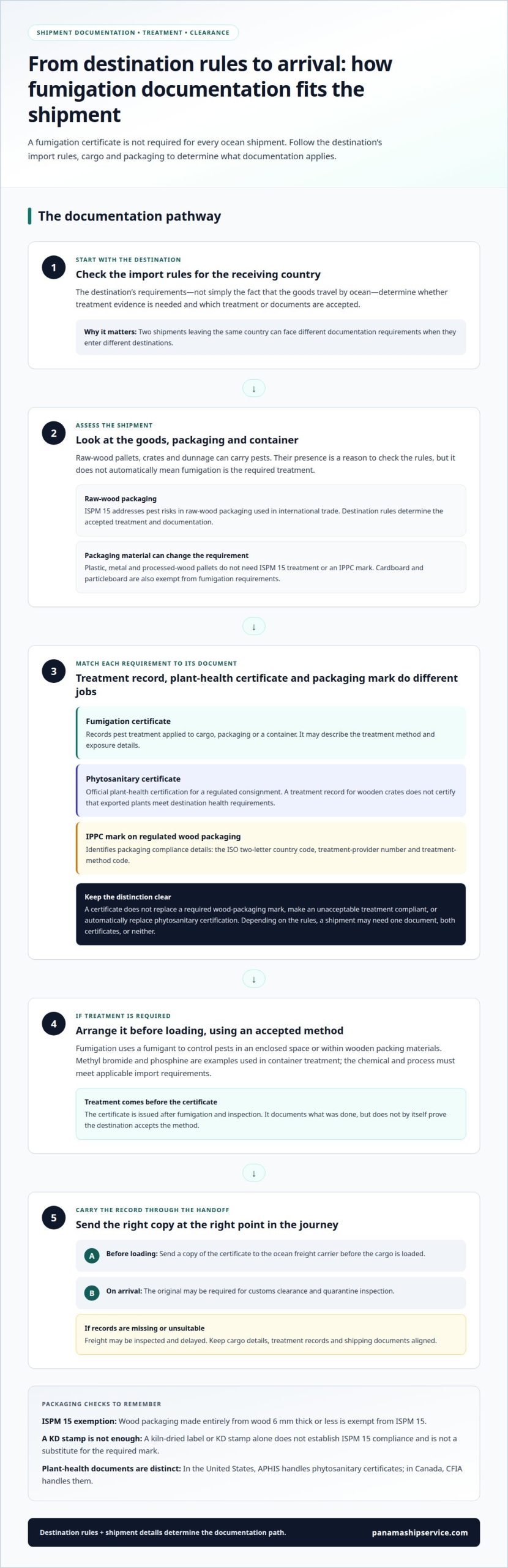
A fumigation certificate isn’t required for every international ocean shipment. Whether one is needed depends on the destination country’s import rules and the cargo, packaging, or container. Ship fumigation certificate requirements may call for proof of treatment, but a certificate doesn’t replace required wood-packaging marks or make an unacceptable treatment compliant.
If your shipment includes wooden pallets, crates, or dunnage, biosecurity requirements may affect its documentation and clearance. It’s also easy to confuse a fumigation certificate with a phytosanitary certificate: one records pest treatment, while the other is official plant-health certification for regulated consignments. Some shipments may need both.
This guide explains when a fumigation certificate may be required, how destination rules shape the requirement, and what information the certificate may contain, including the treatment method and exposure details. You’ll also learn how certification differs from wood-packaging marks, so you can see what each document demonstrates and why complete treatment records matter to a shipment’s progress.
Key Takeaways
- Determine whether treatment documentation applies by considering the destination’s import rules and the shipment’s cargo and packaging.
- Understand why a fumigation certificate and a phytosanitary certificate serve different purposes, and why some consignments need both.
- Learn how wood-packaging marks relate to treatment records, and why one document cannot substitute for the other.
- See which treatment and cargo details may appear on a fumigation certificate, helping clarify what the document records.
Fumigation certificate versus phytosanitary certificate
A fumigation certificate records pest treatment applied to cargo, packaging, or a container. A phytosanitary certificate serves a different purpose: it is official plant-health certification for a regulated consignment, issued through the relevant national plant protection organization. For example, a treatment record for wooden crates does not certify that exported plants meet the destination country’s health requirements.
The documents can apply to the same shipment. A consignment of agricultural goods packed in wooden crates may need phytosanitary certification for the goods and treatment evidence for the packaging, depending on destination import rules. Ship fumigation certificate requirements therefore depend on what is shipped, how it is packed, and the destination’s rules. Customs clearance may require one document, both, or neither.
For U.S.-origin cargo, no single fumigation certificate rule applies to every ocean shipment. Destination import requirements determine whether treatment evidence is needed. ISPM 15 addresses pest risks in raw-wood packaging used in international trade, including treatment and marking requirements. It does not make a fumigation certificate interchangeable with a phytosanitary certificate.
For plant-health certification, the USDA Animal and Plant Health Inspection Service (APHIS) handles U.S. phytosanitary certificates, while the Canadian Food Inspection Agency (CFIA) handles them in Canada. Lumber exports may use heat treatment to obtain phytosanitary certification through APHIS or CFIA. This certification concerns regulated plant products, not simply whether a container or crate was fumigated.
U.S. fumigation and certification costs vary with the goods, treatment volume, chemicals used, and local rules. Charges may include the fumigation service and certificate documentation. The treatment method and amount of cargo affect the cost.
The usual sequence is to arrange treatment before container loading, complete fumigation, and obtain a certificate describing the treatment. Send a copy to the ocean freight carrier before the cargo is loaded; the original may be required for customs clearance and quarantine inspection on arrival. Port submission procedures depend on the destination and its import documentation requirements.
Keep the distinction clear: treatment records document pest control, while phytosanitary certification addresses plant health. Neither document automatically replaces the other or a required wood-packaging mark.
When might a fumigation certificate be required?
A fumigation certificate records treatment performed on cargo, packaging, or a shipping container to control pests. It is issued after fumigation and inspection, documenting that treatment took place. For international shipping, the trigger is usually the destination country’s import rules, not the fact that goods travel by ocean. A certificate isn’t required for every international ocean shipment.
Wood packaging is a common reason to assess the requirement. Pallets, crates, and dunnage made from raw wood can carry pests, so destination authorities may require treatment evidence or compliant packaging. ISPM 15 addresses pest risks in raw-wood packaging used in international trade. However, wood packaging does not automatically mean that fumigation is the required treatment. Destination rules determine the accepted treatment and documentation.
Fumigation uses a fumigant to control pests in an enclosed space or within wooden packing materials. Methyl bromide and phosphine are examples of fumigants used in container treatment; the chemical and process must meet applicable import requirements. A treatment certificate documents what was done. It does not, by itself, establish that the destination accepts the method or that separate packaging marks are unnecessary.
U.S. port or state requirements are not a blanket rule for every vessel or cargo. The need for an import certificate depends on the destination country’s rules and the shipment’s cargo and packaging. For example, two shipments leaving the United States may face different documentation requirements if they enter different countries.
In practice, exporters arrange required fumigation before loading and send the resulting certificate with the shipping documents. The ocean freight carrier may need a copy before loading, while customs or quarantine officials may require the original on arrival. Missing or unsuitable treatment records can lead to inspection and delays. Keeping cargo details, treatment records, and shipping documents aligned helps support an orderly handoff through the shipment process, and companies managing international import or export documentation can find trade compliance support through global-4pl.com.
Biosecurity and pest prevention
Raw wood packaging can carry insects between trading partners. ISPM 15 addresses this pest risk in international trade. A fumigation certificate documents that cargo, its packaging, or its container received fumigant treatment to kill pests. It provides a treatment record, but it cannot replace a required wood-packaging mark or make an unacceptable treatment acceptable.
For regulated wood packaging, the IPPC mark identifies its compliance details. It includes the ISO two-letter country code, a treatment-provider number, and a treatment-method code. Packaging made entirely from wood 6 mm thick or less is exempt from ISPM 15. The mark and certificate serve different functions: one identifies compliant packaging, while the other records fumigation.
Material also matters. Plastic, metal, and processed-wood pallets don’t need ISPM 15 treatment or the IPPC mark. Cardboard and particleboard are also exempt from fumigation requirements. A kiln-dried label or KD stamp alone doesn’t establish ISPM 15 compliance, so it shouldn’t be treated as a substitute for the required mark.
Destination authorities may hold freight arriving without required treatment. They may order treatment on arrival, re-export, or destruction. Those outcomes can disrupt cargo movement and create additional handling demands. A complete document helps establish what treatment took place, but authorities assess compliance against their import rules and packaging requirements.
Biosecurity checks can also involve more than one measure. ISPM 15 recognizes conventional heat treatment, dielectric heat treatment, methyl bromide fumigation, and sulfuryl fluoride fumigation. The applicable method depends on the destination’s rules. Separate seasonal pest measures, such as Brown Marmorated Stink Bug controls, are not interchangeable with wood-packaging compliance. Keeping freight records and treatment documents aligned helps distinguish these checks during inspection.
Details included in fumigation certification
A fumigation certificate records the treatment applied to a shipment, its container, or its wooden packing. Its details help connect the treatment record to the cargo and destination regulations.
Required Documents and Inspections
The certificate is the treatment document issued after successful fumigation and inspection. It may identify the goods and container, fumigant, dose, exposure time, temperature, and treatment date. These details show what was treated and how, rather than simply stating that treatment occurred. The certificate should match the shipment and container described in the export paperwork.
For ocean freight, a copy of the official treatment certificate must reach the carrier before cargo is loaded, and the original may be required for customs clearance and quarantine inspection on arrival. Document requirements depend on the destination’s import rules. A treatment record cannot replace a required wood-packaging mark.
Certificate Validity and Renewal
A fumigation certificate records a specific treatment date and shipment; it isn’t a general certificate for future cargo. There is no single validity period for every destination in the available requirements. The destination’s rules determine whether the recorded treatment remains acceptable for the shipment’s import timeframe.
A new certificate follows a new fumigation and inspection, rather than a calendar-based renewal. For Australian imports with a treatment timeframe in BICON, documentation requirements can include treatment-specific statements. From 2 August 2021, methyl bromide certificates must confirm requirements in Appendix 3 of its Fumigation Methodology; sulfuryl fluoride certificates must confirm those in Appendix 2a of its Fumigation Methodology.
Australian policy also uses one statement for methyl bromide and sulfuryl fluoride certificates, regardless of treatment provider. The certificate should identify the fumigation target and document applicable plastic wrapping, impervious surface, and timber-thickness requirements at the time of treatment. These details connect the treatment evidence to the export shipment and its wooden packing.
Keep the certificate, container details, and export records aligned as you prepare a shipment handoff.
Panama Ship Service
Panama Ship Service supports vessel operations at the Panama Canal while you manage cargo documentation and destination requirements. Its services include Mechanical Ship Repairs, Underwater Hull Services, MARPOL Disposal, and Marine Surveys. These operational services can help address separate vessel needs during a port call, but they don’t replace fumigation treatment or certification.
Turn to Panama Ship Service when your vessel needs technical or operational support alongside shipment planning. Organizing vessel requirements alongside cargo and certificate documentation can help your team coordinate work around transit needs.
Contact Panama Ship Service to discuss support for your vessel’s operational requirements.
Plan the next vessel-side steps
Use the documentation process to organize vessel-side priorities as well. Fumigation records address cargo treatment, while separate operational needs may still require attention during a port call. Keeping these workstreams distinct helps prevent cargo paperwork from being mistaken for a solution to vessel maintenance or other operational requirements.
Panama Ship Service offers Mechanical Ship Repairs, Underwater Hull Services, and MARPOL Disposal for vessel operations. These services address needs separate from fumigation certification. Ship fumigation certificate requirements remain tied to the shipment’s cargo, treatment, and destination rules; vessel support is a different part of the operational picture.
As you plan the next stage of your vessel’s operations, identify which requirements concern cargo documentation and which call for technical or operational support. For the latter, contact Panama Ship Service to discuss your vessel’s needs. A clear separation between these workstreams gives your team a practical way to move forward with confidence.
Frequently Asked Questions
What is fumigation?
Fumigation uses pesticide gas in an enclosed space to control pests in cargo, containers, or wood packaging. Methyl bromide and phosphine are examples of fumigants used for treatment. Because fumigants can be hazardous, treatment areas are ventilated before goods continue in transit. For each shipment, the treatment method must suit the cargo and the destination’s import requirements.
What if you arrange treatment yourself?
You can arrange required treatment before loading, but the certificate must document the treatment actually performed. Coordinate shipment details, treatment timing, and document delivery with the fumigation provider and freight carrier. For example, a certificate that identifies a different container from the one loaded can complicate cargo processing. When required for the shipment, the carrier needs its certificate copy before loading.
What happens if a shipment arrives without required treatment?
Destination authorities may hold the shipment and order treatment, re-export, or destruction if required treatment is missing. For example, untreated regulated wooden packaging can trigger additional action even when the goods themselves are unaffected. Missing paperwork can also delay inspection and clearance while authorities assess compliance. The specific response depends on the destination’s import rules and the shipment’s packaging and treatment status.
What is a ship fumigation certificate, and what information must it include?
A ship fumigation certificate documents pest treatment associated with cargo, packaging, or a container. It may identify the goods and container, fumigant, dose, exposure time, temperature, and treatment date. These details tie the record to a particular treatment event, rather than making it a general clearance document. For wooden packaging, the certificate does not replace a required IPPC mark.
Which authorities or accredited fumigators can issue a valid ship fumigation certificate?
A fumigation provider issues the treatment certificate after fumigation and inspection; qualified fumigation professionals perform the work. The destination’s import rules determine what treatment evidence it accepts. Phytosanitary certificates are different: the relevant national plant protection organization issues them for regulated plant consignments. In the United States, USDA APHIS handles phytosanitary certification, not the fumigation treatment record itself.
When is a fumigation certificate required for a vessel entering a U.S. port?
There is no blanket requirement for every vessel entering a U.S. port to carry a fumigation certificate. The relevant question is whether the cargo, its packaging, or the container requires treatment under applicable import rules. A vessel carrying regulated goods or raw-wood packaging may face different documentation needs from one carrying plastic pallets. Separate requirements may apply to the goods and their packaging.