
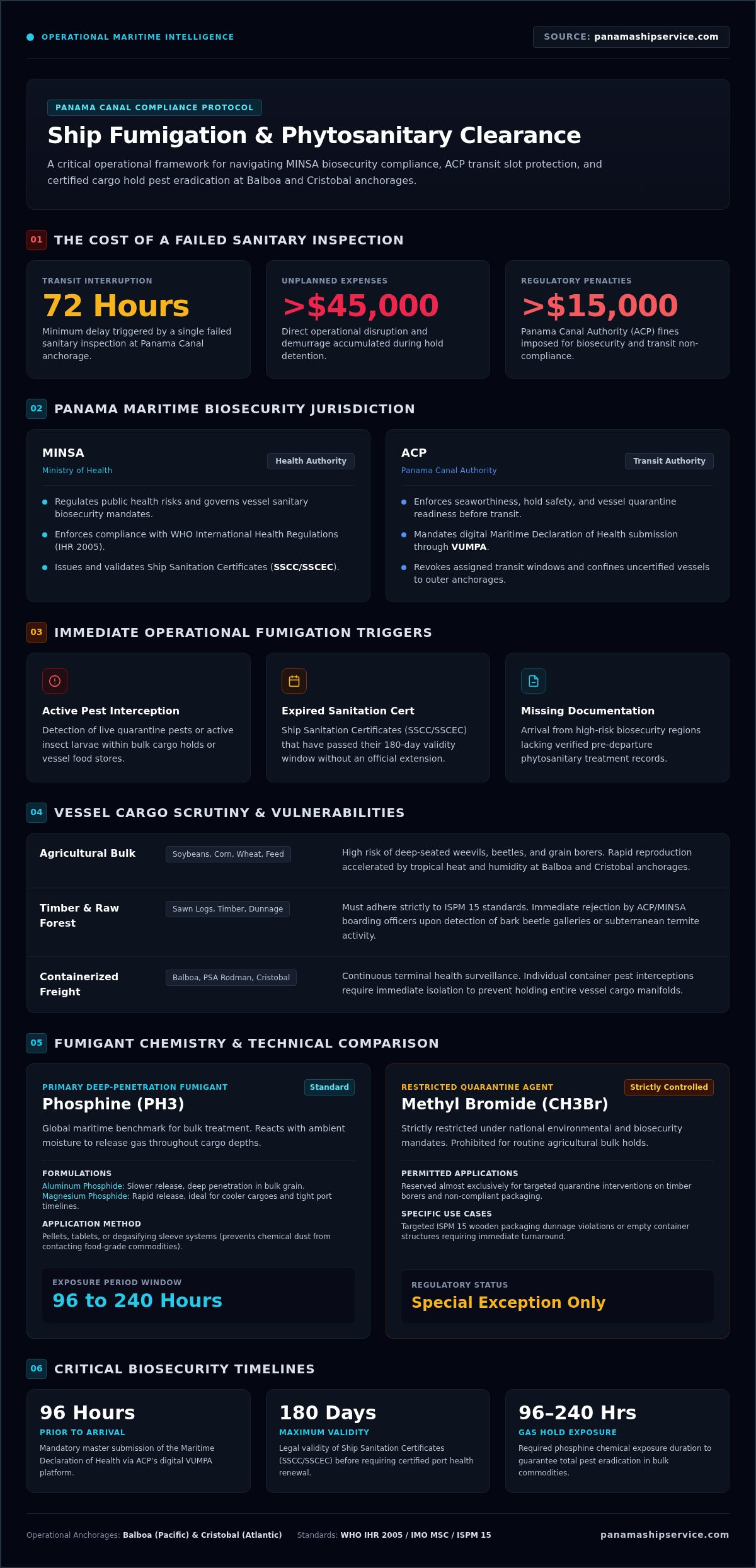
A single failed sanitary inspection at the Panama Canal can trigger a 72-hour delay and over $45,000 in unplanned operational costs. When agricultural commodities show signs of active pest infestation at anchorage, securing professional ship fumigation services panama operators rely on becomes an immediate operational priority.
Every shipmaster and fleet manager knows that aligning chemical exposure windows with strict Panama Canal Authority (ACP) transit booking slots feels like walking a razor-thin line. An uncoordinated contractor arrival, an unvented hold, or an overlooked pest trace doesn’t just generate punishing demurrage charges; it risks immediate quarantine detention by Ministry of Health (MINSA) port health inspectors.
You don’t have to risk crew safety or your canal transit slot to achieve complete phytosanitary clearance. This operational guide shows you how to manage biosecurity compliance, execute safe cargo hold treatments, and secure valid Ship Sanitation Certificates without costly downtime. We break down mandatory 2026 biosecurity standards, venting timelines, and anchorage coordination protocols across Balboa and Cristobal to keep your vessel moving.
Key Takeaways
- Understand how international biosecurity mandates and Panamanian health protocols determine when vessel cargo holds require mandatory quarantine treatment.
- Evaluate the performance of aluminum and magnesium phosphide for deep cargo penetration while managing strict national restrictions on methyl bromide.
- Determine whether in-transit or anchorage treatment best aligns with your Panama Canal transit booking to avoid scheduling disruptions.
- Master the four-step port health inspection process to secure valid Ship Sanitation Certificates and prevent quarantine holds.
- Discover how single-point coordination for ship fumigation services panama vessels require at Balboa and Cristobal anchorages eliminates costly contractor delays.
What Are Ship Fumigation Services in Panama and When Are They Mandatory?
Marine ship fumigation is the targeted application of gaseous pesticides within sealed vessel spaces to eradicate active insect, rodent, and pathogen vectors. Operating at the crossroads of global maritime trade, specialized fumigation methodologies must satisfy both international biosecurity conventions and Panamanian maritime law. Jurisdiction divides between the Ministry of Health (MINSA), which regulates sanitary risks and issues official certificates, and the Panama Canal Authority (ACP), which enforces vessel seaworthiness and quarantine readiness before clearing transits. When inspectors detect biosecurity hazards, contracting accredited ship fumigation services panama authorities approve is the only legal pathway to resume operations.
International Health Regulations and Panama Canal Entry Standards
All merchant traffic entering Panamanian waters must comply with the World Health Organization’s International Health Regulations (IHR 2005) alongside IMO MSC circulars governing safe pesticide application aboard vessels. The ACP mandates that masters submit their Maritime Declaration of Health through the digital VUMPA system at least 96 hours before arrival.
Inspectors order mandatory quarantine fumigation under clear operational triggers:
- Interception of live quarantine pests or active larvae within bulk cargo holds or ship stores.
- Expired Ship Sanitation Certificates (SSCC/SSCEC) that have passed their 180-day validity without an approved extension.
- Vessel arrival from designated high-risk biosecurity regions without verified pre-departure phytosanitary treatment documentation.
Non-compliance doesn’t just draw ACP fines exceeding $15,000; it revokes your assigned transit window and confines the vessel to outer anchorages until full clearance is certified.
Primary Cargo Types Requiring Specialized Fumigation
Quarantine vulnerability depends heavily on cargo category. Agricultural bulk commodities face the most intensive scrutiny at both canal entrances. Shipments of soybeans, yellow corn, wheat, and animal feed regularly harbor deep-seated infestations of weevils, beetles, or grain borers that accelerate rapidly in humid tropical conditions.
Breakbulk timber and raw forest products demand rigorous oversight as well. Sawn logs, raw timber, and non-manufactured wooden dunnage must strictly comply with ISPM 15 standards. ACP and MINSA boarding officers immediately reject shipments showing bark beetle galleries or subterranean termite activity. Furthermore, containerized cargo moving through Balboa, PSA Rodman, or Cristobal terminals undergoes routine health surveillance. Securing compliant ship fumigation services panama specialists provide prevents localized pest interceptions from halting entire cargo manifolds.
Fumigation Methodologies: Phosphine, Methyl Bromide, and Hold Treatment
Selecting the correct fumigant chemistry determines whether your cargo clears quarantine or remains immobilized at canal anchorages. Marine pest eradication primarily relies on two chemical agents: phosphine (PH3) and methyl bromide (CH3Br). Each compound presents distinct penetration profiles, exposure requirements, and regulatory restrictions within Panamanian waters.
Phosphine serves as the global maritime standard for deep bulk treatment. Applied as aluminum phosphide or magnesium phosphide, it reacts with ambient humidity to release toxic gas slowly. Aluminum formulations suit bulk grains where extended exposure allows deep penetration into the stow. Magnesium formulations release gas rapidly, making them ideal when treating cooler cargoes or working under tighter port timelines. In contrast, Panama strictly restricts methyl bromide due to severe environmental and biosecurity mandates. Authorities reserve methyl bromide almost exclusively for rapid quarantine interventions against specific timber borers, non-compliant wooden packaging under ISPM 15, or empty container structures requiring immediate turnaround.
Phosphine (PH3) Treatment Protocols for Agricultural Cargo
Bulk agricultural commodities demand meticulous dosage planning. Technicians deploy phosphine using pellets, tablets, or degasifying sleeve systems. Sleeved systems prevent spent chemical dust from contacting food-grade cargo, simplifying post-treatment disposal. Treatment requires exposure periods between 96 and 240 hours, heavily dictated by internal grain temperatures and target insect life stages.
To eliminate stagnant pockets in deep holds, technicians install recirculation ducting, commonly known as J-systems. These forced-air blowers draw phosphine from the cargo headspace and push it through perforated piping at the tank top, driving uniform chemical concentration throughout the commodity. Operators relying on professional ship fumigation services panama providers ensure these systems are engineered to pass strict ACP inspection checks before transit.
Safety Protocols, Gas Monitoring, and Crew Protection
Crew safety remains governed by IMO MSC.1/Circ.1361-Rev.1 guidelines. Gas-tight hatch sealing forms the first defense line, utilizing heavy polyethylene barrier membranes, expanding foam, and specialized marine sealing tape across all coamings, access hatches, and hold vents.
Certified marine technicians enforce strict safety baselines throughout the treatment cycle:
- Continuous gas monitoring across deck accommodation intakes, bridge wings, and engine rooms using calibrated electronic photoionization detectors.
- Mandatory logging of phosphine concentrations in the official deck logbook, ensuring levels outside cargo holds remain strictly below 0.3 ppm.
- Deployment of positive-pressure self-contained breathing apparatus (SCBA) and specialized phosphine gas canisters during all deck inspections.
- Formal gas-free clearance testing before crew access or hold ventilation is permitted at Cristobal or Balboa anchorages.
In-Transit vs. Port-Side Fumigation: Operational Comparison at the Canal
Deciding between port-side hold treatment and in-transit fumigation represents a pivotal choice for bulk operators approaching the Panama Canal. A miscalculation can wipe out your assigned transit window, forcing your vessel off-schedule into costly anchorage detention. Evaluating each method against canal scheduling constraints ensures biosecurity compliance without losing transit priority.
| Operational Factor | Port-Side / Anchorage Treatment | In-Transit Fumigation (FIT) |
|---|---|---|
| Transit Slot Impact | High risk; requires holding at anchor until exposure and venting finish. | Zero downtime; treatment completes during oceanic passage before arrival. |
| Turnaround Time | Adds 48 to 96 hours to Panamanian waters port stay. | Seamless canal entry if exposure clears prior to boarding pilot. |
| Weather Sensitivity | Exposed to swell at Cristobal Breakwater or Balboa anchorage. | Controlled at sea; independent of local Panama anchorage swells. |
| Gas Safety Demands | Contractor monitors hold perimeter; simplified crew logistics. | Continuous crew monitoring across accommodation deck boundaries. |
Port-Side and Anchorage Treatment at Balboa and Cristobal
Anchorage fumigation remains mandatory when active infestations are discovered during arrival quarantine boarding. Treating at anchor carries distinct environmental variables. Heavy Caribbean swells outside the Cristobal breakwater can flex hatch coamings, challenging gas-tight perimeter seals. Conversely, Balboa inner anchorages offer calmer waters but enforce strict hold-venting prohibitions near populated shorelines.
When quarantine inspectors flag physical hold defects or coaming leaks, operators routinely align corrective actions with independent marine surveys in Panama to verify compartment structural tightness before applying fumigants.
In-Transit Fumigation (FIT) Protocols for Transiting Ships
Fumigation-in-transit allows vessels to treat cargo throughout sea passages, arriving at the canal with eradication fully accomplished. The Panama Canal Authority permits transit under fumigation only under stringent operational conditions. Masters must declare cargo status within the 96-hour pre-arrival VUMPA filing. If holds remain active under gas, vessels cannot enter lock chambers unless the master provides documented proof that holds are completely gastight, accommodations are free of toxic vapors, and specialized detection gear is on board.
Should an active treatment require termination before canal entry, coordinating with professional ship fumigation services panama operators rely on guarantees prompt degasification, residue retrieval, and authorized clearance handovers to ACP pilot stations.
Navigating MINSA Compliance, Port Health Clearance, and Certification
Securing port health clearance from the Ministry of Health (MINSA) is mandatory before any commercial vessel receives transit clearance from the Panama Canal Authority. MINSA port health officers board vessels at Pacific (Balboa) and Atlantic (Cristobal) anchorages to audit hygiene standards, verify biosecurity integrity, and evaluate pest management controls. Understanding the distinction between sanitation certificates protects your operating schedule. A Ship Sanitation Control Certificate (SSCC) documents evidence of active infestation and records the specific eradication measures applied. Conversely, a Ship Sanitation Control Exemption Certificate (SSCEC) confirms that an audit revealed no signs of public health risks, exempting the ship from further quarantine intervention.
Step-by-Step Port Health Inspection Procedure
Vessels must execute an organized four-step procedure to pass official MINSA sanitation audits without losing scheduled canal transit priority:
- Step 1: Digital Pre-Arrival Submission. Transmit the Maritime Declaration of Health, crew lists, cargo manifests, and previous sanitation records via the VUMPA system at least 96 hours before dropping anchor.
- Step 2: Anchorage Boarding Coordination. Facilitate prompt pilot and inspector boarding upon arrival at designated Cristobal or Balboa anchorage stations.
- Step 3: Physical Sanitation Audit. Accompany inspectors through ship spaces. Officers examine galley dry-store rooms, walk-in reefers, potable water systems, waste management lockers, open bilges, and accessible hold perimeters for insect activity or rodent signs.
- Step 4: Certification and Remediation. Obtain your validated certificate immediately if clean. If inspectors intercept live agricultural pests or rodent activity, mobilize accredited ship fumigation services panama specialists to execute rapid containment and clear the hold before the ACP transit window lapses.
Renewing Expired Ship Sanitation Certificates in Panama
Ship Sanitation Certificates carry a strict six-month statutory validity window under International Health Regulations. When operational schedules prevent renewal before expiration, MINSA inspectors can grant a single 30-day extension, provided the vessel demonstrates satisfactory sanitary conditions during arrival boarding. Inspectors scrutinize the vessel’s ongoing Integrated Pest Management (IPM) records, bait station maintenance logs, and potable water testing analyses.
To eliminate operational bottlenecks, technical managers routinely coordinate renewal inspections alongside mandatory environmental obligations, such as certified MARPOL disposal in Panama. Consolidating waste removal with health clearance keeps your vessel fully compliant without incurring separate launch fees or extending anchorage time.
How Panama Ship Service Expedites Ship Fumigation and Minimizes Downtime
Managing fragmented contractors during a canal call creates friction, communication gaps, and costly transit delays. Securing biosecurity compliance requires synchronized logistics rather than piecemeal solutions. With over 20 years serving commercial vessels across Pacific (Balboa) and Atlantic (Cristobal) anchorages, Panama Ship Service integrates specialized hold treatment directly into comprehensive husbandry and port agency workflows, keeping your voyage on schedule.
Strategic Single-Source Coordination at Balboa and Cristobal
Relying on separate vendors for launch boats, gas application, and agency clearances introduces severe timing vulnerabilities. When contractor schedules misalign, vessels risk missing assigned ACP transit slots. Operating through a single technical point of contact removes this friction entirely.
Hold preparation often requires immediate technical remediation to secure airtight hatch boundaries. If inspectors flag coaming leaks, damaged compression bars, or faulty vent gaskets, specialized technicians can execute mechanical ship repairs at the Panama Canal alongside pest eradication teams. Technicians address structural sealing flaws immediately, avoiding separate workshop callouts. Furthermore, dedicated operations personnel maintain round-the-clock liaison with ACP dispatchers, ensuring that hold degassing, residue removal, and canal lockage times proceed without operational conflicts.
Securing Service Coordination for Upcoming Canal Transits
Fast-tracking quarantine clearance requires early operational alignment before dropping anchor. To coordinate the accredited ship fumigation services panama vessels require at either terminal, fleet managers and masters must supply key data in advance:
- Complete cargo manifests detailing commodity specifications, stowage plans, and origin ports.
- Hold cubic capacities alongside existing gas circulation or recirculation ducting layouts.
- Current Ship Sanitation Certificates (SSCC/SSCEC) and onboard pest management logbooks.
Our operations team establishes direct communication channels between the vessel master, technical superintendents, and Panamanian port captains well before vessel arrival. Contact Panama Ship Service today to dispatch certified technicians to Balboa or Cristobal anchorages, clear quarantine audits, and safeguard your canal transit window.
Secure Flawless Canal Clearance and Transit Priority
Navigating biosecurity compliance at the Panama Canal leaves no margin for operational error. Choosing the right hold treatment protocol, maintaining valid Ship Sanitation Certificates, and aligning chemical aeration with ACP slot schedules protect your vessel from debilitating quarantine detentions. When agricultural commodities or timber shipments face biosecurity scrutiny, decisive action keeps your cargo moving.
Backed by over 20 years of trusted operational and technical excellence across the Panama Canal, Panama Ship Service delivers full compliance coordination with MINSA, ACP, and international phytosanitary standards. Rapid response boarding teams positioned at both Balboa and Cristobal anchorages eliminate multi-vendor friction, resolving hold issues and executing treatments without compromising vessel schedules.
Don’t let unexpected pest interceptions jeopardize your voyage economics. When you require dependable ship fumigation services panama masters trust, delegating the operational complexity ensures swift clearance and complete peace of mind. Request certified ship fumigation services from Panama Ship Service today to secure your upcoming canal transit window.
Frequently Asked Questions
Is ship fumigation mandatory for all vessels transiting the Panama Canal?
No, ship fumigation isn’t mandatory for every vessel transiting the waterway. Most commercial ships qualify for a Ship Sanitation Control Exemption Certificate based on clean hygiene audits. Fumigation becomes mandatory only when MINSA inspectors discover live pest infestations, when cargo manifests show uncertified high-risk agricultural goods, or when wooden dunnage lacks ISPM 15 compliance stamps.
How long does cargo hold fumigation take at Panama Canal anchorages?
A typical cargo hold fumigation takes between 24 and 48 hours, though deep bulk phosphine treatments require an exposure window of 72 hours or longer. The exact turnaround depends on cargo volume, grain temperature, and ventilation requirements. Engaging certified ship fumigation services panama operators rely on ensures rapid gas application, preventing unnecessary anchorage delays before your transit slot.
Can a vessel transit the Panama Canal while under in-transit phosphine fumigation?
Yes, vessels under in-transit fumigation can transit canal waters, provided they meet strict ACP biosecurity and safety regulations. Masters must declare active fumigation at least 96 hours ahead via the VUMPA system. Holds must be verified gastight, crew accommodations must remain entirely vapor-free, and calibrated gas monitoring instruments must operate continuously during the passage.
What is the difference between a Ship Sanitation Control and an Exemption Certificate?
The core difference centers on whether pest eradication measures were applied on board. MINSA issues a Ship Sanitation Control Exemption Certificate (SSCEC) when inspections reveal no signs of biosecurity threats or active pests. A Ship Sanitation Control Certificate (SSCC) is issued after inspectors find evidence of infestation and supervise successful eradication treatments. Both documents carry a six-month validity period.
What happens if MINSA port health inspectors discover live pests in grain cargo?
Inspectors immediately issue a quarantine notice, halting cargo operations and notifying the ACP to withhold transit clearance. The vessel is ordered to an anchorage zone until pest eradication occurs. Masters must contract authorized ship fumigation services panama providers to treat the affected holds, document complete mortality, and secure an updated sanitation certificate to release the vessel from quarantine.
Can crew members remain on board the vessel during cargo fumigation?
Yes, crew members can safely remain on board during hold fumigation when IMO safety protocols are rigorously observed. Specialized technicians seal hatch covers and hold vents with airtight barriers before releasing fumigants. Continuous electronic gas testing guarantees that living quarters, bridge spaces, and engine rooms remain completely safe, while crew members keep emergency SCBA equipment readily accessible.
How do I renew an expired deratting or ship sanitation certificate in Balboa or Cristobal?
You can renew an expired certificate by scheduling an official port health audit through your canal agent before dropping anchor. MINSA boarding officers inspect food stores, galleys, waste handling setups, and hold perimeters at Balboa or Cristobal anchorages. If standards are satisfied, officers issue a new six-month SSCEC. In specific operational circumstances, inspectors may grant a single 30-day extension.