
When an engine-speed problem seems to point to the governor, the cause may also involve fuel delivery or another part of the system. For vessel operators, identifying what the crew observed and when it happened gives a technical assessment a useful starting point, especially when planning around a Panama Canal transit. Effective governor and fuel pump services begin with the engine’s symptoms, configuration, and operating needs.
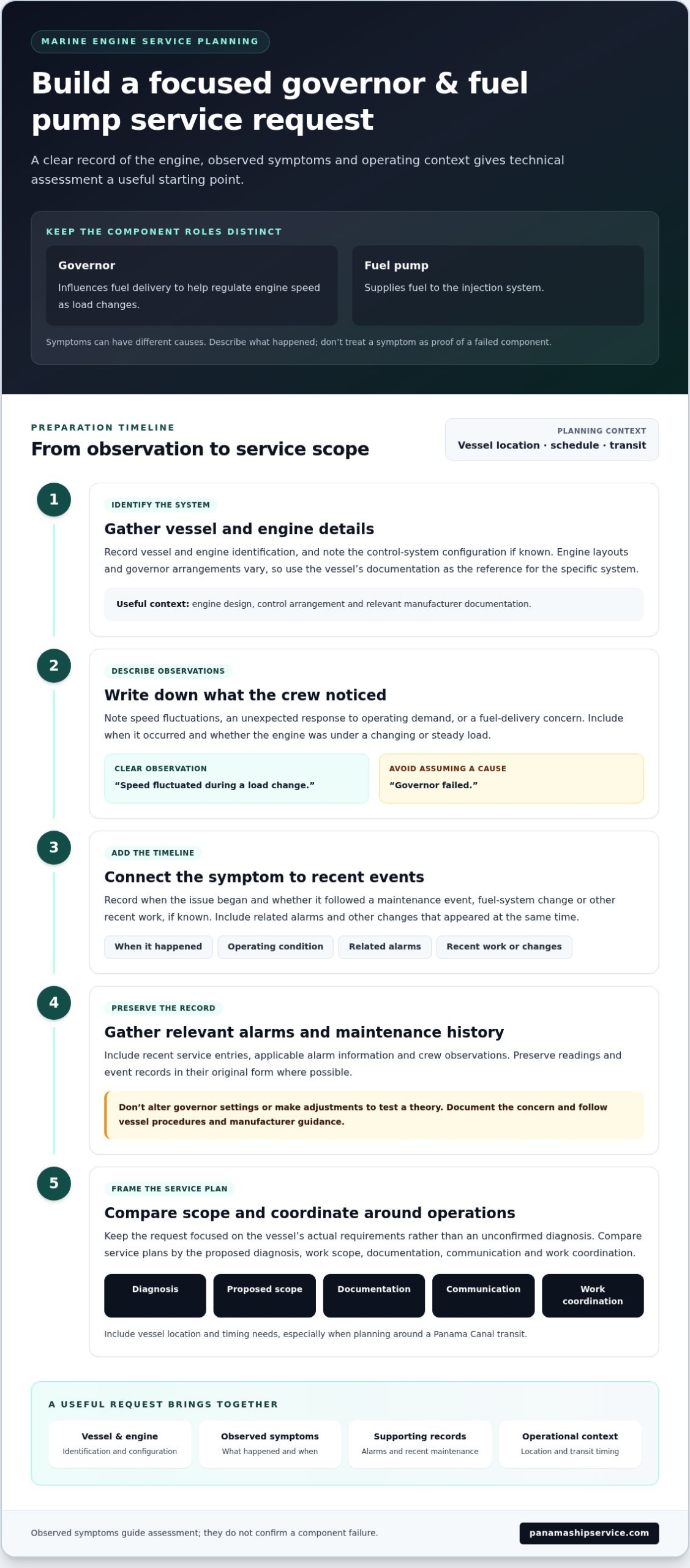
Before arranging work, gather the engine details, a clear symptom timeline, relevant alarms, and recent maintenance records. These details help frame the scope around the vessel’s actual requirements rather than an unconfirmed diagnosis. This guide explains how governors regulate engine speed and how fuel pumps support fuel delivery, then sets out practical steps for comparing service plans and coordinating support around your vessel’s location and schedule.
Panama Ship Service provides Marine Repairs & Services and On-Time Repairs on both sides of the Panama Canal. Its operational and technical support helps vessel teams coordinate repair and maintenance requirements with clear communication and cost-conscious planning. Use this guide to prepare a focused service request and keep operational priorities in view.
Key Takeaways
- Understand how the governor influences engine speed and how the fuel pump supplies fuel to the injection system.
- Treat speed instability, changing engine response, and fuel-delivery concerns as signs to investigate, not proof of a specific component failure.
- Compare governor and fuel pump services by diagnosis, proposed scope, documentation, communication, and work coordination.
- Prepare a concise service request with vessel and engine details, reported symptoms, relevant records, and transit timing.
- Panama Ship Service’s Marine Repairs & Services and On-Time Repairs support vessel technical and operational needs on both sides of the Panama Canal.
Role of Marine Governors and Fuel Pumps in Diesel Engines
A marine diesel engine relies on coordinated speed control and fuel delivery. The governor responds to changes in engine speed and load by influencing how much fuel the engine receives. The fuel pump supplies fuel to the injection system, which delivers it toward the cylinders according to the engine’s design. These components work together, but they perform different functions.
The governor controls engine speed by influencing fuel delivery; the fuel pump supplies fuel to the injection system. Keeping that distinction clear helps describe a concern accurately without assuming that a symptom identifies a failed component.
Engine layouts and operating details vary. Mechanical and electronic control arrangements differ, as does the way a governor interacts with fuel-delivery components. An overview of governor principles and applications is available in this reference on the Marine Engine Governor. For a specific vessel, the engine maker’s documentation describes the relevant system and procedures.
How the governor influences engine speed
Engine load changes with operating conditions. If the load increases, engine speed may fall unless the control system responds. The governor helps regulate speed by adjusting fuel delivery within the limits of the engine’s design. If the load decreases, it can reduce the fuel supplied to help prevent speed from exceeding the intended operating range.
Some mechanical arrangements use a fuel rack to vary fuel delivery, with the governor acting on that mechanism. Other designs differ, so don’t assume that a rack or a particular adjustment method applies to every vessel. For service planning, identify the engine and control system, then use the relevant documentation to describe the arrangement.
Where the fuel pump fits in the fuel system
The fuel pump forms part of the path supplying fuel to the engine’s injection system. Depending on the configuration, it may move fuel from a supply source and provide it at the conditions required by the injection equipment. The arrangement varies by engine, so the vessel’s documentation is the practical reference for tracing the system onboard.
The pump is distinct from the injectors, which deliver fuel into the combustion space, and from other components that support fuel supply or control. A concern described as “fuel delivery” could relate to different points along this path. Avoid identifying a specific component as the cause based on that description alone.
For a useful investigation, consider the governor, pump, injectors, fuel supply, and associated controls as parts of a connected system. Manufacturer guidance helps identify the relevant arrangement, operating limits, and service procedures for the specific engine. Vessel and engine identification also gives technicians a clearer picture of the system under discussion.
When arranging governor and fuel pump services, describe what the engine is doing and when the issue occurs. This gives the service team a more useful starting point than naming a suspected failed part and helps focus the discussion on the engine’s design and observed operation.
Which Governor or Fuel Pump Symptoms Need Service Attention?
Changes in engine speed, response, or fuel delivery can warrant investigation, but they don’t identify the failed component on their own. A speed fluctuation might involve the governor, a fuel-system issue, another engine control, or a combination of factors. In an initial report, describe what the crew observed and leave the diagnosis to the assessment.
Similar symptoms can have different causes across engine systems, so a symptom alone can’t confirm governor or fuel pump failure. This distinction helps keep a suspected part from becoming an assumed repair scope. To plan effective governor and fuel pump services, provide the operating context and relevant engine history alongside the symptom description.
Possible indicators to report include:
- Engine speed that fluctuates or doesn’t respond as expected to a change in operating demand.
- A noticeable change in engine response compared with its usual behavior.
- Fuel-delivery concerns observed by the crew or recorded by the vessel’s monitoring systems.
- Related alarms or other changes that appeared at the same time.
Operational signs to record before requesting service
Record when the issue occurs and the operating condition at the time, including whether the engine was under a changing or steady load. Note whether it began after a maintenance event, fuel-system change, or other recent work, if known. Include relevant alarms, crew observations, and maintenance records. Keep observations separate from theories: write “speed fluctuated during a load change,” not “governor failed.”
Useful records may include the engine’s identification details, recent service entries, and applicable alarm information. Preserve readings and event records in their original form where possible. Don’t alter governor settings or make adjustments to test a theory. Document the concern and follow vessel procedures and manufacturer guidance.
When troubleshooting should become a repair assessment
A recurring symptom, a change that affects engine response, or a concern the crew considers operationally significant calls for structured technical assessment. The next step depends on vessel procedures, the engine maker’s guidance, and the details of the event. Don’t use a general online description to set an operating threshold or decide whether the vessel can continue unchanged.
Share the symptom timeline, operating context, alarms, and maintenance history with the technical team. A clear record helps frame the assessment around what happened and supports discussion of next steps without prematurely assigning fault to the governor or pump.
For vessel support in Panama, Panama Ship Service provides Marine Repairs & Services to help address technical requirements in line with the vessel’s operational needs.
How to Compare Governor and Fuel Pump Service Options
Start a comparison with the vessel’s need, not a list of procedures. A reported symptom may call for an initial assessment, planned preventive maintenance, or repair planning based on findings. The proposed scope should explain how it relates to the concern and the vessel’s operating priorities. For governor and fuel pump services, component design and manufacturer requirements guide which procedures are appropriate.
Use these criteria to compare the service plan and how the work will be coordinated:
| Comparison area | What to look for |
|---|---|
| Diagnosis | A clear explanation of how reported symptoms and available engine information shape the assessment, without treating a suspected cause as a confirmed failure. |
| Proposed scope | Work described in relation to the vessel’s need, with the intended boundaries and any decision points made clear. |
| Documentation | Relevant findings and agreed next steps recorded where applicable, with reference to the engine and component information available. |
| Communication | An agreed point of contact, practical status updates, and clarity about when decisions or additional information are needed. |
| Coordination | A plan that accounts for the vessel’s location, operational priorities, and whether work is assessed onboard or requires a workshop setting. |
Match the service scope to the vessel’s operating need
Symptom assessment aims to understand a reported concern. Preventive maintenance addresses planned upkeep, while repair planning sets out work based on an identified need. These purposes are related but distinct. A clear proposal connects its scope to the symptoms, records, engine design, and vessel priorities. Onboard assessment and workshop work suit different circumstances, so neither is automatically the better option.
Procedures depend on the component arrangement and applicable manufacturer guidance. Don’t assume that a particular adjustment, test, or repair is standard for every governor or pump. Compare whether the proposed work fits the specific component and need, and whether the expected deliverables are stated clearly.
Evaluate communication, documentation, and coordination
Clear communication helps the vessel understand the scope, progress, and any decisions required. Recording findings and agreed next steps can support maintenance records and follow-up planning. In Panama, coordination should account for vessel location and operating schedule, with priorities and constraints stated clearly.
Panama Ship Service provides Marine Repairs & Services and On-Time Repairs as part of its operational and technical support on both sides of the Canal. For wider context on repair planning in this setting, consult the mechanical ship repair guide for Panama.
How to Prepare a Governor or Fuel Pump Service Request in Panama
A concise service request gives the technical team a clear starting point and helps align the assessment with the vessel’s priorities. For governor and fuel pump services, share what the crew observed, which engine is involved, and where and when the vessel can coordinate support. Separate confirmed details from assumptions about the cause.
Information to include in the initial request
Gather the details available onboard before sending the request. Engine and component identification help clarify which system is involved. If a detail is unavailable, mark it as unknown rather than guessing. Include:
- Vessel identity: Provide the vessel’s name and current Panama Canal location, such as its side of the Canal or relevant port or anchorage, if known.
- Engine details: Share the engine maker, model, and identifying information available in vessel records.
- Component information: Identify the governor or fuel pump involved if known, including its maker or model from available documentation.
- Observed symptoms: Describe the change in speed, engine response, or fuel delivery in plain terms. Separate direct observations from a suspected cause.
- Timing and conditions: Note when the issue began, when it occurs, and the operating conditions at the time, including any recent change that may be relevant.
- Records and previous work: Include relevant alarms, maintenance history, and records of recent work on the engine or associated systems.
- Coordination details: Name the preferred communication contact and state the vessel’s operational window, schedule constraints, and requested coordination needs.
Keep the first message focused. A concise timeline and the most relevant records are more useful than a long list of unverified theories. If you’re still gathering information, state what’s available and what will follow.
Coordinate work around the vessel’s operational priorities
Describe timing as a requirement, not an assumed service window. For example, identify a planned port call or the period when the vessel can coordinate an assessment, then explain any schedule constraints. This gives the service team a practical basis for discussing next steps and planning around the vessel’s priorities.
If you’re planning several technical requirements, include them in the same coordination discussion. Consolidating relevant needs can make priorities and logistics easier to manage. For broader scheduling context, the mechanical ship repair and vessel downtime guide explores repair planning in Panama.
Panama Ship Service provides operational and technical support on both sides of the Canal through Marine Repairs & Services and On-Time Repairs. Discuss your vessel’s repair requirements with vessel details, observed symptoms, and coordination priorities ready.
Arrange Marine Repair Support with Panama Ship Service
Planning technical support around a Panama Canal transit takes clear information and coordinated communication. Panama Ship Service provides operational and technical support on both sides of the Canal through Marine Repairs & Services and On-Time Repairs. These services support vessel repair and preventive-maintenance needs alongside local operational coordination, helping operators plan around the vessel’s location and priorities.
For governor and fuel pump services, start with the reported symptoms, engine information, relevant maintenance records, and operating requirements. This gives the service discussion a practical basis for identifying the vessel’s repair needs and coordinating the work. Panama Ship Service emphasizes personalized communication and cost-conscious efficiency when consolidating vessel requirements.
Coordinate marine engine needs through one service partner
Preventive maintenance of marine engine components should be planned around the vessel’s requirements and relevant manufacturer guidance. Panama Ship Service coordinates operational and technical needs on either side of the Panama Canal, helping vessel teams bring related requirements into one planning discussion. Consolidating requests can make priorities, timing constraints, and communication easier to manage.
The company also provides international service. For operators managing requirements across locations, this capability supports a coordinated approach while keeping the vessel’s circumstances central to planning.
Request a service discussion for your vessel
Owners, operators, and charterers can make the first discussion more productive by sharing a concise set of details. Include:
- Vessel name, current location, and relevant Panama Canal transit or port-call information.
- Engine and component identification available in vessel records.
- Observed symptoms, when they occur, and any relevant alarms or recent maintenance.
- Operational priorities, timing constraints, and the preferred onboard contact.
- Other technical or operational needs that may be coordinated alongside the repair request.
These details help establish what the vessel needs and how support can be coordinated. Panama Ship Service offers 24/7 contact availability for vessel representatives to raise operational and technical requirements. Share the vessel’s priorities and relevant records to focus the discussion.
Bring the engine information and symptom record together, then Contact Panama Ship Service about your vessel’s needs to discuss marine repair support and coordination in Panama.
Move Your Vessel’s Repair Planning Forward
Turn an engine concern into a clear plan that fits your vessel’s operating priorities. A focused discussion about governor and fuel pump services can align the reported need with appropriate marine repair support. Keep the vessel’s schedule, location, and technical requirements central to the conversation.
Founded in 1999, Panama Ship Service provides operational and technical support on both sides of the Panama Canal. Its Marine Repairs & Services and On-Time Repairs support vessel repair and maintenance planning through personalized communication and cost-conscious coordination. Contact is available 24/7 for vessel representatives raising operational needs.
Prepare your vessel details and priorities, then Contact Panama Ship Service to discuss your vessel’s repair requirements. A clear starting point makes the planning conversation more productive and helps move the repair plan forward.
Frequently Asked Questions
What does a governor do in a marine diesel engine?
A governor helps regulate engine speed as operating demand changes. If engine load rises, its control response can influence fuel delivery to help maintain the intended speed. The precise arrangement depends on the engine. For vessel-specific questions, refer to the maker’s documentation and identify the engine model, since control systems differ.
Can a faulty governor affect fuel delivery?
Yes. Because the governor’s control function can influence fuel delivery, a problem in that control path may affect engine response. But a fuel-delivery concern doesn’t necessarily point to the governor. The pump, injection equipment, or other parts of the system may also be involved. Describe the observed change and its operating context rather than treating a suspected governor fault as a confirmed diagnosis.
How do I know whether the governor or fuel pump needs service?
A symptom alone can’t reliably identify the component. Compare the event with engine records and the maker’s troubleshooting guidance. Note whether the change appeared alongside an alarm or after related maintenance, and whether it occurs under a particular operating condition. Share those observations for technical assessment instead of changing settings to test a theory.
What information should I include in a fuel pump service request?
Include the vessel and engine identifiers, the pump details available in your records, and a concise description of the concern. Add relevant alarm records or maintenance entries if available, and specify when the issue was observed. A clear image of the component identification plate may help communicate its details. Mark unknown information clearly rather than estimating it.
Can marine engine repair support be coordinated at the Panama Canal?
Yes. Panama Ship Service provides operational and technical support on both sides of the Panama Canal. State the vessel’s location and immediate operational priorities so the discussion can focus on its circumstances. Marine Repairs & Services and On-Time Repairs are starting points for coordinating marine repair needs in the Canal area.
Does governor or fuel pump service always require workshop work?
No. The appropriate setting depends on the component, engine arrangement, reported concern, and applicable manufacturer requirements. Some assessments may be considered in the vessel’s operating context, while other work may call for a workshop. Describe the vessel’s location and constraints so the proposed approach can be matched to the requirement.
Can governor or fuel pump work be coordinated with other ship repairs?
Yes. Include related vessel needs in the same planning discussion. For example, an operator arranging engine-component attention can also identify other mechanical repair requirements or operational support needs. Grouping priorities can clarify timing, communication, and coordination responsibilities. Panama Ship Service consolidates vessel technical and operational needs as part of its marine support approach, with planning focused on the vessel’s requirements.