
Did you know that a single hydraulic failure on a Neo Panamax vessel can trigger a Panama Canal Disruption Charge of up to $250,000? When steering gear or deck machinery malfunctions at the entrance of the Canal, you aren’t just dealing with a mechanical breakdown; you’re facing a massive financial and regulatory crisis. Securing immediate ship hydraulic system repair panama is the only way to protect your schedule and your bottom line from these escalating penalties. Under the current OP Notice to Shipping N-1-2026, the Panama Canal Authority maintains a strict stance on deficiencies that interrupt transit flow, making technical reliability your most valuable asset.
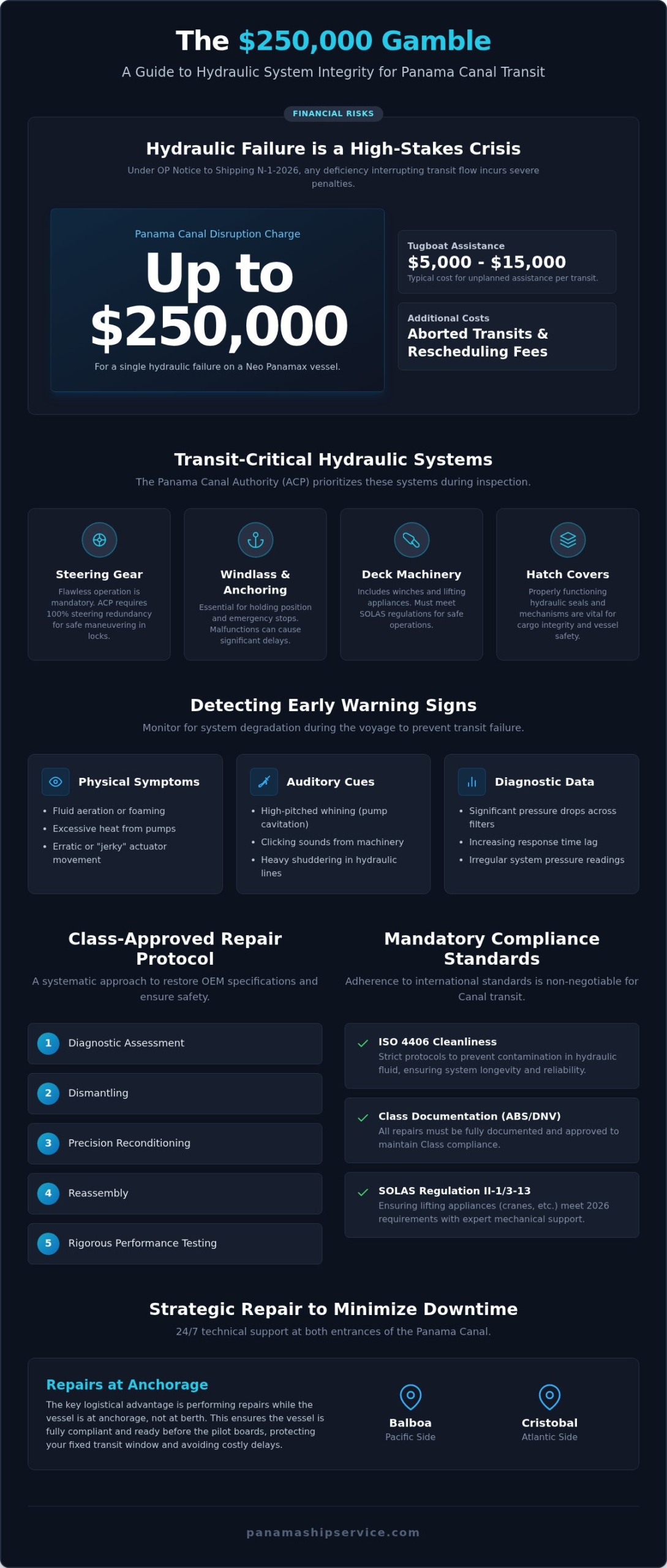
We recognize the intense pressure of maintaining Class compliance while racing against a fixed transit window. It’s a high-stakes environment where any delay translates directly into lost revenue and operational headaches. This guide demonstrates how expert hydraulic solutions can restore your vessel’s operational safety and ensure you meet every PCA requirement without missing your slot. We’ll examine the impact of mandatory SOLAS Regulation II-1/3-13 for lifting appliances, the necessity of Class-approved documentation for ABS or DNV, and how 24/7 technical support in Balboa and Cristobal keeps your voyage on track.
Key Takeaways
- Understand the financial risks of the Panama Canal Disruption Charge and how proactive maintenance prevents these six-figure penalties.
- Identify the technical standards required for a successful ship hydraulic system repair panama, including ISO 4406 cleanliness protocols.
- Learn which hydraulic components the Panama Canal Authority prioritizes during inspections to avoid aborted transits.
- Compare the logistical advantages of performing repairs at anchorage versus at berth within the Balboa and Cristobal port limits.
- Ensure your vessel meets the 2026 SOLAS requirements for lifting appliances with Class-approved documentation and expert mechanical support.
The Financial Impact of Hydraulic Failure at the Panama Canal
Operating a vessel through the Panama Canal requires mechanical precision. When hydraulic systems fail during approach or transit, the financial consequences are immediate and severe. The Panama Canal Authority (ACP) implements a Disruption Charge for vessels with deficiencies that interrupt operations, with penalties ranging from $15,000 to $250,000 depending on the impact. Beyond these fines, a vessel may incur unplanned costs for tugboat assistance, which typically run between $5,000 and $15,000 per transit. Securing expert ship hydraulic system repair panama before entering the lane is the only way to mitigate these risks and ensure the safety of your crew and cargo.
The ACP classifies steering gear and windlass hydraulics as transit-critical because they are essential for the tight maneuvers required within the locks. If a vessel displays any propulsion or steering deficiency, it triggers a mandatory inspection under the OP Notice to Shipping N-1-2026. These inspections often lead to aborted transit slots and massive rescheduling fees. To prevent these bottlenecks, shipowners utilize strategic repair hubs in Balboa on the Pacific side and Cristobal on the Atlantic side. These locations allow for mechanical ship repairs panama to be conducted at anchorage, ensuring the vessel is fully compliant before the pilot boards.
Steering Gear: The Heart of Canal Maneuverability
Navigation through the locks relies on the flawless operation of hydraulic rams or rotary vane actuators. The ACP mandates 100% steering redundancy; if one system fails, the secondary must be capable of providing full control instantly. Any hesitation in response can lead to a collision with lock walls or other vessels. A transit-critical hydraulic failure is any malfunction in a vessel’s steering gear or anchoring systems that compromises the precision required for lock navigation, resulting in an immediate suspension of transit by the ACP. Maintaining these systems is not just a matter of operational preference, it’s a strict regulatory requirement for passage.
Identifying Early Warning Signals
Detecting hydraulic issues before they cause a transit abort is vital for cost management. Technical teams should monitor for specific indicators of system degradation during the voyage toward Panama:
- Physical symptoms: Look for fluid aeration or foaming in the reservoir, excessive heat radiating from pump casings, and erratic or “jerky” movement in actuators.
- Auditory cues: Listen for high-pitched whining or clicking sounds indicating pump cavitation, or heavy shuddering in the hydraulic lines during peak load.
- Diagnostic data: Track significant pressure drops across filters and any increasing response time lag in the steering consoles or winch controls.
Ignoring these signs often leads to catastrophic failure at the most vulnerable point of the journey. Professional ship hydraulic system repair panama provides the specialized diagnostic tools and components needed to resolve these issues while the vessel remains at anchorage, protecting your scheduled transit window.
Technical Standards for Marine Hydraulic System Repair in Panama
Technical precision is the only way to meet the Panama Canal Authority Vessel Requirements and avoid the disruption charges discussed previously. A professional overhaul involves five distinct stages: diagnostic assessment, dismantling, precision reconditioning, reassembly, and rigorous performance testing. Every ship hydraulic system repair panama must adhere to these steps to ensure Class compliance and operational safety during lock maneuvers. Without this systematic approach, vessels risk intermittent failures that can lead to catastrophic steering loss at critical transit points.
Our process includes Non-Destructive Testing (NDT) to identify stress fractures in hydraulic manifolds and housings that are invisible to the naked eye. We focus on achieving precision honing of cylinders and the re-sealing of high-pressure pumps to restore original equipment manufacturer (OEM) specifications. This level of technical rigor is what differentiates a temporary fix from a long-term solution that satisfies the demanding standards of ABS, DNV, and Lloyd’s Register.
Precision Flushing and Fluid Analysis
Fluid that looks clear to the naked eye can still harbor microscopic particulates that destroy pump tolerances. We target ISO 4406 or NAS 1638 cleanliness standards to prevent repeat failures. High-velocity hot oil flushing is utilized to remove varnish and accumulated debris from the entire circuit. This process isn’t complete without a post-flushing lab report that verifies the fluid meets the manufacturer’s specific particle count requirements. It’s a vital step because even small amounts of contamination can cause valve stiction or accelerated wear in high-pressure systems.
Actuator and Pump Reconditioning
Restoring volumetric efficiency in axial piston pumps and motors is critical for maintaining the torque required by heavy deck machinery. During a ship hydraulic system repair panama, we perform cylinder rod re-chroming and install specialized seal kits designed to withstand the humidity of tropical environments. Before any component is returned to service, it undergoes pressure testing to 1.5 times its rated working pressure. This ensures the equipment can handle the extreme loads encountered during lock entry and mooring operations.
Securing Class-approved documentation is the final, essential step in any major repair. These records prove to port state inspectors and ACP officials that your vessel is fit for passage. If you are approaching the locks and suspect a drop in system performance, you can rely on our expertise for mechanical ship repairs panama to keep your schedule intact.
Critical Components: Steering Gear, Winches, and Hatch Covers
Every vessel entering the Canal must demonstrate total control over its maneuverability and mooring capabilities. The Panama Canal vessel requirements leave no room for equipment that operates below peak performance. Steering gear systems, whether ram-type or rotary vane actuators, are the primary focus of port state inspections. A failure here is an automatic transit abort. Expert ship hydraulic system repair panama focuses on the rapid restoration of these actuators, ensuring the vessel can handle the precise course corrections required within the narrow lock chambers. Our technicians prioritize seal integrity and valve response times to guarantee that the pilot’s commands are executed without lag.
Hatch covers and ramps also play a vital role in port operation readiness. While they don’t affect navigation directly, malfunctioning hydraulic cylinders or leaking control valves can prevent cargo handling upon arrival at Balboa or Cristobal. This leads to secondary delays and increased port fees. By addressing these issues at anchorage, shipowners protect their cargo integrity and ensure the vessel is ready for immediate discharge or loading after it exits the Canal system.
Deck Machinery and Lock Safety
Mooring winch tension control is vital for the Panama Canal’s “mule” towing system. These locomotives rely on the vessel’s winches to maintain consistent line tension as the ship moves through the locks. If a winch’s hydraulic motor fails or the brake system is compromised, the vessel risks a runaway load that can damage both the ship and the Canal infrastructure. We specialize in repairing hydraulic brake systems to prevent these dangerous scenarios. Emergency manual override checks are a standard part of our service, ensuring that deck crew can maintain control even in the event of a total power loss. Reliable ship hydraulic system repair panama ensures these systems are tested under load before the first line is thrown to a mule.
Environmental Compliance and SFOC
Modern maritime regulations have created a direct link between hydraulic pump efficiency and Specific Fuel Oil Consumption (SFOC). When a hydraulic pump is worn, it must run longer and harder to maintain the required system pressure, which increases the load on the auxiliary engines. This internal leakage doesn’t just waste energy; it can actively downgrade a vessel’s Carbon Intensity Indicator (CII) rating. Hydraulic reconditioning provides a cost-effective path to EEXI compliance by restoring system efficiency without the capital expenditure of full equipment replacement. By eliminating friction losses and fluid bypass in aging pumps and motors, shipowners can achieve measurable improvements in their environmental profile while simultaneously reducing overhead costs.
Logistics of Repair: Minimizing Downtime in Balboa and Cristobal
Coordinating with the Panama Canal Authority (ACP) during a mechanical emergency requires a partner who understands both the technical and regulatory landscape. When a vessel reports a steering gear or winch failure, the technical team must provide a clear repair plan that satisfies ACP inspectors. We act as your liaison, managing the logistics of ship hydraulic system repair panama while your vessel is still at the outer anchorage. This proactive coordination is essential for maintaining your transit window and avoiding the high-impact disruption charges that follow an aborted passage.
Choosing between anchorage and berth is a critical decision for minimizing downtime. Most ship hydraulic system repair panama projects are completed afloat at the Balboa or Cristobal anchorages to avoid the logistical complexity and cost of shifting to a commercial wharf. This approach allows our teams to perform mechanical ship repairs panama while the vessel remains in the transit queue. To maximize operational efficiency, we often bundle these interventions with marine surveys panama, providing a comprehensive technical overview in a single mobilization.
Afloat Repairs at Balboa and Cristobal
Our riding squads mobilize quickly to perform “on-the-move” diagnostics before your vessel even reaches the Canal entrance. Safety is our primary concern when performing high-pressure hydraulic work at anchorage, and our teams follow strict protocols to manage pressurized systems in open-water environments. For major component removals, such as large steering actuators or windlass motors, we utilize barge-mounted cranes in Panama Bay. This capability allows us to transport heavy machinery to our shore-side workshops for precision honing and testing without requiring the vessel to leave its assigned anchorage position.
Integrated Technical Management
Consolidating your technical needs under a single provider reduces administrative overhead and simplifies communication. By combining hydraulic repairs with underwater hull services, shipowners can address multiple Class requirements during a single waiting period. We provide digital reporting with real-time updates, allowing fleet managers and technical superintendents to monitor repair progress from anywhere in the world. This integrated model ensures that every minute of your mandatory Canal waiting period is used to optimize the vessel’s condition and ensure a successful transit.
If your vessel is approaching the Canal with a known hydraulic deficiency, don’t wait for an ACP inspection to trigger a delay. Contact us today to coordinate a rapid response ship hydraulic system repair panama and keep your schedule on track.
Panama Ship Service: Your Partner for Transit-Safe Hydraulic Care
Managing technical failures at the Canal requires a partner who can operate with the same speed and precision as the waterway itself. Our “One-Stop-Shop” model serves as the industry benchmark for vessels in Balboa and Cristobal because it eliminates the logistical friction of dealing with multiple vendors. We integrate ship hydraulic system repair panama with parts sourcing and Class-approved documentation, allowing you to delegate technical complexity to a single, accountable provider. This integrated approach doesn’t just fix a pump; it protects your entire operational schedule from the cascading costs of missed transit slots.
Our 24/7 Rapid Response Guarantee is designed for the high-stakes environment where every hour at anchorage impacts your bottom line. We maintain a constant state of readiness, allowing our riding squads to mobilize the moment a deficiency is identified. This responsiveness is backed by our deep expertise in mechanical ship repairs, ensuring that your vessel meets every technical requirement before the pilot boards. Whether you’re dealing with a seized actuator or a critical pressure drop in your steering gear, our team provides the calm, expert presence needed to resolve the issue without unnecessary complication.
The Panama Ship Service Advantage
We operate Class-approved workshop facilities staffed by factory-trained hydraulic technicians who understand the specific rigors of Canal transit. Our team has a proven track record of preventing vessel downtime by resolving mechanical issues before they escalate into regulatory violations. We leverage our strategic local knowledge of ACP regulations and port logistics to move specialized components through customs with minimal delay. This localized proficiency allows us to execute ship hydraulic system repair panama faster than international service providers who lack our established port relationships.
Getting Started with Your Repair
To ensure the fastest possible turnaround, our technical desk is available 24/7 to receive emergency support requests. When you contact our engineers for a diagnostic, please have the following information ready: the system’s current operating pressure, a detailed description of the symptoms (such as erratic actuator movement or excessive heat), and the manufacturer of the affected components. Providing this data immediately allows our team to stage the correct high-pressure seals and diagnostic tools before boarding your vessel at anchorage. It’s the most reliable way to secure a first-time fix and maintain your scheduled transit window.
Request a comprehensive ship repair quote in Panama today to ensure your vessel is fully prepared for its next Canal passage.
Securing Your Transit Reliability at the Panama Canal
The financial and operational risks of entering the Panama Canal with compromised hydraulics are too high to ignore. From six-figure Disruption Charges to the strict requirements of the 2026 SOLAS regulations, your vessel’s technical readiness is the primary factor in a successful transit. By prioritizing precision flushing, component reconditioning, and rigorous pressure testing, you ensure that steering gear and deck machinery perform flawlessly during lock navigation. Expert ship hydraulic system repair panama provides the necessary Class-approved documentation and mechanical reliability to satisfy ACP inspectors.
With our strategic locations in Balboa and Cristobal, we deliver 24/7 emergency response directly at anchorage, minimizing downtime and keeping your voyage on schedule. Our workshop facilities adhere to the highest Class-approved standards for ABS, DNV, and Lloyd’s; this gives you the confidence to proceed through the waterway without the threat of a transit abort. Secure your Panama Canal transit with expert hydraulic repair-Contact Panama Ship Service now. We look forward to being your technical partner for a safe and efficient Canal passage.
Frequently Asked Questions
Can hydraulic repairs be performed while the vessel is at the Balboa anchorage?
Yes, most repairs are performed afloat at the Balboa anchorage to avoid the logistical costs and delays of berthing. Our riding squads use specialized barges to transport equipment and technicians directly to your vessel. This approach allows work to proceed while the ship remains in the transit queue, significantly reducing downtime and protecting your schedule.
How long does a typical steering gear hydraulic overhaul take in Panama?
A typical overhaul ranges from 24 to 72 hours depending on the complexity of the component failure and the extent of reconditioning required. We prioritize rapid turnaround by staging necessary spare parts and diagnostic tools before boarding. For more extensive repairs involving precision honing, our shore-side workshop operates around the clock to meet your fixed transit window.
Will the hydraulic repair work be accepted by major Class societies like ABS or DNV?
Yes, all repair work is performed to Class-approved standards and includes full documentation for societies such as ABS, DNV, and Lloyd’s Register. Our technicians follow verified procedures that ensure your vessel remains compliant with international safety regulations. Providing this documentation is a standard part of our service to facilitate a successful inspection by the Panama Canal Authority.
What happens if my vessel fails an ACP steering test before entering the locks?
Failing an ACP steering test results in an immediate suspension of transit and the potential levy of a Disruption Charge. The vessel is typically ordered to an anchorage where it must remain until the deficiency is corrected and a re-inspection is passed. We provide emergency ship hydraulic system repair panama to resolve these failures quickly and minimize the duration of the delay.
Can you source specialized hydraulic seals or pumps for older vessel models?
Yes, we utilize an extensive network of global and local suppliers to source specialized components for older or obsolete hydraulic systems. If a specific part is no longer available, our workshop can often manufacture custom seals or recondition existing pump housings to OEM specifications. This capability is essential for keeping vintage deck machinery operational during Canal transits.
Is 24/7 emergency response available for hydraulic failures on the Cristobal side?
Yes, our technical teams provide 24/7 emergency response at the Cristobal anchorage on the Atlantic side of the Canal. We maintain fully equipped service units ready to mobilize at any hour to address critical failures in steering gear or mooring winches. This ensures that vessels approaching from the Atlantic have the same access to rapid technical support as those in Balboa.
How does hydraulic system efficiency affect my vessel’s CII (Carbon Intensity Indicator) rating?
Inefficient hydraulic systems force auxiliary engines to run longer and consume more fuel to maintain system pressure, which directly increases carbon emissions. By performing a ship hydraulic system repair panama to eliminate internal leakage and friction, you improve the ship’s overall energy efficiency. This reduction in fuel consumption helps maintain or improve your CII rating under current IMO regulations.
What cleanliness standards do you follow for hydraulic system flushing in Panama?
We adhere to ISO 4406 or NAS 1638 cleanliness standards for all hydraulic system flushing operations. Our process uses high-velocity hot oil flushing to remove varnish and particulates that can cause valve stiction or pump failure. Every flushing project concludes with a certified lab report to verify that the fluid meets the manufacturer’s specific technical requirements.