
Unpredictable repair costs, rising material prices, and the constant threat of expensive downtime can turn vessel operations into a high-stakes guessing game. As new environmental regulations loom, the pressure to create a precise, defensible budget has never been greater. For ship owners and charterers, effective ship maintenance budget planning 2026 is not just a financial exercise-it is a critical component of operational strategy and a direct defense against shrinking profit margins.
This is where expert planning provides a clear solution. This ultimate guide is engineered to replace uncertainty with a structured, cost-conscious framework. We will provide the expert insights and actionable checklists you need to accurately forecast costs, prepare for regulatory changes, and maximize fleet reliability. By the end of this article, you will have a clear roadmap to build a realistic budget, confidently justify your financial needs to management, and ensure your vessels remain efficient and profitable through 2026 and beyond.
Key Takeaways
- Understand why simply inflating last year’s budget is a critical mistake and how to account for new economic and regulatory pressures in 2026.
- Master the core components of a vessel’s maintenance budget by clearly differentiating between OPEX and CAPEX for superior financial control.
- Move beyond simple estimates by implementing a data-driven forecasting model, the key to successful ship maintenance budget planning 2026.
- Discover how partnering with an expert, one-stop service provider can create cost predictability and significantly reduce overall maintenance expenses.
Why Your 2025 Budget Model Won’t Work for 2026
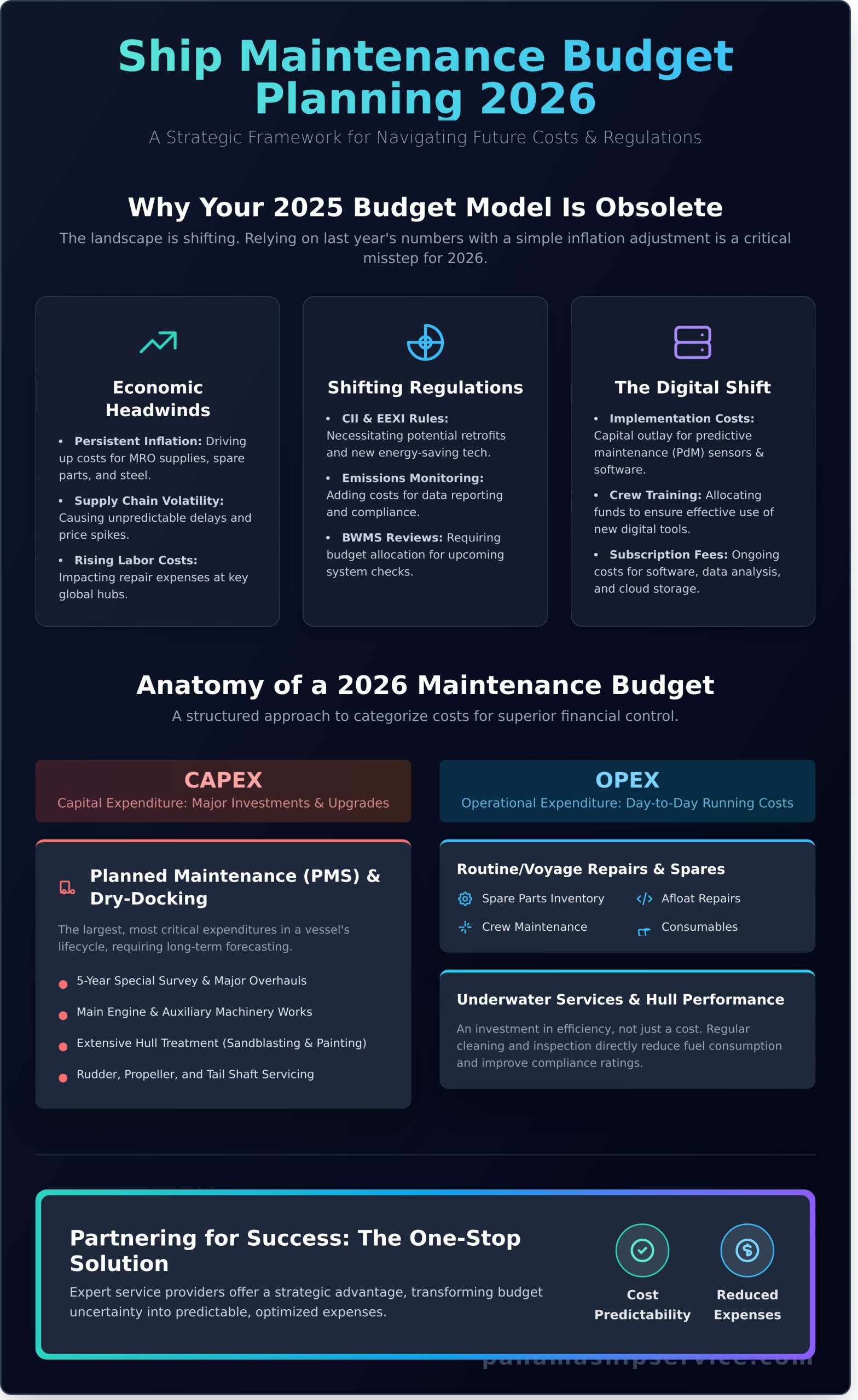
In the high-stakes world of maritime operations, relying on last year’s numbers with a simple percentage increase is a critical misstep. The financial and operational landscape of 2026 is being shaped by forces that render old budgeting models obsolete and dangerous. A reactive approach exposes your fleet to unacceptable financial risks and operational downtime. Effective ship maintenance budget planning 2026 requires a forward-looking, strategic framework that anticipates challenges instead of merely reacting to them. This proactive financial planning is no longer optional; it is essential for survival and profitability.
Key Economic Headwinds: Inflation and Supply Chain Volatility
Persistent global inflation continues to drive up the cost of essential MRO (Maintenance, Repair, and Operations) supplies, from spare parts to steel. Compounding this, unpredictable supply chain disruptions create delays and price spikes, making “just-in-time” a risky proposition. Ship owners must also factor in rising labor costs at key global repair hubs and the direct impact of fluctuating currency exchange rates on overall operational expenditure (OPEX). These variables demand a budget with built-in contingency and flexibility.
The Shifting Regulatory Landscape: IMO 2026 and Beyond
The regulatory environment is tightening, with significant financial consequences. Evolving Carbon Intensity Indicator (CII) and Energy Efficiency Existing Ship Index (EEXI) requirements necessitate budgeting for potential retrofits, such as engine power limitations or new energy-saving technologies. These new demands transform vessel upkeep from a simple task list into a matter of comprehensive ship management, where financial planning and technical compliance are inextricably linked. Furthermore, costs for enhanced emissions monitoring, data reporting, and upcoming Ballast Water Management System (BWMS) reviews must be explicitly allocated.
The Digital Shift: Budgeting for New Maintenance Technologies
Integrating modern technology is an investment in future efficiency, but it carries upfront and ongoing costs that must be included in your ship maintenance budget planning for 2026. Key expenditures include:
- Implementation Costs: Capital outlay for predictive maintenance (PdM) sensors and the software platforms needed to analyze the data.
- Training and Development: Allocating funds for crew training is critical to ensure new digital tools are used effectively and deliver a return on investment.
- Subscription Fees: Ongoing costs for performance monitoring software, data analysis services, and cloud storage must be factored into the operational budget.
Core Components of a Comprehensive Ship Maintenance Budget
Effective ship maintenance budget planning 2026 requires a structured approach that breaks down complex costs into clear, manageable categories. A robust budget distinguishes between Operational Expenditure (OPEX)-the day-to-day costs of running the vessel-and Capital Expenditure (CAPEX), which covers significant investments and upgrades. By categorizing all anticipated costs into planned versus unplanned, ship owners and operators can gain precise control over cash flow and avoid costly surprises.
This framework provides a clear, adaptable structure for any vessel type, ensuring no critical cost center is overlooked.
Planned Maintenance (PMS) and Dry-Docking
This category represents the largest capital expenditures in a vessel’s lifecycle. Accurate forecasting for the 5-year special survey is critical, encompassing major overhauls of main engines and auxiliary machinery, extensive hull treatment like sandblasting and painting, and critical works on the rudder, propeller, and tail shaft. Forecasting these significant capital expenditures years in advance is a complex but essential discipline. For a detailed framework on long-term cost estimation, methodologies like those outlined in Strategic Forecasting: How to Accurately Predict 2026 Costs can provide an invaluable, structured approach to managing these high-value items.
Routine/Voyage Repairs and Spares
These ongoing operational costs are vital for maintaining vessel reliability and safety between major service intervals. A well-managed budget allocates funds for:
- Spare Parts Inventory: Maintaining optimal levels of critical spares based on machinery type and trading routes.
- Crew Maintenance: Costs associated with maintenance tasks performed by the vessel’s crew.
- Afloat Repairs: Setting aside funds for specialized technicians to perform repairs at key ports or transit points.
- Consumables: Budgeting for lubricants, chemicals, gases, and other essential supplies.
Underwater Services and Hull Performance
Viewing underwater services as an investment rather than just a cost is key to reducing overall fuel OPEX. This budget category should include allocations for regular in-water hull cleaning to maintain hydrodynamic efficiency, propeller polishing to reduce drag and improve fuel consumption, and Underwater Inspections in Lieu of Dry-docking (UWILD) where permitted by Class. These proactive measures directly translate to significant fuel savings and improved operational performance.
Inspections, Surveys, and Certification
Compliance is non-negotiable, and its associated costs must be itemized. This section of the budget accounts for all mandatory regulatory activities. Key line items include annual and intermediate surveys by Class societies, flag state inspections, and renewals of statutory certifications. It is also crucial to include costs for specialized surveys (e.g., condition, pre-purchase) and the regular servicing and certification of all safety equipment, such as life rafts, fire extinguishers, and fixed firefighting systems.
Strategic Forecasting: How to Accurately Predict 2026 Costs
Effective ship maintenance budget planning 2026 moves beyond last year’s figures plus inflation. A truly strategic forecast is a data-driven model that anticipates needs, accounts for operational variables, and mitigates financial risk. For ship owners and charterers, this proactive approach transforms the budget from a reactive expense sheet into a powerful tool for maintaining asset value and operational readiness.
Leveraging Historical Data and Performance Analytics
Your vessel’s history is the most reliable predictor of its future needs. By systematically analyzing past data, you can build a highly accurate cost baseline. This process involves a deep dive into your operational records to identify trends and predict requirements before they become urgent. When analyzing 2026 vessel operating costs, consider how evolving regulations and fuel prices will impact your historical models. Key data points to leverage include:
- Past Repair Invoices: Identify recurring costs and seasonal maintenance patterns.
- PMS Data: Use Planned Maintenance System records to forecast component lifecycles and schedule major overhauls.
- Vessel Performance Data: Correlate fuel consumption and speed with potential needs for hull cleaning or engine tuning.
- Cost Baselines: Establish a reliable cost-per-day or cost-per-voyage metric to benchmark future spending.
Building a Realistic Contingency Fund
In the maritime industry, unforeseen events are a certainty. A contingency fund is a non-negotiable component of any robust maintenance budget, serving as a critical buffer against unplanned repairs, unexpected regulatory requirements, or supply chain disruptions. As a best practice, allocate 10-15% of your total budget for these contingencies. This percentage should be adjusted upwards for vessels with a higher risk profile, such as older ships or those operating on harsh trading routes. Minimize surprises. Plan your repairs with a trusted partner.
Consulting Technical Partners for Early-Stage Quotes
Your technical service providers are valuable sources of intelligence. Engaging with them during the budget season provides access to real-time cost data and expert insights. Proactively request preliminary quotes for anticipated works like underwater repairs or major component servicing. This not only validates your cost assumptions for specific regions but also strengthens relationships with reliable partners in critical transit zones, ensuring you have qualified support when and where you need it most. This is a core part of strategic ship maintenance budget planning for 2026.
Partnering for Success: How to Optimize Your Budget with Panama Ship Service
A well-structured budget is only as effective as its execution. To transform your financial plan from a document into a reality, you need a reliable partner on the ground-one who understands the operational pressures and financial stakes of modern shipping. At the Panama Canal, Panama Ship Service moves beyond the role of a vendor to become a strategic asset in your financial planning, ensuring your budget is not just met, but optimized.
One-Stop-Shop for Predictable Costs and Reduced Admin
Effective ship maintenance budget planning 2026 requires clarity and control over expenses. Coordinating multiple vendors for repairs, surveys, and supplies creates administrative burdens and unpredictable costs. As your single, trusted partner at the Canal, we consolidate these needs to provide a clear, comprehensive financial picture. This streamlined approach delivers significant advantages:
- Bundled Services: Combine necessary underwater repairs, MARPOL disposals, bunker surveys, and supply deliveries into a single, coordinated operation.
- Reduced Overhead: Eliminate the time and expense of managing multiple contracts, communications, and payment schedules.
- Consolidated Invoicing: Receive one detailed, transparent invoice for all services rendered, simplifying expense tracking and reconciliation for your accounting team.
Minimizing Downtime with Efficient Port-of-Call Service
The largest unbudgeted expense is often vessel downtime. Our expertise is in maximizing the narrow window of opportunity during Panama Canal transit. By planning necessary afloat repairs and maintenance to coincide with your vessel’s passage, we turn waiting time into productive, cost-saving work. Our 24/7 rapid-response team is built to operate within the tight schedules of canal transit, helping you manage your contingency budget by proactively addressing issues that could otherwise cause costly delays at the next port.
Get Accurate Quotes for Your 2026 Budgetary Needs
Building a robust and defensible maintenance budget starts with reliable data. Our technical team provides detailed, transparent quotes that you can use to add precision to your financial forecasts. Don’t rely on estimates. Engage with our experts now to secure accurate figures for your upcoming maintenance needs. Let us help you build a cost-conscious plan that stands up to scrutiny. Contact our technical team for a no-obligation budget consultation.
Secure Your 2026 Budget with an Expert Partner
The maritime landscape of 2026 demands a new approach. Relying on outdated models is no longer a viable strategy; successful operations will depend on strategic forecasting and a comprehensive understanding of all core maintenance components. Effective ship maintenance budget planning 2026 requires precision, foresight, and the right operational support to control costs without compromising on safety or efficiency.
Don’t navigate this complex process alone. As your trusted partner at the Panama Canal, Panama Ship Service leverages over 20+ years of maritime service experience to provide cost-conscious solutions. We are your one-stop-shop for all technical and operational needs, ensuring your budget is both accurate and optimized. Let our experts provide the data and support you need to build a resilient financial plan. Contact us for a preliminary quote to assist your 2026 budget planning.
Take control of your 2026 operational costs and set a course for a profitable year ahead.
Frequently Asked Questions: Ship Maintenance Budget Planning 2026
What is a typical ship maintenance budget as a percentage of OPEX?
A vessel’s maintenance and repair budget typically constitutes 15% to 25% of its total operational expenditure (OPEX). This figure varies based on the vessel’s age, type, and operational intensity. For instance, a newer, well-maintained vessel might fall closer to the 15% mark, while an older ship requiring more frequent dry-docking and repairs could see this percentage climb above 25%. Accurate forecasting is critical to prevent M&R costs from unexpectedly dominating your operational expenses.
How does a vessel’s trading route impact its maintenance budget?
A vessel’s trading route is a major cost driver. Ships operating in harsh weather environments like the North Atlantic experience greater hull stress and equipment wear, increasing maintenance needs. Similarly, routes through high-salinity or icy waters accelerate corrosion and potential damage. Operating in Emission Control Areas (ECAs) also necessitates meticulous upkeep of emissions-reduction systems, such as scrubbers, which directly impacts budget allocations for compliance and component longevity, making it a key factor in your planning.
What is the difference between OPEX and CAPEX in ship maintenance planning?
In ship maintenance, Operational Expenditure (OPEX) covers routine, day-to-day costs required to keep the vessel running efficiently. This includes consumables like lubricants, spare parts for regular upkeep, and scheduled inspections. Capital Expenditure (CAPEX), in contrast, refers to significant investments that enhance a vessel’s value or extend its operational life. Examples include installing a new ballast water treatment system to meet regulations or a major engine overhaul, which are planned as long-term assets.
How can predictive maintenance (PdM) technologies affect my 2026 budget?
Predictive maintenance (PdM) technologies shift costs from reactive, unplanned repairs to proactive, planned interventions. By using sensors and data analytics to forecast equipment failure, PdM reduces catastrophic breakdowns and costly vessel downtime. While integrating these systems may increase initial CAPEX, it significantly lowers long-term OPEX. Effective ship maintenance budget planning 2026 should account for this, allocating funds for PdM to achieve savings through optimized repair schedules and reduced emergency expenditures.
What are the most common ‘hidden costs’ to account for in a maintenance budget?
Beyond direct repair costs, several ‘hidden’ expenses must be factored into your budget. These include the logistics and freight charges for delivering spare parts to port, which can be substantial. Also, consider costs for specialized tools, waste disposal fees under MARPOL regulations, and potential overtime pay for crew or shore-based technicians. Finally, account for administrative costs like obtaining permits for hot work or the impact of currency fluctuations when sourcing services from overseas.
How do you budget for emergency, unplanned repairs?
Budgeting for unplanned repairs requires establishing a dedicated contingency fund. A common practice is to allocate an additional 5-10% of the total planned maintenance budget specifically for emergencies. This percentage should be adjusted based on the vessel’s age, condition, and trading patterns-older vessels in harsh environments may require a higher contingency. This proactive financial buffer ensures operational continuity without derailing your entire financial plan when unexpected failures occur.