
A single mechanical oversight during a Panama Canal transit can result in a $15,000 fine, but for Neopanamax operators, the real danger is the $65,000 in daily operational losses caused by a missed slot. When a leaking ballast line or a corroded fuel pipe threatens your compliance with the ACP OP Notice to Shipping N-1-2026, the stakes couldn’t be higher. You need a solution that satisfies both the regulator and your delivery schedule.
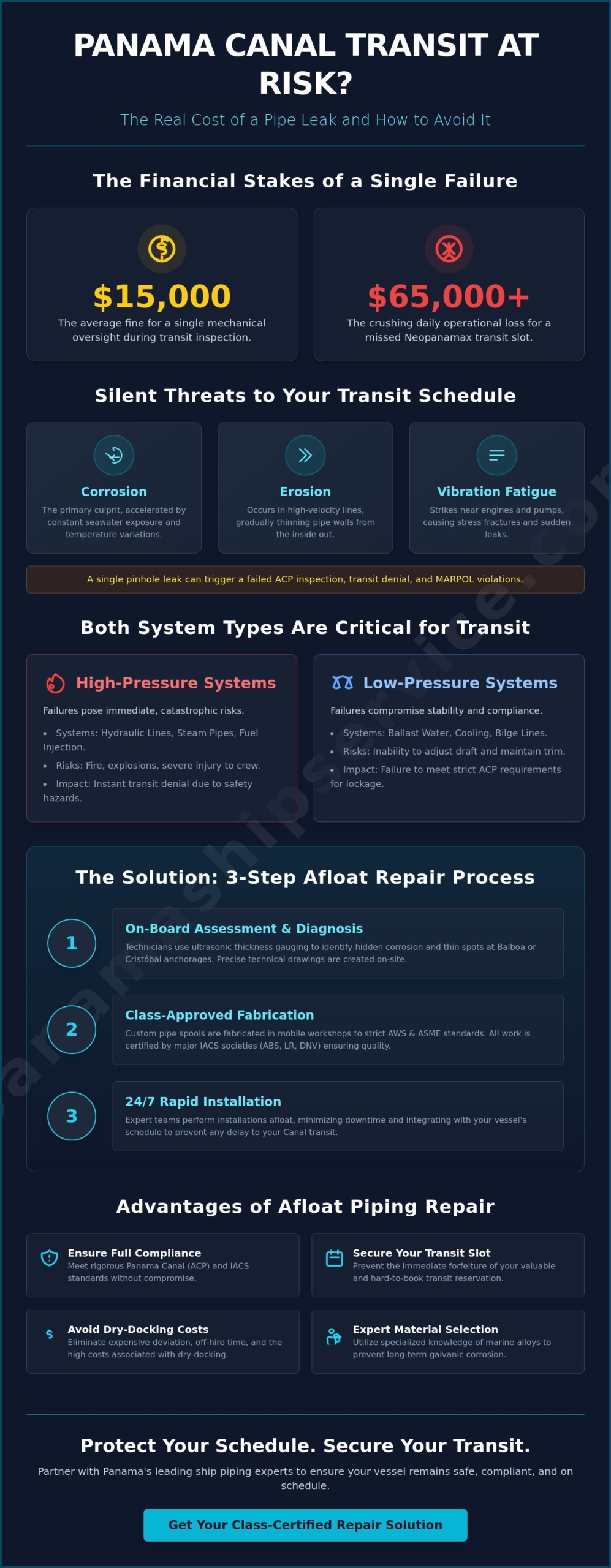
We recognize that every hour of off-hire time erodes your bottom line. This guide demonstrates how expert ship piping fabrication and repair services in Panama minimize downtime by delivering class-certified results right at the Balboa or Cristóbal anchorages. By utilizing technical expertise in diverse marine alloys, these services ensure your vessel remains compliant with IACS standards without requiring a costly deviation for dry-docking.
You’ll learn how to navigate the canal’s strict 2026 technical requirements while maintaining your transit reservation. We’ll preview the essential fabrication capabilities available in the region and explain how rapid, high-quality piping repairs prevent the immediate forfeiture of transit slots, keeping your vessel safe and your schedule intact.
Key Takeaways
- Understand why fuel and ballast line failures are critical and how identifying corrosion or vibration early prevents emergency transit delays.
- Learn how specialized ship piping fabrication and repair services utilize mobile workshops to provide technical support at all major Panamanian ports.
- Discover the importance of material compatibility and how selecting the right alloys for specific fluid types prevents long-term galvanic corrosion.
- Explore the logistical advantages of performing afloat repairs at Balboa or Cristóbal to avoid the high costs and scheduling conflicts of dry-docking.
- Identify the benefits of partnering with a local expert for comprehensive mechanical ship repairs to ensure your vessel remains fully class-compliant during its canal transit.
Common Ship Piping Failures and Their Impact on Transit
Ship piping functions as the vessel’s circulatory system. It carries the essential fluids required for propulsion and safety, including fuel, ballast water, and cooling agents. When these piping systems fail, the entire operation grinds to a halt. Maintaining these networks requires specialized ship piping fabrication and repair to meet the rigorous standards of international classification societies and the Panama Canal Authority (ACP).
Corrosion remains the most frequent driver of failure, often accelerated by the constant exposure to seawater and varying temperatures. Erosion occurs in high-velocity lines, while vibration-induced fatigue typically strikes near engines and pumps. A minor pinhole leak in a fuel line isn’t just a maintenance headache; it’s a trigger for a failed ACP inspection and immediate transit denial. Beyond schedule disruptions, piping failures present severe environmental risks. Leaking lines can lead to oil spills or MARPOL violations, which carry heavy fines and potential legal action in Panamanian waters.
The Consequences of Piping Leaks at the Panama Canal
Transit slots at the Panama Canal are rigid and highly competitive. If an inspector identifies a leak that threatens the safety of the locks or the crew, the vessel is ordered to anchorage for repairs. This results in lost transit fees and significant financial penalties. For Neopanamax operators, daily operational losses can exceed $65,000 during these off-hire periods. Safety hazards also escalate during lock operations, where high-pressure leaks can endanger both ship personnel and ACP line handlers. Rapid response is the only way to protect the bottom line and ensure the vessel meets its delivery window.
High-Pressure vs. Low-Pressure System Vulnerabilities
High-pressure systems, such as hydraulic lines and steam pipes, present the most immediate danger. A rupture in these systems can lead to catastrophic mechanical failure or fire. Conversely, low-pressure ballast water systems are critical for maintaining vessel stability and proper trim during the transit process. If a ballast line fails, the ship may not be able to adjust its draft to meet ACP requirements. Preventive inspection is vital before arriving at the Balboa or Cristobal anchorages. Identifying thinning pipe walls or weeping joints early allows for ship piping fabrication and repair to be completed afloat, preventing a minor technical issue from becoming a multi-day delay.
The Ship Piping Fabrication and Repair Process in Panama
Efficiency dictates the pace of maritime operations at the Panama Canal. When a vessel is at anchor in Balboa or Cristóbal, the window for technical intervention is narrow. Time is the enemy. Our mobile workshops provide a 24/7 response across all major Panamanian ports, bringing industrial-grade equipment directly to the ship’s side. This localized approach to ship piping fabrication and repair eliminates the need for vessels to deviate from their route. It keeps transit schedules intact. By integrating these services with broader mechanical ship repairs, we address the root causes of system failures rather than just treating the visible symptoms.
On-Board Inspection and Damage Assessment
The repair sequence begins with a rigorous technical assessment. Technicians utilize ultrasonic thickness gauging to identify internal corrosion and thin spots that aren’t visible to the naked eye. This data allows for the drafting of precise technical drawings for custom pipe spools while the ship is still operational. We coordinate closely with ship engineers to isolate specific systems. Safety is paramount. This phase strictly adheres to Ship’s piping systems regulations, guaranteeing that all safety protocols for pressure testing and isolation are met before any cutting begins.
Class-Approved Welding and Fabrication
Fabrication standards in Panama are governed by international maritime law. Quality is non-negotiable. Every weld performed on high-pressure systems or structural piping must comply with AWS and ASME standards. We prioritize Class approval from major societies like ABS, LR, and DNV to ensure that every ship piping fabrication and repair project is recognized by the Panama Canal Authority. To accelerate the process, pipe spools are often prefabricated in our shore-based facilities and then transported for final installation. This strategy significantly reduces the time a vessel remains immobilized. Non-Destructive Testing (NDT), such as dye penetrant or magnetic particle inspection, is used to verify the integrity of every joint. For vessel managers, securing professional ship repair services in Panama ensures that these technical hurdles don’t become operational roadblocks.
Material Specialization: From Carbon Steel to Exotic Alloys
Marine environments demand material precision. Selecting the wrong alloy for a specific system doesn’t just invite corrosion; it guarantees premature failure. Proper ship piping fabrication and repair relies on matching material properties to the fluid type, temperature, and pressure of the system. High-temperature steam lines require vastly different metallurgical properties than low-temperature ballast water systems. We prioritize material compatibility to prevent galvanic corrosion. This electrochemical process occurs when two dissimilar metals are in electrical contact within an electrolyte like seawater. If technicians don’t manage these interactions during the fabrication stage, the more anodic metal will corrode at an accelerated rate.
Avoiding these interactions requires deep technical knowledge of the galvanic series and specialized insulation or welding techniques. Investing in superior materials for aggressive environments provides a significant long-term ROI by extending service life and reducing the frequency of emergency repairs at the canal anchorages. We focus on delivering solutions that withstand the unique stresses of trans-oceanic transit, ensuring that every replacement part meets or exceeds the original equipment specifications.
Copper-Nickel (CuNi) and Stainless Steel Systems
CuNi 90/10 is the gold standard for seawater cooling systems because of its inherent resistance to biofouling and stress corrosion cracking. It’s a specialized material that requires specific welding parameters to maintain its integrity. For fuel and chemical lines, 316L stainless steel offers the necessary corrosion resistance and strength. One of the most significant technical challenges involves welding dissimilar metals. This requires precise filler metal selection and heat control to prevent brittle intermetallic zones. Our technicians are experienced in these complex procedures, ensuring that the final install meets all class requirements and operational safety standards.
Carbon Steel and Galvanized Pipe Fabrication
Carbon steel remains the workhorse for non-critical systems, including air, vent, and sounding pipes. While more susceptible to corrosion than exotic alloys, it’s a cost-effective solution for many applications. We enhance the lifespan of these components through high-quality coating and galvanization. Galvanized pipe fabrication is particularly effective for systems exposed to atmospheric moisture but not continuous seawater immersion. When performing ship piping fabrication and repair for these systems, we focus on speed and reliability. This ensures that repairs are completed within the vessel’s stay in Panama without overcomplicating the technical requirements of non-pressure-critical lines.
Afloat vs. Underway Repairs: Maximizing Operational Efficiency
Choosing between afloat and underway repairs depends on the urgency of the system failure and the vessel’s upcoming schedule. Afloat repairs at the Balboa or Cristóbal anchorages represent the most strategic method for addressing immediate defects before a transit. This approach avoids the exorbitant costs and scheduling delays associated with emergency dry docking. By performing ship piping fabrication and repair while the vessel remains in the water, operators maintain their position in the transit queue while fulfilling strict technical requirements. It’s a pragmatic solution for a high-stakes environment.
Logistical coordination is the backbone of these operations. We manage the entire process, from initial damage assessment to final Class certification. This allows ship managers to focus on their primary mission while we handle the technical complexities of localized repairs. By utilizing specialized equipment designed for marine environments, we ensure that every repair is both durable and compliant with international maritime standards.
Minimizing Downtime at Panama Canal Anchorages
We handle the complex coordination with the Panama Canal Authority to secure the necessary repair permits. Efficiency is built into our workflow. We deploy barge-mounted cranes and fully equipped workshops directly to the anchorage, allowing for heavy piping fabrication without requiring the ship to dock. This mobile infrastructure ensures the vessel remains ready for its scheduled transit slot. Our teams work in parallel with other port operations, such as bunkering or crew changes, to maximize the utility of the vessel’s stay in Panamanian waters.
Riding Crews for Underway Piping Maintenance
When a system overhaul is necessary but doesn’t compromise immediate safety, riding crews provide a distinct advantage. These specialized teams board the vessel in Panama and perform maintenance as the ship continues to its next port of call. This is ideal for non-critical system upgrades or extensive ship piping fabrication and repair projects that require more time than a standard anchorage stay allows. We manage all logistical requirements for crew boarding and equipment mobilization, ensuring the riding crew is self-sufficient and doesn’t interfere with the ship’s daily operations.
Safety protocols for hot work are non-negotiable. Every task performed while the vessel is operational requires rigorous gas-free testing and constant fire watch supervision. These measures protect the crew, the cargo, and the vessel’s integrity during complex fabrications. For operators seeking to eliminate transit delays, we offer expert mechanical ship repair services that prioritize both technical precision and operational speed.
Why Panama Ship Service is Your Strategic Piping Partner
Panama Ship Service stands as the definitive partner for operators navigating the logistical pressures of the Canal. We offer a comprehensive suite of mechanical ship repairs in Panama, designed to keep your vessel moving. When piping failures occur, our 24/7 emergency response ensures that technical experts are on-site immediately. We understand that in this industry, waiting isn’t an option. Our commitment to Class-approved quality means every ship piping fabrication and repair project we perform meets the highest safety standards, satisfying both ACP inspectors and insurance underwriters.
Comprehensive Marine Solutions Under One Roof
Consolidating your technical needs under one provider significantly reduces administrative overhead. By integrating ship piping fabrication and repair with other critical tasks, such as underwater hull services and marine surveys, you simplify your port stay. This holistic approach allows our teams to identify and resolve multiple issues simultaneously. We maintain a robust inventory of marine-grade spare parts and specialized alloys, ensuring we have the materials required for immediate action. You won’t waste time waiting for international shipments when your transit slot is on the line.
Reliability and Transit Optimization
Our track record in meeting tight deadlines is proven across thousands of transits. We’ve built our reputation on being a grounded, reliable partner in one of the world’s most strategic maritime hubs. Panama Ship Service prioritizes the vessel’s schedule above all else. We don’t just fix pipes; we protect your operational window. Our local expertise in navigating Panamanian port logistics means we handle the permits, the transport, and the coordination so you don’t have to. We act as your eyes and ears on the ground, ensuring that technical hurdles never translate into financial losses.
Don’t let a leaking line compromise your transit booking. Contact our technical team today for an immediate piping repair assessment and secure your vessel’s operational efficiency.
Secure Your Transit with Expert Piping Solutions
Maintaining the integrity of your vessel’s circulatory system is essential for a successful Panama Canal transit. Selecting the right alloys and utilizing Class-certified welding are non-negotiable requirements for satisfying both safety standards and ACP regulations. By choosing afloat repairs at the Balboa or Cristobal anchorages, you eliminate the need for expensive dry docking and keep your vessel firmly on schedule. This strategic approach ensures that maintenance occurs without disrupting your commercial obligations.
Panama Ship Service provides the technical expertise and rapid response needed to handle any ship piping fabrication and repair challenge. Our 24/7 emergency response teams at both ends of the canal utilize ABS and Lloyd’s Register compliant welding to deliver permanent solutions. We prioritize your operational efficiency to ensure that technical failures never lead to forfeited transit slots or costly off-hire time. Our strategic hub location is designed specifically to minimize delays and maximize your fleet’s performance.
Don’t risk your schedule on unverified repairs. Request an Urgent Ship Piping Repair Quote today and ensure your vessel remains compliant and ready for transit. We look forward to supporting your vessel’s safe passage through Panamanian waters.
Frequently Asked Questions
Can ship piping repairs be performed while the vessel is afloat in Panama?
Yes, most piping repairs are conducted “afloat” at the anchorages in Balboa and Cristóbal. This allows your vessel to undergo essential maintenance without the need for a dry dock or route deviation. Performing repairs at anchor ensures that your ship remains in position for its scheduled canal transit while addressing critical leaks or system failures.
What Class approvals do you hold for marine pipe welding and fabrication?
Our technical services comply with the Unified Requirements of the International Association of Classification Societies (IACS). We provide welding and fabrication that meets the standards of major societies, including ABS, Lloyd’s Register, and DNV. This ensures that all repairs are recognized as class-compliant by the Panama Canal Authority during pre-arrival inspections.
How quickly can a repair team mobilize for a leaking pipe at the Balboa anchorage?
We provide 24/7 emergency response for urgent piping failures at all major Panamanian ports and anchorages. Because our teams and mobile workshops are based locally, we can often mobilize within hours of a service request. This rapid intervention is critical for avoiding the $15,000 fines associated with mechanical oversights during canal transits.
Do you provide piping fabrication for Ballast Water Treatment System (BWTS) installations?
Yes, we offer specialized ship piping fabrication and repair for BWTS retrofits and installations. Our teams handle the entire process, from custom spool fabrication to final installation. We ensure that all materials and welds meet the technical requirements for ballast water management, helping you comply with both international MARPOL standards and ACP regulations.
What materials are best for seawater cooling systems to prevent corrosion?
Copper-Nickel (CuNi) 90/10 is the industry standard for seawater cooling systems due to its superior resistance to biofouling and corrosion. For other applications, we utilize 316L stainless steel or high-grade galvanized carbon steel. Selecting the correct material is vital to prevent galvanic corrosion and ensure the long-term reliability of your vessel’s cooling infrastructure.
Are your welders certified for high-pressure steam line repairs?
Yes, our welders hold certifications for high-pressure systems according to AWS and ASME standards. High-pressure steam and hydraulic lines require specialized welding procedures and rigorous testing to ensure safety. We utilize Non-Destructive Testing (NDT) to verify the integrity of every weld before the system is pressurized and returned to service.
Can you fabricate custom pipe spools based on digital technical drawings?
We can fabricate precise custom pipe spools using your digital technical drawings or measurements taken by our technicians during an on-board assessment. Our shore-based fabrication facilities allow us to prefabricate components while your vessel is still underway. This proactive approach to ship piping fabrication and repair significantly reduces the time your ship spends at anchorage.
Does Panama Ship Service coordinate with the Panama Canal Authority for hot work permits?
We manage all logistical coordination with the Panama Canal Authority (ACP) to secure the necessary hot work and repair permits. Our deep understanding of local port regulations ensures that all safety protocols are met without administrative delays. You can delegate these complex coordination tasks to us, allowing your crew to focus on standard vessel operations.