
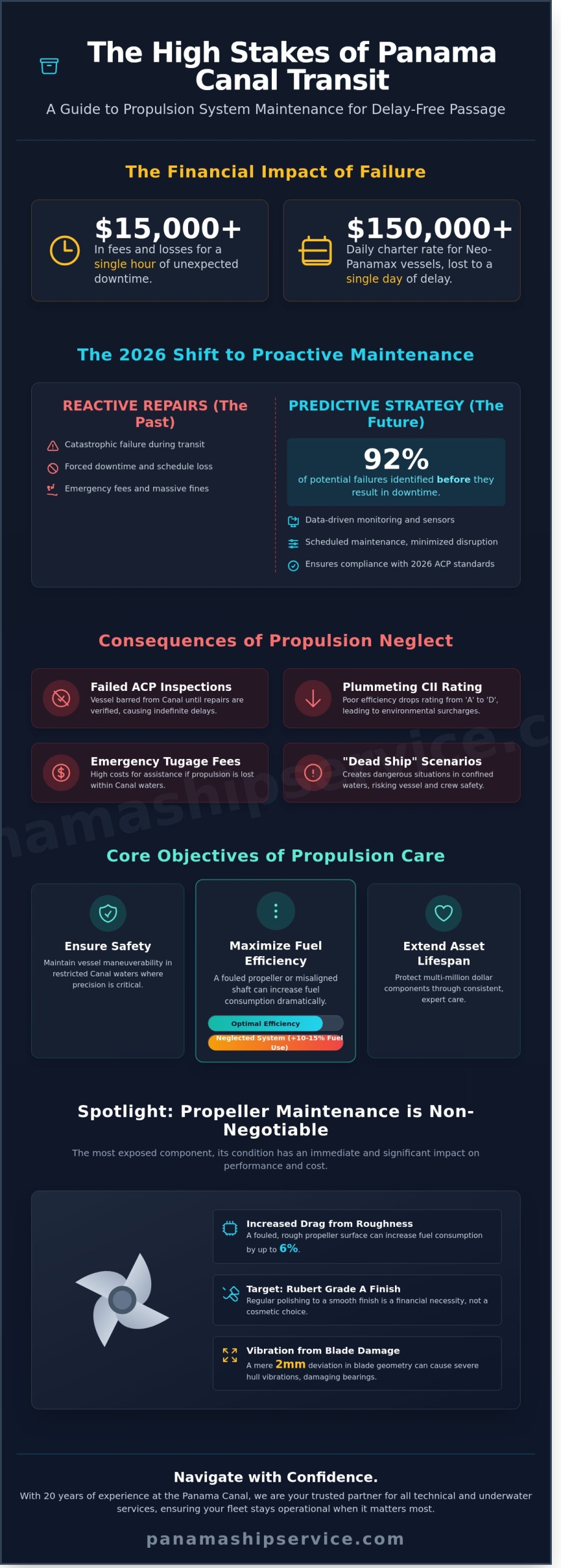
A single hour of unexpected downtime in the Panama Canal can cost a ship owner upwards of $15,000 in late fees and operational losses. You know that keeping a vessel on schedule is getting harder as ACP regulations tighten for the 2026 season. Misjudging your timing can lead to catastrophic expenses, which is why rigorous ship propulsion system maintenance is no longer optional. We have spent 20 years as a trusted partner at the canal, and we know that reliability is your most valuable asset. We are experts so you don’t have to be, ensuring your fleet stays operational when it matters most.
We agree that the complexity of underwater maintenance and the threat of vessel downtime are constant sources of anxiety for charterers. This guide will help you master the technical strategies required to ensure efficient, delay-free transits through the Panama Canal. You’ll learn how to secure Class-approved reports and improve fuel efficiency by at least 7% through proactive care. We will examine the specific mechanical protocols and 2026 inspection standards you need to stay compliant and profitable.
Key Takeaways
- Understand the high-stakes risks of propulsion failure and how to protect your vessel from the financial impact of Panama Canal delays.
- Identify the critical maintenance requirements for propellers and shafting systems to maintain maximum thrust and efficiency.
- Compare the cost-efficiency of in-water services against dry-docking to optimize your ship propulsion system maintenance budget.
- Implement a 48-hour pre-transit checklist to ensure your engineering team is fully prepared for the specific demands of the Canal.
- Learn how a “one-stop-shop” approach to technical and underwater repairs can streamline your operations and minimize vessel expenses.
What is Ship Propulsion System Maintenance and Why is it Critical?
Ship propulsion system maintenance is a rigorous, technical process that ensures every link in the power-to-thrust chain remains operational. It involves inspecting the main engine, shafting, bearings, and propellers to prevent catastrophic failure. For vessels navigating complex waterways, understanding the fundamentals of Marine Propulsion Systems is the first step toward operational reliability. We are the experts so you don’t have to be. Our role is to keep your vessel moving without interruption.
Timing is everything in the shipping industry. A failure during a Panama Canal transit creates a domino effect of expenses. Beyond the immediate safety risks, a vessel that loses propulsion in the locks faces massive fines and the loss of its transit slot. In 2023, daily charter rates for Neo-Panamax vessels often exceeded $150,000. Losing a single day to a preventable mechanical issue is a cost no owner wants to absorb. We provide the technical oversight to ensure your transit remains on schedule.
Operators must also meet strict International Maritime Organization (IMO) and classification society standards to remain seaworthy. The industry is rapidly moving toward predictive maintenance. By January 2026, data-driven monitoring will be the standard for anticipating component wear. This shift allows us to identify up to 92% of potential failures before they result in downtime. Using sensors and real-time data, we help you transition from reactive repairs to a proactive strategy.
The Core Objectives of Propulsion Care
Reliable ship propulsion system maintenance focuses on three primary goals. First, it ensures vessel safety and maneuverability in restricted Canal waters where precision is non-negotiable. Second, it maximizes fuel efficiency. A fouled propeller or misaligned shaft can increase fuel consumption by 10% to 15%. Finally, consistent care extends the operational lifespan of assets worth millions of dollars. We focus on these outcomes to protect your bottom line.
Consequences of Neglect: Delays and Fines
Neglecting your propulsion system leads to “dead ship” scenarios that are both dangerous and expensive. A vessel that fails an ACP pre-transit inspection will be barred from the Canal until repairs are verified. This neglect also impacts your Carbon Intensity Indicator (CII) rating. Since propulsion efficiency determines a major portion of your vessel’s emissions, poor ship propulsion system maintenance can drop your rating from an ‘A’ to a ‘D’ in a single season. Don’t risk your reputation or your budget on avoidable errors.
- Reduces the risk of emergency tugage fees in the Panama Canal.
- Ensures compliance with 2026 predictive maintenance data standards.
- Minimizes the likelihood of failing rigorous ACP safety inspections.
- Optimizes the CII rating to avoid environmental surcharges.
Put your transit in our hands. We understand the high-stakes environment of the Panama Canal and provide the specialized solutions you need to minimize expenses. Our team has 20 years of experience managing the technical challenges that keep ships moving. We are your trusted partner for all technical services at the Canal.
Key Components of Marine Propulsion Systems and Their Maintenance
Effective ship propulsion system maintenance requires a deep understanding of the mechanical synergy between underwater hardware and internal machinery. Every component must operate within strict tolerances to prevent catastrophic failure during transit. In the high-pressure environment of the Panama Canal, a 5% drop in propulsion efficiency can lead to significant scheduling delays and increased fuel costs. We focus on the critical points where mechanical stress and environmental factors intersect.
Propeller Maintenance: More Than Just Cleaning
The propeller is the most exposed element of the propulsion train. Regular polishing is no longer just a cosmetic choice; it’s a financial necessity. By 2026, many global fleets are targeting a Rubert Grade A finish as a standard to maximize fuel savings. A rough propeller surface increases drag and can raise fuel consumption by up to 6%. During inspections, technicians look for cavitation damage, which typically manifests as small pits on the blade surface. If left untreated, these pits grow into larger structural deformations. Edge repairs are equally vital. A 2mm deviation in blade geometry can cause severe hull vibrations that damage internal bearings.
Internal Mechanical Systems
Power starts at the main engine and travels through the shaft coupling. This connection must handle massive torque loads without slipping. We monitor these systems using specific tools like the poker gauge to measure bearing wear-down. This allows for precise data collection without the need for immediate dry-docking. Modern maintenance schedules now prioritize Environmentally Acceptable Lubricants (EAL). Transitioning to biodegradable oils ensures that your vessel meets 2013 VGP (Vessel General Permit) requirements while protecting the shafting from friction-related heat. If you need assistance with these technical inspections, consider a professional underwater survey to verify your system’s integrity.
- Shaft Alignment: Misalignment of just 0.5mm can lead to rapid bearing failure and localized overheating.
- Stern Tube Seals: These seals prevent seawater from entering the engine room and oil from escaping into the ocean. A leaking seal can result in fines exceeding $25,000 in certain jurisdictions.
- Steering Gear: The rudder and its hydraulic actuators are critical for the tight maneuvers required in the Culebra Cut. We recommend testing the full 35-degree swing of the rudder every 24 hours before entering restricted waters.
The steering gear must be responsive. In the Panama Canal, the narrow channels leave zero room for mechanical hesitation. Maintenance involves checking hydraulic pressures and ensuring the rudder stock is free of marine growth. Even a small amount of barnacle accumulation on the rudder can reduce steering response time by 15%. Regular grease injection into the rudder carrier bearings prevents the seizing that leads to emergency steering situations. Proactive ship propulsion system maintenance keeps your vessel compliant and safe during every mile of the transit. We provide the technical expertise to manage these complex systems so you can focus on your operational goals.
Strategic Maintenance: In-Water Services vs. Traditional Dry-Docking
Panama Canal transit schedules leave zero room for error. If your vessel requires ship propulsion system maintenance, choosing between a dry-dock and an in-water intervention determines your profit margin for the quarter. Traditional dry-docking fees and off-hire losses often exceed $165,000 per day for Neo-Panamax vessels. We provide the “Panama Advantage” by performing critical repairs while you wait for your transit slot. This eliminates the need to deviate to a distant shipyard, saving your operation approximately 5 to 9 days of transit time. Our divers work while your vessel is at anchor, turning mandatory downtime into productive maintenance windows that protect your bottom line.
Cost-benefit analyses show a stark contrast in operational expenditure. A typical dry-docking cycle costs between $1.2 million and $3.5 million depending on the vessel class. In contrast, targeted underwater interventions cost a fraction of that amount, often ranging from $25,000 to $55,000. UnderWater Inspection in Lieu of Dry-docking (UWILD) is now a class-approved standard by major societies like ABS and Lloyd’s Register. These surveys allow us to verify the integrity of your hull and propulsion gear without lifting the ship. By 2026, technological advances in hyperbaric welding and modular cofferdams allow our teams to perform complex stern tube seal replacements without draining the oil system. These specialized tools ensure your ship propulsion system maintenance is handled with surgical precision, preventing environmental leaks and costly fines.
When In-Water Maintenance is Sufficient
Routine hull cleaning and propeller polishing are the most effective ways to maintain efficiency. These services can restore vessel speed by 1.4 knots and reduce heavy fuel oil consumption by 10% to 15%. We use high-definition CCTV underwater inspections to provide immediate damage assessment after minor groundings or debris strikes. Our teams also handle anode replacement and ICCP system maintenance to prevent galvanic corrosion. These tasks are completed in hours, not days, ensuring you stay on schedule. We provide detailed reports that satisfy both owners and insurance adjusters immediately after the dive.
The Limitations of Underwater Repair
In-water services cannot solve every problem. Major structural damage to the hull or a full tail-shaft replacement necessitates a dry-dock facility. We help you plan for these inevitable requirements by coordinating long-term maintenance with your Canal schedules. Panama Ship Service bridges the gap between emergency repairs and scheduled surveys. We provide temporary fixes and stabilization to ensure your vessel reaches its next major survey safely. Put your transit in our hands; we manage the technical details so you can focus on the cargo. We are experts so you don’t have to be.
A Preventative Maintenance Checklist for Propulsion Efficiency
Shipowners lose an average of $35,000 per day when a vessel is sidelined by avoidable mechanical failures. Effective ship propulsion system maintenance isn’t just about keeping the engine running; it’s about protecting your transit schedule and your bottom line. We are experts so you don’t have to be, and we know that a proactive approach is the only way to navigate the high stakes of the Panama Canal.
Every Chief Engineer must execute a rigorous propulsion verification 48 hours before arriving at the Canal breakwater. This window is critical for testing the main engine astern functionality and ensuring bow thrusters reach 100% load without tripping breakers. Since the 2024 updated ACP regulations, inspectors have increased their scrutiny of propulsion responsiveness. If your vessel can’t demonstrate immediate power changes, you risk being demoted to a later transit slot or being forced to hire additional tug assistance at a cost of $5,000 or more per hour.
The industry is moving toward a 2026-ready digital standard. This involves shifting from traditional hourly-based schedules to Condition-Based Maintenance (CBM). Instead of opening a gearbox simply because it reached 10,000 hours, you use vibration analysis and oil sample testing to determine actual wear. Modern vibration sensors can detect bearing misalignments as small as 0.05mm before they escalate into a catastrophic failure. Laboratory oil analysis should occur every 3 months to monitor for metallic particulates. Finding 5 to 10 ppm of chrome or tin in your sample is an early warning sign that saves you from a multi-million dollar drydock emergency.
Documentation is your primary defense during inspections. ACP inspectors and class surveyors look for clear, chronological evidence of maintenance. Your logs must show at least 24 months of consistent data to prove the vessel is seaworthy. Accurate record-keeping prevents the frustration of “vessel detained” notices that can ruin a charterer’s budget.
Daily and Weekly Operational Checks
Consistency is the foundation of reliability. Engineers must monitor stern tube oil consumption daily; any loss exceeding 5 liters per 24 hours suggests a seal breach that requires immediate attention. Weekly visual inspections of the steering gear are mandatory to catch hydraulic leaks or loose linkages in the hunting gear. Recording engine performance data, such as exhaust gas temperatures and turbocharger RPM, allows you to detect a 2% or 3% drop in efficiency that usually signals fuel injector wear or hull fouling.
The 6-Month “Deep Dive” Checklist
Every six months, your ship propulsion system maintenance should include a professional underwater hull and propeller inspection at Balboa or Cristobal. Marine growth can increase fuel consumption by 15% to 20% in tropical waters. During this dive, technicians must verify the integrity of rope guards and ensure fishing line cutters are sharp and unobstructed. This is also the time to test the emergency steering system under full load conditions to ensure the vessel remains maneuverable if the main hydraulic pumps fail.
Don’t let a maintenance oversight delay your transit. Schedule your pre-transit propulsion inspection with our expert technical team today.
Expert Propulsion Support with Panama Ship Service
Panama Ship Service has served as the trusted partner for ship owners and charterers at the Panama Canal for over 20 years. We recognize that the maritime environment is often difficult and frustrating. Costs continually increase and schedules are unforgiving. Our company operates on a clear philosophy: we’re the experts so you don’t have to be. We take the technical burden of ship propulsion system maintenance off your shoulders. This allows you to navigate the canal with total confidence in your vessel’s mechanical integrity. You focus on the cargo while we manage the machinery.
We offer a comprehensive one-stop-shop approach. By combining deep-water expertise with heavy mechanical repair capabilities, we resolve issues that would otherwise require expensive dry-docking. Our team understands the high-stakes nature of canal transits. Timing is everything. We prioritize rapid response and efficiency to ensure your vessel stays on schedule. Our technicians are available 24/7 at both the Atlantic and Pacific entrances to the canal. We provide the qualified, cost-conscious solutions you need to keep your fleet moving.
Our Mechanical and Underwater Capabilities
Our service menu covers every critical aspect of your propulsion and steering gear. We utilize specialized equipment to perform underwater propeller polishing to a Rubert Grade A standard. This specific process can improve vessel speed by at least 0.5 knots or reduce fuel consumption by up to 10% depending on the initial fouling. Our underwater hull cleaning services utilize hydraulic brush systems to remove marine growth without damaging expensive anti-fouling coatings. Our core capabilities include:
- Mechanical Repairs: On-site servicing for rudders, shafts, and industrial A/C systems. We handle complex shaft alignments and seal replacements directly at the anchorage.
- Class-Approved Surveys: We conduct Bunker, Draft, and Damage assessments that meet the strict requirements of international classification societies.
- Technical Inspections: We provide detailed underwater photography and CCTV video to document the condition of the propulsion train before and after service.
- Ancillary Services: Beyond propulsion, we manage MARPOL disposals and the procurement of Deratting Certificates to ensure total port compliance.
Secure Your Transit Success
Compliance is mandatory for a successful canal passage. We coordinate directly with the Panama Canal Authority (ACP) to ensure all repairs and ship propulsion system maintenance meet local regulatory standards. Our staff handles the logistics so your maintenance schedule doesn’t interfere with your assigned transit slot. We provide constant daily communication throughout the process. This transparency eliminates anxiety for shore-based managers and ship masters alike. You’ll always know the exact status of your repairs.
Our solutions are designed to minimize vessel expenses. We don’t just fix problems; we prevent them from delaying your journey. With two decades of experience at the Balboa and Cristobal anchorages, we have the local knowledge to navigate any administrative or technical hurdle. Put your transit in our hands and benefit from our professional, efficient service. We’ve optimized our workflows to deliver results faster than competitors, saving you thousands in potential port fees and fuel costs.
Timing determines your profit margin in this industry. Contact our team today for a rapid, competitive quote on your next service call. We are ready to deploy our experts to your location immediately to ensure your vessel remains seaworthy and efficient.
Secure Your Vessel’s Performance for the 2026 Transit Season
Maintaining a vessel’s heart requires more than just a basic checklist; it demands a strategic approach to ship propulsion system maintenance that balances routine inspections with advanced in-water services. By prioritizing preventative care and utilizing underwater hull cleanings, operators can reduce fuel consumption by up to 10% and avoid the massive costs of unscheduled dry-docking. Efficiency in the Panama Canal depends on your ability to react to mechanical issues before they escalate into expensive transit delays. We are experts so you don’t have to be.
Panama Ship Service brings over 20 years of experience to every job, providing a reliable shield against operational downtime. Our team consists of highly qualified technical personnel and certified divers who specialize in rapid response for emergency mechanical repairs. Don’t let a propulsion failure disrupt your schedule or inflate your operational budget. Put your transit in our hands and experience the reliability your fleet deserves at this critical global crossroads.
Contact Panama Ship Service for Expert Propulsion Maintenance and ensure your fleet remains ready for the rigorous demands of 2026 global trade. We’re ready to keep you moving forward.
Frequently Asked Questions
How often should a ship propulsion system be inspected?
Ship propulsion systems require a major inspection every 5 years during scheduled dry dock periods, with intermediate underwater surveys occurring every 2.5 years. Daily monitoring of lube oil quality and vibration levels is mandatory for the crew. Effective ship propulsion system maintenance prevents 85% of unexpected engine failures. We recommend monthly visual checks of shaft seals to avoid leaks that lead to environmental fines.
Can propeller polishing be done while the ship is at anchor in Panama?
You can perform propeller polishing at both the Pacific and Atlantic anchorages while waiting for your canal transit. Our specialized diving teams complete this task in 4 to 6 hours depending on the vessel size. This service is essential because a fouled propeller increases fuel consumption by 10% to 15% immediately. We coordinate with port authorities to ensure all permits are ready before our divers enter the water.
What are the most common propulsion failures for ships transiting the Panama Canal?
Steering gear malfunctions and main engine starting failures account for 40% of propulsion-related delays during Panama Canal transits. These issues often stem from contaminated hydraulic fluid or faulty air compressors. The Panama Canal Authority reports that 15% of mechanical delays involve thruster failures in the neo-panamax locks. We provide rapid response repairs to address these mechanical breakdowns and keep your vessel on schedule.
Is underwater welding for propulsion components class-approved?
Wet welding for minor propulsion repairs is class-approved by societies like ABS and Lloyd’s Register if performed by certified divers. Permanent repairs usually require a dry habitat or cofferdam to meet IACS standards for structural integrity. Over 90% of temporary underwater welds successfully hold until the next scheduled dry dock. We ensure all welding procedures follow AWS D3.6M specifications to maintain your vessel’s safety certification.
How much fuel can be saved by regular propeller maintenance?
Regular ship propulsion system maintenance, specifically propeller polishing to a Rubert Grade A finish, reduces fuel consumption by 3% to 8%. A rough propeller surface creates drag that forces the engine to work harder. For a large container ship, this translates to a daily saving of 2 to 5 tons of fuel. These savings often cover the cost of the diving service within the first 48 hours of steaming.
What documents does the Panama Canal Authority require regarding propulsion status?
The Panama Canal Authority requires a signed Vessel Information and Control System declaration confirming that all propulsion systems are 100% operational. Ships must also provide the last 3 months of engine room logs if a previous deficiency was noted. Failure to provide accurate data results in fines starting at 5,000 USD or a loss of your transit slot. We help you prepare this documentation for a seamless arrival.
How long does a typical underwater propulsion inspection take?
A standard underwater inspection of the propeller, shaft, and rudder takes between 2 and 4 hours to complete. This timeframe includes the setup of CCTV equipment and a full sweep of the stern gear. Our divers provide a detailed report and high-definition video footage within 12 hours of the dive. This speed is critical for vessels with tight windows before their scheduled Panama Canal pilot boarding time.
What is the difference between AC and DC ship propulsion systems in terms of maintenance?
AC propulsion systems require less frequent maintenance because they lack the carbon brushes and commutators found in older DC systems. DC motors need monthly brush inspections and cleaning to prevent 20% of common grounding faults. Modern AC variable frequency drives instead focus on cooling fan performance and capacitor health, with major overhauls occurring every 10 years. We’re experts in both systems so you don’t have to be.