
Paying $385,000 for a canal slot is a massive investment, but an engine failure during transit can trigger an immediate $250,000 ACP disruption charge that wipes out your voyage profits. You know that in 2026, timing is everything, and unpredictable ship repair costs panama can derail even the most meticulous budget. We’re experts so you don’t have to be, and we understand the pressure of keeping your vessel moving through this critical corridor without delay.
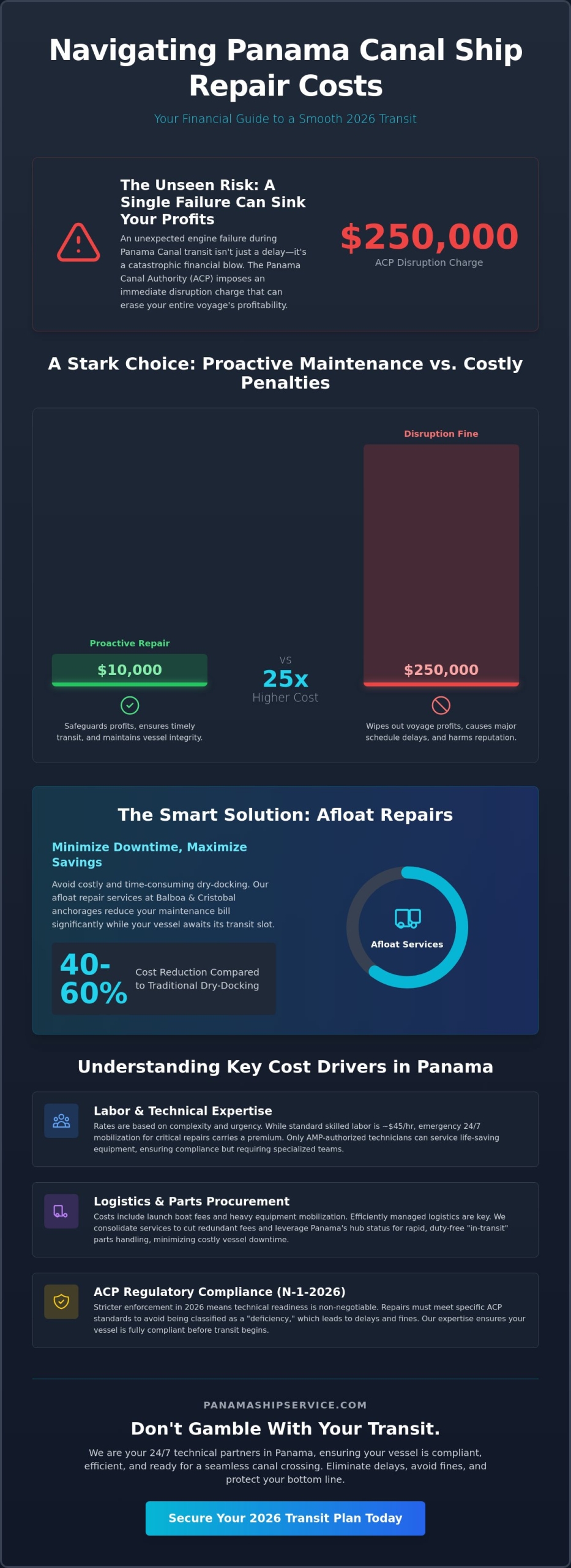
This guide provides a clear breakdown of commercial ship repair expenses, from $45 per hour skilled labor rates to the high price of avoiding Panama Canal Authority penalties. You’ll learn how the shift toward afloat repairs can reduce your maintenance bill by 40% to 60% compared to traditional dry-docking. We also preview the technical requirements of the ACP Notice to Shipping N-1-2026 to ensure you avoid fines, minimize downtime, and keep your 2026 transit schedule intact.
Key Takeaways
- Identify the specific pricing tiers for mechanical overhauls and steel fabrication to ensure your 2026 maintenance budget remains accurate.
- Learn how to manage ship repair costs panama by utilizing afloat services at Balboa or Cristobal anchorages to avoid expensive dry-docking.
- Understand the direct financial correlation between a $10,000 proactive repair and avoiding a $250,000 ACP disruption fine for engine failure.
- Discover how to eliminate deviation costs by scheduling technical services and surveys during your planned Panama Canal transit window.
- Evaluate the mobilization factors for specialized dive teams and marine engineers that impact the final cost of emergency underwater repairs.
Factors Influencing Ship Repair Costs in Panama in 2026
Operating a commercial vessel through the Panama Canal requires more than just fuel and a pilot. It demands technical readiness. In 2026, the variables affecting ship repair costs panama have shifted due to increased traffic and stricter enforcement of technical standards. While smaller vessel facilities list skilled labor between $30 and $45 per hour as of early 2025, commercial ship owners must account for the specialized nature of afloat repairs at major anchorages like Balboa and Cristobal. The final invoice isn’t just about man-hours; it’s about the technical expertise required to meet the Panama Canal Authority (ACP) Notice to Shipping N-1-2026 regulations.
Labor and Technical Expertise
Technical labor in the canal zone is priced based on the complexity of the machinery and the urgency of the arrival. Standard rates apply for scheduled maintenance, but emergency response for engine or steering failure carries a premium. Panama Maritime Authority (AMP) Circular MMC-258, updated April 15, 2026, mandates that only authorized providers can handle life-saving equipment repairs. This certification ensures compliance but limits the pool of qualified technicians. Because we provide 24/7 service availability, the cost reflects the immediate mobilization of experts who understand how to prevent a vessel from becoming a “deficiency” in the eyes of the ACP. Rapid response isn’t just a convenience. It’s a financial safeguard against the $250,000 disruption charges often levied for transit delays.
Logistics and Parts Procurement
Panama is a global logistics hub, yet the physical delivery of spare parts to a vessel at anchorage adds specific costs. Launch boat fees and mobilization of heavy equipment to Balboa or Cristobal can inflate a budget if not managed efficiently. Consolidation is the key to cost control. When we coordinate mechanical repairs alongside underwater hull services or MARPOL disposal, we eliminate redundant mobilization fees. “In-transit” spare parts handling allows for duty-free movement of critical components, provided the logistics partner understands the local customs framework. By leveraging the canal’s status as an energy and logistics hub, owners can source parts faster than in other regional ports, reducing the vessel downtime that often costs more than the repair itself. Efficiency in procurement directly impacts the total ship repair costs panama by ensuring the technical team isn’t waiting on a single valve while the transit window closes.
Breakdown of Common Repair Services and Pricing Tiers
Commercial operators often find that ship repair costs panama are influenced by the specific technical scope rather than just time at the pier. While the global ship repairing market continues to face inflationary pressures, Panama remains a strategic hub for afloat maintenance. This is especially true as traffic increased by 2.8% in January 2026, putting a premium on service availability at Balboa and Cristobal. Understanding the pricing tiers for mechanical, steel, and underwater work helps charterers avoid the sticker shock of emergency mobilization.
Mechanical and Engine Repair Costs
Mechanical ship repairs panama are a critical service for canal transit safety. Engine work generally falls into two categories: diagnostic troubleshooting and component replacement. Troubleshooting is labor-intensive and requires senior marine engineers, whereas part replacement costs are driven by the 2026 supply chain for OEM spares. In Balboa, emergency repairs for auxiliary power systems or A/C overhauls often involve rapid response teams to ensure the vessel meets the strict technical requirements of the ACP. We focus on getting the job done right the first time because we know a failed engine in the Culebra Cut is not an option. For complex overhauls, the total invoice will reflect the specialized tools and 24/7 labor required to meet a tight transit window. If you’re planning a technical stop, you can request a detailed quote to align your maintenance budget with current 2026 market rates.
Underwater and Hull Maintenance
Investing in underwater hull services is one of the most effective ways to manage long-term operational expenses. With fuel prices remaining volatile in 2026, a clean hull and polished propeller can significantly improve vessel performance. For smaller vessels, basic scraping and pressure washing were priced at $1.50 per foot as of early 2025, but commercial-scale operations involve much larger variables. Neopanamax vessels with beams up to 51.25 meters require extensive dive teams and specialized hydraulic cleaning equipment.
- Propeller Polishing: Routine polishing reduces cavitation and fuel consumption by approximately 3% to 5%.
- UWILD Inspections: Class-approved underwater inspections in lieu of dry-docking are essential for maintaining compliance without the high cost of hauling out the vessel.
- Hull Cleaning: Removing biofouling before a canal transit prevents speed loss and ensures the vessel stays within its calculated arrival time.
Mobilization costs for dive teams are most efficient when services are consolidated. Scheduling a hull cleaning alongside a marine survey or MARPOL disposal reduces the total mobilization fee, which is a significant portion of the underwater service invoice. We provide the technical expertise to handle these high-stakes tasks, ensuring your vessel remains compliant with international safety and structural integrity standards.
The High Price of Neglect: Disruption Charges vs. Repair Costs
Misjudging a minor mechanical glitch before entering the canal isn’t just a technical oversight; it’s a massive financial gamble. In 2026, the Panama Canal Authority (ACP) has intensified its enforcement of vessel readiness. While ship repair costs panama for proactive maintenance might seem like an added line item, they’re a fraction of the penalties for a mid-transit failure. For example, an engine telegraph malfunction or a failure in the starting air lines can trigger “Disruption Charges” that range from $125,000 to $250,000. When you compare a $10,000 proactive component replacement to a $250,000 fine plus the loss of a $385,000 auction slot, the return on investment for maintenance is clear.
Beyond the immediate fines, structural neglect carries environmental risks. Bottom plating corrosion that leads to even a minor oil weep can result in staggering pollution fines and mandatory MARPOL disposal costs. We’ve seen cases where a simple welding job, if performed at anchorage before transit, could’ve saved an owner three weeks of detention and millions in legal and cleaning fees. Efficiency in this environment means addressing the small issues before they become canal-wide disruptions.
Financial Impact of Transit Delays
The true cost of a mechanical failure includes the snowball effect on your operational budget. If your vessel is unable to maintain the required RPMs or loses steering control, the ACP will mandate immediate tug assistance. These unplanned tug fees mount quickly and are billed on top of the disruption charge. Furthermore, if a failure causes you to miss your scheduled window, you’re looking at daily hire rates that continue to burn while you wait for a new slot. Utilizing mechanical ship repairs at the Balboa or Cristobal anchorages ensures your vessel meets the strict technical standards required to keep your transit on track and your budget intact.
Mitigating Risk with Proactive Surveys
The best way to avoid the ACP’s “deficiency” list is to identify problems before the official boarding officer does. Scheduling marine surveys panama provides an objective look at your vessel’s readiness through the lens of local regulations. These surveys categorize findings into ‘low impact’ and ‘high impact’ deficiencies based on the ACP Notice to Shipping N-1-2026. A pre-transit checklist should include:
- Testing the main engine astern power and starting air capacity.
- Verifying the accuracy and response time of the bridge telegraph.
- Inspecting hull integrity to prevent any potential fluid leaks.
- Checking that all steering gear meets the 2026 safety equipment standards.
We are experts so you don’t have to be. By identifying these issues at the anchorage, we can deploy rapid response teams to perform repairs afloat, ensuring you enter the canal with a clean bill of health and no risk of high-impact charges.
Strategic Budgeting: Panama vs. Global Repair Hubs
Budgeting for 2026 maintenance requires a shift from looking at simple labor rates to evaluating total operational impact. In the current maritime climate, the variables that define ship repair costs panama are increasingly tied to the speed of service and the avoidance of deviation. Research shows that opting for afloat repairs in Panama can reduce your total invoice by 40% to 60% compared to traditional dry-docking. This trend is driven by the high cost of taking a vessel out of service and the limited availability of regional yards. We’re experts so you don’t have to be, and we focus on delivering technical solutions that keep your vessel in the water and on schedule.
Minimizing Deviation and Downtime
Every mile your vessel travels away from its primary route to reach a repair yard is a drain on your voyage profits. By performing mechanical or underwater work in Balboa or Cristobal while you wait for your canal slot, you eliminate unnecessary fuel burn and crew overtime. Coordinating these technical tasks with MARPOL disposal panama creates a high-efficiency window where multiple compliance requirements are met simultaneously. This “Transit-Concurrent” maintenance strategy ensures that while your waste is being handled, your engine or hull is being serviced by authorized specialists. It’s a pragmatic approach that maximizes port time and protects your bottom line from the rising costs of dedicated repair stops.
Regional Comparison and Market Trends
Panama offers a technical service value that consistently outperforms neighboring Caribbean and Pacific hubs due to its deep pool of authorized specialists and robust maritime supply chain. While global inflation has impacted shipyard pricing across the board, the sheer volume of traffic at the canal helps in stabilizing ship repair costs panama through healthy competition and better labor availability. In 2026, the ability to source IACS-certified technicians 24/7 gives Panama a distinct edge over smaller regional ports that lack the same infrastructure. Our 20 years of experience as a trusted partner at the Panama Canal allows us to navigate these market shifts, ensuring you receive competitive rates without sacrificing technical quality or safety standards.
Consolidating your services with a one-stop-shop is the most effective way to control your 2026 budget. Managing a single vendor for surveys, mechanical repairs, and supplies reduces administrative friction and prevents mobilization overlaps. To get a transparent breakdown of expenses for your next transit, you can request a ship repair quote panama that accounts for your vessel’s specific technical needs and the current logistical landscape. Put your transit in our hands and let us help you minimize vessel expenses through proactive, expert-led maintenance. Contact us today for a custom service proposal.
Optimizing Your Bottom Line with Panama Ship Service
Managing ship repair costs panama effectively requires a partner who understands the high stakes of a canal transit. For 20 years, we’ve served as the trusted partner at the Panama Canal, providing owners and charterers with the technical expertise needed to avoid costly delays. We understand that in 2026, a single deficiency can derail your entire voyage. Our approach is built on transparency and cost-conscious solutions. This ensures you receive the highest standard of repair without the unpredictability often found in emergency maritime work. We focus on pragmatic results that protect your charter party agreements and vessel performance.
Consolidated Technical Solutions
Efficiency at the canal is achieved through consolidation. By integrating mechanical repairs, steel fabrication, and underwater services into a single operation, we eliminate the logistical friction of managing multiple vendors. We provide constant daily communication and rapid reporting. This gives ship managers real-time visibility into project progress and budget tracking. Our rapid response teams are qualified to handle everything from auxiliary power overhauls to class-approved underwater inspections. We’ve built a proven track record of ensuring ACP compliance, helping vessels navigate the strict requirements of the 2026 transformation decade without incurring disruption charges. Our goal is to minimize vessel expenses while maintaining total structural and mechanical integrity.
Next Steps for Your Vessel
Proactive maintenance is your strongest defense against unplanned expenses. Don’t wait until your vessel is at the lock entrance to discover a technical fault. Scheduling a pre-transit inspection allows our experts to identify and resolve issues while your vessel is at anchorage, keeping your schedule intact. We provide itemized, competitive quotes that reflect the current 2026 market conditions. This allows for accurate budgeting and financial predictability for your entire fleet. Whether you require a routine hull cleaning or an emergency engine overhaul, our teams are ready to mobilize 24/7 at both Balboa and Cristobal.
We are experts so you don’t have to be. Put your transit in our hands and ensure your vessel remains compliant, efficient, and profitable in this high-demand corridor. Our 20 years of experience at the canal is your guarantee of reliability and technical excellence. Contact Panama Ship Service for a competitive repair quote today and let our specialized teams secure your 2026 transit schedule.
Secure Your 2026 Transit with Proactive Technical Support
Navigating the 2026 maritime landscape requires technical precision and a clear understanding of the financial risks involved in canal transits. You’ve seen how proactive maintenance at the Balboa or Cristobal anchorages prevents the $250,000 ACP disruption charges that can cripple a voyage’s profitability. By addressing mechanical and structural issues before they become “deficiencies” under the ACP Notice to Shipping N-1-2026, you ensure your vessel remains on schedule. Managing ship repair costs panama isn’t just about the invoice; it’s about the value of uninterrupted operations in a high-stakes environment.
Panama Ship Service is your trusted partner at the Panama Canal with over 20 years of maritime expertise. We provide a one-stop-shop for MARPOL disposals, class-approved marine surveys, and rapid mechanical repairs. Our goal is to minimize your vessel expenses through efficient, consolidated services that get the job done right the first time. Put your transit in our hands and avoid the pitfalls of unpredictable regional pricing. Get a Competitive Ship Repair Quote for Your Panama Transit today and keep your 2026 budget on track. We’re ready to support your fleet’s success.
Frequently Asked Questions
How much does the Panama Canal Authority charge for vessel disruptions?
The Panama Canal Authority (ACP) imposes disruption charges ranging from $125,000 to $250,000 for vessels that suffer mechanical failures during transit. These fines are calculated based on the vessel’s dimensions and the specific location where the incident occurs. These penalties are billed in addition to any required tug assistance fees or costs associated with losing a scheduled auction slot.
What are the most common mechanical failures that lead to fines in Panama?
Steering gear malfunctions and engine telegraph failures are the primary technical issues that trigger ACP penalties in 2026. Faulty starting air systems that prevent a vessel from reversing its engine also lead to immediate fines. Ensuring these systems comply with the technical standards in the ACP Notice to Shipping N-1-2026 is the most effective way to avoid these charges.
Can repairs be performed while the vessel is waiting for canal transit?
Repairs are routinely performed at the Balboa and Cristobal anchorages while vessels wait for their scheduled transit window. This “afloat” service model allows technical teams to complete mechanical or underwater work without the vessel ever leaving its route. We coordinate these interventions to ensure all technical deficiencies are resolved before the canal pilot boards the vessel.
Is it cheaper to perform hull cleaning in Panama or at a dry dock?
Performing hull cleaning afloat in Panama is typically 40% to 60% cheaper than traditional dry-docking. This approach eliminates the high cost of hauling out the vessel and reduces downtime to a matter of hours rather than weeks. According to 2026 performance data; a clean hull also improves fuel efficiency by 3% to 5% during the subsequent voyage.
What documentation is required for class-approved repairs in Panama?
Class-approved repairs require technical reports that meet the International Association of Classification Societies (IACS) Unified Requirements. Technicians must provide material certificates for steel work and detailed service entries for mechanical overhauls. We handle all necessary documentation to ensure your repairs are recognized by your classification society and the Panama Maritime Authority (AMP).
How do I avoid emergency ship repair costs during a canal transit?
The best way to manage ship repair costs panama is to schedule a proactive marine survey at least 48 hours before your canal entry. These inspections identify “high impact” deficiencies that would otherwise be flagged by ACP boarding officers. Addressing minor mechanical issues at the anchorage prevents them from escalating into emergency repairs that carry premium labor rates and disruption fines.
What is the typical lead time for mechanical parts in Panama?
Standard mechanical parts generally have a lead time of 24 to 72 hours due to Panama’s status as a global logistics hub. The “in-transit” customs framework allows for the duty-free movement of critical spares directly to vessels at anchorage. We leverage our local supply chain to source and deliver OEM components faster than most other regional ports.
Does Panama Ship Service provide 24/7 emergency support?
Yes, we provide 24/7 emergency technical support for all vessels at the Panama Canal anchorages and terminals. Our rapid response teams are always on standby to handle urgent mechanical failures or underwater hull issues. We are experts so you don’t have to be; you can mobilize our technical team at any hour to protect your transit schedule.