
Every day a vessel spends in drydock is a day of lost revenue. For ship owners and charterers, the high daily hire rates, limited slot availability, and complex logistics of traditional repairs represent a significant drain on operational budgets. The constant pressure to keep vessels moving makes any off-hire time a critical financial liability. But what if you could maintain Class compliance and execute essential maintenance without ever leaving the water?
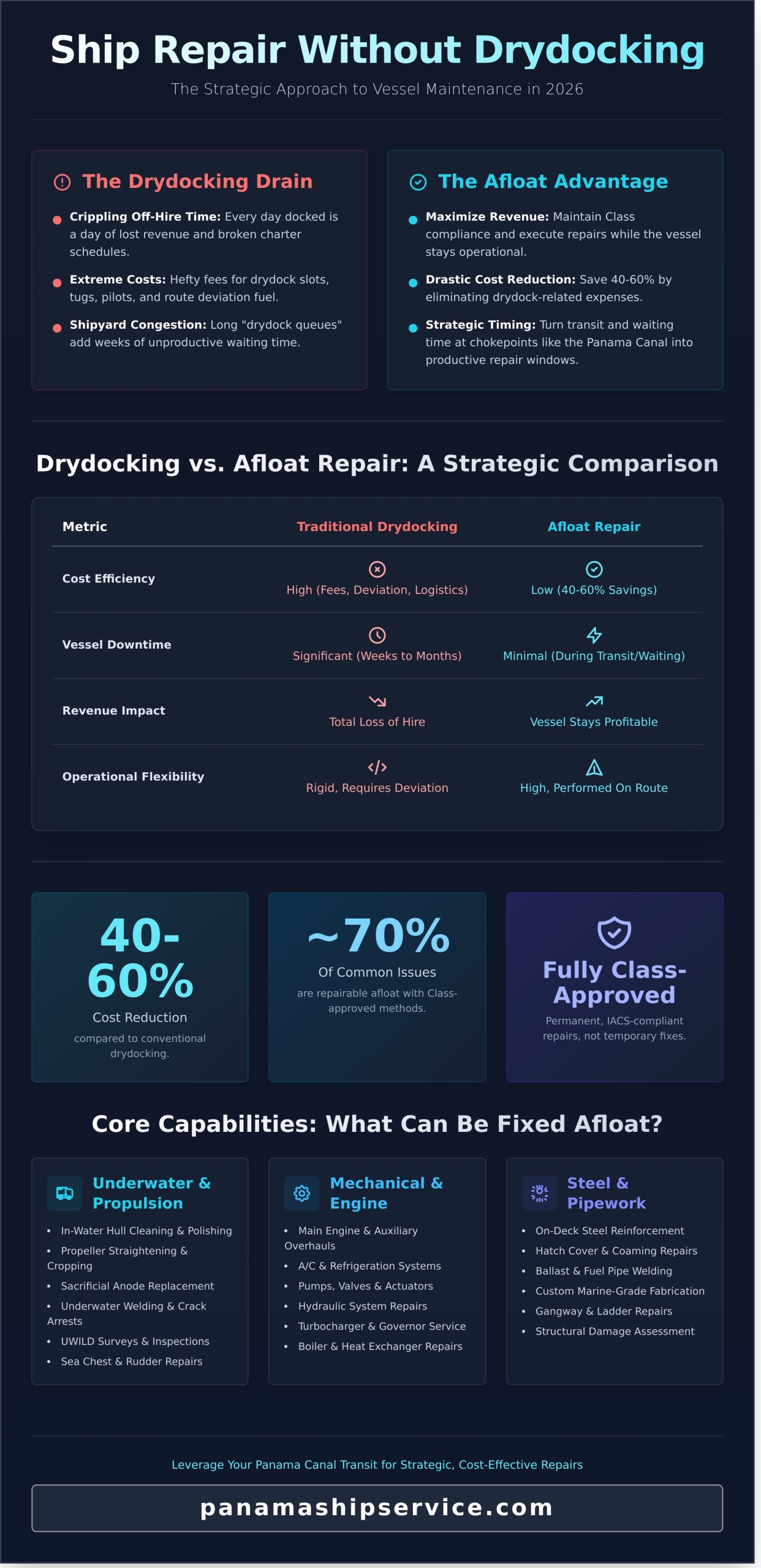
The solution is expert ship repair without drydocking, a strategic, cost-conscious approach to afloat maintenance that keeps your vessel on schedule. In this complete 2026 guide, we provide the definitive operational plan for leveraging afloat and underwater services at the strategic chokepoint of the Panama Canal. You will discover how qualified, Class-approved procedures can turn transit time into productive maintenance time, helping you minimize downtime and reduce repair costs by 40-60% compared to conventional drydocking.
Key Takeaways
- Understand the critical cost-benefit analysis between afloat repair and drydocking to significantly reduce your vessel’s off-hire time.
- Discover the extensive range of mechanical, structural, and underwater services available for ship repair without drydocking, maximizing operational readiness.
- Learn to identify the “red line”-the specific repairs that still require a drydock-to make informed and cost-effective maintenance decisions.
- Navigate the requirements for class society approvals (IACS) and UWILD surveys to ensure all afloat work is fully certified and compliant.
- Leverage your vessel’s waiting time at the Panama Canal as a strategic “repair window” to perform essential maintenance without impacting your schedule.
Understanding the Shift to Afloat Ship Repairs in 2026
The maritime industry is facing a critical inflection point. Escalating daily off-hire costs and congested shipyards are making conventional maintenance schedules untenable for cost-conscious owners and charterers. This economic pressure is accelerating the adoption of ship repair without drydocking-a strategic approach where essential maintenance is performed while the vessel remains waterborne, either at anchorage or alongside a pier. Unlike the lengthy and expensive process of traditional dry docking, afloat repairs minimize downtime and keep vessels generating revenue.
The Evolution of “Permanent” Afloat Repairs
What was once considered a temporary emergency fix has evolved into a permanent, Class-approved solution. Advances in underwater technology, such as hyperbaric “habitat” welding and specialized cold-bonding techniques, now meet and exceed the stringent standards set by classification societies. These expert interventions are no longer just patches; they are durable, long-term repairs. Afloat repair is now a Class-approved alternative to drydocking for an estimated 70% of common hull and engine issues.
Economic Impact on Vessel Operations
The financial advantages of embracing afloat repairs are direct and substantial. By avoiding the drydock, vessel operators can realize immediate and significant cost reductions that directly impact the bottom line. Key benefits include:
- Immediate Cost Savings: Eliminating expenses related to drydock fees, tugs, pilotage, and fuel for deviation. The vessel remains on its operational route, preserving charter hire revenue.
- Bypassing Shipyard Congestion: Afloat repairs circumvent the notorious “drydock queue,” which can add weeks of unproductive waiting time to a vessel’s schedule.
- Favorable 2026 Insurance Premiums: Proactive maintenance via afloat repairs is increasingly viewed favorably by insurers, who may offer better premiums to owners demonstrating a commitment to minimizing risk and operational downtime.
Global trade chokepoints like the Panama Canal have become pivotal hubs for these efficient interventions. By leveraging these strategic locations, owners can execute critical ship repair without drydocking, turning transit time into productive maintenance windows and securing a competitive edge in a demanding market.
Core Capabilities: What Can Be Fixed Without Drydocking?
The scope of afloat repair is far broader than many operators assume. Our services for ship repair without drydocking range from emergency interventions while a vessel is in transit (“In-Navigation” repairs) to extensive work at anchorage. The objective is always the same: restore operational integrity and maintain schedule without the extreme cost and delay of a drydock. Our qualified teams provide rapid, 24/7 response to execute critical tasks, ensuring your vessel remains compliant and profitable, especially when transiting high-traffic zones like the Panama Canal.
A persistent misconception in the industry is that any significant work on rudders or propellers mandates a trip to the shipyard. This is no longer the case. Modern techniques and specialized equipment allow our certified diver-technicians to perform complex underwater repairs, including propeller straightening and blade cropping, directly in the water.
Mechanical and Engine Room Interventions
Our expert technicians are equipped to perform comprehensive mechanical services while your vessel is at anchorage. This includes full overhauls of main engines and auxiliary machinery, troubleshooting and repair of A/C and refrigeration systems essential for tropical transits, and the replacement of critical pumps and valves-all executed without compromising vessel stability or operational readiness. We keep your engine room performing at peak efficiency.
Underwater Hull and Propulsion Services
We provide a full suite of underwater services designed to restore performance and ensure structural integrity. Our capabilities for afloat repair include in-water hull cleaning to reduce drag, propeller polishing with specialized hydraulic tools, sacrificial anode replacement, and underwater welding for crack arrests. All procedures are meticulously planned and executed in compliance with class requirements, such as the ABS Rules for Survey After Construction, ensuring your vessel remains fully certified.
Steel Fabrication and Pipework
Damage to steel structures and piping requires immediate, expert attention. Our mobile fabrication teams are deployed directly to your vessel to perform on-deck steel reinforcement, hatch cover repairs, and emergency welding of ballast or fuel system pipework. We can custom-fabricate marine-grade components on-site, providing a permanent, class-approved solution that gets you back on schedule without delay.
Drydocking vs. Afloat Repair: A Strategic Comparison
For ship owners and operators, the choice between drydocking and afloat repair is a critical business decision, not merely a technical one. The core objective is to maximize vessel availability and operational revenue. While traditional drydocking offers a controlled environment for extensive work, modern techniques in ship repair without drydocking provide a highly efficient and cost-conscious alternative for a wide range of maintenance tasks. This comparison outlines the key factors that drive a sound strategic decision.
The Cost-Benefit Decision Matrix
Analyzing the financial impact is the first step. Afloat repairs present a compelling case by directly targeting the largest expenses associated with drydocking: downtime and high shipyard fees. The financial calculus is clear:
- Direct Costs: Mobilizing a qualified dive and repair team to a vessel’s location is significantly less expensive than the combined costs of pilotage, tugs, and docking fees required for a shipyard period.
- Opportunity Cost: The most significant saving is in vessel availability. A 14-day drydocking period represents 14 days of lost charter revenue. In contrast, a targeted 3-day afloat repair keeps the vessel in a “charter-ready” state, minimizing off-hire time.
- Specific Savings: For routine maintenance like hull cleaning, the savings are substantial. Performing this service in-water can cost up to 40% less than the equivalent service in a drydock, without sacrificing quality.
Scope and Complexity Limitations
While afloat repair offers immense advantages, it is crucial to recognize its operational limits. Not all work can be safely or effectively performed while waterborne. Understanding this “red line” is key to effective maintenance planning.
- Ideal for Afloat Repair: Minor to medium-scope tasks are perfectly suited for in-water service. This includes propeller polishing, hull cleaning, anode replacement, sea chest grating repairs, and minor Class-approved weld repairs.
- Drydock-Mandatory Repairs: Major structural work, such as significant steel replacement below the waterline, major collision damage repair, tail shaft withdrawal, or servicing main propulsion systems, unequivocally requires a drydock. These are tasks where stability, safety, and regulatory compliance demand the vessel be out of the water.
A proactive, hybrid approach is the most effective strategy. By scheduling routine and medium-scope ship repair without drydocking, operators can defer non-critical issues and consolidate major work into planned drydocking cycles, optimizing both budget and vessel uptime.
Navigating Class Approvals and Safety Standards
Executing a successful ship repair without drydocking requires more than technical skill-it demands rigorous adherence to international standards and meticulous documentation. Navigating the complex requirements of Classification Societies and port authorities is a critical component of any afloat repair project. Failure to secure proper approvals can lead to significant delays, invalidating the cost and time savings of avoiding the drydock.
Securing Class Approval for Afloat Interventions
Gaining approval from a member of the International Association of Classification Societies (IACS) is non-negotiable. Before any work begins, our qualified team prepares and submits a comprehensive documentation package. This includes detailed repair procedures, material certifications, and the qualifications of the technicians and dive teams involved. This proactive approach ensures surveyors have everything they need for a swift review.
During the repair, transparency is key. We utilize real-time, high-definition video feeds for all Underwater Inspections in Lieu of Drydocking (UWILD) and subsequent repairs. This allows Class surveyors to witness the work live from any location, providing the direct oversight necessary to validate the quality and compliance of the intervention. This technology is fundamental to modern ship repair without drydocking, providing the verification needed to keep your vessel on schedule.
Upon successful completion, the final step is certification. The Class surveyor issues a formal approval, which is then meticulously recorded in the vessel’s logbook. This final entry ensures the repair is officially recognized, maintaining the vessel’s classification and seaworthiness for its onward journey.
Safety and Environmental Compliance
Operating in sensitive areas like the Panama Canal demands an unwavering commitment to safety and environmental regulations. Our procedures are designed to mitigate risk and ensure full compliance with international and local standards.
- MARPOL Compliance: All waste, slops, and contaminated materials generated during repairs are managed according to MARPOL annexes. We coordinate with certified disposal services to ensure all waste streams are handled responsibly and documented correctly.
- Risk Mitigation: For operations involving hot work or diving, we implement stringent safety protocols. This includes continuous gas monitoring, dedicated fire watches, and clear, established communication lines between the dive supervisor, the bridge, and the engine room.
- Pest Control: During extended anchorage for repairs, vessels may require services like fumigation to obtain or renew a Deratting Certificate, a requirement we manage efficiently to prevent port entry issues.
Constant communication is the foundation of a well-managed project. We provide a “Daily Report” to owners, operators, and Class surveyors, detailing progress, findings, and next steps. This ensures all stakeholders remain fully informed and aligned. Our expert team manages this complex coordination, ensuring your vessel remains compliant and on schedule. Put your repair in the hands of a trusted partner by contacting us at panamashipservice.com.
Optimizing Panama Canal Transits with Panama Ship Service
For any vessel operator, the waiting period for a Panama Canal slot can feel like costly, unproductive downtime. However, this “Panama Window” presents a strategic opportunity to perform essential maintenance and repairs without impacting your sailing schedule. With over 20 years of dedicated experience in the ports of Balboa and Cristobal, Panama Ship Service is your trusted partner, turning waiting time into productive, value-added service time. We transform potential delays into a competitive advantage.
Our approach is to serve as your single, reliable point of contact-a true one-stop-shop for all technical and operational needs. Instead of coordinating with multiple vendors in a complex environment, you make one call. We handle the rest, ensuring every service is executed with precision and efficiency, from complex afloat repairs to routine husbandry.
Strategic Logistics at the Canal
Maximizing your time at the canal requires flawless coordination. Our expert team manages a full spectrum of services concurrently to ensure your vessel is ready for its transit slot. We provide:
- Integrated Service Delivery: We seamlessly coordinate critical ship repair without drydocking alongside bunkering, provisions, and spare parts delivery, eliminating sequential delays.
- Rapid Bilateral Mobilization: Our specialized equipment and qualified technicians can be deployed swiftly to your vessel, whether it is anchored on the Atlantic or Pacific side of the canal.
- Comprehensive Vessel Management: While our technical teams are at work, we efficiently manage parallel operations, including crew changes, certifications, and cargo handling, to optimize every moment of your stay.
Why Panama Ship Service is the Trusted Partner
Our entire operation is built on a simple philosophy: “We are experts so you don’t have to be.” We simplify the complexities of port calls and afloat repairs, allowing you to focus on your core business. Our reputation is backed by a team of highly qualified technicians and Class-approved underwater dive teams capable of executing a wide range of tasks to the highest industry standards. When you need reliable and efficient ship repair without drydocking, you need a partner with proven local expertise. Get a competitive quote for your afloat repairs today and experience the PSS difference.
Don’t let your next Panama Canal transit be a source of frustration and expense. Contact Panama Ship Service for a rapid-response quote and let our team ensure your vessel is serviced, supplied, and ready for its voyage with minimal delay.
Partner with the Experts for Efficient Afloat Repairs
As we look towards 2026, the shift towards afloat maintenance is undeniable. This guide has shown that modern techniques and Class-approved procedures have transformed ship repair without drydocking from a temporary solution into a core operational strategy. By leveraging these services, ship owners and operators can significantly reduce downtime, control costs, and maintain operational momentum without the logistical complexities of a shipyard. The key is choosing a partner with proven expertise and a comprehensive service portfolio.
At the Panama Canal, Panama Ship Service is your trusted, one-stop-shop solution. With over 20 years of operational experience, our Class-approved underwater and mechanical teams are equipped to handle everything from complex repairs and surveys to MARPOL compliance. We are experts so you don’t have to be, ensuring your vessel remains on schedule and on budget.
Ready to ensure your vessel’s transit is smooth and cost-effective? Get an Expert Ship Repair Quote in Panama today.
Put your transit in our hands and navigate your operations with confidence.
Frequently Asked Questions About Afloat Ship Repair
Is ship repair without drydocking recognized by insurance companies?
Yes, major Classification Societies and insurers recognize ship repair without drydocking when executed by certified companies following approved procedures. P&I clubs and hull & machinery underwriters accept these repairs provided they are fully documented and class-approved. This ensures the vessel maintains its classification and insurance coverage without interruption. Our expert team handles all necessary coordination and certification to guarantee full compliance for your peace of mind.
Can a propeller be changed or repaired while the ship is in the water?
Absolutely. Our certified diver technicians are equipped for a range of underwater propeller services, including cropping bent blades, polishing for fuel efficiency, and complete propeller replacement. Using specialized habitats and cofferdams, we perform these complex tasks safely and efficiently while the vessel is at anchor. This targeted approach eliminates the need for drydocking, directly minimizing operational downtime and associated costs for ship owners and charterers.
How much time can I save by choosing afloat repair over drydocking?
The time savings are substantial. A typical drydocking can take weeks, factoring in deviation, docking, the repair period, and undocking. In contrast, many afloat repairs are completed in a matter of days, often while the vessel is at anchor awaiting transit or during cargo operations. This rapid turnaround keeps your vessel on schedule and in service, maximizing its revenue-generating potential by avoiding costly off-hire periods.
What is a UWILD survey and how does it help avoid drydocking?
A UWILD, or Underwater Inspection in Lieu of Drydocking, is a comprehensive survey of the vessel’s hull performed by certified divers under the direct supervision of a Classification Society surveyor. This inspection assesses the condition of the hull, rudder, propeller, and sea chests. A successful UWILD satisfies class requirements, allowing you to legally and safely postpone a mandatory drydocking, saving significant time and expense while ensuring full regulatory compliance.
What happens if a repair started afloat is found to be too complex?
Our process begins with a thorough assessment to ensure the feasibility of an afloat repair. If unforeseen complexities arise mid-job, our project managers provide an immediate, transparent evaluation. We then present all viable, class-approved options, which may include modifying the repair plan or, in rare cases, coordinating a seamless transition to a local repair facility. Our priority is always a safe, permanent, and cost-conscious solution for your vessel.
Are underwater welding repairs considered permanent or temporary?
Modern underwater wet welding, when performed by certified welder-divers according to Class-approved procedures, results in permanent repairs. We utilize advanced techniques and proprietary electrodes to achieve Class A welds that meet or exceed the structural integrity standards required for permanent classification. Temporary patches are only used for emergency situations or as an interim solution when a permanent repair is not immediately feasible due to operational constraints.
Can I perform engine overhauls while transiting the Panama Canal?
Yes, engine overhauls and other critical machinery maintenance can be efficiently performed while your vessel is transiting or awaiting its slot at the Panama Canal. Our qualified “riding squads” of marine engineers and technicians can board your vessel to carry out work without interrupting its voyage. This is a key strategy for effective afloat maintenance, turning non-productive transit time into productive repair time and maximizing your vessel’s operational availability.
What are the main environmental regulations for afloat repairs in Panama?
The Panama Maritime Authority (AMP) enforces strict environmental regulations to protect the Canal’s sensitive ecosystem. All afloat repairs must prevent any form of pollution. This includes mandatory containment measures for hull cleaning debris, proper disposal of all waste materials under MARPOL protocols, and the use of environmentally safe procedures for any underwater work. We are experts in these regulations and ensure all our operations are fully compliant.