
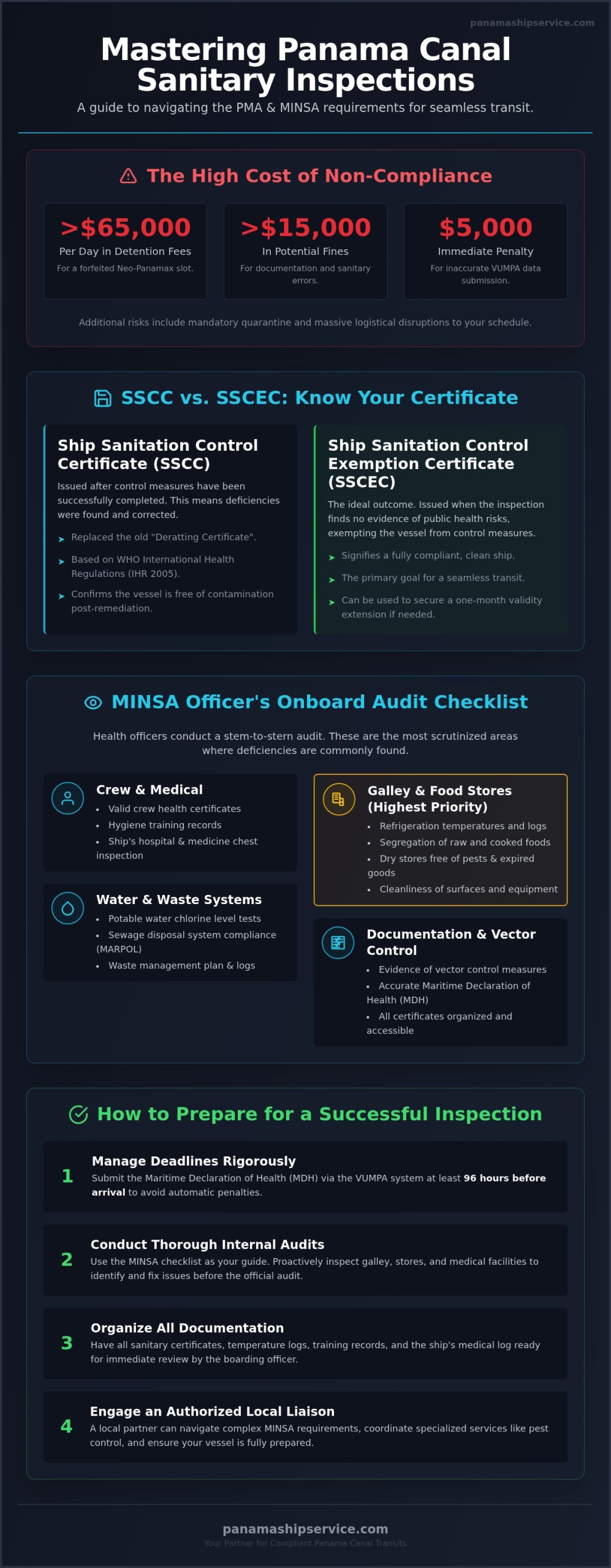
A single documentation oversight during a ship sanitary inspection in Panama can trigger daily detention fees exceeding $65,000 and fines of more than $15,000. For vessels transiting the Panama Canal in 2026, the margin for error has disappeared as the Panama Maritime Authority (PMA) shifts toward a strict Risk-Based Vessel Inspection Model. You’re likely facing the pressure of tight schedules while trying to decipher the technical differences between a Ship Sanitation Control Certificate (SSCC) and an exemption (SSCEC). It’s a high-stakes environment where local Ministry of Health (MINSA) standards often feel like a moving target.
We understand that your primary goal is a seamless transit without the threat of Neo-Panamax slot forfeitures. This guide provides the technical clarity you need to master the latest Panama Canal sanitary requirements and ensure your vessel remains compliant. You’ll learn how to manage the 96-hour VUMPA submission deadline and prepare your crew for a successful boarding officer visit. We’ll detail the specific steps required to achieve zero deficiencies and secure your certificates on time, allowing you to focus on your operational schedule.
Key Takeaways
- Learn how to navigate the transition from legacy Deratting Certificates to modern SSCC standards for a successful ship sanitary inspection in Panama.
- Pinpoint the most scrutinized areas of a stem-to-stern health audit, particularly the food storage zones where inspectors find the most common faults.
- Master the differences between SSCC and SSCEC requirements to maintain your certificate’s validity and secure a one-month extension when necessary.
- Prepare your bridge documentation and sanitary spaces using internal audit strategies that eliminate the risk of unexpected fines or delays.
- Discover the advantages of using an authorized local liaison to handle complex Ministry of Health requirements and specialized pest control services.
Understanding Ship Sanitary Inspections for Panama Canal Transit
The ship sanitary inspection panama is more than a bureaucratic formality; it’s a vital biosecurity measure designed to prevent the international spread of pathogens and vectors via maritime traffic. As a critical global chokepoint, the Panama Canal enforces some of the world’s most rigorous health standards. A valid Ship Sanitation Certificate is mandatory for all vessels entering these waters. This modern certification replaced the legacy “Deratting Certificate” under the International Health Regulations (IHR 2005). While the old system focused primarily on rodents, the current SSCC framework covers a broad spectrum of public health risks, including food safety, water quality, and vector control.
The Panama Ministry of Health (MINSA) holds the primary authority for conducting these audits. They act as the technical arm that ensures every vessel transiting the Isthmus meets both local and international hygiene benchmarks. Because Panama serves as a gateway between the Atlantic and Pacific, MINSA officers are notoriously thorough. They look for any evidence of contamination that could compromise the local ecosystem or the health of canal personnel.
The Legal Framework: WHO and the Panama Maritime Authority
Compliance in Panama is a coordinated effort between the Panama Maritime Authority (PMA) and MINSA. While the PMA manages the administrative and safety aspects of the registry, MINSA health officers enforce the IHR 2005 standards. Before arrival, vessels must submit a Maritime Declaration of Health (MDH) through the Vessel’s Universal Maritime Profile and Pre-Arrival (VUMPA) system. Failure to provide accurate data in this digital profile can lead to an immediate $5,000 penalty. This transparency allows authorities to assess risk levels before the boarding officer ever steps onto the gangway.
Why Timing Matters: The Cost of a Failed Inspection
In the high-pressure environment of the Panama Canal, time is the most expensive commodity. If a health officer finds discrepancies, they’ll issue a “Notice of Deficiency.” This doesn’t just mean paperwork; it often results in the vessel being held at anchorage. For a Neo-Panamax vessel, forfeiting a transit slot can cost over $65,000 per day in detention fees. When you factor in potential fines for documentation errors, which can exceed $15,000, the financial impact of a failed ship sanitary inspection panama becomes staggering. In extreme cases where vectors or infectious diseases are found, the vessel may face mandatory quarantine, effectively halting operations and causing massive logistical disruptions for the entire shipowner’s schedule.
What the Health Officer Checks: Key Inspection Points
The physical inspection serves as a comprehensive stem-to-stern health audit of the vessel’s entire living and working environment. Officers from the Ministry of Health (MINSA) follow the Panama Canal Authority’s official regulations to ensure no biological threats enter the waterway. During a ship sanitary inspection panama, the galley and food storage areas remain the most scrutinized zones. Any sign of non-compliance here can halt a transit immediately. Beyond food safety, the officer evaluates potable water systems for chlorine levels and inspects sewage disposal mechanisms to confirm they meet MARPOL and local standards. It’s a process that requires meticulous attention to detail, especially since this audit aligns with the data you’ve already submitted through the digital VUMPA system.
Food Safety and Galley Hygiene Standards
MINSA officers take a zero-tolerance approach to galley hygiene. They’ll verify that refrigeration units maintain correct temperatures, typically checking for the clear segregation of raw and cooked products to prevent cross-contamination. Temperature logs must be up to date and consistent. Dry stores are examined for signs of pest infestation, such as weevils or rodent droppings, and expired goods. Officers also inspect the cleanliness of food preparation surfaces and the condition of cooking equipment. You must also have crew health certificates and hygiene training records organized and ready for review. If your stores are running low or equipment needs repair before the officer arrives, coordinating with Panama Ship Service for supplies ensures you meet these standards without delay.
Medical Facilities and Vector Control
The ship’s hospital and medicine chest are critical components of the ship sanitary inspection panama. Health officers will review your inventory for expired supplies and ensure the facility is maintained in a sterile condition. Expired medications are a frequent cause for a Notice of Deficiency, so conducting a pre-arrival audit is essential. Don’t wait until you’re at anchorage to organize your documents. Vector control is equally vital in the tropical climate of the Isthmus. The inspector will search for rodents, cockroaches, and mosquitoes. They specifically look for standing water on deck or in lifeboats where mosquitoes could breed. You’ll need to present your last fumigation report and a current pest management plan to prove proactive control measures are in place.
SSCC vs. SSCEC: Which Certificate Does Your Vessel Require?
The outcome of a ship sanitary inspection panama is documented in one of two ways: a Ship Sanitation Control Exemption Certificate (SSCEC) or a Ship Sanitation Control Certificate (SSCC). Both documents are standardized under the International Health Regulations (IHR 2005) and maintain a validity period of 180 days. Understanding the difference is vital for your operational planning. An SSCEC is the goal for every vessel. It’s only issued when the health officer finds no evidence of public health risks, vectors, or contamination. It serves as proof that your ship’s hygiene standards meet the highest criteria. If an inspector identifies deficiencies, you’ll receive an SSCC instead.
Receiving an SSCC isn’t just a paperwork change; it carries mandatory legal obligations. This certificate details specific “control measures” that the master must implement. These might include immediate fumigation, disinfection of potable water tanks, or the disposal of contaminated stores. Failing to address these listed measures can lead to transit denials or heavy fines when entering subsequent ports. We recommend treating the ship sanitary inspection panama as a rigorous technical audit rather than a simple walkthrough.
When is an SSCC Issued?
A Control Certificate is triggered by any physical evidence of a health threat. The most common triggers include active rodent or cockroach infestations, standing water in lifeboats, or expired medical supplies. Panamanian authorities prioritize vector control above almost all else. If control measures are required, you must engage authorized technicians to perform the treatment. Once the fumigation or disinfection is complete and documented, the vessel can eventually return to exemption status during its next full inspection cycle. Proactive maintenance is the only way to avoid the administrative burden of an SSCC.
Managing Certificate Expiry at the Panama Canal
Operational delays at the canal can put your documentation at risk. If your certificate expires while you’re waiting for a transit slot, you don’t necessarily face an immediate crisis. Panamanian regulations allow for a 30-day grace period, during which you can apply for a one-month extension. This process is typically handled at the Port of Balboa on the Pacific side or Cristobal on the Atlantic side. Health officers will board the vessel to verify that current conditions haven’t deteriorated before granting the extension. For operators managing multiple compliance requirements simultaneously, our expertise in marine surveys in Panama provides a comprehensive solution for maintaining vessel readiness and avoiding costly downtime.
How to Prepare for a Sanitary Inspection in Panamanian Waters
Preparation for a ship sanitary inspection panama begins long before the pilot boards. You must conduct a comprehensive internal audit of all sanitary spaces at least 48 hours prior to arrival. This proactive approach identifies potential red flags that health officers prioritize. Focus your energy on a deep cleaning of the galley and food handling areas 24 hours before the visit. It’s not enough for surfaces to look clean; they must be free of grease, standing water, and any organic residue that attracts pests. A well-prepared galley often sets a positive tone for the remainder of the health audit.
Crew interaction is equally critical. Instruct your team to interact professionally and transparently with the Panamanian boarding officer. Provide a designated escort who is familiar with the ship’s sanitation systems and can answer technical questions immediately. Efficiency in response often signals a well-managed vessel, which can influence the officer’s overall assessment. Avoid unnecessary delays by ensuring all keys to locked storage areas or medical lockers are readily available.
Document Checklist for the Master
The Master must have a dedicated compliance folder ready on the bridge. This organization prevents delays and demonstrates operational proficiency. Your documentation package should include:
- The original copy of the previous SSCC or SSCEC.
- A signed Maritime Declaration of Health (MDH) matching the VUMPA submission.
- Recent potable water analysis reports from a certified laboratory.
- Ballast water management logs and bio-hazard logs.
- Garbage record books that align with your MARPOL disposal in Panama documentation.
Physical Preparation of the Vessel
Physical readiness extends beyond the galley. Ensure all floor drains and scuppers throughout the accommodation and engine room are clean, functional, and free of odors. Blocked drains are a common cause for a Notice of Deficiency. You must also verify that the ship hospital’s medical supplies are within their expiry dates; health officers will check these meticulously. Finally, confirm that all fly screens are intact and rodent guards are properly installed on all mooring lines. These simple barriers are your first line of defense against a failed ship sanitary inspection panama.
If your internal audit reveals gaps in supplies or requires professional pest management before the inspector arrives, contact Panama Ship Service to coordinate immediate support and ensure your vessel is transit-ready.
Efficient Sanitation Support with Panama Ship Service
Managing the logistical requirements of a ship sanitary inspection panama requires a partner with deep local roots and technical authority. Panama Ship Service acts as the expert liaison between your vessel and the Ministry of Health (MINSA), ensuring that every regulatory hurdle is cleared before your transit begins. We understand the high-stakes nature of canal scheduling. Our team provides 24/7 availability at both the Pacific and Atlantic terminals, allowing us to respond to your needs at Balboa or Cristobal without delay. By delegating the complexity of local bureaucracy to us, you can focus on the safe navigation of your vessel while we handle the compliance details that prevent costly detention fees.
Our role goes beyond simple coordination. We provide a comprehensive “one-stop-shop” advantage that streamlines your port call. Instead of managing multiple vendors for sanitation, repairs, and supplies, you can consolidate your requirements through a single, reliable partner. This approach doesn’t just simplify your communication; it optimizes your budget by reducing the overhead associated with multiple service providers. With over 20 years of maritime expertise in the region, we ensure that your vessel meets the strict 2026 standards enforced by the Panama Canal Authority.
Professional Fumigation and Pest Management
When a health officer identifies a need for control measures, immediate action is required to maintain your transit slot. Our authorized technicians perform specialized maritime pest control using advanced techniques such as fogging and precision gel applications. We prioritize the safety of your crew and the environment by utilizing eco-friendly, MARPOL-compliant chemicals that effectively eliminate vectors without leaving harmful residues. Once treatment is complete, we provide the official documentation required to secure a certificate approved by the Panama Maritime Authority. This proactive pest management is essential for vessels arriving from high-risk regions that must provide proof of treatment within the mandatory 72-hour window.
Consolidated Technical Services at the Canal
Operational efficiency is the cornerstone of a successful Panama Canal transit. Shipowners find significant value in combining their ship sanitary inspection panama preparation with other essential tasks. For instance, integrating sanitation services with mechanical ship repairs at the canal allows for synchronized scheduling, ensuring that all technical and health-related requirements are met during a single window of availability. Our local expertise allows us to navigate the specific demands of Panamanian maritime bureaucracy with speed and precision. We ensure all your documentation, from ballast water logs to fumigation reports, is organized and ready for inspection. Contact Panama Ship Service to schedule your sanitary inspection and fumigation today and secure your vessel’s timely transit through the waterway.
Mastering Seamless Compliance for Your Next Panama Canal Transit
Mastering the 2026 regulatory landscape requires more than just basic hygiene; it demands technical precision and strict adherence to the latest Panama Canal Authority standards. You’ve seen how a single documentation error in the VUMPA system or a failed ship sanitary inspection panama can lead to massive detention fees and forfeited transit slots. Success depends on proactive preparation, from deep cleaning the galley to organizing your SSCC documentation long before reaching the anchorage.
Don’t let bureaucratic complexity disrupt your operational schedule. With over 20 years of local expertise, Panama Ship Service is authorized by the Panama Ministry of Health to provide the critical support you need. We’re available 24/7 at both Balboa and Cristobal ports to coordinate inspections, fumigation, and certification. Our team acts as your on-the-ground expert, handling the technical details so your crew can focus on a safe passage. Secure Your Panama Canal Transit with Expert Sanitation Support and ensure your vessel remains compliant and on schedule. We look forward to being your reliable partner in the Isthmus.
Frequently Asked Questions
Is a deratting certificate the same as a Ship Sanitation Control Certificate?
No, the Ship Sanitation Control Certificate (SSCC) is the modern regulatory successor to the legacy deratting certificate. While the old system focused exclusively on rodent control, the SSCC framework implemented under IHR 2005 addresses a comprehensive range of public health risks. This includes food safety, vector control, and water quality. Vessels must carry the updated certification to comply with current Panama Canal Authority standards and international maritime health regulations.
How long is a Ship Sanitation Control Exemption Certificate valid in Panama?
A Ship Sanitation Control Exemption Certificate (SSCEC) is valid for 180 days from the date of issuance. This six-month period is standard across all international jurisdictions, including Panama. You must monitor this expiration date closely to avoid transit delays. If your certificate expires while you’re in Panamanian waters, you’ll need to schedule a new ship sanitary inspection panama to maintain compliance and ensure your vessel remains eligible for canal transit.
What happens if my ship fails a sanitary inspection in the Panama Canal?
Failing an inspection results in the immediate issuance of a “Notice of Deficiency.” Your vessel may be held at anchorage, leading to significant daily detention fees that can exceed $65,000. You’ll be required to implement specific control measures, such as professional fumigation or disinfection, before a new certificate is issued. These delays can cause you to forfeit your canal transit slot, resulting in massive operational costs and logistical disruptions for your fleet.
Can I get a 30-day extension on an expired SSCC in Panama?
Yes, you can apply for a one-time, 30-day extension if your certificate expires while the vessel is in transit or waiting for a slot. This grace period is typically granted at the Port of Balboa or Cristobal. A health officer will board the ship to verify that sanitary conditions remain acceptable before authorizing the extension. It’s a critical tool for managing unexpected canal delays, but it shouldn’t replace a full inspection scheduled in advance.
Does the Panama Canal Authority require a specific fumigation certificate?
The Panama Canal Authority requires fumigation certificates issued by technicians authorized by the Panama Maritime Authority and the Ministry of Health. Generic or foreign certificates may not be recognized if they don’t meet local 2026 biosecurity standards. Using a local, authorized partner ensures your documentation is MARPOL-compliant and matches the requirements of the boarding officer. This is especially vital for vessels arriving from designated high-risk regions that require proof of treatment.
Who is authorized to conduct ship sanitary inspections in Panama?
Only official health officers from the Panama Ministry of Health (MINSA) are authorized to conduct the ship sanitary inspection panama and issue the resulting certificates. While private agencies and ship service providers can coordinate the visit and perform necessary treatments like fumigation, they cannot perform the inspection itself. Ensuring your vessel is prepared for these government officers is the most effective way to secure a valid Ship Sanitation Control Exemption Certificate.
What are the most common deficiencies found during Panamanian ship inspections?
Inspectors frequently identify expired medical supplies in the ship hospital and improper food segregation in galley refrigeration units. Other common issues include blocked floor drains, missing rodent guards on mooring lines, and standing water in lifeboats where mosquitoes can breed. Documentation errors in the digital VUMPA system or incomplete ballast water logs also trigger frequent deficiencies. Addressing these specific physical and administrative areas during a pre-arrival audit significantly reduces the risk of transit delays.
Are crew health records checked during a ship sanitary inspection?
Yes, health officers meticulously check crew health records during the inspection. They verify that all food handlers possess valid health certificates and have received proper hygiene training. The inspector may also review the medical log to check for recent illnesses or outbreaks among the crew. Maintaining organized, up-to-date personnel records on the bridge is essential for a smooth audit and demonstrates the ship’s overall commitment to international health standards and crew welfare.