
Misjudging the timing of your ship sanitation certificate panama isn’t just a clerical mistake; it’s a logistical failure that can cost your charterer thousands in idle time. With the Panama Canal recording 6,288 vessel transits in the first half of fiscal year 2026, the margin for error with the Ministry of Health (MINSA) has never been thinner. You likely feel the pressure of coordinating inspectors across different terminals while fearing that one expired document will halt your transit entirely. It’s a high-stakes environment where timing is everything and costs continually increase.
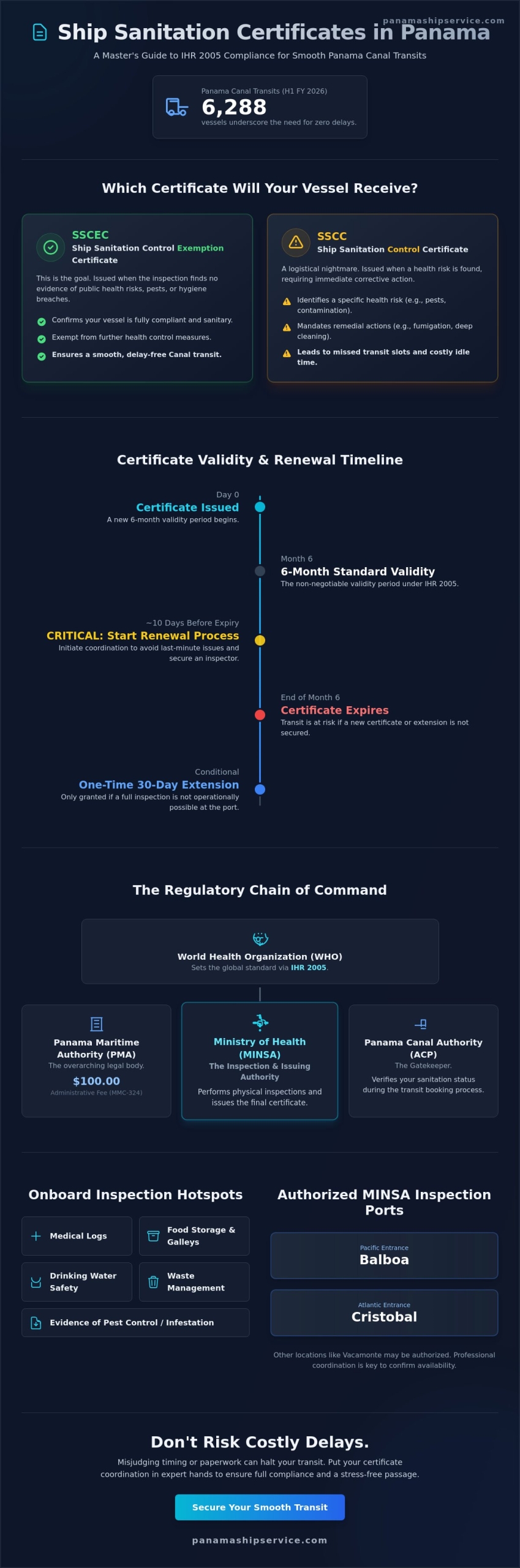
We understand that the terminology shift from “deratting” to IHR 2005 sanitation standards creates unnecessary confusion for even the most seasoned masters. This guide provides the clarity you need to secure your Ship Sanitation Control Exemption Certificate efficiently, ensuring a smooth and delay-free journey through the Canal. We’ll examine the latest 2026 requirements, the $100 administrative fees mandated by the Panama Maritime Authority, and the exact protocols for inspections at authorized ports like Balboa and Cristobal. We are experts so you don’t have to be. Put your transit in our hands and ensure full compliance without the stress of downtime.
Key Takeaways
- Understand the role of the Ministry of Health (MINSA) as the sole authority for issuing valid SSCEC and SSCC documents in Panama.
- Learn how to manage the strict six-month validity period and the specific conditions required for a 30-day extension.
- Discover the most efficient process to secure your ship sanitation certificate panama while complying with IHR 2005 standards and Panama Maritime Authority fees.
- Identify the critical documentation and physical inspection areas, such as medical logs and food storage, that must be ready before inspectors board.
- Find out how professional coordination at Balboa or Cristobal terminals prevents the common paperwork errors that cause costly Canal transit delays.
What is a Ship Sanitation Certificate in Panama?
The Ship Sanitation Certificate is a mandatory document governed by the International Health Regulations (IHR 2005). Its primary purpose is to identify and control public health risks on international vessels. In the maritime world, the old “Deratting Certificate” is a relic of the past. Today, the ship sanitation certificate panama represents a comprehensive health and hygiene standard that covers everything from waste management to the safety of drinking water and food storage. Because Panama is a global maritime crossroads, the Ministry of Health (MINSA) maintains rigorous oversight to prevent the cross-border spread of disease.
Panama’s role as a critical hub makes these inspections a routine yet high-stakes part of Canal operations. During the first half of fiscal year 2026, the Panama Canal recorded 6,288 vessel transits. This massive volume of traffic means that MINSA inspectors are highly experienced but operate on strict schedules. If your paperwork isn’t in order when you arrive at Balboa or Cristobal, the authorities won’t hesitate to delay your transit. We are experts so you don’t have to be; we ensure your vessel meets every technical requirement before the inspector arrives.
SSCEC vs. SSCC: Which Does Your Vessel Need?
There are two distinct types of certificates issued by Panamanian authorities. The Ship Sanitation Control Exemption Certificate (SSCEC) is what every master wants. It’s issued when the inspector finds no evidence of infection, pests, or hygiene breaches. It confirms your vessel is “exempt” from further control measures.
Conversely, the Ship Sanitation Control Certificate (SSCC) is issued if the inspection reveals a health risk. This document outlines the specific “controls” or remedial actions you must take, such as fumigation or deep cleaning. Receiving an SSCC in Panama is often a logistical nightmare. It usually means your vessel must remain at anchor for treatment, leading to missed transit slots and thousands of dollars in idle time. Our goal is to help you maintain a clean record and secure an SSCEC every time.
Validity and Extension Rules in Panama
A standard certificate is valid for exactly six months. This timeline is non-negotiable under international law. However, Panama provides a small window of flexibility through a one-time, 30-day extension. This extension is only granted if a full inspection cannot be performed at the current port due to specific operational constraints.
Timing is everything in this industry. You shouldn’t wait until the final 48 hours of validity to start the renewal process. With daily transit averages rising to 37 vessels in March 2026, the demand for MINSA inspectors is intense. We recommend starting the coordination process at least 10 days before your current certificate expires to ensure zero downtime. Put your transit in our hands to avoid the panic of an expiring document in the middle of a Canal booking window.
Regulatory Framework: PMA, MINSA, and IHR 2005
The regulatory landscape in Panama is a coordinated effort between three distinct local bodies and one international framework. At the global level, the World Health Organization (WHO) defines the operating standards through the International Health Regulations (IHR 2005). Panama strictly adheres to these rules to prevent the international spread of disease while avoiding unnecessary interference with maritime traffic. For ship owners, this means that securing your ship sanitation certificate panama requires meeting specific criteria that align with global health security protocols.
Locally, the Panama Maritime Authority (PMA) acts as the overarching legal body. Per Merchant Marine Circular MMC-324, the PMA charges a USD 100.00 administrative fee for statutory or technical certificates issued on its behalf. While the PMA sets the rules, the Ministry of Health (MINSA) is the agency that performs the physical inspections and issues the actual certificates. Finally, the Panama Canal Authority (ACP) acts as the gatekeeper. During the booking process, the ACP verifies your sanitation status. If your certificate is expired or invalid, your transit slot is at risk. We are experts so you don’t have to be; we manage the friction between these agencies to keep your vessel moving.
Authorized Ports in Panama for SSC Issuance
Inspectors are not available at every pier. In Panama, the primary authorized ports for issuance are Balboa on the Pacific side and Cristobal on the Atlantic side. Other authorized locations include Vacamonte and Charco Azul. With daily transit averages reaching 37 vessels in March 2026, terminal congestion is a constant factor. Whether you are docked at specialized terminals like PSA Panama or Manzanillo International Terminal (MIT), timing the inspector’s arrival is critical. To maximize your port call efficiency, we recommend coordinating these inspections alongside your scheduled marine surveys in Panama. Bundling these technical services reduces the logistical burden on your crew and minimizes the chance of a missed window.
The Legal Necessity of Fumigation and Pest Control
Panamanian law is clear regarding pest management. Certain vessel types or those arriving from specific high-risk regions may face mandatory fumigation requirements. MINSA only recognizes interventions performed by authorized pest control technicians who hold valid Panamanian certifications. During an inspection, you must provide documented proof of recent pest management. This includes:
- A detailed pest management log showing recent treatments.
- Certificates of fumigation issued by recognized providers.
- Inventory lists of onboard pesticides and application equipment.
Failing to produce these documents can trigger an immediate “Control” certificate (SSCC) instead of an “Exemption” (SSCEC). To avoid this, ensure your records are updated before arrival. If you are unsure about your vessel’s current compliance status, contact our team for a rapid response and expert guidance on local requirements.
The Inspection Process: What to Expect Onboard
The inspector’s arrival isn’t a formality; it’s a rigorous audit of your vessel’s hygiene ecosystem to secure your ship sanitation certificate panama. Once the MINSA official boards, the process begins with a deep dive into your documentation. You must have your medical logbooks, waste management plans, and previous SSC ready for immediate review. Any gap in these records can trigger further scrutiny. The inspector will cross-reference your MARPOL disposal records with your current waste storage to ensure full compliance. This initial phase sets the tone for the entire port call. We are experts so you don’t have to be; we ensure your crew is prepared and your records are flawless before the gangway is lowered.
After the paperwork is verified, the physical inspection moves through the vessel’s primary service areas. The inspector will visit the galley, food storage rooms, and dry provision lockers. They aren’t just looking for cleanliness; they’re looking for operational standards that meet IHR 2005 requirements. The inspection continues into crew quarters, hospital facilities, and potable water systems. Every area must demonstrate that it is free from health risks that could compromise the ship’s crew or the ports of call. This systematic approach ensures that nothing is left to chance during your stay in Panamanian waters.
Key Areas Evaluated by MINSA Inspectors
MINSA officials focus on three critical pillars: food safety, water safety, and vector control. For food safety, they check temperature logs for all reefers and the general hygiene of the galley. Water safety involves testing chlorine levels and reviewing maintenance records for storage tanks. Vector control is perhaps the most scrutinized area. Inspectors search for any evidence of rodents, cockroaches, or mosquitoes. Finding even a single sign of infestation can lead to the issuance of a Control certificate (SSCC) instead of an Exemption (SSCEC), which can immediately disrupt your transit schedule.
Issuance and Documentation Delivery
Once the inspection is successfully completed, the issuance of the ship sanitation certificate panama follows a specific administrative path. While the physical inspection happens onboard, the final hard-copy certificate requires official processing. As of April 1, 2026, the Panama Maritime Authority has streamlined the issuance of electronic certificates for seafarers, but physical stamps remain vital for many statutory ship documents. We coordinate the rapid delivery of these documents to ensure they are transmitted to the ACP for transit clearance. Don’t leave your Canal slot to chance. Put your transit in our hands to guarantee that your new certificate is correctly stamped and delivered without delay.
Avoiding Delays: Common Pitfalls and Compliance Tips
Mismanaging your ship sanitation certificate panama is the fastest way to lose your transit slot. The #1 cause of delay isn’t a mechanical failure; it’s an expired certificate discovered during the Canal booking window. With daily transit averages climbing to 37 vessels in March 2026, the Panama Canal Authority (ACP) has no patience for administrative oversights. If your SSCEC expires while you’re in the queue, you won’t just face a fine. You’ll likely be bumped to the back of the line, costing your charterer thousands in daily hire fees.
Failing an inspection often stems from poor record-keeping rather than actual hygiene issues. Inspectors scrutinize the medical and galley logs with clinical precision. If your temperature logs for the reefers have gaps or your medicine chest inventory is outdated, the inspector will issue a Control certificate (SSCC). Another dangerous pitfall is hiring unauthorized pest control vendors. Panamanian law requires technicians to hold specific PMA licensing. Using an unauthorized vendor to save a few dollars will result in your documentation being rejected by MINSA, forcing a costly re-inspection. We are experts so you don’t have to be; we only work with fully licensed partners to guarantee your compliance.
Pre-Inspection Checklist for the Crew
Success begins before the inspector boards the pilot ladder. Your crew must follow a strict cleaning protocol for all food preparation surfaces and grease traps. The medicine chest and medical log should be organized for rapid review, with all expired medications clearly segregated for disposal. Additionally, ensure that your MARPOL disposal in Panama is fully documented and up to date. Inspectors often check waste storage areas first. If they see an overflowing garbage room or missing disposal receipts, they’ll assume the rest of the ship’s hygiene is equally neglected.
Scheduling Your Inspection Around the Transit
Logistics are everything at the Canal. You should always schedule your inspection while at anchor before entering the locks. This prevents the inspector’s presence from interfering with critical navigation or mooring operations. To maximize your port call efficiency, we recommend coordinating the sanitation visit with other technical needs, such as bunker surveys or mechanical ship repairs. Managing multiple vendors creates a high risk of miscommunication. By using a “one-stop-shop” agency, you ensure that the MINSA inspector, the repair team, and the bunker barge don’t arrive at the same time. Contact Panama Ship Service today to coordinate your entire port call through a single, trusted partner.
Panama Ship Service: Expert Coordination for SSC
Securing a ship sanitation certificate panama shouldn’t be a source of anxiety for your crew or shore-side management. In the high-stakes environment of the Panama Canal, where timing is everything and costs continually increase, you need a partner who understands the local bureaucracy. Panama Ship Service has been in business for over 20 years, acting as a seasoned veteran in maritime logistics. We’ve built our reputation on being the indispensable “one-stop-shop” for owners and charterers who cannot afford a single hour of downtime. We are experts so you don’t have to be; we handle the complex coordination with the Ministry of Health (MINSA) while you focus on safe navigation.
Our role goes beyond simple agency work. We act as a direct liaison between your vessel and the Panamanian authorities, ensuring rapid inspector deployment regardless of which terminal you’re calling. Whether your vessel is at the Balboa anchorage or docked in Cristobal, we manage the inspector’s schedule to align with your port stay. This proactive approach eliminates the logistical bottlenecks that often occur during peak transit periods. By integrating your sanitation requirements with our broader suite of technical services, we provide a seamless operational experience that minimizes your administrative burden and protects your transit slot.
Why Choose Us for Your Sanitary Certification?
Efficiency in Panama requires constant daily communication and a rapid response to changing schedules. We provide real-time updates on inspector status and the progress of your document issuance, so you’re never left guessing about your compliance status. Our pricing is competitive and transparent. You won’t find hidden “emergency” fees in our quotes; we believe in building long-term trust through cost-conscious solutions. While your vessel waits for its new ship sanitation certificate panama, we can also coordinate a full suite of underwater hull services. This allows you to complete mandatory inspections and hull cleanings simultaneously, maximizing your time at the Canal.
Contact Us for Your Next Panama Canal Transit
Don’t let a clerical oversight at the 48-hour mark jeopardize your voyage. Putting your transit in our hands ensures that every detail, from the MINSA inspection to the final PMA stamp, is handled with professional precision. To request a quote for your SSC inspection or authorized fumigation services, we require the following information:
- Full vessel name and IMO number.
- Estimated Time of Arrival (ETA) at Balboa or Cristobal.
- The expiry date of your current Ship Sanitation Control Exemption Certificate.
- Any specific hygiene or pest control issues noted in previous inspections.
Timing is critical in the shipping industry. Reach out to our team today to ensure your vessel meets all IHR 2005 standards before arriving at the locks. Get a quote for your transit services today.
Secure Your Transit With Expert Sanitary Coordination
Maintaining a valid ship sanitation certificate panama is a non-negotiable requirement for a successful Canal crossing. The margin for error is non-existent when dealing with the Ministry of Health’s six-month validity rules and the Panama Canal Authority’s strict booking windows. A single documentation gap or a failed hygiene inspection can derail your entire schedule. This leads to significant financial losses for owners and charterers alike.
Panama Ship Service provides the specialized expertise needed to navigate these regulatory waters. With over 20 years of experience at the Panama Canal, we act as your authorized MARPOL and technical service provider. We are a true one-stop-shop for all your transit requirements, from sanitation inspections to mechanical repairs. We are experts so you don’t have to be. Put your transit in our hands to guarantee a smooth, compliant, and delay-free journey through the locks.
Request Your Ship Sanitation Certificate Coordination Now
Your next successful transit starts with professional preparation. We look forward to being your trusted partner at the Panama Canal.
Frequently Asked Questions
How long is a Ship Sanitation Control Exemption Certificate valid?
A Ship Sanitation Control Exemption Certificate (SSCEC) is valid for exactly six months from the date of issuance. This timeline is a strict international requirement under the IHR 2005 framework. You must ensure your certificate is valid for the entire duration of your stay in Panamanian waters, as an expired document will lead to an immediate transit block by the Panama Canal Authority.
Can I get an extension on an expired certificate in Panama?
Yes, you can secure a one-time 30-day extension if a full inspection cannot be performed at your current port. This extension is intended to allow the vessel to reach a port where a thorough inspection is possible. You should request this extension through your agent before the original six-month period expires to avoid fines or delays during the Canal booking process.
What is the difference between a Deratting Certificate and an SSCEC?
The SSCEC is the modern version of the old Deratting Certificate, reflecting broader health standards beyond just rodent control. While the old certificate focused specifically on rats, the ship sanitation certificate panama now covers food safety, water quality, and waste management. This shift occurred to align maritime health protocols with the comprehensive International Health Regulations (IHR 2005).
Are inspections available 24/7 at the Panama Canal terminals?
Inspections are generally available during standard Ministry of Health (MINSA) operating hours, though coordination for specific windows is necessary. While the Canal itself never closes, inspectors from MINSA usually board vessels during daylight hours or pre-arranged shifts at Balboa and Cristobal. We manage these appointments for you to ensure the inspector’s arrival doesn’t conflict with your pilot’s schedule.
Does every vessel transiting the Panama Canal need an SSC?
Yes, all international vessels transiting the Panama Canal must carry a valid Ship Sanitation Certificate. This is a mandatory requirement for the “N-1-2026 – Vessel Requirements” notice published by the ACP. Whether you carry a Control (SSCC) or an Exemption (SSCEC) certificate, the document must be issued by a competent authority recognized by the World Health Organization.
What happens if an inspector finds evidence of pests during the visit?
If an inspector finds evidence of pests like rodents or cockroaches, they will issue a Ship Sanitation Control Certificate (SSCC). This document mandates specific remedial actions, such as fumigation by a licensed Panamanian technician, before a new exemption can be granted. Failing to maintain a pest-free environment can result in your vessel being held at anchor, causing you to miss your transit slot.
How long does the physical inspection usually take for a commercial vessel?
A physical inspection typically takes between 2 and 4 hours depending on the vessel’s size and readiness. The process moves much faster when the crew has all documentation, such as medical logs and chlorine records, organized for the inspector. We are experts so you don’t have to be; we provide a pre-inspection checklist to help your crew minimize the time the inspector spends onboard.
Do I need to be at a pier, or can the inspection happen at anchor?
Inspections can happen at either a pier or at a designated anchorage, such as the Balboa or Cristobal outer anchorages. For many operators, conducting the inspection at anchor is the most cost-effective way to secure a ship sanitation certificate panama without paying additional berthing fees. We coordinate the launch service to transport the MINSA inspector to your vessel safely and efficiently.