
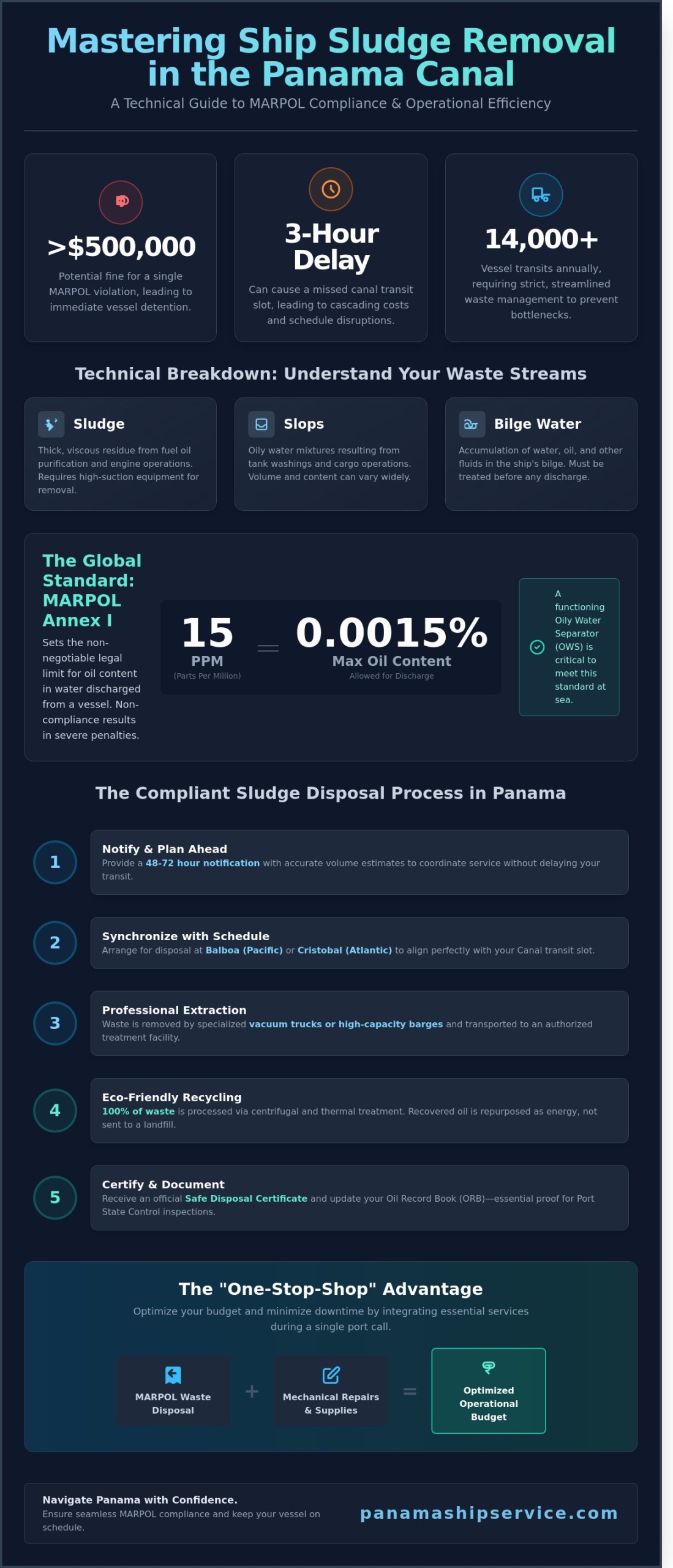
A single MARPOL Annex I violation can result in fines exceeding $500,000 and immediate vessel detention, turning a routine canal transit into a financial disaster. In a high-stakes environment where the Panama Canal Authority maintains strict oversight, mismanaging your waste disposal isn’t just an environmental risk; it’s a massive operational threat. You already know that timing is everything in this corridor. A three-hour delay in coordinating ship sludge removal in Panama can cause your vessel to miss its scheduled transit slot, leading to cascading costs and frustrated charterers.
We’ve spent 20 years helping ship owners navigate these complexities so you don’t have to. This guide provides the technical roadmap you need to master the logistics of waste management while ensuring total regulatory compliance. We’ll examine current port reception facility requirements, explain how to streamline the discharge process, and show you how to minimize expenses through better coordination. By the end of this article, you’ll have a clear framework to handle sludge disposal efficiently and keep your vessel on schedule without the fear of unexpected penalties.
Key Takeaways
- Understand the critical distinctions between sludge, slops, and bilge water to ensure full MARPOL compliance during your transit.
- Learn how to synchronize ship sludge removal panama with your Canal schedule at Balboa or Cristobal to avoid unnecessary downtime.
- Master the essential vessel preparation steps, including the 48-72 hour notification window and accurate volume estimation.
- Discover how a “one-stop-shop” approach integrates waste management with mechanical repairs to optimize your operational budget.
- Explore the infrastructure differences between the Atlantic and Pacific terminals to select the most efficient offloading point for your route.
What is Ship Sludge Removal and Why is it Critical in Panama?
Ship sludge is the residual waste generated during fuel oil purification and standard engine room operations. It’s a thick, oily substance that accumulates in settling tanks and must be removed to maintain vessel safety and operational capacity. Ship sludge removal panama services are a vital component of maritime logistics because Panama serves as a primary global hub for MARPOL-compliant waste offloading. With over 14,000 transits occurring annually, the Panama Canal requires a streamlined approach to waste management to prevent operational bottlenecks.
The Panama Maritime Authority (AMP) strictly regulates local disposal contractors to ensure they meet rigorous international standards. If a vessel fails to manage its waste properly, the Panama Canal Authority (ACP) can impose significant transit delays. These delays don’t just cost time; they result in heavy financial losses for ship owners and charterers. We are experts so you don’t have to be. Our team manages the logistics of ship sludge removal panama to ensure your vessel remains compliant and your schedule stays on track.
The Environmental Impact of Marine Waste
Professional removal is the only way to protect the delicate Panamanian ecosystem from oily contamination. Improper disposal can lead to heavy fines and long-term damage to local marine biodiversity. Beyond environmental protection, proper engine room waste management directly impacts vessel performance. High volumes of stored sludge can limit tank capacity and indirectly affect overall engine efficiency. Ship sludge is a hazardous byproduct requiring specialized handling to ensure it doesn’t enter the water supply or cause mechanical issues during transit.
Maintaining the integrity of fluid systems is a universal priority; for residential property owners in the Phoenix area looking for the same level of professional care for their home systems, they can visit Sweet Dreams Plumbing.
MARPOL Annex I: The Regulatory Framework
The legal framework governing this process is established by the MARPOL Annex I regulations, which focus on preventing oil pollution from ships. Ship masters have a non-negotiable legal obligation to maintain an accurate Oil Record Book (ORB). Every liter of sludge generated, transferred, or discharged must be documented with absolute precision. When you offload waste in Panama, you receive a Safe Disposal Certificate from a licensed provider. This document is essential for international port state control inspections. Without it, your vessel risks detention in future ports of call. We coordinate with certified contractors to provide the exact documentation you need for a smooth, worry-free transit.
Technical Breakdown: Sludge, Slops, and Bilge Water Standards
Managing maritime waste requires a precise understanding of different oil-water mixtures. Sludge consists of heavy fuel oil residues and waste from oil purifiers. It’s thick, viscous, and requires high-suction equipment for extraction. Slops are the residues resulting from tank washings and cargo operations. Bilge water is the mixture of water, oil, and chemicals that accumulates in the lowest part of the vessel’s hull. Each waste stream requires specific handling to meet international environmental laws.
The MARPOL Annex I regulation sets a strict global standard for discharge: 15 parts per million (ppm). This 15 ppm limit is the maximum amount of oil allowed in water discharged overboard. If a vessel’s oily water separator (OWS) isn’t functioning at this 0.0015% concentration level, the ship cannot legally discharge at sea. To maintain compliance, Panama Ship Service provides professional ship sludge removal panama using specialized vacuum trucks and high-capacity barges. We deploy equipment capable of handling high-viscosity sludge at both Balboa and Cristobal ports, ensuring your vessel remains within legal limits without disrupting your schedule.
The Sludge Disposal Process and Recycling
The journey of waste oil doesn’t end at the ship’s manifold. Once we extract the sludge, we transport it to authorized treatment facilities in Panama. These plants utilize centrifugal separation and thermal treatment to isolate hydrocarbons from water and solids. The recovered oil is often repurposed as fuel for cement kilns or industrial boilers. This process supports a circular economy by turning hazardous maritime waste into a viable energy source. By choosing a certified partner, you ensure that 100% of your waste is handled through legitimate ecological channels rather than ending up in a landfill.
Documentation and Compliance Paperwork
In the maritime industry, an operation isn’t complete until the paperwork is verified. The Safe Disposal Certificate is the most critical document we provide. This certificate proves to Port State Control (PSC) and the Panama Canal Authority that your waste was handled by a licensed facility. You must ensure that the volumes recorded in your Oil Record Book (Part I) match the physical discharge volumes exactly. Discrepancies often lead to vessel detentions and fines that can reach tens of thousands of dollars. Our team focuses on providing rapid, accurate documentation to prevent any administrative delays during your transit. You can trust our team to manage these technical details so your crew can focus on navigation.
Managing Logistics: Sludge Removal at Balboa and Cristobal Ports
Timing is everything when your vessel is scheduled for a canal transit. Mismanaging your waste disposal can lead to costly delays or even missed windows. To ensure a seamless ship sludge removal panama operation, you must coordinate collection with your arrival at either the Pacific or Atlantic entrance. We provide constant daily communication between the vessel, the agent, and the disposal team to manage these tight windows. Canal congestion and sudden weather shifts, particularly during the rainy season from May to December, can alter schedules by several hours. We stay ahead of these changes so you don’t have to.
Balboa Port Operations (Pacific Side)
The Pacific side offers distinct logistical advantages for vessels waiting at the Balboa anchorage. This area is often the preferred location for ship sludge removal panama because of its proximity to major bunkering hubs. We utilize specialized barges with capacities ranging from 200 to 800 cubic meters to handle large volume transfers efficiently. Most operations occur at the designated Pacific anchorages, such as Amador or the outer hills. You can maximize your downtime by integrating sludge removal with underwater hull services while the ship is stationary. Consolidating these technical services reduces the number of barge movements and saves significant operational time.
Cristobal and Colon Operations (Atlantic Side)
Operations on the Atlantic side require a different approach due to the layout of the Colon terminals. For vessels exiting the canal toward the North or entering from the Caribbean, Cristobal provides a strategic stop. While barge transfers are available at the Breakwater anchorage, the Atlantic side is better suited for pier-side collections. We deploy rapid-response trucks to terminals like Manzanillo International Terminal (MIT) or Colon Container Terminal (CCT) for vessels alongside. These trucks provide a fast, direct solution for smaller waste volumes. Each terminal in Colon has specific safety regulations and access protocols. Our team manages all the necessary permits and documentation required by the Colon Port Authority to ensure your vessel remains compliant with local terminal laws.
- Daily Coordination: We sync with the Panama Canal Authority (ACP) schedule to prevent transit interference.
- Infrastructure: We leverage deep-water anchorages in Balboa and truck-accessible piers in Colon.
- Reliability: 24/7 monitoring of weather patterns and canal traffic flow ensures on-time service.
Efficiency in Panama isn’t just about having the equipment; it’s about knowing the local rhythm. We act as your trusted partner to navigate these complexities, ensuring your engine room waste is handled without disrupting your schedule.
Step-by-Step: Preparing Your Vessel for Sludge Discharge
Efficiency in the Panama Canal depends on precision and timing. To ensure a seamless ship sludge removal panama operation, you must notify your local agent at least 48 to 72 hours before your vessel enters Panamanian waters. This window allows for the coordination of authorized barges or vacuum trucks and ensures all MARPOL documentation is ready for inspection. Waiting until you’re at the anchorage to start this process often results in costly delays and missed transit slots.
Accuracy in your reporting is critical for cost control. You need to provide an exact estimate of the sludge and oily bilge water volumes intended for discharge. If your actual volume exceeds the estimate by more than 10%, the disposal contractor may lack the tank capacity to complete the job, leading to a second mobilization fee. Before the barge arrives, your engineering team should inspect the discharge manifold and verify that all safety valves are fully operational. Most contractors in Panama use the standard MARPOL universal flange connection; however, confirming compatibility beforehand prevents technical setbacks during the connection phase.
Every operation must begin with a formal Toolbox Talk. This pre-discharge safety meeting involves the vessel’s Chief Engineer, the deck crew, and the contractor’s supervisor. During this briefing, you’ll confirm the pumping sequence, emergency stop procedures, and the specific communication channels to be used throughout the transfer.
Crew Responsibilities During the Transfer
The vessel’s crew remains the first line of defense against operational errors. It’s vital to maintain a continuous watch at the manifold and monitor tank levels every 15 minutes to track the discharge rate. We recommend starting the pump at a reduced speed to check for leaks before reaching the maximum flow rate. Clear communication protocols are essential; use dedicated VHF channels or hand signals that both the vessel and the disposal team understand. If the pumping pressure fluctuates by more than 0.5 bar, the watch officer should alert the pump room immediately to prevent pressure surges.
Safety and Spill Prevention
Panama enforces a strict “zero accident record” philosophy. We prioritize safety over speed because a single spill can result in massive fines and the detention of your vessel. Before any hoses are connected, the crew must ensure 100% of the scuppers are plugged and that the SOPEP (Shipboard Oil Pollution Emergency Plan) equipment is positioned on deck for immediate use. Since the 2017 updates to local environmental regulations, the oversight at the Canal has intensified. If you detect a leak or equipment failure, you must activate the emergency stop immediately. Don’t attempt to fix a leak while the line is under pressure. Once the flow stops, contain the spill using sawdust or absorbent pads before investigating the cause.
Don’t let compliance issues delay your transit. Contact our expert team to coordinate your next sludge disposal with professional precision.
Panama Ship Service: Your Trusted Partner for MARPOL Disposal
Panama Ship Service has spent over 20 years perfecting MARPOL-compliant waste management at the Panama Canal. Timing is everything in this industry. We understand that delays cost money and misjudging your schedule can lead to significant financial loss. Our team provides an efficient solution for ship sludge removal panama, ensuring your vessel remains compliant with international standards and Panama Maritime Authority regulations. We are experts so you don’t have to be. Put your transit in our hands and benefit from our established relationships with local authorities and port terminals.
Our “one-stop-shop” model sets us apart from standard providers. By combining disposal services with mechanical ship repairs, we eliminate the need for you to manage multiple vendors. This consolidated approach keeps your expenses low and your schedule intact. We prioritize cost-conscious solutions and work to minimize vessel expenses through competitive pricing and rapid operational execution. Our goal is to provide a calm, expert presence in a high-stakes environment.
Why Consolidated Services Save You Time
Managing several different contractors during a busy Panama Canal transit is often difficult and frustrating. Consolidating your requirements reduces the number of personnel on board, which simplifies security protocols and logistics. Our team coordinates marine surveys in Panama alongside your waste removal to ensure all technical needs are met in a single window. This synchronization prevents overlapping schedules and reduces vessel downtime. Fleet managers also benefit from streamlined billing and proactive administrative support, ensuring all documentation is ready for inspection before the vessel departs.
Contact Us for a Rapid Response
We operate 24/7 to handle both scheduled ship sludge removal panama and emergency disposal requests. Our response team is grounded and reliable, moving quickly from identifying your pain point to delivering a direct solution. To provide an accurate and timely estimate, our team requires the following information:
- Vessel name and IMO number
- Estimated volume of sludge, bilge water, or oily waste for disposal
- Current location or expected arrival time at Balboa or Cristobal
- Specific certificates or documentation required
We focus on business outcomes like cost and time savings for every client we serve. Our communication is fast-paced and efficient, providing you with constant updates until the job is done. Get a MARPOL disposal quote today and ensure your transit is handled by the most experienced partner at the Panama Canal.
Secure Your Transit with Expert MARPOL Compliance
Managing waste disposal while transiting the Panama Canal is a high-stakes operation where timing determines your vessel’s profitability. Effective ship sludge removal panama requires more than just a service provider; it demands a partner who understands the technical nuances of MARPOL Annex I through V. By coordinating logistics at Balboa or Cristobal ports and preparing your vessel according to international standards, you avoid costly delays and ensure your operations remain fully compliant with global environmental regulations.
Panama Ship Service brings over 20 years of maritime experience to every disposal operation. We are experts so you don’t have to be. Our team ensures full MARPOL compliance and issues Certified Safe Disposal Certificates immediately upon completion, providing the essential documentation your vessel needs for port state control. Don’t risk your schedule or your compliance record on unverified providers. Request an Efficient MARPOL Disposal Quote to streamline your next canal passage. Put your vessel in expert hands and experience a seamless, worry-free transit through the canal today.
Frequently Asked Questions
Is ship sludge removal mandatory for all vessels transiting the Panama Canal?
Sludge removal isn’t mandatory for every transit, but maintaining tank capacity within MARPOL Annex I limits is a legal requirement for all 14,000 vessels passing through annually. If your tanks are at 80% capacity or higher, the Panama Canal Authority recommends discharge to avoid operational delays. We manage these requirements so you don’t have to worry about compliance during your transit.
How long does the typical sludge discharge process take in Balboa?
A standard ship sludge removal panama operation in Balboa takes between 4 and 6 hours from barge arrival to disconnection. Total time depends on your vessel’s pump capacity and the volume of waste, which typically ranges from 10 to 50 cubic meters for standard merchant ships. Our team coordinates with local pilots to ensure the process fits within your scheduled window.
Can I discharge bilge water and sludge simultaneously?
You can’t discharge bilge water and sludge through the same line simultaneously because they’re classified as different waste streams under MARPOL regulations. Most barges in Panama use separate compartments and manifolds to handle these fluids. We coordinate the sequence of discharge to ensure both Annex I wastes are removed efficiently without cross-contamination or equipment delays.
What documentation will I receive after the disposal is complete?
You’ll receive a formal MARPOL Waste Delivery Receipt and a stamped Bunker Delivery Note equivalent for the disposal. These documents are essential for your Oil Record Book Part I entries and must be kept on board for 3 years. We provide these certificates immediately after the operation to ensure your vessel remains compliant with Port State Control inspections.
Are there specific pump rate requirements for waste transfer in Panama?
Most waste barges in Panama require a minimum pump rate of 5 to 7 cubic meters per hour to maintain operational efficiency. If your vessel’s pumps can’t meet this threshold, we can arrange for portable pneumatic pumps to speed up the transfer. This ensures the ship sludge removal panama process doesn’t exceed the allotted time at anchor or the pier.
Can sludge removal be performed while the vessel is at the pier or only at anchor?
Sludge removal can be performed at both the inner harbor piers and the Pacific or Atlantic anchorages. In Balboa, 90% of disposals occur at the anchorages to avoid interfering with cargo operations. We deploy specialized barges to your specific coordinates, providing flexibility whether you’re waiting for a transit slot or completing a crew change.
How does Panama Ship Service ensure the recycled oil is handled environmentally?
We transfer all collected waste to Ministry of Environment certified treatment plants that utilize centrifugal separation and thermal cracking. These facilities recover up to 95% of the hydrocarbons for industrial reuse. With 20 years of experience in the region, we ensure every liter of oil is tracked from your manifold to the final recycling destination.
What are the penalties for improper oil record book entries in Panama?
Improper entries in the Oil Record Book can result in fines starting at $10,000 and may lead to immediate vessel detention by the Panama Maritime Authority. Port State Control officers inspect these logs on 100% of targeted vessels to verify that sludge levels match the reported disposal volumes. Accurate documentation is your best defense against these costly legal complications.