
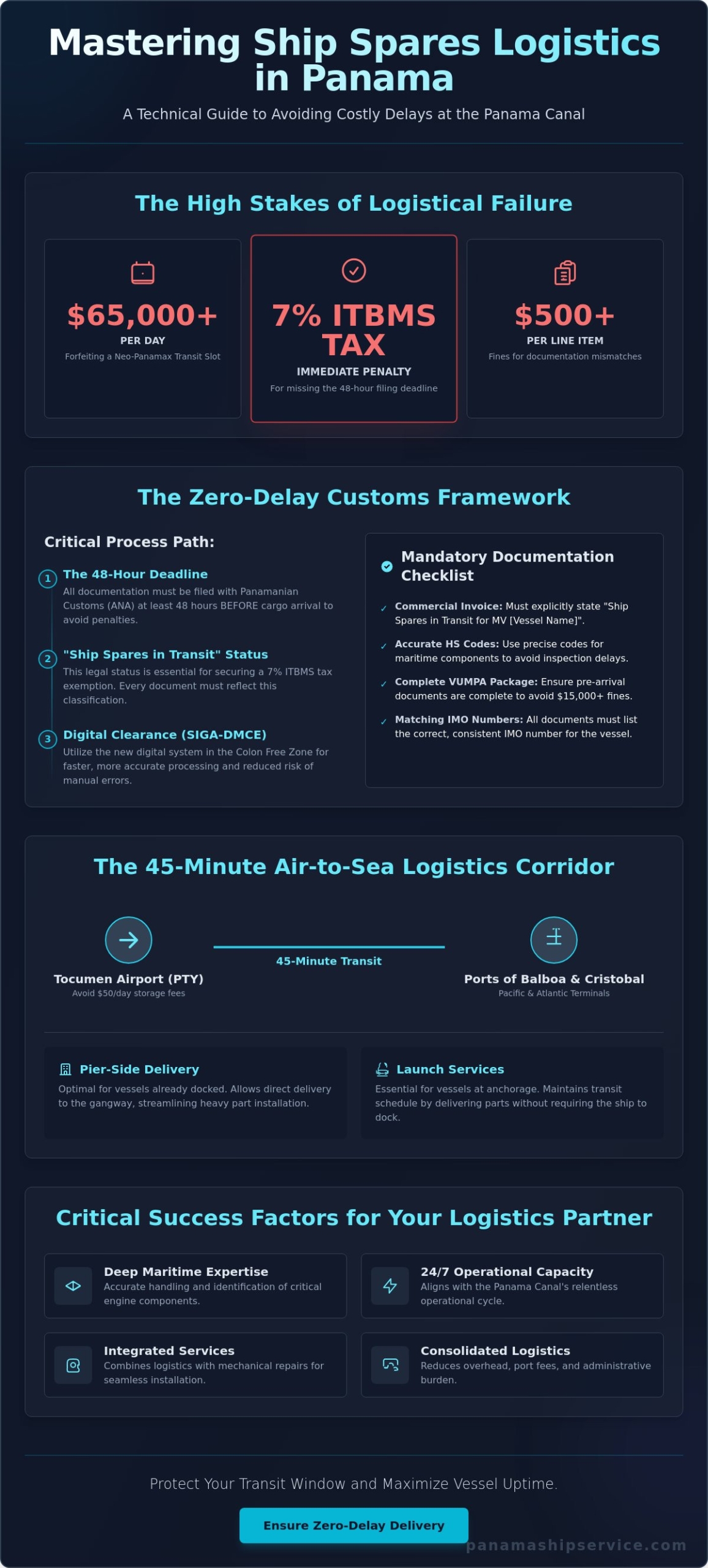
Forfeiting a pre-booked Neo-Panamax transit slot in 2026 costs your operation over $65,000 per day. When a critical component fails, the pressure to secure a replacement is immense, but rushing the paperwork is often where the real delays begin. You already know that managing ship spares logistics panama is a high-stakes race against the Panama Canal Authority’s strict transit windows. A single documentation mismatch or a missed 48-hour filing deadline for “Spares in Transit” status can trigger a 7% ITBMS tax and immediate customs fines starting at $500 per line item.
You need a logistics strategy that eliminates these variables and protects your bottom line. This article provides the technical expertise required to master Panamanian customs protocols and ensure your vessel stays on schedule. We’ll break down the new SIGA-DMCE digital controls in the Colon Free Zone, explain how to avoid escalating storage fees at Tocumen International Airport, and outline a path toward zero-delay delivery. You’ll gain a clear framework for coordinating part status and last-mile installation at the port so you can focus on the voyage ahead.
Key Takeaways
- Identify the specific documentation required to secure “Ship Spares in Transit” status and avoid unnecessary 7% ITBMS taxes and customs fines.
- Streamline your supply chain by utilizing the 45-minute logistics corridor to ensure efficient ship spares logistics panama from Tocumen Airport to Balboa or Cristobal.
- Assess the operational advantages of launch services versus pier-side delivery to maintain your vessel’s strict Panama Canal transit window.
- Prioritize logistics partners who possess deep technical maritime expertise to ensure accurate handling and identification of critical engine components.
- Maximize vessel uptime by combining logistics with professional mechanical ship repairs for a seamless delivery and installation process.
The Strategic Role of Ship Spares Logistics in Panama Canal Operations
Ship spares logistics panama is the specialized management of procurement, customs handling, and last-mile delivery of marine components. It’s a critical operational function that ensures a vessel remains seaworthy and compliant while transiting one of the world’s most demanding maritime passages. Panama’s role as a global hub for maritime spares and emergency repairs is cemented by its strategic location and the sheer volume of traffic. In 2026, the demand for rapid spares delivery is growing. This is driven by stricter enforcement of equipment standards and maneuvering requirements outlined in the ACP Notice to Shipping N-1-2026.
The financial consequences of a logistical failure are severe. Forfeiting a pre-booked Neo-Panamax transit slot in 2026 can cost over $65,000 per day. Additionally, a single failed inspection by the Panama Canal Authority can result in over $50,000 in lost time and fines. Even minor documentation errors, such as incomplete VUMPA pre-arrival packages, can trigger fines starting at $15,000. These high stakes make efficient ship spares logistics panama a necessity for any ship manager looking to protect their bottom line.
The Time-Sensitive Nature of Canal Transits
The Panama Canal Authority (ACP) operates on a relentless 24-hour cycle. Every minute of a vessel’s stay is meticulously scheduled. This leaves zero margin for error in the delivery of critical parts. Successful Panama Canal operations depend on a “just-in-time” delivery model where components arrive exactly when the vessel is accessible. Coordinating these efforts with ship supplies panama canal allows for consolidated deliveries. This synchronization prevents the vessel from missing its assigned transit window and ensures environmental compliance is met before arrival.
Consolidating Logistics to Reduce Overhead
Managing multiple vendors during a transit increases operational complexity and raises costs. By using a single integrated partner for spares, ship supplies, and mechanical repairs, ship managers can significantly reduce overhead. Consolidation minimizes the need for multiple port entry fees and reduces the frequency of expensive launch service trips. It also streamlines the administrative burden for technical superintendents. Instead of tracking multiple agents, you receive a single, clear point of communication regarding the status of all parts and services. This unified approach ensures every logistical move is optimized for both cost and schedule.
Navigating Panama Customs and Regulatory Frameworks for Marine Spares
Efficiency in ship spares logistics panama relies on precise adherence to the “Ship Spares in Transit” regime. This legal framework allows critical marine components to enter the country tax-free, exempting them from the standard 7% ITBMS (sales tax). Compliance is non-negotiable. The Panamanian National Customs Authority (ANA) requires all documentation at least 48 hours before the cargo reaches Panamanian soil. If you miss this window, the 7% tax applies immediately to the total value of the goods. As of May 2026, ANA enforces strict penalties for data discrepancies. Errors such as mismatched quantities or missing IMO numbers on a commercial invoice trigger fines starting at $500 per line item.
The local agent’s role is pivotal in managing the flow between Tocumen International Airport and the maritime hubs of Balboa and Cristobal. They ensure that the arrival of parts aligns with the vessel’s position. This coordination prevents the accumulation of storage fees at Tocumen, which currently run approximately $50 per day after a brief grace period. Expert guidance from a qualified canal transit agency simplifies this complexity, allowing technical teams to focus on the engine room rather than the customs office.
Documentation Requirements for Rapid Clearance
To qualify for tax-exempt status, every commercial invoice must explicitly state “Ship Spares in Transit for MV [Vessel Name].” Accurate HS codes are vital for specialized maritime components. Using the wrong code leads to inspections that can delay a delivery by days. Digitalization is currently transforming this process. The implementation of the SIGA-DMCE system in the Colon Free Zone as of April 1, 2026, has digitalized customs processes and improved cargo traceability. This shift allows for faster pre-clearance, provided the digital filings are submitted correctly and on time.
Managing Hazardous Materials and Specialized Cargo
Shipping hazardous materials like lithium batteries, specialized chemicals, or pressurized cylinders requires additional layers of compliance. These items must meet specific packaging and labeling standards before they can be transported from the airport to the port. Additionally, all wooden crates must adhere to ISPM 15 standards for fumigation to prevent the introduction of pests. If your logistical needs include the removal of old, damaged parts, it’s essential to coordinate with MARPOL disposal panama services. This ensures that the landing and disposal of components meet all environmental Panama Canal Authority regulations, protecting your vessel from environmental fines during its transit.
Last-Mile Delivery: Tocumen Airport to Balboa and Cristobal Ports
The final leg of ship spares logistics panama begins at Tocumen International Airport (PTY), the primary gateway for high-priority marine components. The logistics corridor from the airport to the ports of Balboa on the Pacific side or Cristobal on the Atlantic side is a 45-minute transit. While the distance is relatively short, execution requires precision. You’ve got to decide between pier-side delivery and launch services. Pier-side is the most cost-effective option if your vessel is already alongside for cargo handling. If the vessel is at the anchorage or mid-transit, launch services become essential to avoid stopping the ship and risking its transit slot.
Visibility during this phase is a requirement for operational control. Real-time tracking isn’t just a convenience; it’s a tool to prevent the $50 daily storage fees at the airport and ensure the technical team is ready the moment the part arrives. You can’t afford to have a launch boat waiting for a part that’s still clearing customs. This phase of the journey is where the most significant delays occur if the hand-off between the air courier and the local transport team isn’t seamless.
Pacific vs. Atlantic Side Logistics
Delivering to Balboa differs significantly from Cristobal. Your strategy must account for the vessel’s transit direction and the prevailing weather conditions. Sudden tropical downpours can impact launch service availability and safety. It’s often more efficient to deliver spares on the arrival side before the vessel enters the locks. Adhering to the Panama Canal Authority Maritime Regulations ensures these transfers don’t interfere with the canal’s strict scheduling. This coordination prevents the vessel from being “not ready” for its assigned window.
Heavy Lift and Technical Transport
Large components like engine blocks, rudders, or propeller shafts require more than a standard delivery truck. These items demand specialized transport, heavy-lift permits, and coordinated cranage at the port. To minimize downtime, you should coordinate these deliveries with mechanical ship repairs panama. This allows the technical repair team to begin installation immediately upon delivery. Safety and compliance are paramount during these maneuvers. Any incident during a heavy-lift operation can lead to immediate port authority investigations and significant vessel delays.
Critical Success Factors for Choosing a Logistics Partner in Panama
Choosing a partner for ship spares logistics panama is a strategic decision that directly affects your vessel’s operational readiness. A standard logistics provider often lacks the specific maritime context required to navigate the Panama Canal’s rigid scheduling. You need a partner whose operational clock matches the Canal’s 24-hour cycle. Reliability in this environment is built on deep local relationships with the National Customs Authority (ANA) and port officials at Balboa and Cristobal. These connections ensure that when issues arise during the digital filing process, they’re resolved before the vessel reaches the locks.
Transparency is another vital metric. Complex logistics often hide local handling fees or unexpected launch surcharges. A professional partner provides a clear, comprehensive fee structure from the outset. This fiscal responsibility allows ship managers to budget accurately and avoid the administrative friction of disputed invoices. Look for an integrated provider that offers more than just transport. The ability to handle cargo handling, ship supplies, and technical services simultaneously reduces the number of agents you must manage during a high-pressure transit window.
Vetting Technical Competency
A standard courier cannot distinguish a fuel injector from a piston ring. This lack of technical knowledge leads to documentation errors and incorrect part identification during the customs inspection. Your agent must understand the critical nature of class-approved parts and their specific storage requirements. Ask potential partners about their experience coordinating with technical teams for immediate installation. An agent who understands the requirements of marine surveys panama brings an extra layer of scrutiny to the logistics process, ensuring that delivered parts meet the standards required by class surveyors.
Evaluating Response Times and Communication
During a delivery window, a single point of contact is non-negotiable. You shouldn’t have to navigate a call center to find the status of a critical engine component. Evaluate your partner based on specific KPIs: clearance time from Tocumen Airport, accuracy of documentation, and the speed of last-mile delivery. Proactive communication is the best defense against transit-stopping delays. If a flight is delayed or a customs system is down, your agent should notify you with a resolution plan before you even ask. For reliable coordination of your next delivery, contact Panama Ship Service to secure your transit schedule.
Panama Ship Service: Your Integrated Partner for Spares and Repairs
Logistics alone doesn’t solve the problem of a broken-down vessel; technical execution does. Panama Ship Service operates as more than a delivery agent. We provide the skilled mechanical teams required to install the components we transport. By maintaining a strategic presence at both the Pacific and Atlantic entrances of the Canal, we offer maximum flexibility for your fleet. This localized positioning allows us to manage ship spares logistics panama with a level of precision that global generalists can’t match. We focus on minimizing your vessel’s overhead by consolidating mechanical ship repairs with the rapid delivery of critical spares.
Our approach centers on the optimization of your schedule. We understand that a vessel in transit is a vessel under pressure. By integrating our repair capabilities with our logistics network, we ensure that parts don’t just arrive at the port; they reach the engine room. This eliminates the need for ship managers to coordinate between a transport company and a separate repair firm. We handle the complexity so you can focus on the voyage. Our team is grounded in the reality of the engine room, allowing us to identify potential issues before they become transit-stopping delays.
The One-Stop-Shop Advantage
Managing multiple vendors during a Canal transit creates gaps in communication and increases the risk of schedule slippage. We eliminate this friction by handling the entire chain: customs clearance, last-mile transport, and final mechanical installation. In one recent operational case, our integrated approach reduced a projected 48-hour delay to a 12-hour turnaround. While our logistics team delivers engine parts, we can simultaneously perform underwater hull services to improve your vessel’s fuel efficiency. This coordination ensures that every hour spent at the pier or anchorage is productive and cost-effective.
Contact Us for Panama Logistics Support
Urgent maritime operations require immediate action and clear communication. You can request a priority quote for ship spares logistics panama to secure your vessel’s transit window and avoid costly fines. We maintain emergency response protocols to assist vessels currently in the Canal or at the Balboa and Cristobal anchorages. Contact our operations desk directly through our website to receive immediate assistance from a technical superintendent. We’re ready to handle your most complex logistical and repair challenges without unnecessary complication or delay.
Secure Your Vessel’s Schedule in 2026
Mastering the regulatory environment is the first step toward efficient ship spares logistics panama. You’ve seen how precise documentation and adhering to the 48-hour filing window for “Spares in Transit” status prevents 7% ITBMS taxes and costly customs fines. Effective logistics in the Canal Zone requires more than just transport; it demands an agent who understands the technical specifications of your engine room and the strict scheduling of the Panama Canal Authority. By integrating technical expertise with local customs knowledge, you eliminate the delays that threaten your transit window.
Panama Ship Service provides the integrated support necessary to remove operational friction from your supply chain. We offer 24/7 emergency response and class-approved technical expertise, ensuring your parts are not only delivered but professionally installed. Our teams are strategically located at Balboa and Cristobal to provide immediate assistance at either end of the Canal. Request a Quote for Ship Spares Logistics and Repairs in Panama to optimize your vessel’s performance and maintain your transit window. We’re ready to handle your maritime requirements with the proficiency your fleet deserves.
Frequently Asked Questions
What documents are required for shipping spares to Panama?
You must provide a commercial invoice, a detailed packing list, and the Air Waybill (AWB). The commercial invoice must explicitly state “Ship Spares in Transit for MV [Vessel Name]” to qualify for tax exemptions. Ensure all HS codes are accurate and that the vessel’s IMO number is clearly listed to avoid the $500 per line item fines implemented by customs authorities in 2026.
How long does it take for ship spares to clear customs in Panama?
Clearance typically occurs within 24 hours if all documentation is submitted at least 48 hours before the cargo’s arrival. This pre-arrival filing is essential for maintaining the “Spares in Transit” status. Delays usually stem from documentation discrepancies or missing digital filings in the SIGA-DMCE system, which can extend the process and lead to daily storage fees at the airport.
Can I ship hazardous materials as ship spares to the Panama Canal?
Yes, hazardous materials such as lithium batteries, specialized chemicals, and pressurized cylinders are permitted but require strict adherence to international packaging and labeling standards. You must coordinate these shipments with an agent capable of handling specialized technical transport. This ensures the cargo moves safely through the logistics corridor from Tocumen Airport to the designated port without regulatory interference.
Are ship spares exempt from import taxes in Panama?
Ship spares are exempt from the 7% ITBMS sales tax and other import duties when correctly processed under the “Spares in Transit” regime. You must adhere to the 48-hour documentation deadline to maintain this exemption. Failure to comply with these specific ship spares logistics panama protocols results in the immediate application of the 7% tax on the total value of the goods.
What is the best way to deliver parts to a vessel while it is transiting the Canal?
Launch services are the most effective method for delivering critical components to vessels at anchorage or those currently in transit. This method prevents the ship from stopping, which is vital to avoid forfeiting a Neo-Panamax transit slot. Pier-side delivery is only recommended if the vessel has scheduled cargo handling operations at the Balboa or Cristobal terminals.
Can Panama Ship Service install the spares once they arrive?
Yes, Panama Ship Service provides integrated mechanical ship repairs and can install the spares we deliver. Our technical teams work alongside our logistics department to ensure that components move directly from the port to the engine room. This unified approach eliminates the need for multiple vendors and ensures that repairs are completed within your vessel’s scheduled stay.
Which ports in Panama can receive international ship spare shipments?
The ports of Balboa on the Pacific side and Cristobal on the Atlantic side are the primary receiving hubs for international spares. While the parts usually arrive via Tocumen International Airport, they are quickly transferred through a dedicated logistics corridor. Effective ship spares logistics panama ensures that parts are positioned at the correct port based on your vessel’s transit direction and schedule.
How do I track my marine parts once they arrive at Tocumen Airport?
You can track your parts through the digital SIGA-DMCE system by coordinating with your local maritime agent. This system, fully implemented as of April 2026, provides real-time traceability for all cargo entering the Colon Free Zone and port areas. Constant visibility is necessary to avoid the $50 daily storage fees that accrue at the airport after the initial grace period.