
Did you know a single 24-hour delay at the Panama Canal can cost a vessel operator $65,000 in lost time and fuel? When structural deficiencies threaten your transit slot, the pressure to secure reliable ship steel fabrication in Panama becomes a high-stakes race against the clock. You’re likely already feeling the strain of stricter 2026 ACP technical standards and the looming threat of a $250,000 disruption charge if a technical failure occurs during transit. It’s a complex environment where there’s no room for uncertified work or logistical delays at the anchorage.
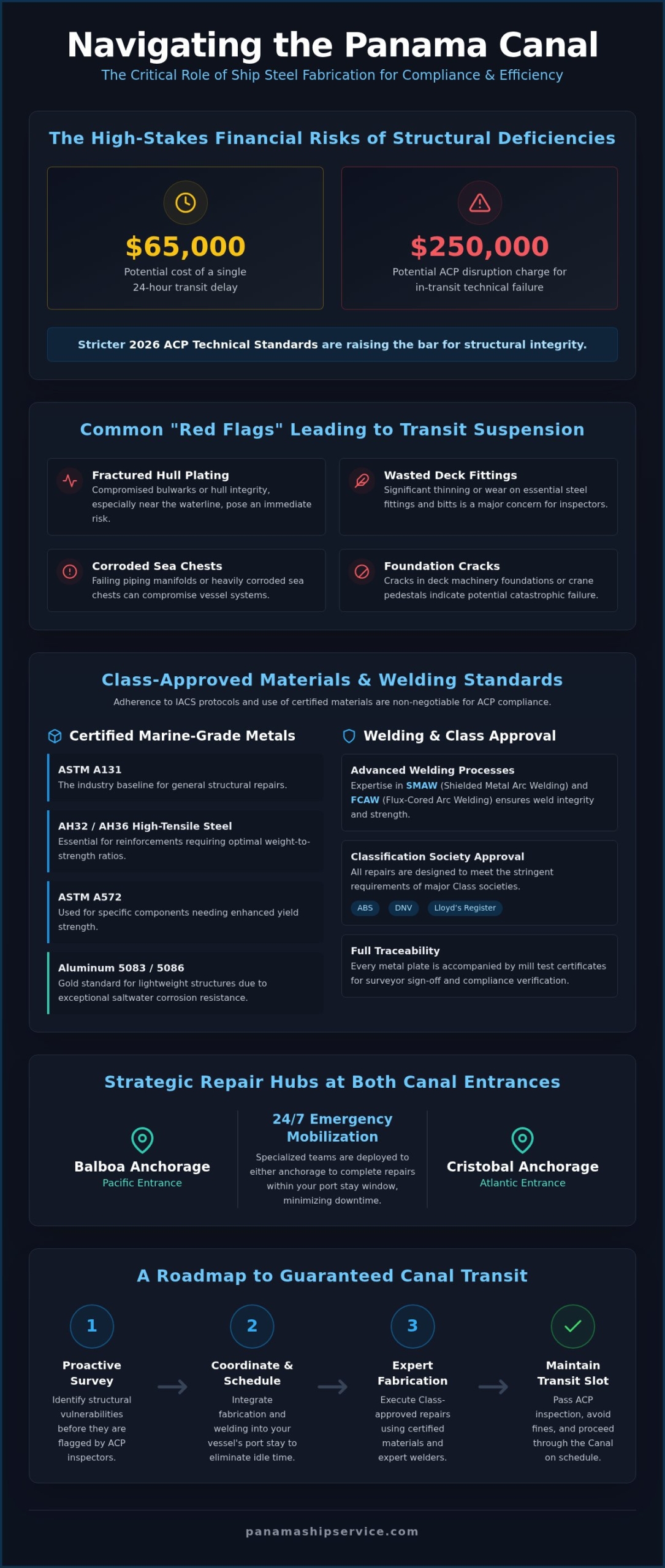
This article provides a roadmap for ensuring your vessel meets every Class requirement through expert marine welding and precision fabrication. We’ll explain how to coordinate structural repairs within your port stay window at Balboa or Cristobal anchorages. You’ll also learn about the specific steel grades like ASTM A131 and welding processes such as SMAW and FCAW that are essential for successful ACP inspections this year. By the end, you’ll know exactly how to maintain compliance, avoid costly auction fees for missed slots, and keep your operations moving efficiently through the Canal.
Key Takeaways
- Understand the critical structural requirements set by the Panama Canal Authority to avoid immediate transit suspensions and heavy fines.
- Learn about the 2026 technical standards for marine-grade steel and aluminum alloys used in Class-approved structural repairs.
- Discover how to integrate ship steel fabrication panama into your vessel’s schedule at Balboa or Cristobal anchorages to minimize downtime.
- Identify custom fabrication solutions for sea chests and piping manifolds that ensure long-term reliability and operational safety.
- Find out how 24/7 emergency mobilization can resolve structural deficiencies within your specific transit slot window.
The Critical Role of Ship Steel Fabrication in Panama Canal Transits
Ship steel fabrication in Panama is the technical process of custom cutting, shaping, and welding marine-grade metals to restore or maintain a vessel’s seaworthiness. While the history of shipbuilding highlights the evolution from timber to high-tensile steel, the core necessity remains the same: structural reliability. For vessels approaching the Panama Canal, this integrity isn’t a suggestion. It’s a non-negotiable requirement for the Panama Canal Authority (ACP) safety inspections. Utilizing expert ship steel fabrication panama ensures that corrective actions happen immediately, preventing the need to deviate from global shipping routes for emergency dry-docking elsewhere.
Meeting ACP Structural Standards and Avoiding Fines
The ACP follows strict guidelines, specifically outlined in the OP Notice to Shipping N-1-2026. During pre-transit inspections, inspectors look for specific structural vulnerabilities that could jeopardize the safety of the Canal locks. If these deficiencies are found, the vessel faces an immediate transit suspension. Common structural “red flags” include:
- Fractured bulwarks or compromised hull plating near the waterline.
- Wasted or thinning steel on deck fittings and bitts.
- Corroded sea chests or failing piping manifolds.
- Cracks in deck machinery foundations and crane pedestals.
The financial consequences of a failed inspection are severe. A single 24-hour delay at the Panama Canal can cost an operator $65,000 or more in fuel and lost time. If a structural failure causes a disruption during the actual transit, the ACP disruption charge can reach $250,000. A proactive structural survey identifies these vulnerabilities before they trigger a financial crisis.
Strategic Repair Hubs: Balboa vs. Cristobal
Efficient logistics require choosing the right location for repair work. The Pacific entrance at Balboa and the Atlantic entrance at Cristobal serve as the primary hubs for afloat repairs. Each site presents unique logistical challenges. Sea conditions at the anchorages can influence the complexity of precision welding tasks, making it vital to work with a partner who understands local variables. Panama Ship Service provides a distinct advantage by mobilizing specialized personnel to both entrances 24/7. This flexibility allows for structural repairs to be completed within the scheduled port stay window. By coordinating fabrication with your vessel’s ETA and transit slot, you eliminate unnecessary downtime and ensure the ship is Class-compliant before the ACP inspector steps on board.
Technical Standards for Marine Steel and Welding in 2026
Technical precision in ship steel fabrication panama is defined by strict adherence to the International Association of Classification Societies (IACS) protocols. In the high-pressure environment of the Panama Canal, using generic materials isn’t an option. Repairs must meet the specific requirements of major Class societies like ABS, DNV, and Lloyd’s Register. This process begins with the selection of certified marine-grade metals that possess the necessary chemical and mechanical properties to withstand the unique stresses of maritime operations. Every plate and section used in a repair must be accompanied by mill test certificates to ensure full traceability and compliance during the final surveyor sign-off.
Marine-Grade Steel and Aluminum Specifications
Our workshops maintain a consistent inventory of high-tensile steels, specifically AH32 and AH36, which are essential for structural reinforcements where weight-to-strength ratios are critical. While ASTM A131 remains the industry baseline, we prioritize ASTM A572 for specific structural components that require enhanced yield strength. A common challenge for operators in Central America is the local availability of specialized alloys. We address this gap by stocking marine aluminum grades 5083 and 5086. These alloys are the gold standard for lightweight structures and high-speed vessel components due to their exceptional corrosion resistance in tropical saltwater environments. Using the correct grade prevents galvanic corrosion and ensures the longevity of the repair long after the vessel leaves the anchorage.
Advanced Welding Processes for Ship Repair
The quality of a weld is only as good as the certification of the person performing it. All fabrication work follows rigorous procedures, often mirroring the technical depth found in U.S. Coast Guard welding regulations for vessels operating in regulated zones. We deploy three primary welding processes based on the specific repair requirements:
- SMAW (Shielded Metal Arc Welding): This remains the most versatile method for robust structural hull repairs, especially for afloat work where environmental conditions are variable.
- FCAW (Flux-Cored Arc Welding): We utilize this for high-productivity fabrication on heavy sections, providing deep penetration and excellent mechanical properties for major structural inserts.
- TIG (Tungsten Inert Gas) Welding: This precision method is reserved for specialized piping systems, including Cunife and stainless steel, where weld purity is paramount.
For projects requiring strict technical compliance and verified material sourcing, the expert teams at Panama Ship Service manage the entire fabrication cycle. This includes everything from initial fit-up to the final non-destructive testing (NDT) required for Class approval. By maintaining these high standards, we ensure your vessel doesn’t just pass a temporary inspection but remains structurally sound for the remainder of its voyage.
Custom Marine Fabrication Solutions: Beyond Basic Hull Repairs
Ship steel fabrication panama extends far beyond basic hull patching. While maintaining the integrity of the outer shell is vital, the operational efficiency of a vessel depends on the precision of its internal and deck-side components. Many of these custom fabrication needs are driven by the strict Panama Canal maritime regulations, which mandate that all structural and safety equipment remain in peak condition. Our technical teams specialize in creating bespoke solutions for sea chests, strainers, and specialized piping manifolds that must withstand high-pressure environments and constant fluid flow.
Structural integrity also involves the reinforcement of deck machinery foundations and crane pedestals. These areas endure massive dynamic loads, and even minor stress fractures can lead to catastrophic equipment failure. By utilizing specialized ship steel fabrication panama, operators can address these vulnerabilities during their scheduled anchorage stay, ensuring that heavy-lift equipment remains certified and safe for cargo operations.
Piping and Fluid Management Systems
The technical demands of modern shipping require sophisticated piping solutions, particularly for the integration of Ballast Water Treatment Systems (BWTS). We handle the on-board fabrication of BWTS piping, ensuring that new installations align perfectly with existing layouts. In the brackish water environments common to the Gatun Lake region, corrosive damage to internal piping is a frequent issue. We use specialized alloys to replace thinned sections, providing long-term resistance to localized pitting. Fabricating intricate piping manifolds during a port stay requires absolute dimensional accuracy to ensure seamless integration with existing shipboard systems without extending the vessel’s downtime.
Deck Structural Reinforcements and Superstructure
Heavy weather transits often result in stress fractures within the superstructure or damage to safety-critical items like bulwarks, railings, and ladders. These aren’t just aesthetic concerns; they’re essential for crew safety and regulatory compliance. Our fabrication services include:
- Repair and replacement of damaged bulwarks to restore the vessel’s weather-tight integrity.
- Fabrication of custom engine room floor plates and equipment mounting brackets to improve internal safety.
- Custom solutions for securing heavy-lift cargo or unusual deck loads that require temporary structural lashing points.
Cargo integrity is another priority. Emergency hatch cover repairs are often necessary to ensure that holds remain weather-tight before a vessel enters the open sea. We provide rapid-response welding and fabrication to fix warped seals or damaged cleats, preventing potential cargo claims and ensuring the ship remains seaworthy for its next leg of the journey.
Logistics and Timing: Scheduling Steel Repairs in Panama
Scheduling ship steel fabrication panama requires more than technical skill; it demands perfect timing. Every hour counts when a missed transit slot can result in fees exceeding $10,000 or the total loss of a slot that may have cost up to $385,000. We start by aligning the repair window with your vessel’s ETA. This coordination ensures the fabrication team is ready to board the moment the ship arrives at the Balboa or Cristobal anchorage. Our 24/7 emergency mobilization process moves from the initial damage report to on-site welding in hours, not days. We understand that in the Panama Canal, speed is the only metric that matters once a deficiency is identified.
Managing material logistics through Panamanian customs is a critical step for the rapid arrival of specialized components or spare parts. We handle these administrative hurdles to prevent technical delays. Choosing between an anchorage and a berth is another vital decision. Afloat repairs at anchorage are often the most cost-effective choice for fabrication needs. These repairs can reduce maintenance bills by 40% to 60% compared to the high costs of dry-docking. We help you determine the best location based on sea conditions and the complexity of the welding task at hand.
Minimizing Vessel Downtime at the Canal
Integrating mechanical ship repairs panama with steel work allows for a consolidated service model. Instead of managing multiple vendors, a single technical partner utilizes the transit waiting period for non-disruptive on-board fabrication. This efficiency is maintained through strict communication protocols between the vessel master, the local agent, and our technical supervisors. We ensure that hot work and structural repairs happen concurrently with other technical services, maximizing the utility of every hour spent at the anchorage.
Class Approval and Certification Logistics
Restoring structural steel is only successful if it carries the necessary certifications. We coordinate with Class surveyors from bodies like ABS, DNV, and Lloyd’s Register to witness and approve welding repairs. Our documentation process is meticulous. We provide comprehensive Non-Destructive Testing (NDT), including ultrasonic and dye penetrant tests, to verify weld integrity. Having all paperwork, mill certificates, and NDT reports ready for the ACP inspector before the transit pilot boards is essential. It’s the only way to avoid the $250,000 disruption charge associated with technical failures during transit. For a seamless repair experience that protects your schedule, contact Panama Ship Service today.
Panama Ship Service: Your Expert Partner for Steel Fabrication
Panama Ship Service operates as a strategic technical partner for vessel owners navigating the complexities of the Panama Canal. Our specialized personnel provide 24/7 fabrication support at both the Balboa and Cristobal anchorages. This localized presence ensures that structural issues identified at either entrance are resolved without delaying your transit slot. By choosing a partner with a proven track record of delivering Class-approved repairs, you delegate technical complexity to experts who prioritize your schedule and budget. We’ve built our reputation on efficiency and the ability to execute high-stakes welding tasks within the narrow windows provided by canal logistics.
One-Stop-Shop for Canal Transit Services
Consolidating services is the most effective way to reduce operational overhead. We combine our expertise in steel work with underwater hull services to provide total hull care from a single point of contact. This integrated approach eliminates the friction of managing multiple contractors and ensures that all repairs, whether above or below the waterline, meet the same high standards. Additionally, accessing our full suite of marine surveys in Panama allows for comprehensive compliance checks. We ensure every structural component is verified and documented before the ACP inspector boards, simplifying your canal logistics and preventing last-minute surprises.
Qualified Personnel and Expert Oversight
The reliability of our ship steel fabrication panama stems from our commitment to using only certified marine-grade materials and qualified welding procedures. Our welders are certified to international standards and possess deep experience with diverse vessel types, from Panamax bulkers to Neopanamax container ships. Dedicated project management oversees every task, ensuring that fabrication work meets the 2026 safety requirements and Class protocols. Our service focuses on:
- Immediate 24/7 mobilization to all Panamanian anchorages for emergency repairs.
- Adherence to SMAW, FCAW, and TIG welding standards to ensure Class approval.
- Use of certified ASTM A131 steel and marine-grade aluminum alloys 5083 and 5086.
- Fixed-price reliability to prevent budget overruns during transit.
We don’t just perform repairs; we provide expert oversight that guarantees the structural integrity of your vessel. Our teams understand the urgency of minimizing downtime and avoiding the heavy fines associated with canal delays. Contact us today for a mechanical ship repairs and fabrication consultation to secure your next transit.
Secure Your Vessel’s Structural Integrity and Transit Schedule
Maintaining structural compliance is the only way to navigate the Panama Canal without facing technical suspensions or severe financial penalties. Relying on Class-approved welding ensures that every repair, from sea chest fabrication to deck reinforcement, meets current international standards. By coordinating these essential repairs at Balboa or Cristobal anchorages, you eliminate the need for expensive dry-docking and keep your vessel on its global route. Expert ship steel fabrication panama provides the technical precision and rapid response required for high-stakes maritime logistics, turning potential delays into successful transits.
Panama Ship Service offers 24/7 emergency mobilization and full ACP compliance support to protect your operational efficiency. Our teams of Class-approved certified welders are ready to handle complex structural repairs during your scheduled port stay, ensuring all work is documented and ready for inspection. Don’t risk your transit slot on uncertified work or logistical delays. You can delegate the technical complexity of your next repair to a partner who understands the urgency of the Canal environment.
Request a Quote for Ship Steel Fabrication in Panama to ensure your vessel remains seaworthy and compliant for its entire voyage.
Frequently Asked Questions
Can steel fabrication be performed while the vessel is at the Panama Canal anchorage?
Yes, we perform ship steel fabrication panama directly at the Balboa and Cristobal anchorages while your vessel is afloat. This approach avoids the high costs and scheduling delays associated with dry-docking. Our teams mobilize via launch to handle structural repairs without disrupting your position in the transit queue.
What marine-grade steel standards are available for repairs in Panama?
We maintain a consistent inventory of international marine-grade steel standards to ensure full compliance with global maritime requirements. This includes ASTM A131 (Grades A, B, D, and E) and high-tensile steels like AH32 and AH36. All materials used in our fabrication processes come with mill test certificates to satisfy Class surveyor requirements during final inspections.
Do you provide Class-approved welding certifications (ABS, DNV, Lloyd’s)?
Yes, all our welding procedures and personnel are certified by major classification societies including ABS, DNV, and Lloyd’s Register. We strictly adhere to IACS protocols to ensure that every structural repair meets the rigorous safety standards required for continued vessel operation and insurance coverage. This certification is vital for passing ACP inspections without delay.
How quickly can a welding team be mobilized for an emergency structural repair?
Our technical teams are available for 24/7 emergency mobilization at both the Pacific and Atlantic entrances of the Canal. Once we receive an initial damage report, we can typically have a specialized welding crew on-site at the anchorage within a few hours. This rapid response is critical for addressing structural deficiencies before they trigger a transit suspension or heavy fines.
Can you perform aluminum welding and fabrication for high-speed vessels?
Yes, we specialize in both steel and aluminum fabrication using marine-grade alloys 5083 and 5086. These materials are the industry standard for lightweight structures and high-speed craft. We utilize specialized welding processes like TIG and MIG to maintain the integrity and corrosion resistance of aluminum components in tropical saltwater environments.
Are your fabrication services compliant with Panama Canal Authority (ACP) regulations?
Yes, all our ship steel fabrication panama services fully comply with the latest Panama Canal Authority regulations, including OP Notice to Shipping N-1-2026. We focus on rectifying the specific structural vulnerabilities that ACP inspectors prioritize. This proactive approach ensures your vessel passes safety checks and avoids the $250,000 disruption charge associated with technical failures.
Do you offer Non-Destructive Testing (NDT) to verify weld integrity?
Yes, we provide comprehensive Non-Destructive Testing (NDT) to verify the integrity of all structural fabrication work. This includes ultrasonic testing (UT), dye penetrant inspection (DPI), and magnetic particle inspection (MPI). These tests provide the objective evidence and documentation required for Class surveyors to officially approve structural repairs and inserts.
Is it possible to coordinate steel repairs during the vessel’s bunkering operation?
Yes, we can often coordinate steel repairs to occur concurrently with bunkering or other technical services at the anchorage. This requires strict adherence to safety protocols and the issuance of “hot work” permits by the relevant authorities. By consolidating these tasks, we help you maximize the efficiency of your port stay and ensure the vessel is ready for transit.