
A single 24-hour delay during your Panama Canal transit in 2026 can drain over $65,000 from your vessel’s operating budget. For Neopanamax operators, the cost of missing a scheduled slot is even more staggering when you factor in lost charter hire and rescheduling fees. You understand that unscheduled downtime is the enemy of profitability; yet, finding certified welders who can perform high-quality ship steel fabrication panama on short notice remains a constant challenge. Relying on emergency dry-docking for minor structural issues is a fiscal burden that most modern fleets simply can’t afford.
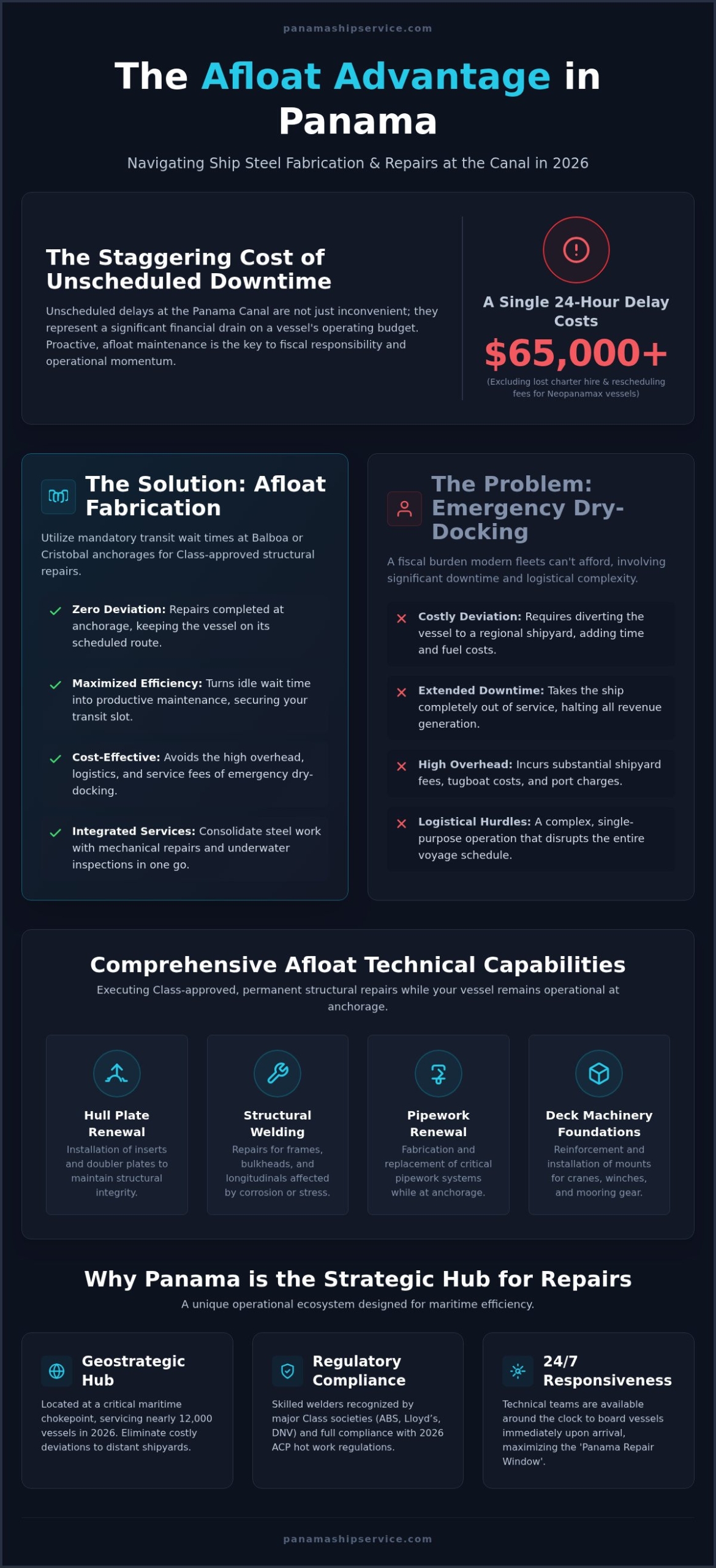
This guide provides the technical roadmap you need to execute class-approved structural repairs while at anchorage, ensuring your vessel stays in compliance without missing its transit window. We’ll explore the logistics of afloat fabrication, from securing hot work permits under 2026 ACP regulations to managing transparent technical reporting for insurance surveyors. You’ll learn how to synchronize specialized steel work with your existing husbandry requirements to maximize every hour spent at the Balboa or Cristobal terminals. By the end of this article, you’ll have a clear strategy for delegating complex repairs to expert mobile teams, allowing you to maintain operational momentum in one of the world’s most demanding maritime hubs.
Key Takeaways
- Utilize mandatory transit wait times at Balboa or Cristobal anchorages to perform critical steel maintenance without deviating from your route.
- Learn how specialized ship steel fabrication panama allows for hull plate renewal and internal structural repairs to be completed afloat, avoiding the high overhead of emergency dry-docking.
- Master the 2026 regulatory landscape for hot work permits and Class certification requirements from major societies like ABS, Lloyd’s, and DNV.
- Discover the “Afloat Advantage” of consolidating steel repairs with mechanical services and underwater inspections to maximize operational efficiency during your Canal transit.
- Identify the specific logistical differences between barge-based repairs at Balboa and pier-side fabrication at Cristobal to optimize your repair schedule.
Why Panama is the Strategic Hub for Ship Steel Fabrication in 2026
Panama remains the most critical maritime bottleneck on the planet. In 2026, nearly 12,000 vessels will transit the waterway. This creates a unique operational opportunity for technical managers. Instead of viewing the wait for a transit slot as lost time, savvy fleet managers use it for essential maintenance. The history and strategic importance of the Panama Canal as a trade artery makes it the logical choice for mid-voyage interventions. Performing ship steel fabrication panama at anchorage eliminates the need for costly deviations to regional shipyards that often lack the same level of logistical integration.
Global shipping trends in 2026 show a decisive shift toward afloat repairs, particularly for container and LNG fleets. High charter rates and the volatility of fuel costs make taking a ship out of service for dry-docking a last resort. Mobile fabrication teams now execute complex structural work, such as hull plate inserts or pipework renewal, while the vessel is idle at the Balboa or Cristobal anchorages. Immediate access to the Colon Free Zone ensures that marine-grade steel and specialized alloys are available for rapid procurement. This proximity reduces lead times that often paralyze repairs in less connected regional ports.
The Cost of Transit Delays vs. Repair Efficiency
Efficiency is the primary driver of ROI in the current maritime market. With Neopanamax auction slots reaching prices as high as $425,000 in mid-2026, every minute of the transit schedule is scrutinized. By coordinating mechanical ship repairs alongside steel fabrication, operators consolidate multiple technical needs into a single service window. This eliminates the risk of missing a hard-won ACP slot due to technical failures. The ‘Panama Repair Window’ is the strategic period between arrival at anchorage and the commencement of pilotage where technical complexities are resolved without disrupting the master schedule.
Geopolitical and Logistical Advantages
Panama serves as a Tier 1 maritime hub because it offers a concentrated ecosystem of specialized labor. Panamanian welders are recognized by major Class societies for their proficiency in high-pressure environments. Because services are available 24/7, technical teams board vessels immediately upon arrival. This responsiveness is vital for maintaining vessel turnaround times. A single day’s delay can cost $65,000 in operational overhead, making the presence of a reliable ship steel fabrication panama partner essential for fiscal responsibility. Our teams handle the complexity, so your crew can focus on the transit ahead.
Technical Capabilities: Hull Repairs, Pipework, and Structural Welding
Executing structural repairs while a vessel is afloat requires high technical precision and strict adherence to class-approved procedures. Our ship steel fabrication panama services focus on delivering permanent solutions for hull and internal damage without the need for dry-docking. Hull plate renewal often involves the installation of inserts or doubler plates. These must meet specific thickness and grade requirements to maintain structural integrity. We repair frames, bulkheads, and longitudinals that have suffered from corrosion or mechanical stress during heavy weather. These repairs are performed at anchorage, allowing your vessel to remain operational while maintaining its position in the transit queue.
Deck machinery foundations require specialized reinforcement to handle the extreme loads of mooring and cargo operations. We fabricate and install mounts for cranes, winches, and mooring gear using high-tensile steel. All structural work aligns with the Panama Canal Authority’s official maritime safety standards to ensure that any hot work performed at anchorage is fully compliant with local regulations. This compliance is often verified through detailed marine surveys that document the quality of the repair for Class surveyors.
Specialized Welding Processes for 2026
Modern vessels utilize a variety of alloys that demand specific welding techniques. We employ MIG, TIG, and Arc welding standards tailored to the material at hand. For LPG and LNG carriers, we provide stainless steel and aluminum fabrication to ensure compatibility with cryogenic or specialized cargo systems. High-stress structural areas often require pre-heating and post-weld heat treatment (PWHT) to prevent hydrogen cracking and relieve residual stresses. Our welders follow these technical protocols meticulously to ensure the longevity of every weld. We provide shipyard-quality results in a mobile environment.
Pipework and Outfitting
Marine pipe fabrication is a core component of our technical offering. We handle specialized welding for ballast, fuel, and cooling systems using materials like CuNiFe for seawater lines. To accelerate the repair timeline, we often utilize a hybrid approach:
- Prefabrication: Creating complex pipe sections in our workshop based on precise measurements.
- On-site fitting: Final adjustments and welding performed directly on the vessel at anchorage.
Precision is mandatory. Every new installation undergoes rigorous hydro-testing and Non-Destructive Testing (NDT) to confirm leak-free performance and weld quality. This systematic approach ensures that your vessel’s essential systems are restored to full capacity before it enters the locks.
Afloat Steel Fabrication vs. Dry-Docking at the Panama Canal
Deciding between afloat repairs and scheduled dry-docking is a critical choice for technical managers. While major overhauls require a graving dock, many structural issues can be resolved at anchorage. Choosing ship steel fabrication panama for mid-sized repairs offers the “Afloat Advantage,” allowing you to avoid the high costs of emergency dry-docking. This method is superior for your budget when the scope involves hull inserts, pipe renewals, or internal structural reinforcements that don’t require the vessel to be completely out of the water. By performing work at the Balboa or Cristobal anchorages, you maintain your position in the Canal transit queue.
Regulatory compliance is the cornerstone of afloat work. Navigating the Panama Canal Authority (ACP) ‘Hot Work’ permits requires precise documentation and safety protocols. Our teams ensure that every welding procedure and safety measure aligns with International Maritime Organization (IMO) standards. To maximize efficiency, we often employ a hybrid repair strategy. This involves pre-fabricating complex steel components at our shore-side workshops and then transporting them by barge for installation. This method significantly reduces the time technicians spend on board, minimizing disruption to the crew’s routine.
Port Logistics: Balboa vs. Cristobal Supply Chains
The choice between the Pacific and Atlantic terminals impacts your logistical timeline. Balboa is the primary hub for vessels awaiting Northbound transit. It offers extensive anchorage support and is ideal for heavy structural work. Cristobal, located on the Atlantic side, provides immediate proximity to the Colon Free Zone. This allows for faster sourcing of technical stores and specialized marine-grade steel. To optimize your stay, you can sync these steel repairs with underwater hull services. Combining these tasks ensures that your vessel’s downtime is used productively, addressing both structural and hydrodynamic needs simultaneously.
Weather and Environmental Considerations
Panama’s tropical climate presents unique technical challenges for welding. During the rainy season, managing humidity and water ingress is vital for weld quality. We use specialized protective enclosures and humidity control systems to maintain a dry environment for all hot work; for engineered modular hot work safety enclosures across maritime and offshore operations, discover PetroHab LLC. Additionally, the intense tropical heat can cause significant steel expansion. Our fabrication teams account for these thermal variables during the fit-up phase to ensure precision. Working in high-traffic Canal anchorages also demands strict safety protocols. We maintain constant communication with the ACP and the vessel’s bridge to ensure all afloat work is conducted without risking the safety of the ship or the surrounding maritime traffic.
Ensuring Quality: Class Approvals and Welding Standards in Panama
Quality assurance in ship steel fabrication panama is not merely a preference; it is a regulatory requirement for maintaining a vessel’s seaworthiness. Every structural repair performed at anchorage must withstand the scrutiny of Class surveyors from societies such as ABS, Lloyd’s, or DNV. To ensure a seamless approval process, we follow a rigorous five-step protocol that guarantees every weld meets international standards. This systematic approach eliminates the risk of repair rejection and ensures that all work is recorded as a permanent repair in the vessel’s hull history.
- Step 1: Reviewing the repair plan: Before technical teams board, we coordinate with Class surveyors to approve the repair method and extent of steel renewal.
- Step 2: Material verification: We ensure all steel plates and profiles possess valid mill certificates, verifying they meet the required grade and thickness.
- Step 3: WQR and PQR: Our technicians operate under strictly maintained Welder Qualification Records and Procedure Qualification Records tailored to specific marine alloys, where digital platforms such as SOCWeld are widely used across the industry to automate and manage welding documentation.
- Step 4: Non-Destructive Testing (NDT): Specialized technicians utilize ultrasonic and dye-penetrant inspections to confirm the internal integrity of every joint.
- Step 5: Final documentation: We provide a comprehensive technical report for Class endorsement, ensuring the vessel’s permanent record is updated accurately.
If you require Class-certified structural work during your next transit, contact Panama Ship Service to coordinate your repair plan with our expert fabrication teams.
The Role of NDT in Afloat Repairs
Non-Destructive Testing is the primary tool for verifying structural health without damaging the vessel. Ultrasonic thickness (UT) gauging is the mandatory first step in any steel project; it allows us to map the exact boundaries of corrosion or thinning. For high-stress areas like engine foundations or crane pedestals, we utilize Magnetic Particle Inspection (MPI) to identify surface-breaking cracks that are invisible to the naked eye. We frequently coordinate with marine survey teams to provide independent verification, ensuring that every repair is backed by data-driven technical reporting.
Compliance with MARPOL and Local Regulations
Performing hot work at anchorage requires strict environmental and safety management. We implement rigorous containment protocols to prevent metal dust, slag, and grinding debris from entering the marine environment. Managing the resulting fabrication waste is equally critical. We coordinate MARPOL disposal for all old steel scrap and industrial waste, ensuring your vessel remains compliant with both ACP and international environmental laws. Our fire-watch protocols are designed to exceed standard requirements, providing a calm and secure environment for complex technical interventions.
Panama Ship Service: Precision Steel Fabrication and Integrated Repairs
Panama Ship Service operates as a strategic technical partner for global ship managers. Our 2026 commitment focuses on delivering high-precision results within the strict constraints of your Panama Canal transit window. We understand that technical delays aren’t just an inconvenience; they’re a direct threat to your vessel’s profitability. By specializing in ship steel fabrication panama, we provide a reliable alternative to the traditional shipyard model. Our mobile fabrication teams are available 24/7 at both Balboa and Cristobal anchorages. This ensures that structural issues are addressed the moment your vessel arrives, regardless of the time or day.
The primary advantage of our service model is the integrated ‘One-Stop-Shop’ approach. We don’t just handle steel; we consolidate structural work with mechanical repairs and underwater hull services. This synchronization allows for a more efficient use of anchorage time. While our welders perform internal reinforcements, our divers can simultaneously conduct hull cleaning or NDT inspections. This consolidated husbandry model reduces the need for multiple service providers and simplifies the logistical coordination for your local agent. Our proven track record with major Class societies ensures that all integrated work meets the highest maritime standards without compromise.
Case Study: Rapid Hull Insert at Balboa Anchorage
A recent project at Balboa Anchorage demonstrates our ability to handle high-pressure timelines. A Neopanamax container vessel required a Class-approved hull insert due to localized structural fatigue identified during transit. Our team coordinated with the ACP and Class surveyors to begin work immediately upon the vessel’s arrival. We utilized a support barge to transport pre-fabricated plates and heavy welding equipment directly to the vessel’s side. The entire project, including NDT verification and final Class endorsement, was completed in 48 hours. This rapid intervention allowed the vessel to maintain its original pilot schedule without interruption. Utilizing our mobile teams for this repair saved the operator thousands in potential dry-docking fees and avoided a multi-day deviation from their route.
Request a Technical Consultation
To provide an accurate and competitive quote, our technical department requires detailed information regarding the repair scope. Please provide your latest thickness reports, structural drawings, and any preliminary Class survey findings. Our estimators are available 24/7 to review emergency structural requirements and provide a logistical plan that fits your transit schedule. We specialize in rapid-response interventions for emergency hull damage or critical pipe failures. Optimize your structural integrity with Panama Ship Service by scheduling your technical consultation today.
Strategic Structural Maintenance for the 2026 Transit Landscape
The 2026 maritime environment demands a shift from reactive maintenance to strategic, afloat interventions. Utilizing the mandatory wait time at the Panama Canal for critical structural work eliminates the need for costly dry-docking and prevents devastating transit delays. By prioritizing Class-approved ship steel fabrication panama, fleet managers ensure that every hull insert or pipe renewal meets the highest technical standards while the vessel remains in the transit queue.
Panama Ship Service provides the specialized expertise required to handle these complexities. Our 24/7 afloat repair teams, featuring Class-certified welders from ABS, DNV, and Lloyd’s, deliver high-precision results through a consolidated husbandry model. This approach integrates steel work with mechanical and underwater services to streamline your operations and minimize vendor coordination. It’s time to delegate technical complexity to a partner that understands the urgency of your schedule and the critical nature of Class compliance.
Request a Technical Quote for Ship Steel Fabrication in Panama and secure your vessel’s operational integrity for the voyage ahead. We’re ready to support your fleet with reliable, round-the-clock technical solutions that keep your transit on track.
Frequently Asked Questions
Can major steel fabrication be done at the Panama Canal without dry-docking?
Yes, major structural work can be executed while your vessel remains afloat. Panama Ship Service specializes in performing ship steel fabrication panama, including hull plate renewal and internal reinforcements at the Balboa or Cristobal anchorages. This “Afloat Advantage” allows you to resolve technical issues without the high costs of emergency dry-docking. Our mobile teams board your vessel upon arrival; they ensure all structural work is completed within your scheduled transit window to minimize operational downtime.
Which Class societies approve steel repairs performed by Panama Ship Service?
We maintain a proven track record of working with all major Class societies, including ABS, DNV, and Lloyd’s Register. Every project involving ship steel fabrication panama follows Class-approved welding procedures. We coordinate directly with surveyors on-site to review repair plans and verify material certifications. Upon completion, we provide comprehensive technical reports and NDT results. This ensures the repair is endorsed as a permanent entry in the vessel’s hull history.
What is the typical lead time for sourcing marine-grade steel in Panama?
Marine-grade steel sourcing is highly efficient due to our strategic location near the Colon Free Zone. We leverage established supply chains to procure certified plates and profiles with minimal lead times. Our teams coordinate material requirements well in advance of your vessel’s arrival at the Canal. This proactive approach ensures that the specific alloys and steel grades required for your repair are ready for fabrication as soon as the vessel drops anchor.
Are hot work permits required for steel fabrication at the Balboa anchorage?
Hot work permits are mandatory for any welding or grinding activities performed at the Balboa or Cristobal anchorages. These permits must be secured from the Panama Canal Authority (ACP) to ensure compliance with local safety regulations. Our team handles the entire application process, including the implementation of strict fire-watch protocols. We ensure that all afloat fabrication work meets the rigorous safety and environmental standards required by the ACP and international maritime law.
Can you perform steel repairs while the vessel is transiting the Canal?
Structural repairs are strictly performed while the vessel is at anchorage in Balboa or Cristobal. We don’t conduct steel fabrication during the actual movement through the locks or the Culebra Cut. This ensures compliance with ACP pilotage safety regulations and prevents any interference with the vessel’s navigation. By executing the work during the mandatory wait time before or after transit, we maximize efficiency without risking the safety of the vessel or the Canal.
What type of NDT (Non-Destructive Testing) do you provide for welding verification?
We provide a comprehensive suite of Non-Destructive Testing (NDT) to verify the quality of every weld. This includes ultrasonic thickness (UT) gauging to map corrosion and dye-penetrant inspections to identify surface defects. These technical verifications are essential for securing Class approval. By using data-driven testing, we ensure that all structural repairs meet international standards for strength and durability, providing you with a transparent technical record for insurance and regulatory compliance.
How do you coordinate steel fabrication with the ACP pilot schedule?
Our operations department maintains 24/7 communication with the Panama Canal Authority to synchronize our technical work with your pilotage slot. We monitor transit schedules in real-time to ensure our mobile fabrication teams are ready the moment your vessel arrives. This coordination allows us to execute complex repairs during the idle period at anchorage. We prioritize efficiency to ensure your vessel completes its structural maintenance without missing its hard-won transit window.
Do you offer pre-fabrication services for ship components in Panama?
We offer extensive pre-fabrication services to accelerate the repair timeline for transiting vessels. Our shore-side workshops create complex components like pipe sections, foundations, and structural inserts based on provided drawings or measurements. These pre-fabricated elements are then transported by barge to the vessel for rapid installation at anchorage. This hybrid approach significantly reduces the hours technicians spend on board. It allows us to deliver shipyard-quality results within a very tight transit schedule.