
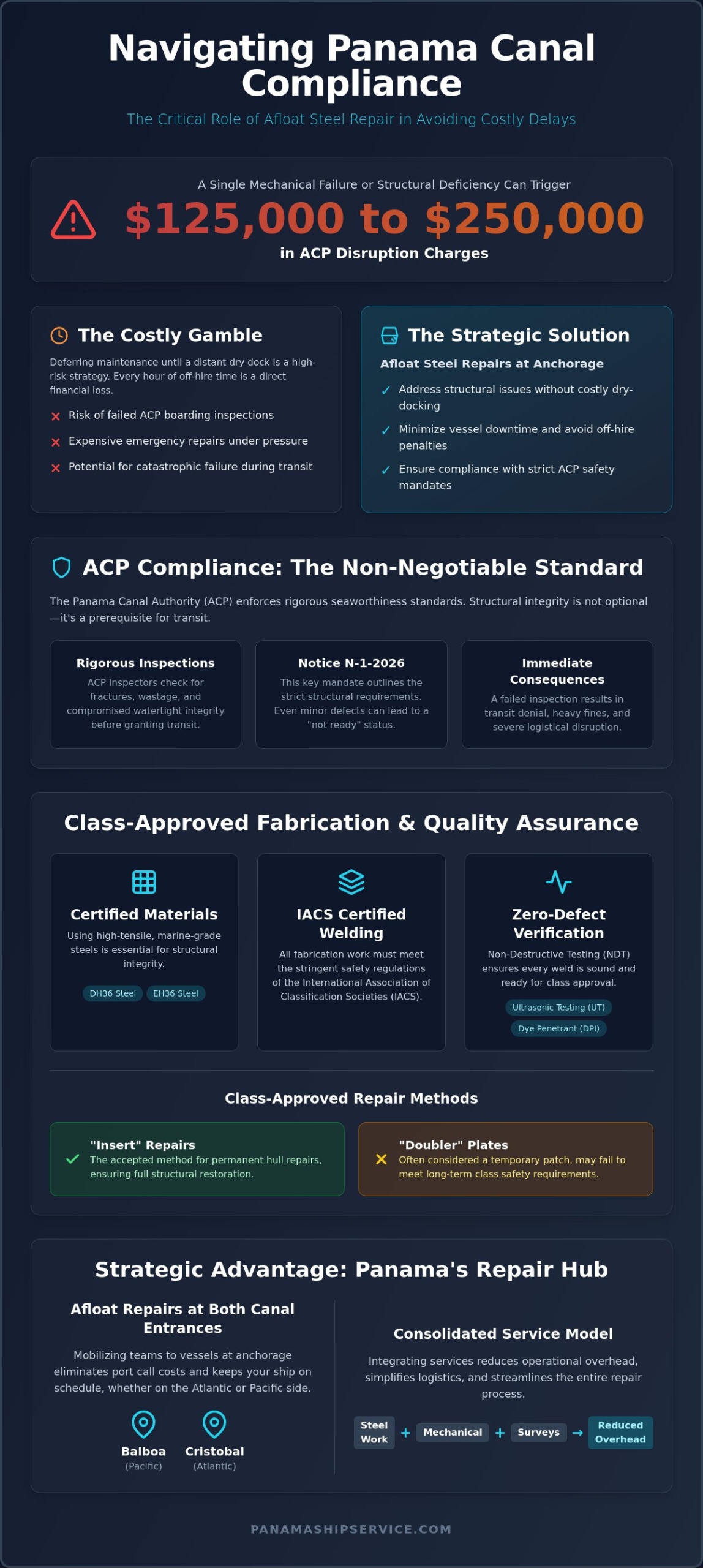
A single mechanical failure or structural deficiency during a Panama Canal transit can trigger ACP disruption charges ranging from $125,000 to $250,000. For vessel operators, the pressure to maintain structural integrity while adhering to a strict transit window is constant. You recognize that every hour spent off-hire for ship steel repair panama is a direct hit to your bottom line. Finding certified welders who can perform class-approved work on short notice is often the difference between a successful transit and a costly delay.
It’s possible to execute critical steel repairs in Panama without disrupting your schedule or compromising safety standards. This article explores how specialized afloat fabrication and hull services allow for high-quality repairs at anchorages like Balboa and Cristobal. We will cover the latest 2026 ACP safety mandates, the technical requirements for IACS-certified welding, and how consolidated service models reduce overhead. You’ll discover how to secure fixed-price reliability for fabrication jobs that keep your vessel moving and compliant with current draft restrictions.
Key Takeaways
- Understand how structural hull integrity directly influences Panama Canal Authority (ACP) boarding inspections and your vessel’s transit eligibility.
- Learn why afloat ship steel repair panama at Balboa or Cristobal anchorages is the most efficient method to address structural issues without the costs of dry-docking.
- Identify the critical IACS welding standards and certifications required to ensure all marine fabrication meets international class-approved safety regulations.
- Discover how to coordinate complex structural reinforcements and plate renewals within tight transit windows to avoid off-hire penalties.
- See the logistical advantages of a consolidated service model that integrates steel work with mechanical repairs and marine surveys to reduce operational overhead.
The Critical Role of Ship Steel Repair in Panama Canal Transits
Maintaining structural integrity is a matter of operational survival for any vessel approaching the Panama Canal. Ship steel repair in this context involves the precision restoration of hull plating, internal bulkheads, and deck structures to ensure they can withstand the mechanical stresses of lock operations. Every ship entering these waters faces a rigorous boarding inspection by the Panama Canal Authority (ACP). If inspectors identify fractures, localized wastage, or compromised watertight integrity, the vessel risks being denied transit. This immediate halt in operations leads to massive financial losses and logistical nightmares for the ship owner.
ACP Requirements and Vessel Seaworthiness
ACP inspectors enforce strict seaworthiness standards to prevent accidents within the locks. Notice to Shipping N-1-2026 outlines these requirements, emphasizing that even minor structural defects can lead to a “not ready” status. Localized steel wastage or cracks in the hull can lead to transit delays or heavy fines. Proactive ship steel repair panama prevents these scenarios. It’s far more cost-effective to address a thinning plate at anchorage than to pay for a failed inspection and subsequent emergency repairs under extreme pressure.
Strategic Repair Locations: Balboa and Cristobal
Having repair teams available at both Balboa and Cristobal is a strategic necessity for modern fleet managers. These locations allow for “afloat” repairs while the vessel waits for its assigned transit window. Mobilizing specialized welders and equipment to a vessel at anchorage eliminates the need for expensive port calls or dry-docking. This mid-voyage hub model keeps the ship on schedule. It’s a localized, functional solution designed for a high-pressure maritime environment where timing is everything.
Deferring maintenance until a distant dry dock is a dangerous gamble. Heavy weather during the approach to the Canal can quickly turn a minor structural weakness into a major failure. If a hull failure occurs during transit, the resulting disruption charges can range from $125,000 to $250,000. By choosing ship steel repair panama, operators leverage the country’s status as a global logistics hub to source parts and labor with minimal delay. This approach prioritizes fiscal responsibility by reducing overhead and optimizing the vessel’s schedule. You delegate the technical complexity to experienced local partners to ensure your ship remains compliant and earns its passage through the Canal.
Comprehensive Marine Steel Services: Scope and Capabilities
Effective ship steel repair panama requires more than basic welding equipment. It demands a deep understanding of metallurgical properties and the ability to source certified materials on short notice. When a vessel is flagged for structural deficiencies, the solution must align with both international class standards and specific Panama Canal Authority regulations. Our fabrication capabilities cover the full spectrum of maritime needs, from simple deck repairs to complex hull restorations. You can delegate the technical complexity of these requirements to our experienced teams to ensure your vessel remains compliant and seaworthy.
We prioritize the use of high-tensile, marine-grade steels like DH36 or EH36. These materials are essential for maintaining the strength-to-weight ratio required for modern commercial fleets. Using inferior materials is not an option; it risks immediate rejection by class surveyors and endangers the vessel’s structural integrity under load. Every weld must be verified. We utilize Non-Destructive Testing (NDT) methods, including ultrasonic testing (UT) and dye penetrant inspection (DPI), to ensure zero-defect results. This proactive verification process provides the documentation needed for class approval, ensuring fiscal responsibility by avoiding expensive rework.
Hull Plating and Structural Reinforcement
Replacing wasted or damaged hull plating while a vessel is afloat is a specialized operation. We focus on “insert” repairs, which involve cutting out the damaged section and welding in a new plate of equal thickness. This is the only method widely accepted by IACS members for permanent repairs. While “doubler” plates might provide a temporary patch, they often fail to meet long-term safety requirements. Our teams handle internal structural reinforcements, including frames, longitudinals, and bulkheads, ensuring the ship’s skeleton is as robust as its skin. For comprehensive support, you can integrate these services with our mechanical ship repairs to address both structural and engine room needs simultaneously.
Marine Pipework and Custom Fabrication
Steel work in Panama isn’t limited to the hull. Marine pipework is a critical service, especially for high-pressure systems like ballast, fuel oil, and fire mains. We fabricate and install replacement sections using specialized welding techniques for stainless steel and aluminum applications. Our custom fabrication services also extend to deck fittings, ladders, and safety railings. These components are often damaged during canal transits or heavy-weather voyages. We provide quick turnaround times for these items, fabricating them to exact specifications in our local workshops before mobilizing them to your vessel at anchorage. This localized efficiency keeps your maintenance schedule on track without unnecessary delays.
While marine fabrication often focuses on large-scale vessels, the principles of structural integrity and precision apply to all water-adjacent construction; for those interested in high-quality waterfront infrastructure in Canada, you can visit Cardwell Property Services Inc. to see how expert craftsmanship is applied to custom dock building.
Afloat Steel Repairs: Minimizing Vessel Downtime
Afloat repair refers to structural work performed while the vessel remains in the water, typically at a designated anchorage. For operators seeking ship steel repair panama, this method is the gold standard for maintaining a transit schedule. By avoiding the need for a dry dock, you eliminate the massive overhead of docking fees and the significant downtime associated with taking a ship out of service. Industry data suggests that performing repairs at anchorages like Balboa and Cristobal can reduce maintenance bills by 40% to 60% compared to traditional shipyard stays. This approach prioritizes fiscal responsibility by keeping your vessel in the water and ready for its next cargo commitment.
Logistical coordination is the backbone of successful afloat work. We mobilize riding squads equipped with portable welding machines, gas cutting gear, and NDT tools directly to your vessel. This requires precise timing to align with the Panama Canal Authority’s Notices to Shipping, ensuring all hot work is completed before your transit slot begins. Safety protocols are non-negotiable in a marine environment. Every job begins with a gas-free certification to prevent accidents in enclosed spaces, and we strictly monitor weather conditions to ensure stable welding environments. You delegate the complexity of these logistics to our team, allowing your crew to focus on core bridge and engine room operations.
The Afloat Repair Process Step-by-Step
The process begins with an initial damage assessment. Technicians perform ultrasonic thickness gauging to determine the exact extent of steel wastage or structural deformation. Once the work area is prepared, a certified chemist issues a gas-free certificate for hot work. Our mobile riding squads then execute the fabrication and welding. This systematic approach ensures every repair meets IACS standards while the ship continues its cargo operations or waits for its assigned transit window.
Emergency vs. Scheduled Steel Maintenance
Urgent repairs often involve structural cracks that threaten cargo contamination or environmental leaks. We treat these with the highest priority to avoid the heavy disruption charges associated with mechanical or structural failure during transit. Conversely, scheduled maintenance allows you to address thinning plates or corroded deck fittings during planned Canal wait times. We optimize the “window of opportunity” at anchorage, turning idle time into productive maintenance. This proactive strategy ensures your vessel arrives at the locks in peak condition, fully compliant with all 2026 technical standards.
Quality Assurance: Class Approvals and Welding Standards
Quality assurance is the foundation of every structural maritime project. When executing ship steel repair panama, merely having a “skilled” team is insufficient. Every structural weld must comply with the stringent standards set by the International Association of Classification Societies (IACS). This ensures that repairs are recognized as permanent by your vessel’s classification society, such as ABS, DNV, or Lloyd’s Register. Failing to secure these approvals can result in the repair being classified as “temporary,” requiring expensive re-work at the next scheduled dry-dock cycle. We prioritize fiscal responsibility by getting the repair right the first time, meeting all regulatory requirements without compromise.
Our process involves seamless coordination between our technical supervisors and the Class surveyor. We manage the entire technical lifecycle of the repair. This includes providing the surveyor with the necessary Welding Procedure Specifications (WPS) and Procedure Qualification Records (PQR) before work begins. Upon completion, we deliver a comprehensive documentation package. This package includes welder performance qualification (WPQ) certificates and material mill certificates for the steel used, ensuring your vessel’s records are impeccable for future inspections. If your vessel requires third-party verification, we can also coordinate marine surveys to provide an independent assessment of the structural work.
IACS Certified Welding Procedures
Welding Procedure Specifications (WPS) are non-negotiable documents that dictate the parameters for a safe, strong weld. We use only certified consumables, such as low-hydrogen electrodes, which are essential for maintaining the integrity of marine-grade steel. Panama’s humid, tropical environment presents unique challenges, specifically the risk of hydrogen-induced cracking. Our teams use specialized storage and heating equipment to keep electrodes dry, ensuring the weld remains free of porosity and inclusions. This attention to detail is what separates a professional repair from a temporary patch.
Post-Repair Inspections and Certification
Once the welding is finished, we conduct a series of post-repair inspections. Visual inspections are followed by Non-Destructive Testing (NDT), typically ultrasonic testing (UT) or magnetic particle inspection (MPI). These tests verify that the weld has achieved full penetration and is free of internal defects. After the Class surveyor is satisfied, they issue a “Statement of Fact” or an equivalent endorsement in the ship’s survey report. This document is vital for your permanent records, proving that the repair meets international safety standards and is accepted for continued service until the next major dry-docking.
By delegating these technical complexities to a seasoned partner, you eliminate the anxiety of failed inspections. Our systematic approach to ship steel repair panama ensures that every plate and pipe we install is backed by the certifications your fleet managers require. We focus on efficiency and reliability, providing the authoritative expertise needed to navigate the high-stakes environment of the Panama Canal hub.
Why Panama Ship Service is Your Strategic Steel Partner
Choosing a partner for ship steel repair panama requires more than just technical proficiency. It demands a provider that understands the operational pressures of the Canal transit. We’ve established ourselves as a strategic hub for ship owners by offering a consolidated service model that prioritizes your vessel’s schedule and fiscal responsibility. By maintaining a presence at both Balboa and Cristobal, we ensure that our mobile riding squads are ready to mobilize to your vessel the moment you reach anchorage. This localized expertise eliminates the logistical friction often associated with international repair projects.
The administrative burden on fleet managers and superintendents is significantly reduced when you utilize a single agency for multiple technical needs. Instead of coordinating between separate entities for welding, surveying, and logistics, you deal with one authoritative point of contact. This transparency ensures that communication remains clear and that all technical documentation is centralized. Our commitment to responsiveness is driven by the high-stakes nature of the Panama Canal schedule. We recognize that an emergency steel failure isn’t just a repair job; it’s a threat to your transit window and your bottom line.
Consolidated Maritime Solutions
Our “one-stop-shop” advantage allows us to address the vessel as a complete system. While our steel teams handle structural renewals, our technicians can simultaneously perform mechanical ship repairs in the engine room or on deck. This integration extends to the hull as well. By combining fabrication work with underwater hull services, we provide a comprehensive maintenance solution that covers both internal and external structural needs. This holistic approach ensures that no part of the vessel’s integrity is overlooked during its stay in Panamanian waters.
Requesting a Steel Repair Quote
To provide an accurate and fixed-price reliability for fabrication jobs, we require specific technical data. When requesting a quote, please provide detailed drawings, current NDT reports, and the specific steel grades required (e.g., AH36, DH36). Clear communication regarding your estimated time of arrival (ETA) and your assigned transit window is essential for our planning. We use this information to optimize the repair schedule, ensuring all work is completed and certified before you enter the locks. Contact Panama Ship Service for a comprehensive technical assessment and a quote tailored to your vessel’s specific structural requirements.
Secure Your Transit with Certified Steel Expertise
Successful maritime operations depend on maintaining structural integrity while adhering to a strict transit window. Executing IACS-compliant repairs while afloat at anchorage is the most efficient way to avoid the high costs of off-hire time and ACP disruption charges. By choosing a partner with localized expertise at both ends of the Canal, you ensure that technical failures don’t become logistical roadblocks. This proactive approach to ship steel repair panama is essential for navigating the current regulatory environment and meeting 2026 technical standards.
Panama Ship Service provides the specialized welding and fabrication needed to keep your vessel compliant. Our 24/7 mobile repair squads operate in both Balboa and Cristobal, delivering consolidated services that handle everything from hull plating to complex mechanical repairs. This integrated model minimizes administrative burden and keeps your transit schedule on track. Reliable maintenance is the key to a predictable and safe voyage through this global shipping hub.
The requirement for expert structural care and mechanical proficiency is universal; for high-quality automotive maintenance and bodywork, Logan Auto & Smash Repairs offers professional smash repair services that prioritize safety and structural integrity.
Request a Technical Consultation for Your Steel Repair in Panama to secure your vessel’s integrity and transit readiness. We’re ready to support your fleet with the proficiency and reliability required for a successful passage.
Frequently Asked Questions
Can ship steel repairs be performed while the vessel is at anchorage in Panama?
Yes, mobile repair squads perform afloat repairs at major anchorages including Balboa and Cristobal. This allows your vessel to address structural issues while waiting for an assigned transit slot. Performing work at anchorage is a highly efficient method that eliminates the need for dry-docking. It ensures the ship remains in the water and ready for cargo operations while minimizing operational downtime and docking fees.
What certifications should a steel repair company in Panama possess?
A reputable provider must employ welders who hold current IACS certifications. These credentials ensure that all welding procedures and results meet the strict safety standards required by the International Association of Classification Societies. The company should also maintain a working relationship with major classification societies like ABS, DNV, or Lloyd’s Register. This ensures that any structural work is recognized as a permanent repair in the vessel’s records.
Does the Panama Canal Authority (ACP) inspect steel repairs before transit?
Yes, ACP inspectors conduct boarding inspections to verify vessel seaworthiness before any transit begins. If they identify structural defects or compromised hull integrity, they require proof of class-approved repairs. Maintaining structural integrity is a mandatory requirement for safe passage through the lock systems. Failing to meet these standards can lead to significant transit delays or heavy disruption charges for the vessel owner.
How long does a typical hull plate renewal take at a Panama anchorage?
The duration depends on the plate size and internal structural complexity, but most minor renewals are completed within 24 to 72 hours. This timeframe covers the entire process from initial damage assessment and gas-free certification to the final fabrication. Efficient coordination ensures that these structural fixes fit within the standard waiting window for a Canal transit, preventing any loss of your assigned slot.
Are underwater steel repairs possible in the Panama Canal region?
Yes, specialized underwater hull services include wet welding and the use of cofferdams for dry-space repairs below the waterline. These advanced techniques allow for critical structural fixes without the vessel needing to enter a dry dock. Such services are vital for addressing hull breaches or thinning plates discovered during pre-transit inspections, ensuring the vessel remains compliant with all current technical and safety mandates.
What is the difference between an insert and a doubler plate repair in Class rules?
An insert repair involves cutting out the damaged section and welding a new plate into the hull, which IACS members accept as a permanent fix. A doubler plate is a temporary patch welded over the existing structure. While doublers offer a quick stop-gap solution, most classification societies require their replacement with permanent inserts during the next scheduled dry-docking to maintain long-term structural integrity.
Can you provide IACS-certified welders for emergency crack repairs?
We provide certified riding squads for ship steel repair panama specifically to handle emergency structural failures. These teams are ready for immediate mobilization to address fractures in the hull or internal bulkheads at anchorage. Using certified professionals ensures that emergency work meets the technical standards required to prevent cargo leaks. This proactive approach protects your vessel’s integrity and prevents environmental issues during the transit.
How do I coordinate a steel repair with my vessel’s Canal transit slot?
Coordination begins by sharing your ETA and transit window with the repair team as early as possible. This allows for the mobilization of equipment and labor to the anchorage before your vessel arrives. By aligning the ship steel repair panama schedule with the mandatory waiting period, you can address structural deficiencies without losing your position in the transit queue. This optimizes your schedule and reduces overhead.