
For vessel operators and charterers, a transit through the Panama Canal is a critical juncture in any voyage. Efficiently sourcing provisions, essential stores, and technical parts during this transit is key to maintaining operational readiness and preventing costly delays. This guide provides a complete overview of securing ship supplies at the Panama Canal, helping you streamline procurement and ensure a smooth passage.
Why the Panama Canal is a Critical Resupply Hub
The Panama Canal’s unique geographical position makes it more than just a waterway; it is a strategic hub for global shipping logistics. As the link between the Atlantic and Pacific oceans, it serves as an ideal point for vessels to restock before or after long, uninterrupted voyages. Access to a wide range of international-standard goods and services allows crews to prepare for the next leg of their journey. Most importantly, efficient and timely resupply at the Canal is fundamental to minimizing vessel downtime, a crucial factor in the profitability of any maritime operation.
Key Supply Categories for Transiting Vessels
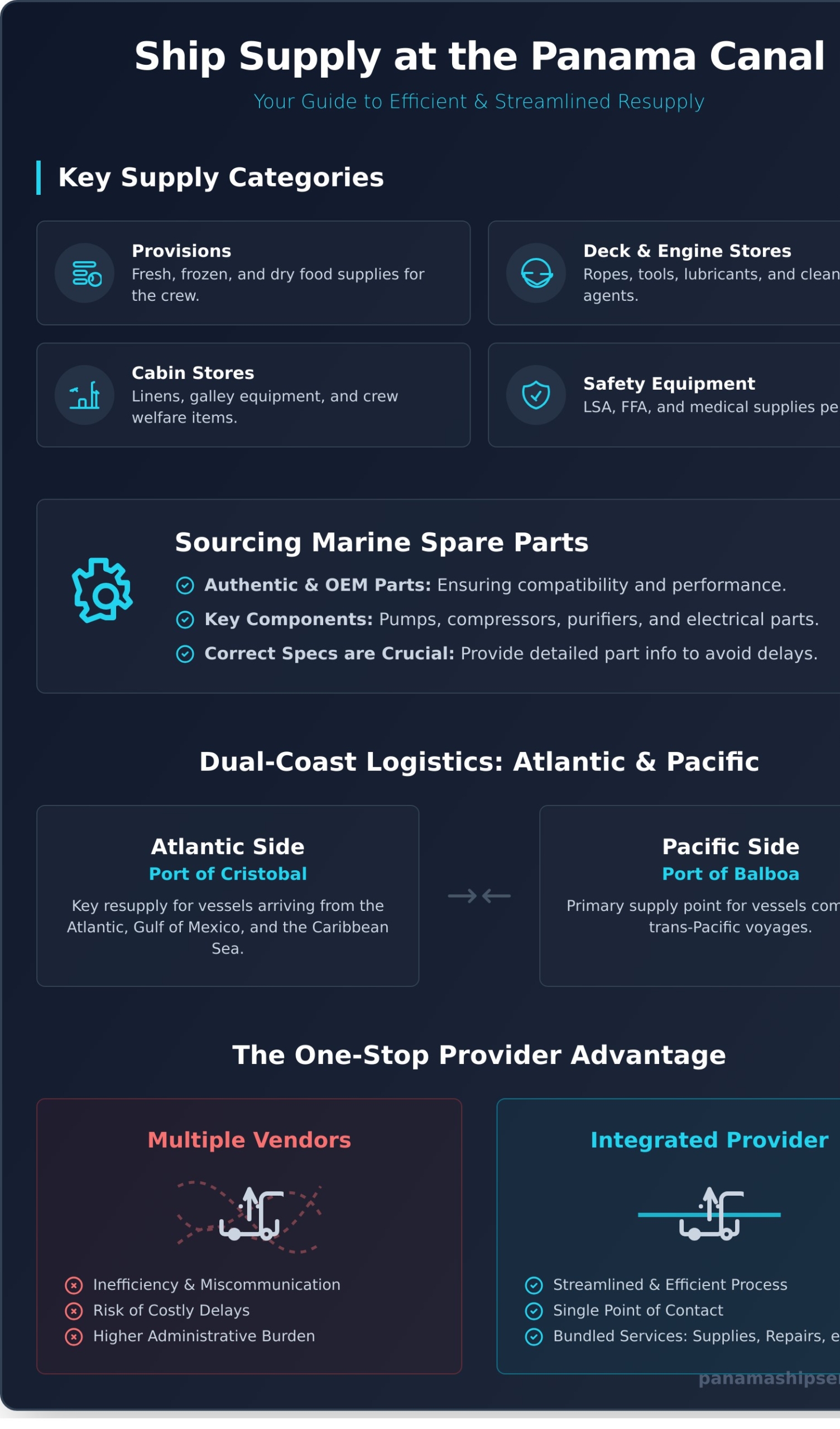
Vessels require a diverse range of supplies to maintain operations and ensure crew welfare. A reliable ship chandler in Panama can provide comprehensive solutions covering all essential categories:
- Provisions: A full range of fresh, frozen, and dry food supplies to meet the dietary needs of the entire crew for extended voyages.
- Deck & Engine Stores: Essential consumables and equipment, including ropes, mooring lines, tools, lubricants, chemicals, and cleaning agents.
- Cabin Stores: All necessary items for the accommodation areas, such as linens, cleaning supplies, galley equipment, and crew welfare products.
- Safety Equipment: Critical life-saving apparatus (LSA), fire-fighting appliances (FFA), and fully stocked medical supplies to comply with SOLAS and flag state requirements.
- Bonded Stores: A selection of tobacco, spirits, and other consumables for the crew, delivered in compliance with customs regulations.
Sourcing Marine Spare Parts in Panama
Beyond routine consumables, securing the right technical spare parts is vital for vessel maintenance and repair. A well-connected supplier can be an invaluable partner in this process.
- Sourcing includes access to authentic and OEM spare parts for main and auxiliary engines, ensuring compatibility and performance.
- Key components like pumps, compressors, purifiers, and electrical parts can be procured to address both planned maintenance and unexpected repairs.
- It is crucial for the vessel’s technical team to provide correct and detailed specifications to avoid errors and delays.
- A professional supplier will coordinate timely delivery directly to the vessel, aligning with its specific transit schedule to avoid any disruption.
Logistics of Ship Supply at the Panama Canal
Supplying a vessel at the Panama Canal requires deep knowledge of a unique and demanding operational environment. Success hinges on seamless coordination with port authorities, pilots, and canal transit schedulers. In a location where timing is everything, a supplier’s ability to deliver within tight windows is non-negotiable. Operations are primarily handled on both the Pacific and Atlantic sides of the Canal.
Supply at Pacific Side Ports (Balboa)
The Port of Balboa and its associated anchorages serve as the primary supply point for vessels entering or exiting the Canal from the Pacific Ocean. This location offers logistical advantages for ships completing trans-Pacific voyages. Deliveries to vessels at anchorage are common and require expert coordination with dedicated supply launches to ensure safe and efficient transfer of goods.
Supply at Atlantic Side Ports (Cristobal)
On the Atlantic side, the Port of Cristobal and its anchorages are the key resupply points for vessels arriving from the Atlantic Ocean, the Gulf of Mexico, and the Caribbean Sea. This is a high-traffic area where an experienced supplier’s ability to navigate complex port logistics is essential for on-time delivery without impacting the vessel’s transit slot.
The Advantage of a One-Stop Service Provider
Managing multiple vendors for different services during a short canal transit can be inefficient and increases the risk of miscommunication and delays. Partnering with a single, integrated service provider offers significant advantages. By bundling ship supplies with other essential services like mechanical repairs, underwater inspections, or MARPOL-compliant waste disposal, you create a streamlined, efficient process. A single point of contact reduces the administrative burden on ship managers and the vessel’s crew, allowing them to focus on the transit itself. Panama Ship Service offers this fully integrated solution, ensuring all your vessel’s needs are met with professionalism and expertise. Consolidate your vessel services in Panama. Get a quote.
Frequently Asked Questions (FAQs)
What are the main categories of ship supplies available in Panama?
The main categories include provisions (fresh, frozen, dry), deck and engine stores (tools, chemicals), cabin stores (linens, galley supplies), safety equipment (LSA/FFA), and bonded stores.
How do you deliver supplies to a vessel at anchorage?
Supplies are delivered to vessels at anchorage using specialized and certified supply launches. This process is carefully coordinated with the vessel’s agent and crew to ensure a safe and timely transfer.
What is the difference between deck stores and engine stores?
Deck stores relate to the cargo, mooring, and deck maintenance equipment (e.g., ropes, paint, cleaning gear). Engine stores are consumables and tools specifically for the engine room and machinery (e.g., filters, lubricants, gaskets).
How much advance notice is required to order ship supplies?
While we can accommodate urgent requests, providing at least 48-72 hours of notice is ideal. This allows for proper sourcing, quality control, and logistical planning to ensure on-time delivery.
Can you source specialized technical spare parts?
Yes, we specialize in sourcing a wide range of technical spare parts. Providing detailed information, including part numbers, drawings, and equipment manuals, is essential for accurate and fast procurement.
Is it possible to receive fresh water along with provisions?
Yes, the delivery of fresh water (potable water) can be arranged alongside your provision and stores supply via water barges, coordinated to match your vessel’s schedule.
Ensuring your vessel is well-stocked and operationally sound is paramount for a successful Panama Canal transit. Choosing an experienced and reliable partner to handle your supply needs removes uncertainty and streamlines your operations in this critical maritime corridor. With a focus on quality, timeliness, and comprehensive service, you can navigate the Canal with confidence. Request a quote for your ship supply needs at the Panama Canal.