
What if a single overlooked sludge deposit cost your vessel its $100,000 Neopanamax reservation fee? In the high-pressure environment of the Panama Canal, technical compliance isn’t just a checkbox; it’s a strategic necessity for maintaining your transit slot. You’ve likely felt the pressure of tight windows and the looming risk of ACP environmental fines for improper disposal. Securing a reliable ship tank cleaning panama partner is the only way to mitigate these risks while managing the high costs of vessel downtime.
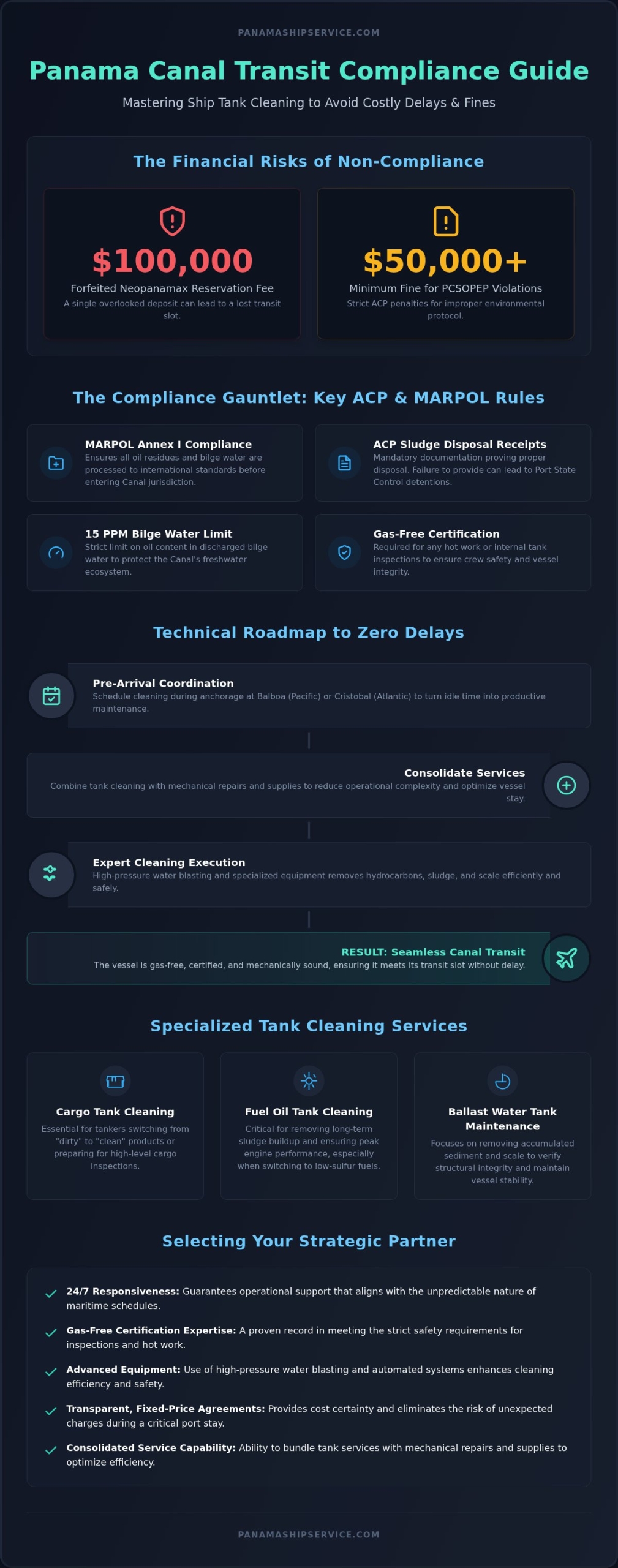
We understand that your priority is a seamless transition from port to Canal. This 2026 buying guide will show you how to select the most efficient, MARPOL-compliant tank cleaning service to ensure zero operational delays. We’ll break down the latest ACP environmental regulations, the requirements for gas-free certification, and the importance of fixed-price transparency in your service agreements. By the end of this article, you’ll have a clear roadmap for delegating these complex technical tasks to experts who handle the details so you can focus on the transit.
Key Takeaways
- Understand the rigorous ACP environmental protocols and MARPOL-compliant disposal requirements necessary to avoid transit fines and slot forfeitures.
- Identify the criteria for selecting a professional ship tank cleaning panama provider, focusing on gas-free certification and 24/7 operational responsiveness.
- Master the technical roadmap for tank maintenance, from pre-arrival coordination to final inspection, to ensure your vessel remains on schedule.
- Evaluate the impact of specialized equipment, such as high-pressure water blasting and automated systems, on cleaning efficiency and safety.
- Learn how consolidating tank services with mechanical repairs and supplies reduces operational complexity and optimizes your vessel’s stay in Panama.
The Critical Role of Professional Ship Tank Cleaning in Panama Canal Logistics
Professional ship tank cleaning panama involves more than just rinsing out residue. It is a high-stakes technical operation performed within a critical maritime corridor. In Panama, this service encompasses the removal of hydrocarbons, sludge, and scale to prepare vessels for cargo changes, inspections, or maintenance. Ship managers don’t just order a cleaning; they secure a guarantee of operational readiness. This process is the foundation of a successful transit, ensuring that a vessel meets every safety and environmental benchmark before it enters the locks.
The Panama Canal Authority (ACP) maintains some of the world’s strictest environmental protocols. The Canal is a freshwater system supplying local drinking water, so the risk of contamination is met with severe penalties. For instance, PCSOPEP violations result in a minimum fine of $50,000 and the immediate forfeiture of your transit slot. Clean tanks are your primary defense against accidental discharge. Tank condition also directly impacts engine performance. Sludge buildup in fuel tanks can clog filters and injectors, leading to power loss during the critical maneuvers required in the Canal’s narrow reaches. Efficient ship tank cleaning panama removes these contaminants, ensuring your propulsion systems operate at peak efficiency. Success in marine surveys in Panama depends on the visual condition of your tanks. Inspectors need to see the steel and welds clearly to verify structural integrity. If they can’t see the surface, they won’t sign the certificate.
Compliance with MARPOL and ACP Regulations
Adhering to MARPOL Annex I is non-negotiable for oil tankers and vessels with large machinery spaces. Professional cleaning ensures that all oil residues and bilge water are processed according to international standards before entering the Canal’s jurisdiction. This process often involves the Crude Oil Washing (COW) system for tankers, a method that uses crude oil itself as a solvent to minimize sludge buildup. Locally, the ACP requires detailed documentation of sludge disposal. Failing to provide this can lead to Port State Control detentions. This effectively freezes your vessel’s movement and results in mounting daily costs.
- Sludge disposal must be documented with ACP-approved receipts.
- Bilge water must meet the 15 ppm oil content limit.
- Gas-free certificates must be current for hot work or inspections.
Minimizing Transit Delays Through Strategic Cleaning
Timing is everything. A missed Neopanamax transit slot costs $100,000 in reservation fees alone. This doesn’t include the logistical nightmare of rescheduling or the high costs of vessel downtime. Smart operators schedule cleaning during anchorage periods at Balboa on the Pacific side or Cristobal on the Atlantic side. By coordinating these services with mechanical ship repairs in Panama, you turn idle waiting time into productive maintenance. This consolidated approach ensures that when your slot opens, the vessel is gas-free, certified, and mechanically sound for the transit. It’s about eliminating variables that lead to downtime.
Types of Tank Cleaning Services Available in Panama
Versatility is a requirement for any provider of ship tank cleaning panama. The specific technical approach depends entirely on the tank’s previous contents and its next intended use. Ship managers must distinguish between these categories to ensure the correct equipment and chemicals are deployed for the job. Whether you are preparing for a change of grade or routine maintenance, the goal remains the same: a clean, gas-free environment that meets all international safety standards.
- Cargo Tank Cleaning: Essential for product tankers switching from “dirty” to “clean” products or preparing for high-level inspections. It requires precise chemical application to remove all traces of previous cargo.
- Fuel Oil Tank Cleaning: This is a critical step when switching to low-sulfur fuels or removing long-term sludge buildup that can compromise engine performance.
- Ballast Water Tank Maintenance: When executing ship tank cleaning panama, technicians focus on removing accumulated sediment and mud. This restores vessel deadweight and ensures the integrity of the ballast system.
- Potable Water Tank Sanitization: This service is vital for maintaining crew health. It involves thorough cleaning and disinfection to meet WHO and international health standards for drinking water on board.
Heavy Fuel Oil (HFO) and Sludge Tank Cleaning
Removing high-viscosity HFO residue presents significant technical challenges. These heavy oils adhere to heating coils and bulkheads, requiring a combination of thermal application and specialized chemical circulation to break down the carbon structure. It isn’t just about cleaning; it’s about responsible waste management. The resulting slurry must be handled through certified MARPOL disposal in Panama to avoid environmental penalties. This entire process follows strict international maritime regulations designed to prevent sea pollution and ensure operational transparency.
Double Bottom and Wing Tank Maintenance
These areas are notorious for being difficult to access. Confined space entry protocols are the absolute priority here. We use specialized ventilation systems and explosion-proof lighting to ensure worker safety throughout the operation. During the cleaning, technicians perform structural inspections to identify corrosion or weld failures that are often hidden under layers of mud and scale. Using high-capacity diaphragm pumps allows for the efficient removal of liquids from these deep-tank structures. Coordinating these efforts with your mechanical ship repairs in Panama ensures that all technical systems are optimized simultaneously, reducing your overall time at anchorage.
Evaluating Providers: Equipment, Safety, and Compliance Standards
Safety certifications are the most critical metric for evaluating any service provider. A “Gas-Free” certification isn’t a suggestion; it’s a non-negotiable requirement for hot work or shipyard entry. This certificate must be issued by a certified marine chemist who has personally inspected the atmosphere within the tanks. Beyond the paperwork, the expertise of the personnel on the ground matters. Ensure your provider employs confined space specialists who are trained in emergency rescue protocols and equipped with calibrated multi-gas detectors. These tools are essential for monitoring oxygen levels and detecting explosive vapors in real-time, protecting both your crew and your asset.
The Technology Behind “Green” Tank Cleaning
Environmental scrutiny in the Panama Canal has never been higher. Modern ship tank cleaning panama services now leverage green technology to meet ESG goals and ACP requirements. This includes the use of biodegradable cleaning agents that break down hydrocarbons without leaving toxic residues. Advanced providers use closed-loop systems; these units recycle cleaning water and separate solids from liquids on-site. This technology significantly reduces the total volume of waste generated, which in turn lowers your MARPOL disposal costs and minimizes the risk of accidental discharge into the Canal’s freshwater ecosystem.
Verifying Insurance and Liability Coverage
Operating within the jurisdiction of the Panama Canal Authority (ACP) requires specific legal and financial safeguards. You must verify that your contractor holds valid local Panama liability insurance. This coverage is your primary protection against the financial fallout of accidental spills or property damage during the cleaning process. Additionally, confirm that the provider is explicitly authorized by the ACP for harbor operations. An unauthorized contractor can be barred from the anchorage mid-operation, leaving your vessel in a state of partial readiness and potentially causing you to miss your scheduled transit window. Demand proof of these credentials before signing any service agreement.
The Tank Cleaning Process: A Technical Roadmap for Ship Managers
Executing a successful ship tank cleaning panama operation requires a disciplined, phased approach. It’s not merely a matter of labor; it’s a sequence of technical milestones that must be reached to satisfy both Class surveyors and the ACP. Ship managers should view this process as a critical path toward transit readiness. A systematic roadmap ensures that every safety protocol is met and every liter of waste is accounted for, preventing the types of oversight that lead to slot forfeitures or environmental fines.
Step 1: Planning and Risk Assessment
Efficiency begins long before the vessel reaches the anchorage. You must first define the specific scope of work: is the objective “mucking” for routine sludge removal, or do you require “gas-free for hot work” status? The latter demands significantly more intensive ventilation and chemical treatment to eliminate all volatile organic compounds. We calculate the required timeframe based on total tank volume and the specific residue type, such as high-viscosity HFO or persistent cargo scale. If you’re planning concurrent maintenance, we coordinate with underwater hull services to ensure that deck-side cleaning activities don’t interfere with dive operations. This pre-arrival planning ensures that technical teams are ready for immediate deployment the moment the vessel arrives at Balboa or Cristobal.
Step 2: Execution and Waste Management
Once the vessel is secured at anchorage, the technical team moves into the execution phase. We deploy specialized diaphragm pumps and chemical-resistant hoses to the vessel’s deck. Safety is the absolute priority; we conduct initial inspections and gas-free testing before any personnel enter confined spaces. Throughout the physical cleaning phase, technicians perform real-time monitoring of oxygen levels and explosive gas concentrations using calibrated multi-gas detectors. Mechanical removal of heavy sludge is often followed by high-pressure chemical washing to reach bare metal surfaces, which is essential for successful structural inspections.
Effective waste management serves as the final hurdle in the ship tank cleaning panama process. All removed residues are transferred to shore facilities for MARPOL-compliant disposal. This step requires meticulous documentation for the Oil Record Book (Part I), as any discrepancies can lead to ACP detentions or fines. After the cleaning is complete, a final inspection is conducted to issue the necessary certifications for Class approval. This systematic process eliminates operational variables and ensures your vessel meets the strict August 2026 environmental standards for the Panama Canal. For a streamlined operation that guarantees compliance, book your tank cleaning and MARPOL disposal with Panama Ship Service.
Why Panama Ship Service is the Strategic Choice for Tank Maintenance
Operating in the Panama Canal means working against a ticking clock where every minute of delay translates into significant financial loss. Panama Ship Service acts as your strategic partner on the ground, eliminating the “Panama Complexity” that often traps less experienced operators. We provide a consolidated service model designed for the high-stakes nature of 2026 maritime logistics. Our 24/7 responsiveness ensures that your ship tank cleaning panama schedule aligns perfectly with your assigned transit slot, regardless of sudden changes in Canal traffic flow or draft restrictions.
We don’t just provide labor; we provide a calm, expert presence in a high-pressure environment. By delegating the technical intricacies of tank maintenance to a seasoned veteran, ship managers can focus entirely on the transit itself. Our approach is grounded in reliability and fiscal responsibility, ensuring that every operation is performed with maximum efficiency and zero unnecessary complication. We understand the specific operational pressures of the Canal and position ourselves as a comprehensive provider that simplifies your vessel’s stay in Panamanian waters.
Consolidated Technical Services
Efficiency is best achieved through the reduction of administrative and operational layers. We offer a one-stop-shop approach that integrates tank maintenance with ship supplies at the Panama Canal. This allows you to delegate multiple logistical requirements to a single, accountable partner. Instead of managing several different contractors for surveys, mechanical repairs, and provisions, you deal with one organized team. Our technical experts operate with equal proficiency at both the Balboa and Cristobal anchorages. This dual-port presence ensures we’re ready to support your vessel on either side of the isthmus, providing the flexibility required in a dynamic maritime hub.
Proven Track Record of MARPOL Compliance
Compliance is the core of our operational philosophy. Our long-standing relationship with local authorities facilitates smooth waste discharge and rapid documentation processing. We utilize advanced green technology to minimize environmental impact, which is a critical factor for ESG-conscious shipping lines and essential for meeting ACP freshwater protection standards. Our systematic approach to waste management ensures that your Oil Record Book remains beyond reproach. We’re committed to safe, clean, and successful operations for every fleet we serve. By choosing a partner with deep local roots and technical expertise, you ensure your vessel meets all international and local regulatory standards without the risk of administrative bottlenecks or Port State Control detentions.
Ensure Operational Readiness for Your Next Panama Canal Transit
Managing a vessel’s schedule in the Panama Canal requires technical foresight and absolute precision. We have detailed the critical necessity of MARPOL compliance and the technical roadmap required to achieve gas-free certification. Professional ship tank cleaning panama is your primary defense against the catastrophic costs of missed transit slots and environmental fines. By prioritizing specialized equipment and certified personnel, you protect both your asset and your operational timeline.
Panama Ship Service stands ready as your ACP Authorized Contractor, offering 24/7 Technical Support and full MARPOL Annex I, IV, and V Compliance. We handle the technical complexity of sludge removal and waste disposal so your crew can focus on a safe transit. Our team ensures that your vessel meets every environmental standard without compromising your time at anchorage. Don’t leave your canal slot to chance with unverified providers when a proven partner is available to simplify your logistics. We focus on delivering results that keep your fleet moving forward without delay.
Request a Technical Quote for Ship Tank Cleaning in Panama and secure your vessel’s operational success today. We look forward to facilitating your most efficient transit yet.
Frequently Asked Questions
How long does a typical ship tank cleaning take in Panama?
The duration depends on the tank volume and the nature of the residue. A standard fuel tank cleaning usually takes between 24 and 48 hours, while complex cargo tank grade changes may require up to 72 hours. We prioritize efficiency to ensure you don’t miss your assigned transit window. It’s a fast-paced process designed to match the high-stakes nature of the shipping industry.
Can tank cleaning be performed while the vessel is at anchor waiting for transit?
Cleaning is routinely performed at the Balboa or Cristobal anchorages while vessels wait for their Canal slots. This allows ship managers to turn mandatory idle time into productive maintenance. Our teams are mobile and fully equipped to operate at these locations 24/7, ensuring the vessel is ready the moment the ACP authorizes transit. It’s an efficient way to reduce overall vessel downtime.
What certifications will I receive after the cleaning is completed?
You’ll receive a comprehensive documentation package upon completion. This includes a Gas-Free Certificate issued by a certified marine chemist and a detailed cleaning report for Class approval. Additionally, we provide official MARPOL disposal receipts to prove that all waste was handled through ACP-authorized facilities. This documentation is essential for your Oil Record Book and ensures compliance during Port State Control inspections.
How is the sludge and waste disposal handled to ensure MARPOL compliance?
All sludge and oily waste are transferred from the vessel to authorized shore-side facilities via specialized barges or vacuum trucks. This process strictly follows MARPOL Annex I requirements for oil pollution prevention. We manage the entire chain of custody to ensure environmental safety and provide the necessary paperwork to satisfy ACP inspections. It’s a systematic approach that eliminates the risk of environmental fines.
Is it possible to clean fuel tanks while the engine is running on a different service tank?
It’s possible to clean fuel tanks while the vessel is operational, provided the engine is drawing from a separate, isolated service tank. This requires careful coordination with the vessel’s engineering department to ensure safety and prevent air locks. This method is an effective way to maintain ship tank cleaning panama schedules without interrupting essential ship systems. It provides the flexibility needed for tight transit windows.
What are the safety protocols for crew members during a third-party cleaning operation?
We implement rigorous safety protocols including mandatory confined space entry permits and continuous multi-gas monitoring. Exclusion zones are established around the working area to prevent unauthorized access during the operation. Our personnel follow a strict chain of command and maintain constant communication with the vessel’s Duty Officer. This ensures the safety of both the ship’s crew and our technical teams.
Does Panama Ship Service provide gas-free certificates for hot work repairs?
Yes, we provide official Gas-Free Certificates specifically for hot work repairs. A certified marine chemist conducts the testing to ensure the atmosphere is safe for welding or cutting operations. This is a critical step for vessels undergoing ship tank cleaning panama before entering a shipyard or performing mechanical repairs. We handle the technical complexity so you can focus on a successful transit.
Are the chemicals used for tank cleaning safe for the vessel’s coating systems?
We use specialized cleaning agents that are specifically formulated to be safe for epoxy and other marine coating systems. These chemicals effectively break down hydrocarbons without causing delamination or structural damage to the tank’s interior. We verify the compatibility of our cleaning products with your specific coating specifications before starting the work. This proactive approach protects your asset while achieving a superior level of cleanliness.